On this page
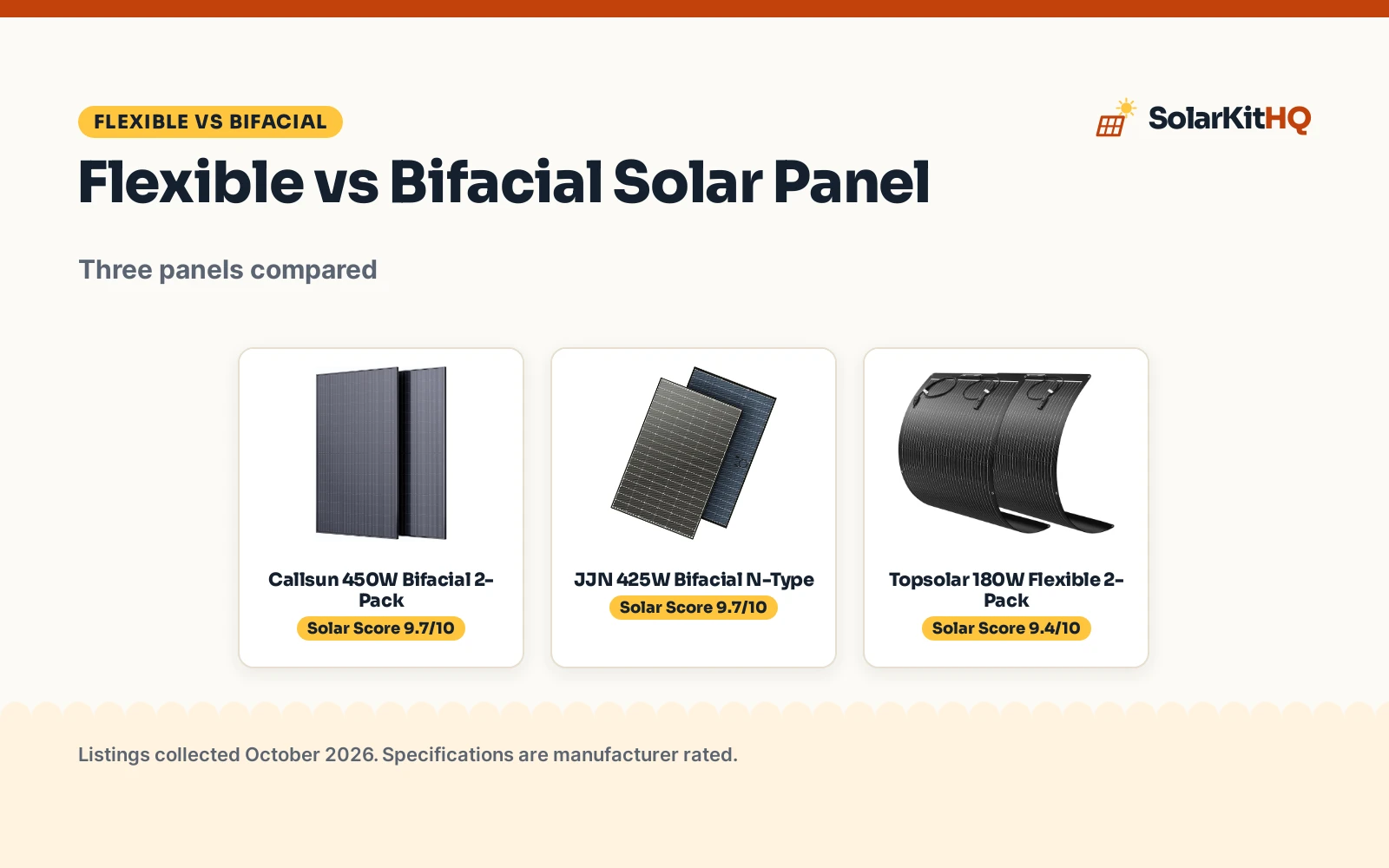
The short answer on flexible vs bifacial solar panel designs: choose a flexible panel when the roof curves or you want a light, low-profile mount, and choose a bifacial panel when you have a flat, open mount and want the highest stated watts per panel. We compared one flexible two-pack and two bifacial panels on what each listing states: stated watts, panel size, weather protection and warranty terms. The bifacial examples state 425W and 450W per panel with rear-side capture through a transparent backsheet; the flexible example states 180W per panel and a bendable build for RV, boat, van and car roofs.
SolarKitHQ earns a commission when you buy through links on this page, at no extra cost to you. As an Amazon Associate I earn from qualifying purchases. Affiliate disclosure.
Flexible vs Bifacial: side by side
| Flexible vs Bifacial | Callsun 450W Bifacial 2-Pack | JJN 425W Bifacial N-Type | Topsolar 180W Flexible 2-Pack | Amazon |
|---|---|---|---|---|
| Side | Bifacial | Bifacial | Flexible | |
| Stated watts | 450W per panel, 900W total | 425W | 180W per panel (2-pack) | |
| Stated efficiency | 25.6% | Up to 25% increased efficiency claimed | Not stated | |
| Rear-side generation | Transparent backsheet stated | Transparent backsheet stated | Not stated | |
| Panel size | 69.37 x 44.65 in | 44.7 x 67.8 in (spec table labels swapped) | 55 x 30 in | |
| Weight | Not stated | 51.6 lb | Not stated | |
| Weather protection | IP68 | IP65 junction box, IP68 connectors | Scratch-resistant surface, no IP code | |
| Output warranty | 25-year output commitment | 30-year output warranty | Not stated |
Specifications are manufacturer rated as listed, collected 22 October 2026.
Watts and rear-side capture
Stated watts are the widest gap. The Callsun two-pack lists 450W per panel and 900W total, and the JJN lists 425W; the Topsolar two-pack lists 180W per panel. Both bifacial listings state a transparent backsheet that captures reflected and ambient light from the rear, with the JJN claiming up to 25% increased efficiency over conventional panels and the Callsun stating 25.6% efficiency with N-type 16BB cells. The Topsolar listing makes no rear-side claim, so compare it on front-side watts and mounting fit only.
Size, weight and mounting
The Topsolar panels are listed at 55 by 30 inches with a 1 inch profile and a bendable design for curved RV, boat, van and car roofs, with no heavy-duty mounting gear required. The JJN is listed at 51.6 pounds with pre-drilled mounting holes and a black corrosion-resistant aluminum frame; its spec table dimensions read 44.7″L x 1.2″W x 67.8″H, which looks like the width and depth labels were swapped. The Callsun panels are listed at 69.37 by 44.65 inches with a 1.18 inch profile, a double-glass structure and a reinforced aluminum frame. No weight is stated for the Callsun or the Topsolar, so the listings leave that comparison open.
Weather protection and certifications
The JJN is the only one of the three that names UL 61730, and it states an IP65 junction box with IP68 connectors plus 2400Pa wind and 5400Pa snow load figures. The Callsun states IP68 and a double-glass, low-iron tempered glass build. The Topsolar states a scratch-resistant surface against rain, snow, dust and UV but names no IP code. On stated protection alone, the glass bifacial pair documents more than the flexible example.
What the listings leave unclear
The Callsun title promises a 2-pack totaling 900W while its spec table lists Number of Items as 1; the title and bullets win, but the table is sloppy. The JJN spec table dimension order looks mislabeled, as noted above. The Topsolar title pairs 2PCS with 180W and the spec table says 2*180W, which we read as 180W per panel; the listing never states a combined total, so we do not compute one. None of the three states a temperature coefficient or a low-light watt figure.
Three examples
| # | Product | Solar Score | Buy |
|---|---|---|---|
| 1 |  Callsun 450W Bifacial 2-Pack | 9.7/10 | Buy on Amazon |
| 2 |  JJN 425W Bifacial N-Type | 9.7/10 | Buy on Amazon |
| 3 |  Topsolar 180W Flexible 2-Pack | 9.4/10 | Buy on Amazon |

Callsun 450W Bifacial 2-Pack
A 450W bifacial panel sold as a 2-pack totaling 900W, with N-type 16BB cells, a stated 25.6% efficiency and a dual-module parallel design that limits shading losses.
Pros
- 450W per panel, 900W total across the two-pack
- 25.6% efficiency stated with N-type 16BB cells
- Dual-module parallel design keeps one half producing when the other half is shaded
- Double-glass build with IP68 protection and an anodized aluminum frame
Cons
- Title promises a 2-pack while the spec table lists Number of Items as 1
- No weight figure is stated
- No rear-side-only output figure is stated
- Bullets commit to 84.5% output at 25 years, which is a stated decline
Detailed Review
The listing describes a 450W bifacial panel sold as a 2-pack totaling 900W, built with N-type 16BB monocrystalline cells at a stated 25.6% efficiency and a transparent backsheet that captures reflected light from the rear. It also claims a dual-module parallel design so one half keeps producing when the other half is shaded. One wrinkle: the title promises a 2-pack while the spec table lists Number of Items as 1 (with Number of Packs as 2); the title and bullets win, but the table is sloppy.
Who it's for: buyers building a high-watt array who want the most stated watts per panel and a two-pack in one box. Who should skip it: anyone who needs a stated weight for roof loading, or who wants the named UL listing the JJN carries.
Its Solar Score of 9.7/10 comes from performance 30/35, build 21/25, value 21/25, safety 8/10 and warranty 4/5: 84 of 100 points, placed on our 9.2 to 9.8 scale.
Key Specifications
| Stated power | 450W per panel, 900W total |
|---|---|
| Efficiency | 25.6% |
| Size | 69.37 x 44.65 x 1.18 in |
| Cell tech | N-type 16BB monocrystalline |
Figures as published on the retailer listing, collected 22 October 2026. Performance figures are manufacturer rated.
Safety and Warranty
What this listing states. IP68 stated; double-glass structure, low-iron tempered glass and anodized aluminum frame, so safety scores 8 of 10. 25-year commitment to maintain at least 84.5% output stated, plus 10 years of technical support. It does not say everything a buyer needs, such as who pays return shipping, so warranty scores 4 of 5. See How We Pick.
Panels make voltage in daylight. Keep connectors covered until you connect them, check the panel's stated open circuit voltage and current against your controller or power station input limits, and use cables rated for the current. Roof and permanent mounts belong to a qualified installer.
This is general buying information, not professional advice. Follow each product manual and local rules, and see our Safety Disclaimer.

JJN 425W Bifacial N-Type
A 425W bifacial panel with 16BB N-type cells, a transparent backsheet for rear-side generation, UL 61730 named, and a 30-year transferable power output warranty.
Pros
- 425W with a stated transparent backsheet for rear-side generation
- UL 61730 named, plus an IP65 junction box and IP68 connectors
- Stated 2400Pa wind and 5400Pa snow load figures
- 30-year transferable power output warranty
Cons
- Package contains the panel only, with MC4 connectors and no mounting gear
- Listed at 51.6 lb, the heaviest stated weight here
- Spec table dimensions look mislabeled (44.7"L x 1.2"W x 67.8"H)
- The up to 25% increased efficiency claim names no baseline efficiency figure
Detailed Review
The JJN listing states a 425W bifacial panel with 16BB N-type cells, a transparent backsheet for rear-side generation, and a claim of up to 25% increased efficiency over conventional panels. It is the only listing here that names UL 61730, and it states an IP65 junction box with IP68 connectors plus 2400Pa wind and 5400Pa snow load figures. The spec table's dimensions read 44.7"L x 1.2"W x 67.8"H, which looks like the width and depth labels were swapped. The package is the panel only.
Who it's for: buyers who want the strongest stated certifications here, UL 61730 plus IP codes, with a 30-year output warranty. Who should skip it: anyone who needs a two-pack in one box or a stated combined watt total beyond the single 425W panel.
Its Solar Score of 9.7/10 comes from performance 29/35, build 20/25, value 20/25, safety 9/10 and warranty 4/5: 82 of 100 points, placed on our 9.2 to 9.8 scale.
Key Specifications
| Stated power | 425W |
|---|---|
| Size | 44.7"L x 1.2"W x 67.8"H as listed |
| Weight | 51.6 lb |
| Certifications | UL 61730; IP65 junction box, IP68 connectors |
Figures as published on the retailer listing, collected 22 October 2026. Performance figures are manufacturer rated.
Safety and Warranty
What this listing states. UL 61730 named; IP65 junction box and IP68 connectors; 2400Pa wind and 5400Pa snow load figures, so safety scores 9 of 10. Extra-long transferable power output warranty of 30 years stated. It does not say everything a buyer needs, such as who pays return shipping, so warranty scores 4 of 5. See How We Pick.
Panels make voltage in daylight. Keep connectors covered until you connect them, check the panel's stated open circuit voltage and current against your controller or power station input limits, and use cables rated for the current. Roof and permanent mounts belong to a qualified installer.
This is general buying information, not professional advice. Follow each product manual and local rules, and see our Safety Disclaimer.

Topsolar 180W Flexible 2-Pack
A semi-flexible monocrystalline panel with a bendable design for curved RV, boat, van and car roofs, sold with two panels at 180W each and no heavy mounting gear required.
Pros
- Bendable design fits curved RV, boat, van and car roofs
- Two panels at 180W each per the listing
- Lightweight, thin structure with no heavy-duty mounting gear required
- Scratch-resistant surface stated against rain, snow, dust and UV
Cons
- No warranty term is stated
- No IP code is stated
- No weight figure is stated
- 180W per panel is the lowest stated watt figure here
Detailed Review
The Topsolar listing states a semi-flexible monocrystalline panel with a bendable design for curved RV, boat, van and car roofs, sold with two panels at 180W each. It claims a lightweight, thin structure that needs no heavy-duty mounting gear and a scratch-resistant surface against rain, snow, dust and UV. No IP code, weight, or warranty term is stated. The title pairs 2PCS with 180W and the spec table says 2*180W, which we read as 180W per panel; the listing never states a combined total.
Who it's for: owners of curved or weight-limited roofs who want a bendable panel without a rack. Who should skip it: anyone who wants stated weather certifications, a warranty term, or the highest watts per panel in this group.
Its Solar Score of 9.4/10 comes from performance 27/35, build 20/25, value 21/25, safety 0/10 and warranty 0/5: 68 of 100 points, placed on our 9.2 to 9.8 scale.
Key Specifications
| Stated power | 180W per panel, 2-pack |
|---|---|
| Size | 55 x 30 x 1 in |
| Output | 12V DC |
| Cell type | Monocrystalline, semi-flexible |
Figures as published on the retailer listing, collected 22 October 2026. Performance figures are manufacturer rated.
Safety and Warranty
What this listing states. No UL, TÜV or IEC listing and no weather rating is stated, so safety scores zero. No warranty term, so warranty scores zero. See How We Pick.
Panels make voltage in daylight. Keep connectors covered until you connect them, check the panel's stated open circuit voltage and current against your controller or power station input limits, and use cables rated for the current. Roof and permanent mounts belong to a qualified installer.
This is general buying information, not professional advice. Follow each product manual and local rules, and see our Safety Disclaimer.
As an Amazon Associate I earn from qualifying purchases.
How we scored them
The Solar Score weighs performance, build, value, safety and warranty. For solar panels, safety means stated weather protection, certifications such as UL 61730 or IP codes, and load figures where given; two of the three listings state IP codes, and one names UL 61730. Two of the three state a warranty term with a concrete time span. How we pick explains the weights.
| Product | Solar Score | Perf. /35 | Build /25 | Value /25 | Safety /10 | Warranty /5 |
|---|---|---|---|---|---|---|
| Callsun 450W Bifacial 2-Pack | 9.7 | 30 | 21 | 21 | 8 | 4 |
| JJN 425W Bifacial N-Type | 9.7 | 29 | 20 | 20 | 9 | 4 |
| Topsolar 180W Flexible 2-Pack | 9.4 | 27 | 20 | 21 | 0 | 0 |
Scores run from 9.2 to 9.8: each product’s point total is placed on that range, so more points always means a higher score.
Flexible vs Bifacial Solar Panel: Which Should You Buy?
Choose the flexible Topsolar example if your roof curves: its listing states a bendable design for RV, boat, van and car roofs and a light, thin structure with no heavy mounting gear. Choose a bifacial example if the mount is flat and open and you want the highest stated watts per panel: the Callsun two-pack states 450W per panel with 900W total, and the JJN states 425W with UL 61730 and the longest stated output warranty here at 30 years. For more on mounts and roof fit, see the best solar panel for RV roof and the portable vs rigid solar panel guide.
| If you need | Look at |
|---|---|
| Curved RV or boat roof | Topsolar 180W Flexible 2-Pack, bendable design |
| Highest stated watts per panel | Callsun 450W Bifacial 2-Pack, 450W per panel |
| Longest stated output warranty | JJN 425W Bifacial N-Type, 30 years |
| Named UL listing | JJN 425W Bifacial N-Type, UL 61730 |
Sizing Notes
- Match each panel’s stated output voltage to the charge controller or power station input: the listings state 12V DC (Topsolar), 31.05V (JJN) and 25V DC (Callsun).
- Check the listed panel dimensions against the roof or rack space: 55 by 30 inches (Topsolar), 69.37 by 44.65 inches (Callsun), and the JJN spec table order noted above.
- Size the array from stated totals only: the Callsun two-pack states 900W total, while the Topsolar listing never states a combined total.
- The JJN states 13.78A amperage capacity and the Callsun states 14.97A; choose cable gauge and fuses as the manual gives.
Frequently Asked Questions
Does a flexible panel make power from the back side?
Not in this listing. The Topsolar flexible panel makes no rear-side claim; only the JJN and Callsun listings state a transparent backsheet for rear-side generation.
How many watts do the bifacial examples state?
The JJN states 425W, and the Callsun states 450W per panel with 900W total for the two-pack.
Which listing names a UL listing?
The JJN 425W names UL 61730. The Callsun and Topsolar listings state no UL listing.
Can the flexible example mount on a curved RV roof?
The Topsolar listing states a bendable design for curved surfaces including RV, boat, van and car roofs. The bifacial examples state rigid framed builds, with the JJN listing pre-drilled mounting holes.
Related guides
See every Rigid and Flexible Panels guide and all Solar Panels and Kits guides. Also see the portable vs rigid solar panel guide and the best solar panel for RV roof. Also see our best flexible solar panel for boat, monocrystalline vs polycrystalline solar panel, series vs parallel solar panels, best solar panel for partial shade.