On this page
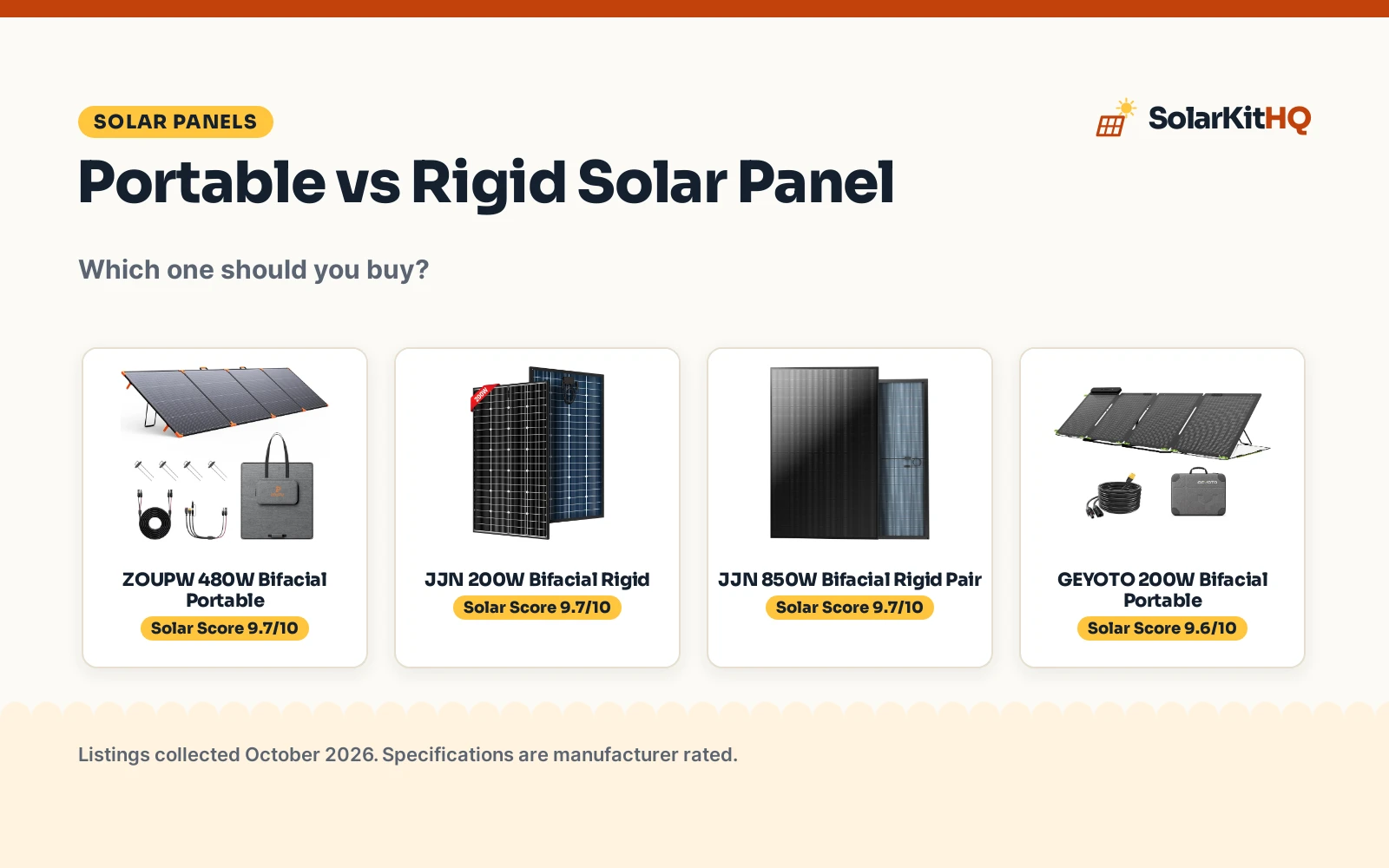
Portable vs rigid solar panel: the short verdict is about the job. If you move camp, chase the sun or pack power for a station, the portable examples fold up, carry in a bag and ship with stands and cables. If you mount on a roof, RV or farm rack and leave it there for decades, the rigid examples bolt down with frames and glass. We compared two portable and two rigid listings on what each states: watts, efficiency, weight, weather codes and warranty terms. The portable side wins on moving weight; the rigid side wins on stated mounting and the longest warranty.
SolarKitHQ earns a commission when you buy through links on this page, at no extra cost to you. As an Amazon Associate I earn from qualifying purchases. Affiliate disclosure.
Portable vs rigid: side by side
| Attribute | ZOUPW 480W (portable) | GEYOTO 200W (portable) | JJN 200W (rigid) | JJN 850W (rigid) | Amazon |
|---|---|---|---|---|---|
| Wattage | 480W | 200W | 200W | 850W (2x 425W) | |
| Efficiency | 25% | 26% | 25%+ | 25% | |
| Bifacial | Yes, +30% | Yes | Yes | Yes, +30% | |
| Weight | 22.5 lb | 15 lb | 24.3 lb | 103.2 lb | |
| Weather | IP68 | IP68 surface | IP67 / IP65 | UL61730 | |
| Warranty | 36-month | 2-year | 10-year workmanship | Not stated | |
| In the box | Bag, cables, stakes | Case, kickstand, cable | PV only | PV, drain clips |
Specifications are manufacturer rated as listed, collected 21 October 2026.
Watts and efficiency
The examples span 200W to 850W. The ZOUPW portable example states 480W at 25% efficiency with N-Type 16BB cells, 42.5V and 11.3A, plus up to 30% extra bifacial gain on reflective ground. The GEYOTO portable example states 200W at 26% with a bifacial rear that collects reflected light. On the rigid side, the JJN 200W example states 200W at 25% plus with 16BB N-Type cells, and the JJN 850W example (a 2-pack of 425W) states 25% efficiency with dual-glass bifacial construction and up to 30% more yield. Both JJN examples and both portable examples are bifacial, so that feature does not separate the sides here.
Weight and moving
This is the clearest gap. The GEYOTO portable example is 15 pounds and folds into a reflective carrying case with a Y-shaped carbon-steel kickstand and a 10 ft MC4-to-XT60 cable; the ZOUPW portable example is 22.5 pounds, folds, ships in a storage bag with ground stakes, a 2 ft 12AWG 4-in-1 cable and a 13 ft 12AWG extension cable. The rigid examples mount instead of folding: the JJN 200W example is 24.3 pounds with pre-drilled holes and a black corrosion-resistant aluminum frame, and the JJN 850W example is 103.2 pounds for the pair at 67.8 by 44.6 by 1.2 in per panel. The portable solar panels category covers more folding options.
Weather codes and mounting
The ZOUPW portable example states IP68. The GEYOTO portable example states the panel surface is IP68-rated but adds that the junction box is not, so keep it out of rain and standing water. The JJN 200W rigid example states IP67 connectors and an IP65 junction box, plus 2400Pa wind and 5400Pa snow load figures on the frame. The JJN 850W rigid example states UL61730 and includes drainage clips. For fixed mounting hardware, see the rigid and flexible solar panels category.
What the listings leave unclear
The ZOUPW example advises against long-term fixed, series or parallel connections in its safety section, so it is a traveler, not a rooftop panel. The GEYOTO bullets state a 2-year limited warranty while its spec table states 3 Year Manufacturer; trust the bullets. The JJN 200W bullets state 24.3 pounds while its spec table states 23.2 pounds; trust the bullets. The JJN 850W example states no warranty term at all, which is the weakest warranty line here despite the UL61730 marking.
Four examples
| # | Product | Solar Score | Buy |
|---|---|---|---|
| 1 |  ZOUPW 480W Bifacial Portable | 9.7/10 | Buy on Amazon |
| 2 |  JJN 200W Bifacial Rigid | 9.7/10 | Buy on Amazon |
| 3 |  JJN 850W Bifacial Rigid Pair | 9.7/10 | Buy on Amazon |
| 4 |  GEYOTO 200W Bifacial Portable | 9.6/10 | Buy on Amazon |

ZOUPW 480W Bifacial Portable
A 480W bifacial portable solar panel with 25% N-Type 16BB cells, 42.5V, IP68 and a 36-month warranty.
Pros
- 480W at 25% efficiency, the most portable watts here
- Bifacial with up to 30% extra gain stated
- Bag, stakes and two 12AWG cables included
- 36-month warranty stated
Cons
- 42.5V needs a compatible controller or station
- Not recommended for long-term fixed connections
- 22.5 pounds is heavy for a folder
- Composite surface needs shade-free placement
Detailed Review
The listing states a 480W bifacial portable solar panel with N-Type 16BB cells at 25% efficiency, 42.5V maximum and 11.3A, up to 30% extra bifacial gain on high-albedo surfaces, bypass diodes, 22.5 pounds, a folding composite design, IP68, a storage bag, a 2 ft 12AWG 4-in-1 cable, a 13 ft 12AWG extension cable and 4 ground stakes. Its safety section advises against long-term fixed, series or parallel connections. A 36-month warranty is stated.
Who it's for: big power stations and off-grid backups that need folding watts. Who should skip it: rooftop installs that need fixed mounting.
Its Solar Score of 9.7/10 comes from performance 33/35, build 21/25, value 21/25, safety 7/10 and warranty 4/5: 86 of 100 points, placed on our 9.2 to 9.8 scale.
Key Specifications
| Watts | 480W |
|---|---|
| Efficiency | 25% stated |
| Voltage | 42.5V |
| Warranty | 36-month stated |
Figures as published on the retailer listing, collected 21 October 2026. Performance figures are manufacturer rated.
Safety and Warranty
What this listing states. IP68 with bypass diodes stated, so safety scores 7 of 10. 36-month warranty stated. It does not say everything a buyer needs, such as who pays return shipping, so warranty scores 4 of 5. See How We Pick.
Panels make voltage in daylight. Keep connectors covered until you connect them, check the panel's stated open circuit voltage and current against your controller or power station input limits, and use cables rated for the current. Roof and permanent mounts belong to a qualified installer.
This is general buying information, not professional advice. Follow each product manual and local rules, and see our Safety Disclaimer.
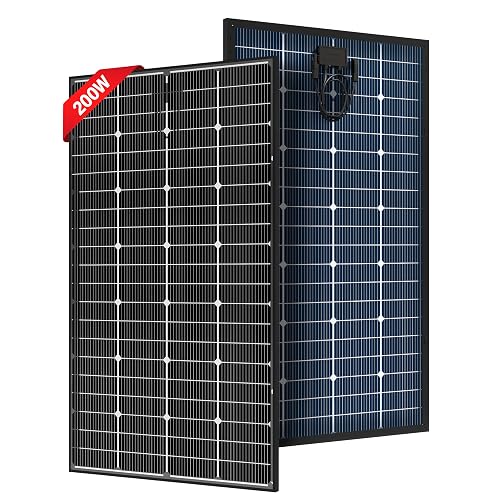
JJN 200W Bifacial Rigid
A 200W bifacial rigid solar panel with 25% plus N-Type 16BB cells, aluminum frame, IP67/IP65 and a 10-year workmanship warranty.
Pros
- 10-year workmanship warranty, the longest here
- Aluminum frame with 2400Pa wind and 5400Pa snow stated
- IP67 connectors and IP65 junction box
- Pre-drilled holes for easy mounting
Cons
- PV only; no cables or accessories included
- 24.3 pounds needs solid mounting
- Spec table disagrees on weight; bullets say 24.3
- Bifacial rear needs reflective ground to pay off
Detailed Review
The listing states a 200W bifacial rigid solar panel with 16BB N-Type cells at 25% plus efficiency, 28.1V maximum and 9.12A, a black corrosion-resistant aluminum frame, 2400Pa wind and 5400Pa snow load figures, IP67 connectors, an IP65 junction box, MC4 connectors, pre-drilled mounting holes and 24.3 pounds in the bullets (the spec table says 23.2; trust the bullets). A 10-year workmanship warranty and 88.9% output at 30 years are stated.
Who it's for: RV roofs, farms and off-grid cabins that mount once. Who should skip it: anyone who needs to fold and carry.
Its Solar Score of 9.7/10 comes from performance 28/35, build 22/25, value 19/25, safety 8/10 and warranty 4/5: 81 of 100 points, placed on our 9.2 to 9.8 scale.
Key Specifications
| Watts | 200W |
|---|---|
| Efficiency | 25%+ stated |
| Frame | Aluminum, 2400Pa/5400Pa |
| Warranty | 10-year workmanship |
Figures as published on the retailer listing, collected 21 October 2026. Performance figures are manufacturer rated.
Safety and Warranty
What this listing states. IP67 connectors and IP65 junction box stated, so safety scores 8 of 10. 10-year workmanship warranty stated. It does not say everything a buyer needs, such as who pays return shipping, so warranty scores 4 of 5. See How We Pick.
Panels make voltage in daylight. Keep connectors covered until you connect them, check the panel's stated open circuit voltage and current against your controller or power station input limits, and use cables rated for the current. Roof and permanent mounts belong to a qualified installer.
This is general buying information, not professional advice. Follow each product manual and local rules, and see our Safety Disclaimer.

JJN 850W Bifacial Rigid Pair
An 850W rigid solar panel pair with 25% dual-glass bifacial cells, UL61730 and drainage clips.
Pros
- 850W across two 425W panels, the most watts here
- UL61730 certified with dual-glass bifacial build
- Drainage clips to reduce hot spots
- Up to 30% more bifacial yield stated
Cons
- No warranty term is stated
- 103.2 pounds for the pair needs a strong rack
- 67.8 by 44.6 in per panel needs real roof space
- PV only; plan cables and mounting separately
Detailed Review
The listing states an 850W rigid solar panel pair (two 425W panels) with A+ grade monocrystalline 16BB cells at 25% efficiency, 38V maximum and 13.78A, dual-glass bifacial construction with up to 30% more yield, UL61730, 0.16% efficiency loss per 1°F rise stated, a 30-year lifespan claim and drainage clips, at 103.2 pounds. No warranty term is stated.
Who it's for: larger fixed arrays that want certified dual-glass panels. Who should skip it: anyone who needs a stated warranty or portability.
Its Solar Score of 9.7/10 comes from performance 34/35, build 24/25, value 21/25, safety 8/10 and warranty 0/5: 87 of 100 points, placed on our 9.2 to 9.8 scale.
Key Specifications
| Watts | 850W (2x 425W) |
|---|---|
| Efficiency | 25% stated |
| Certification | UL61730 stated |
| Weight | 103.2 pounds |
Figures as published on the retailer listing, collected 21 October 2026. Performance figures are manufacturer rated.
Safety and Warranty
What this listing states. UL61730 with dual-glass bifacial build stated, so safety scores 8 of 10. No warranty term, so warranty scores zero. See How We Pick.
Panels make voltage in daylight. Keep connectors covered until you connect them, check the panel's stated open circuit voltage and current against your controller or power station input limits, and use cables rated for the current. Roof and permanent mounts belong to a qualified installer.
This is general buying information, not professional advice. Follow each product manual and local rules, and see our Safety Disclaimer.

GEYOTO 200W Bifacial Portable
A 200W bifacial portable solar panel with 26% N-Type cells, kickstand, IP68 surface and a 2-year warranty.
Pros
- 26% cell efficiency, the highest figure here
- Y-shaped kickstand with sundial for aiming
- Reflective carrying case included
- 2-year limited warranty stated in bullets
Cons
- Junction box has no water protection, per the listing
- Bullets say 2 years, spec table says 3; trust bullets
- 200W is the least portable watts here
- Rear gain depends on placement and ground
Detailed Review
The listing states a 200W bifacial portable solar panel with N-Type cells at 26% conversion, 25.2V maximum and 7.94A, a foldable design, a reflective carrying case, a carbon-steel Y-shaped kickstand with sundial, a concealed connector and a 10 ft MC4-to-XT60 cable, at 15 pounds. The panel surface is IP68-rated; the junction box is not, per the listing. A 2-year limited warranty is stated in the bullets (the spec table says 3 Year Manufacturer; trust the bullets).
Who it's for: light travel and power-station topping where aiming matters. Who should skip it: wet installs where the junction box sees rain.
Its Solar Score of 9.6/10 comes from performance 28/35, build 20/25, value 19/25, safety 7/10 and warranty 3/5: 77 of 100 points, placed on our 9.2 to 9.8 scale.
Key Specifications
| Watts | 200W |
|---|---|
| Efficiency | 26% stated |
| Weight | 15 pounds |
| Warranty | 2-year stated (bullets) |
Figures as published on the retailer listing, collected 21 October 2026. Performance figures are manufacturer rated.
Safety and Warranty
What this listing states. IP68 panel surface stated, so safety scores 7 of 10. 2-year limited warranty stated. It does not say everything a buyer needs, such as who pays return shipping, so warranty scores 3 of 5. See How We Pick.
Panels make voltage in daylight. Keep connectors covered until you connect them, check the panel's stated open circuit voltage and current against your controller or power station input limits, and use cables rated for the current. Roof and permanent mounts belong to a qualified installer.
This is general buying information, not professional advice. Follow each product manual and local rules, and see our Safety Disclaimer.
As an Amazon Associate I earn from qualifying purchases.
How we scored them
The Solar Score weighs performance, build, value, safety and warranty. Safety means the weather codes and certifications the listing actually states; the UL61730 on the JJN 850W example and the IP67/IP65 pair on the JJN 200W example outscore the IP68 surface-only note on the GEYOTO. Warranty ranges from none stated to a 10-year workmanship term. How we pick explains the weights.
| Product | Solar Score | Perf. /35 | Build /25 | Value /25 | Safety /10 | Warranty /5 |
|---|---|---|---|---|---|---|
| ZOUPW 480W Bifacial Portable | 9.7 | 33 | 21 | 21 | 7 | 4 |
| JJN 200W Bifacial Rigid | 9.7 | 28 | 22 | 19 | 8 | 4 |
| JJN 850W Bifacial Rigid Pair | 9.7 | 34 | 24 | 21 | 8 | 0 |
| GEYOTO 200W Bifacial Portable | 9.6 | 28 | 20 | 19 | 7 | 3 |
Scores run from 9.2 to 9.8: each product’s point total is placed on that range, so more points always means a higher score.
Portable vs rigid solar panel: which should you choose?
Choose portable if you move: camping, RV travel or topping up a power station, where the folding case, kickstand and included cables matter. The ZOUPW suits big power stations with its 480W and 42.5V; the GEYOTO suits lighter trips at 15 pounds. Choose rigid if you mount once: rooftops, farms and off-grid cabins, where the frame, wind and snow figures and the 10-year workmanship warranty on the JJN 200W example matter more. The JJN 850W example suits larger arrays with its dual-glass bifacial build, but its listing states no warranty term.
| If you need | Look at |
|---|---|
| Most watts that folds | ZOUPW 480W Bifacial Portable, 22.5 lb |
| Lightest example | GEYOTO 200W Bifacial Portable, 15 lb |
| Longest stated warranty | JJN 200W Bifacial Rigid, 10-year workmanship |
| Biggest rigid array | JJN 850W Bifacial Rigid Pair, UL61730 |
Sizing Notes
- Match watts to your battery and controller: 480W, 200W, 200W and 850W across the examples.
- Check the voltage: 42.5V on the ZOUPW, 25.2V on the GEYOTO, 28.1V on the JJN 200W, 38V on the JJN 850W.
- Check moving weight: 15 and 22.5 pounds portable vs 24.3 and 103.2 pounds rigid.
- Warranty terms stated: 36-month, 2-year, 10-year workmanship, none stated.
- The ZOUPW listing advises against long-term fixed connections; use it as a traveler.
Frequently Asked Questions
Which side is lighter?
The portable examples: the GEYOTO at 15 pounds and the ZOUPW at 22.5 pounds. The rigid examples are 24.3 pounds for one 200W panel and 103.2 pounds for the 850W pair.
What warranties do the examples state?
The JJN 200W states a 10-year workmanship warranty. The ZOUPW states 36 months, the GEYOTO states 2 years and the JJN 850W states no warranty term.
Do the portable examples include accessories?
Yes. The ZOUPW ships a storage bag, ground stakes and two cables; the GEYOTO ships a reflective carrying case, a Y-shaped kickstand and a 10 ft cable. The rigid examples ship PV panels only.
What weather codes are stated?
IP68 on the ZOUPW, IP68 on the GEYOTO panel surface only, IP67 connectors and IP65 junction box on the JJN 200W, and UL61730 on the JJN 850W.
Can the portable panels be permanently mounted?
The ZOUPW safety section advises against long-term fixed, series or parallel connections. Use the portable examples for travel and temporary setups.
Related guides
See every Solar Panels and Kits guide. Also see our portable solar panels. Also see our rigid and flexible solar panels.