On this page
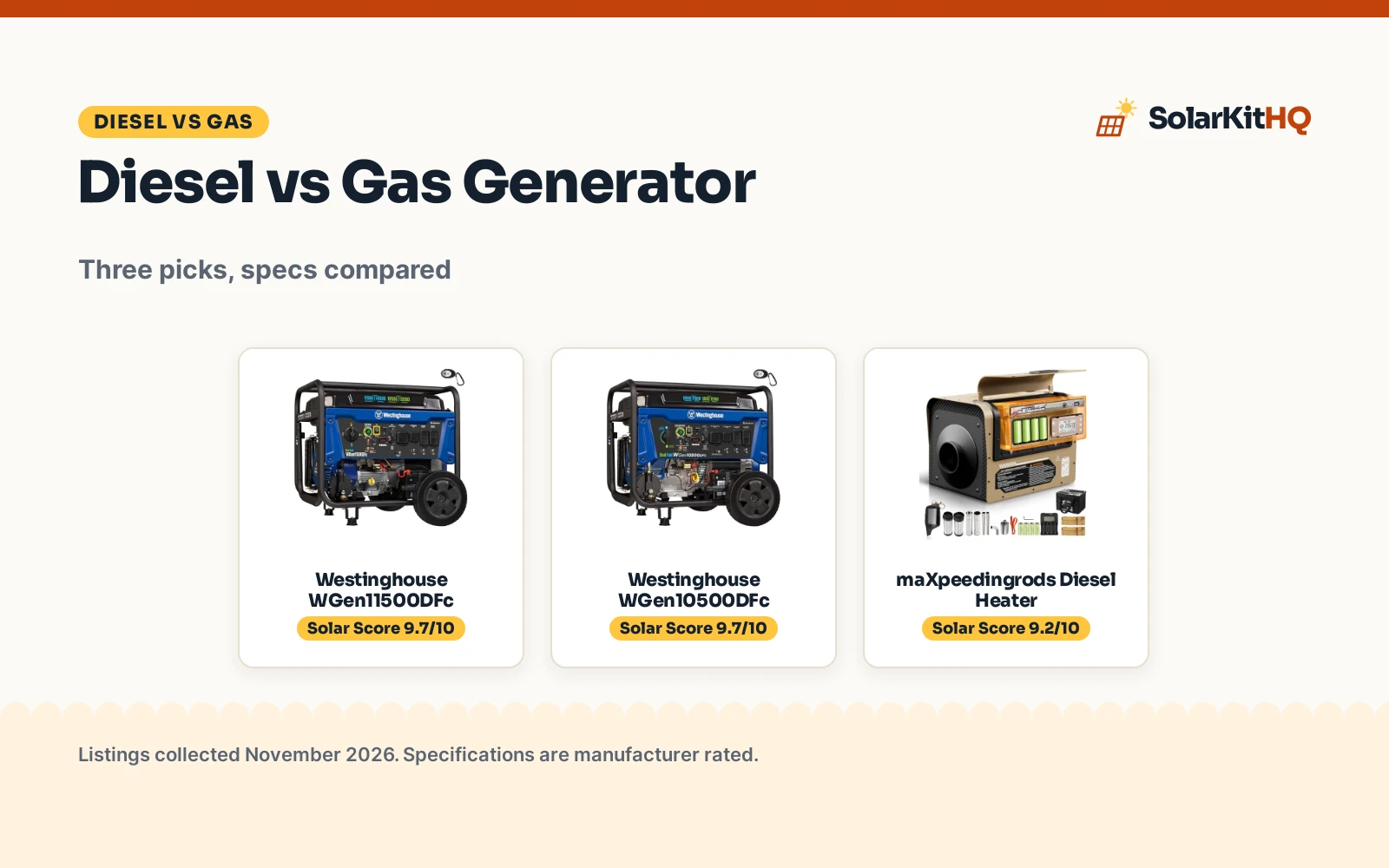
An outage at dinner time shows why diesel vs gas generator matters: one side should power a home, and the other side, in these listings, warms a space instead. Pick the gas examples for generator power, and pick the diesel example only for heating, because the diesel listing is a heater, not a generator. This comparison uses three listings, two dual fuel gas generators and one diesel heater, and compares only the figures each listing actually states. Where a figure is missing, the comparison says so, rather than treating a gap as a win for either side.
SolarKitHQ earns a commission when you buy through links on this page, at no extra cost to you. As an Amazon Associate I earn from qualifying purchases. Affiliate disclosure.
Diesel vs gas generator: side by side
| Generator | Solar Score | Fuel | Running watts | Runtime | Weight | Warranty | Amazon |
|---|---|---|---|---|---|---|---|
| Westinghouse WGen11500DFc | 9.7/10 | Gasoline and propane | 11,500 | Up to 19 hours at 25% load | 230.0 pounds | 3-year limited residential warranty | View on Amazon |
| Westinghouse WGen10500DFc | 9.7/10 | Gasoline and propane | 10,500 | Up to 19 hours at 25% load | 230.0 pounds | 3-year limited residential warranty | View on Amazon |
| maXpeedingrods Diesel Heater | 9.2/10 | Diesel | Not stated | Not stated | 43.43 pounds | Not stated | View on Amazon |
Figures in this table are the manufacturer’s ratings as listed, captured 3 November 2026.
Power and fuel
The gas examples state generator power plainly. The larger Westinghouse example delivers 11,500 running watts and 14,500 peak watts on gasoline, and the smaller Westinghouse example delivers 10,500 running watts and 13,500 peak watts on gasoline. Both gas examples offer gasoline and propane, but neither listing states running watts on propane, so propane power stays unclear. The diesel example states no generator running watts at all: it states a 5kW heater rating, with fuel use of 0.17 to 0.48 liters per hour for heating, which is not a generator power figure and must not be compared with the gas watts.
Weight and size
Weight and size differ sharply, but the products differ in kind, so the figures do not settle a side win. Both Westinghouse examples list 230.0 pounds in the spec table, with dimensions of 27.2 by 26.1 by 26.5 inches for the smaller example and 28.9 by 29.6 by 26.9 inches for the larger example. The diesel heater listing gives its weight and dimensions only in the spec table, and its all-in-one heater form is meant for vehicles, camping, tents and boats, not for home backup power. A lighter heater form does not make a diesel generator lighter, because no diesel generator is listed here.
Safety and warranty
For the gas examples, safety means automatic low-oil shutdown and a CO sensor that shuts down the generator when elevated carbon monoxide is detected, and both gas examples state a 3-year limited residential warranty. For the diesel heater, safety means a heat shield, an anti-spill pressure tank cap and a side-mounted exhaust, and no warranty term is stated. Fuel generators run outdoors only, far from doors and windows, because of carbon monoxide. A licensed electrician should install any home backup connection.
What the listings leave unclear
Several figures a buyer would want are simply missing. No diesel generator is listed, so diesel generator watts, runtime and fuel tank size stay unclear. None of the three listings states a noise level in decibels, and none states a UL or ETL certification or an IP rating. Propane running watts are not stated for either gas example, and the diesel heater listing does not state a warranty term. Those gaps are reasons to pause, not reasons to call either side better on an unstated spec.
Three examples
| # | Product | Solar Score | Buy |
|---|---|---|---|
| 1 |  Westinghouse WGen11500DFc | 9.7/10 | Buy on Amazon |
| 2 |  Westinghouse WGen10500DFc | 9.7/10 | Buy on Amazon |
| 3 |  maXpeedingrods Diesel Heater | 9.2/10 | Buy on Amazon |

Westinghouse WGen11500DFc
A dual fuel home backup portable generator with 11,500 running watts and 14,500 peak watts on gasoline, remote and push-button start, and a 3-year limited residential warranty.
Pros
- 11,500 running watts and 14,500 peak watts on gasoline
- Runs up to 19 hours at 25% load on a 9.5-gallon gas tank
- Less than 5% THD for sensitive electronics, with copper windings
- Remote and push-button start, with 50A and 30A outlets
Cons
- Weighs 230.0 pounds, per the spec table
- No noise level is stated
- Propane running watts are not stated
- No recoil start is stated
Detailed Review
The listing states a dual fuel home backup portable generator with a 550cc engine, 11,500 running watts and 14,500 peak watts on gasoline, up to 19 hours at 25% load on a 9.5-gallon gas tank, push-button and remote start, 50A and 30A outlets, automatic low-oil shutdown, a CO sensor and a 3-year limited residential warranty. Less than 5% THD is stated for sensitive electronics, with copper windings stated to help the generator run cooler.
Who it's for: buyers who need home backup generator power with stated running and peak watts on gasoline. Who should skip it: buyers who need stated propane watts, a stated noise level, or a lighter unit than 230.0 pounds.
Its Solar Score of 9.7/10 comes from performance 32/35, build 22/25, value 21/25, safety 8/10 and warranty 3/5: 86 of 100 points, placed on our 9.2 to 9.8 scale.
Key Specifications
| Running watts | 11,500 on gasoline |
|---|---|
| Peak watts | 14,500 on gasoline |
| Engine | 550cc |
| Warranty | 3-year limited residential warranty |
Figures as published on the retailer listing, collected 3 November 2026. Performance figures are manufacturer rated.
Safety and Warranty
What this listing states. Automatic low-oil shutdown and CO sensor, so safety scores 8 of 10. 3-year limited residential warranty. It does not say everything a buyer needs, such as who pays return shipping, so warranty scores 3 of 5. See How We Pick.
Follow the manual. Connect and use the product as the maker describes, stay within every stated rating, and read the manual before first use.
This is general buying information, not professional advice. Follow each product manual and local rules, and see our Safety Disclaimer.

Westinghouse WGen10500DFc
A dual fuel home backup portable generator with 10,500 running watts and 13,500 peak watts on gasoline, remote, push-button and recoil start, and a 3-year limited residential warranty.
Pros
- 10,500 running watts and 13,500 peak watts on gasoline
- Runs up to 19 hours at 25% load on a 9.5-gallon gasoline tank
- Remote, push-button and recoil starting
- 500cc engine with pressure lubrication and a reusable oil screen
Cons
- Weighs 230.0 pounds, per the spec table
- No noise level is stated
- Propane running watts are not stated
- No THD figure is stated
Detailed Review
The listing states a dual fuel home backup portable generator with a 500cc engine, 10,500 running watts and 13,500 peak watts on gasoline, up to 19 hours at 25% load on a 9.5-gallon gasoline tank, push-button and remote start with backup recoil starting, 50A and 30A outlets, automatic low-oil shutdown, a CO sensor and a 3-year limited residential warranty. A reusable oil screen and pressure lubrication are stated for engine life.
Who it's for: buyers who need home backup generator power with stated running and peak watts on gasoline, plus recoil starting. Who should skip it: buyers who need stated propane watts, a stated THD figure, a stated noise level, or a lighter unit than 230.0 pounds.
Its Solar Score of 9.7/10 comes from performance 30/35, build 22/25, value 21/25, safety 8/10 and warranty 3/5: 84 of 100 points, placed on our 9.2 to 9.8 scale.
Key Specifications
| Running watts | 10,500 on gasoline |
|---|---|
| Peak watts | 13,500 on gasoline |
| Engine | 500cc |
| Warranty | 3-year limited residential warranty |
Figures as published on the retailer listing, collected 3 November 2026. Performance figures are manufacturer rated.
Safety and Warranty
What this listing states. Automatic low-oil shutdown and CO sensor, so safety scores 8 of 10. 3-year limited residential warranty. It does not say everything a buyer needs, such as who pays return shipping, so warranty scores 3 of 5. See How We Pick.
Follow the manual. Connect and use the product as the maker describes, stay within every stated rating, and read the manual before first use.
This is general buying information, not professional advice. Follow each product manual and local rules, and see our Safety Disclaimer.

maXpeedingrods Diesel Heater
A 5kW self-powered diesel heater with remote control, USB output and a plateau mode, for vehicles, camping, tents and boats.
Pros
- 5kW diesel heater with self-generating power and USB output
- Fuel use of 0.17 to 0.48 liters per hour, per the listing
- Remote control and wireless startup, with a plateau mode
- All-in-one design for vehicles, camping, tents and boats
Cons
- A heater, not a generator: no generator running watts are stated
- No warranty term is stated
- No decibel figure is stated
- USB output is stated only for small lights, phones and lighting equipment
Detailed Review
The listing states a 5kW portable diesel heater with self-generating power, remote control, wireless startup, a plateau mode, USB output and fuel use of 0.17 to 0.48 liters per hour, in an all-in-one design for vehicles, camping, tents and boats. The title calls the product a heater, but one bullet calls it a generator when describing the exhaust system, so the title is followed here: this example is a heater, not a generator, and its 5kW figure is a heater rating, not generator watts.
Who it's for: buyers who need diesel heating for a vehicle, tent or boat, with USB output for small lights and phones. Who should skip it: buyers who need generator power, stated running watts, or a stated warranty term.
Its Solar Score of 9.2/10 comes from performance 18/35, build 16/25, value 15/25, safety 5/10 and warranty 0/5: 54 of 100 points, placed on our 9.2 to 9.8 scale.
Key Specifications
| Heater rating | 5kW |
|---|---|
| Fuel use | 0.17 to 0.48 liters per hour |
| Features | Remote control, USB output, plateau mode |
Figures as published on the retailer listing, collected 3 November 2026. Performance figures are manufacturer rated.
Safety and Warranty
What this listing states. Heat shield, anti-spill pressure tank cap and side-mounted exhaust, so safety scores 5 of 10. No warranty term, so warranty scores zero. See How We Pick.
Follow the manual. Connect and use the product as the maker describes, stay within every stated rating, and read the manual before first use.
This is general buying information, not professional advice. Follow each product manual and local rules, and see our Safety Disclaimer.
As an Amazon Associate I earn from qualifying purchases.
Where the points went
The Solar Score weighs performance, build, value, safety and warranty. For generators, safety means the stated shutdown and sensor features, and for the heater it means the stated heat shield and anti-spill cap. Two of the three listings state a warranty, both gas examples with a 3-year limited residential warranty, and the diesel heater states none. How we pick explains the weights.
| Product | Solar Score | Perf. /35 | Build /25 | Value /25 | Safety /10 | Warranty /5 |
|---|---|---|---|---|---|---|
| Westinghouse WGen11500DFc | 9.7 | 32 | 22 | 21 | 8 | 3 |
| Westinghouse WGen10500DFc | 9.7 | 30 | 22 | 21 | 8 | 3 |
| maXpeedingrods Diesel Heater | 9.2 | 18 | 16 | 15 | 5 | 0 |
The Solar Score runs on a 9.2 minimum and a 9.8 maximum, and the weighted point total is placed on that line in proportion, so more points can only raise it.
How to choose the best diesel vs gas generator
Match running watts to the load
Start from the running watts each gas listing states, 11,500 watts for the larger Westinghouse example and 10,500 watts for the smaller Westinghouse example, and match those figures to the loads planned. The diesel example gives no running watts for generator power, so it cannot be matched the same way. For a wider comparison, see the gas generator vs inverter generator guide.
Fuel and runtime
Both gas examples state gasoline and propane as fuel choices, with up to 19 hours at 25% load on a 9.5-gallon gasoline tank. The diesel heater states diesel fuel use for heating only, at 0.17 to 0.48 liters per hour, with no generator runtime figure. Do not compare heater fuel use with generator runtime, because the two figures measure different jobs. The dual fuel vs gas generator guide covers the dual fuel choice in more detail.
Weight, placement and starting
Both gas examples weigh 230.0 pounds, so placement and moving need a plan, and both offer remote and push-button start, with the smaller example also stating recoil start. The diesel heater offers remote control and wireless startup for heating, in an all-in-one form for vehicles and camping. For home backup use, see the inverter generator for home backup picks.
| Example | Fuel | Running watts |
|---|---|---|
| Westinghouse WGen11500DFc | Gasoline and propane | 11,500 |
| Westinghouse WGen10500DFc | Gasoline and propane | 10,500 |
| maXpeedingrods 5KW Diesel Heater | Diesel | Not stated |
Sizing Notes
- Match the stated running watts, 11,500 watts or 10,500 watts, to the loads planned, and keep running watts and peak watts separate.
- Match the stated fuel, gasoline and propane for the gas examples and diesel for the heater, to the fuel on hand.
- Match the stated runtime, up to 19 hours at 25% load on a 9.5-gallon gasoline tank, to the outage length planned.
- Match the stated weight, 230.0 pounds for each gas example, and the stated dimensions to the placement space.
FAQ: power away from the grid
Is the diesel example a generator?
No. The diesel listing is a heater with a 5kW rating, remote control and USB output, and it states no generator running watts.
What watts do the gas examples deliver on gasoline?
The larger Westinghouse example delivers 11,500 running watts and 14,500 peak watts on gasoline, and the smaller example delivers 10,500 running watts and 13,500 peak watts on gasoline. Propane running watts are not stated for either example.
How long do the gas examples run?
Both gas examples state up to 19 hours at 25% load on a 9.5-gallon gasoline tank.
Do these examples state a noise level?
No. None of the three listings states a noise level in decibels, although the diesel heater listing describes a muffler and quiet operation.
Related solar guides
See every inverter and dual fuel generators guide and all power stations guides.
More picks: browse gas generator for camping, tri-fuel home backup portable generator and remote start inverter generators.