On this page
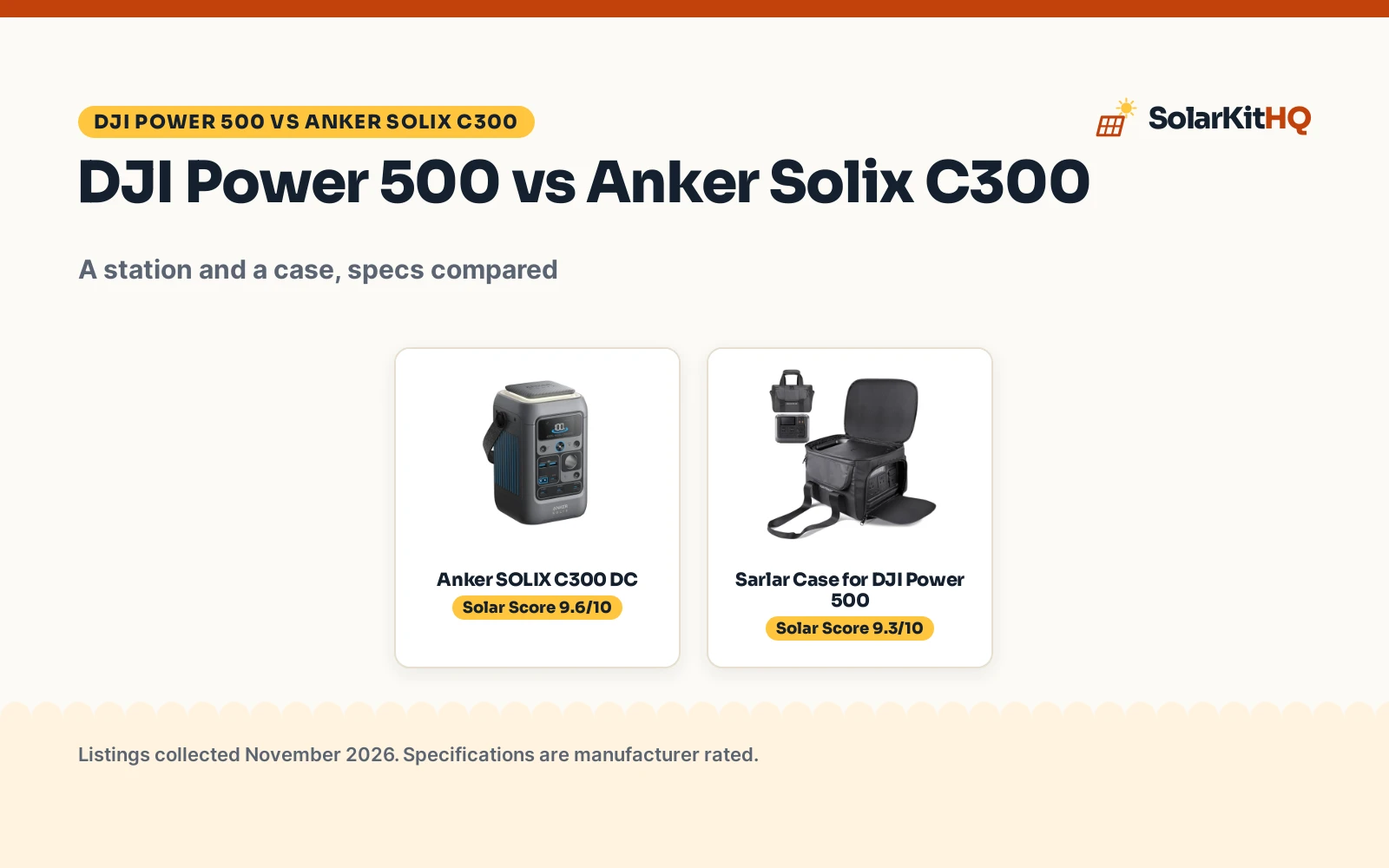
The lights go out at dinner time, the phones are nearly dead, and the campsite at dusk leaves you choosing what stays plugged in. That is the moment dji power 500 vs anker solix c300 starts to matter, because a small power station has to cover the gear you actually carry. We compared the listings on what each states: capacity, output, ports, size and warranty terms. The result is lopsided: the Anker side brings a real station with stated figures, while the DJI side brings a carrying case made for the DJI Power 500, not the station itself. Pick the Anker side if you need power away from an outlet, and pick the DJI side only if you already own a DJI Power 500 and want a padded case for it.
SolarKitHQ earns a commission when you buy through links on this page, at no extra cost to you. As an Amazon Associate I earn from qualifying purchases. Affiliate disclosure.
DJI Power 500 vs Anker Solix C300: side by side
| Power station | Solar Score | Capacity | Output | Ports | Size | Warranty |
|---|---|---|---|---|---|---|
| Anker SOLIX C300 DC | 9.6/10 | 288Wh | 300W | 7 ports | 4.89 x 7.87 x 4.72 in | 3-year term stated |
| Sarlar Case for DJI Power 500 | 9.3/10 | Not stated | Not stated | Not stated | 13.1 x 10 x 8 in | 1 year |
These specs are rated by the maker and quoted from each listing on 18 November 2026.
Capacity and output
The Anker side is the only side with power figures. The maker lists 288Wh and 90,000mAh, with output rated at 300W. The DJI side states no capacity and no output, because the listing is a carrying case, not a station. That gap decides the comparison for anyone who needs power: only the Anker side can run gear. The case side still matters, but only as protection for a station you already own.
Ports and charging
The Anker lists 7 charging ports: a 120W car socket, two 140W USB-C ports, a 100W USB-C port, a 15W USB-C port and two 12W USB-A ports. The box holds a 60cm 140W USB-C to C cable. Recharging to 80% takes an hour through the dual USB-C ports, and the first charge needs an 18W or higher USB-C wall charger, using only the USB-C2 and USB-C3 ports. Solar charging pairs with a 100W or 60W Anker panel, and the maker names the PS30, PS200 and PS400 panels as incompatible. The case side offers no ports of its own; its back space and side pockets hold the charging cable and accessories.
Size and carry
The Anker measures 4.89 by 7.87 by 4.72 inches, and the maker describes a design 30% smaller than similar power stations. The strap is sold separately. The case measures 13.1 by 10 by 8 inches, with a 15mm padded liner, two-way zippers and handles that hold up to 110 lbs. The case is the larger package of the pair, and it only fits the DJI Power 500.
What the listings leave unclear
The DJI side has no station in this comparison, so no capacity, output or port figure exists for it. The Anker warranty reads two ways: a 3-year term for the LiFePO4 battery in one place and 3 months in another. The case size also reads two ways: 13.1 by 10 by 8 inches and 13.1 by 13.1 by 8 inches. The Anker unit is sold as renewed, and neither side states a weight for the station itself.
The kits we chose

Anker SOLIX C300 DC
A 288Wh DC power bank station rated at 300W with 7 charging ports, LiFePO4 cells and a 3-year term stated for the battery, sold as renewed.
Pros
- 288Wh capacity with 300W output stated
- 7 charging ports, including two 140W USB-C ports
- LiFePO4 battery with smart temperature control stated
- Fast recharge to 80% in an hour stated for the dual USB-C ports
Cons
- No AC outlet is stated, so mains-powered gear is out
- Sold as renewed, not new
- Carrying strap is sold separately
- Solar charging needs a 100W or 60W Anker panel, and some Anker panels are not compatible
Detailed Review
The maker lists a 288Wh DC power bank station rated at 300W, with 90,000mAh, 7 charging ports: a 120W car socket, two 140W USB-C ports, a 100W USB-C port, a 15W USB-C port and two 12W USB-A ports. The LiFePO4 battery carries a 3-year term in one place and 3 months in another, so check the term before ordering. It recharges to 80% in an hour through the dual USB-C ports, pairs with a 100W or 60W Anker solar panel, and measures 4.89 by 7.87 by 4.72 inches. The maker also describes a design 30% smaller than similar power stations. First use needs an 18W or higher USB-C wall charger, and only the USB-C2 and USB-C3 ports can be used for that first charge.
Who it's for: campers and travelers who charge phones, laptops and small DC gear and want a compact 288Wh station with fast USB-C charging. Who should skip it: anyone who needs an AC outlet, a brand-new unit, or solar charging from a panel outside the stated 100W or 60W Anker pair.
Its Solar Score of 9.6/10 comes from performance 29/35, build 21/25, value 20/25, safety 8/10 and warranty 2/5: 80 of 100 points, placed on our 9.2 to 9.8 scale.
Key Specifications
| Capacity | 288Wh, 90,000mAh |
|---|---|
| Output | 300W |
| Ports | 7 charging ports, two 140W USB-C |
| Size | 4.89 x 7.87 x 4.72 in |
Taken from the seller's listing on 18 November 2026. Capacity and output figures are rated by the manufacturer.
Safety and Warranty
What this listing states. LiFePO4 battery with smart temperature control and impact-resistant design stated, so safety scores 8 of 10. 3-year term stated for the LiFePO4 battery. It does not say everything a buyer needs, such as who pays return shipping, so warranty scores 2 of 5. See How We Pick.
Power station limits. Stay within the stated continuous output and solar input limits, keep the unit ventilated and dry, charge within the stated temperature range, and never connect it to home wiring except through equipment a licensed electrician installs.
This is general buying information, not professional advice. Follow each product manual and local rules, and see our Safety Disclaimer.

Sarlar Case for DJI Power 500
A padded carrying case made for the DJI Power 500, sized 13.1 by 10 by 8 inches with cable pockets and a 1-year warranty.
Pros
- Made to fit the DJI Power 500, with a clamshell opening and vents on both sides
- 15mm thickened padded liner with tear-resistant 900D Oxford fabric
- Back and side pockets hold the charging cable and accessories
- Handles rated to hold up to 110 lbs
Cons
- It is a case, not a power station, so it adds no capacity or output
- It only fits the DJI Power 500, so it is useless with any other station
- Carrying the station inside the case means carrying a 13.1 by 10 by 8 inch package
- 1-year warranty while the Anker states a 3-year term
Detailed Review
The maker lists a carrying case made for the DJI Power 500 in 900D Oxford fabric with a 15mm thickened padded liner, two-way zippers and a clamshell opening with vents on the left and right sides, so the station can run without leaving the case. The back holds a space for cable management, side pockets take accessories, and the handles hold up to 110 lbs. The maker gives two sizes, 13.1 by 10 by 8 inches and 13.1 by 13.1 by 8 inches; check before ordering. The warranty is 1 year.
Who it's for: DJI Power 500 owners who want padded protection and cable storage for travel and storage. Who should skip it: anyone shopping for a power station itself, since this case holds no battery and adds no output.
Its Solar Score of 9.3/10 comes from performance 14/35, build 20/25, value 18/25, safety 5/10 and warranty 1/5: 58 of 100 points, placed on our 9.2 to 9.8 scale.
Key Specifications
| Size | 13.1 x 10 x 8 in |
|---|---|
| Material | 900D Oxford fabric, 15mm padded liner |
| Fits | DJI Power 500 |
| Handle load | Up to 110 lbs |
Taken from the seller's listing on 18 November 2026. Capacity and output figures are rated by the manufacturer.
Safety and Warranty
What this listing states. 15mm thickened padded liner and water-resistant 900D Oxford fabric stated, so safety scores 5 of 10. 1 year warranty stated. It does not say everything a buyer needs, such as who pays return shipping, so warranty scores 1 of 5. See How We Pick.
Power station limits. Stay within the stated continuous output and solar input limits, keep the unit ventilated and dry, charge within the stated temperature range, and never connect it to home wiring except through equipment a licensed electrician installs.
This is general buying information, not professional advice. Follow each product manual and local rules, and see our Safety Disclaimer.
As an Amazon Associate I earn from qualifying purchases.
Where the points went
The Solar Score weighs performance, build, value, safety and warranty. For portable power stations, safety means the battery chemistry, temperature control and impact-resistant design the listing names; the Anker states LiFePO4 cells with smart temperature control, while the case states padding and water-resistant fabric. Both state a warranty term, 3 years for the Anker battery and 1 year for the case. How we pick explains the weights.
| Product | Solar Score | Perf. /35 | Build /25 | Value /25 | Safety /10 | Warranty /5 |
|---|---|---|---|---|---|---|
| Anker SOLIX C300 DC | 9.6 | 29 | 21 | 20 | 8 | 2 |
| Sarlar Case for DJI Power 500 | 9.3 | 14 | 20 | 18 | 5 | 1 |
Every total is translated into a figure between 9.2 and 9.8 with a linear formula; ranking by points and ranking by score always agree.
DJI Power 500 vs Anker Solix C300: which should you choose?
Pick the Anker side if you need power away from an outlet: 288Wh, 300W and 7 ports cover phones, laptops and small DC gear, and the 140W USB-C ports recharge fast. Pick the DJI side only if you already own a DJI Power 500 and want padded protection with cable storage for travel. If you are still sizing a station, see the power station sizes guide and our best portable power station for camping picks.
| If you need | Look at |
|---|---|
| Power away from an outlet | Anker SOLIX C300 DC, 288Wh and 300W |
| Fast USB-C charging | Anker SOLIX C300 DC, two 140W USB-C ports |
| Padded protection for a DJI Power 500 | Sarlar Case for DJI Power 500, 13.1 x 10 x 8 in |
| Longest stated warranty term | Anker SOLIX C300 DC, 3-year term stated |
Sizing Notes
- Match the station’s 300W output and 288Wh capacity to the loads you plan to run.
- Match the solar panel to the stated 100W or 60W Anker panel pairing, and skip the PS30, PS200 and PS400 panels the maker names as incompatible.
- Check the case size, 13.1 by 10 by 8 inches, against the DJI Power 500 before ordering.
- Use an 18W or higher USB-C wall charger for the first charge, and only the USB-C2 and USB-C3 ports for that first charge.
- Keep the total draw within the stated 300W output.
FAQ: power away from the grid
How many devices can the Anker SOLIX C300 charge at once?
7 charging ports are stated: a 120W car socket, two 140W USB-C ports, a 100W USB-C port, a 15W USB-C port and two 12W USB-A ports.
Does the DJI Power 500 side include a power station?
No. The DJI side listing is a carrying case made for the DJI Power 500, sized 13.1 by 10 by 8 inches, with no battery or output stated.
How fast does the Anker SOLIX C300 recharge?
The maker states a fast recharge to 80% in an hour with the dual USB-C ports, and solar charging with a 100W or 60W Anker panel.
What warranty does each side state?
The Anker side states a 3-year term for the LiFePO4 battery in one place and 3 months in another, so check before ordering. The case states a 1-year warranty.
Can the Anker SOLIX C300 charge from a solar panel?
Yes, with a 100W or 60W Anker solar panel, per the maker. It is not compatible with the Anker SOLIX PS30, PS200 or PS400 panels.
Related solar guides
See every Portable Power Stations guide and all Power Stations and Generators guides. Also see our best portable power station for camping. Also see our power station sizes.
More picks: best power station for RV, 200Wh vs 500Wh power station, power station types.