On this page
At a campsite at dusk, with a phone fading and a power station waiting for sun, the choice in a foldable vs rigid solar panel comparison comes down to how often the panel moves and where it stays. Foldable examples fold for transport and unfold at camp, while a rigid example stays put in a fixed spot. This comparison looks at foldable examples and a rigid example through what each listing states, and the short verdict is plain: pick a foldable panel for moving camp, and pick a rigid panel for a fixed spot that does not move.
SolarKitHQ earns a commission when you buy through links on this page, at no extra cost to you. As an Amazon Associate I earn from qualifying purchases. Affiliate disclosure.
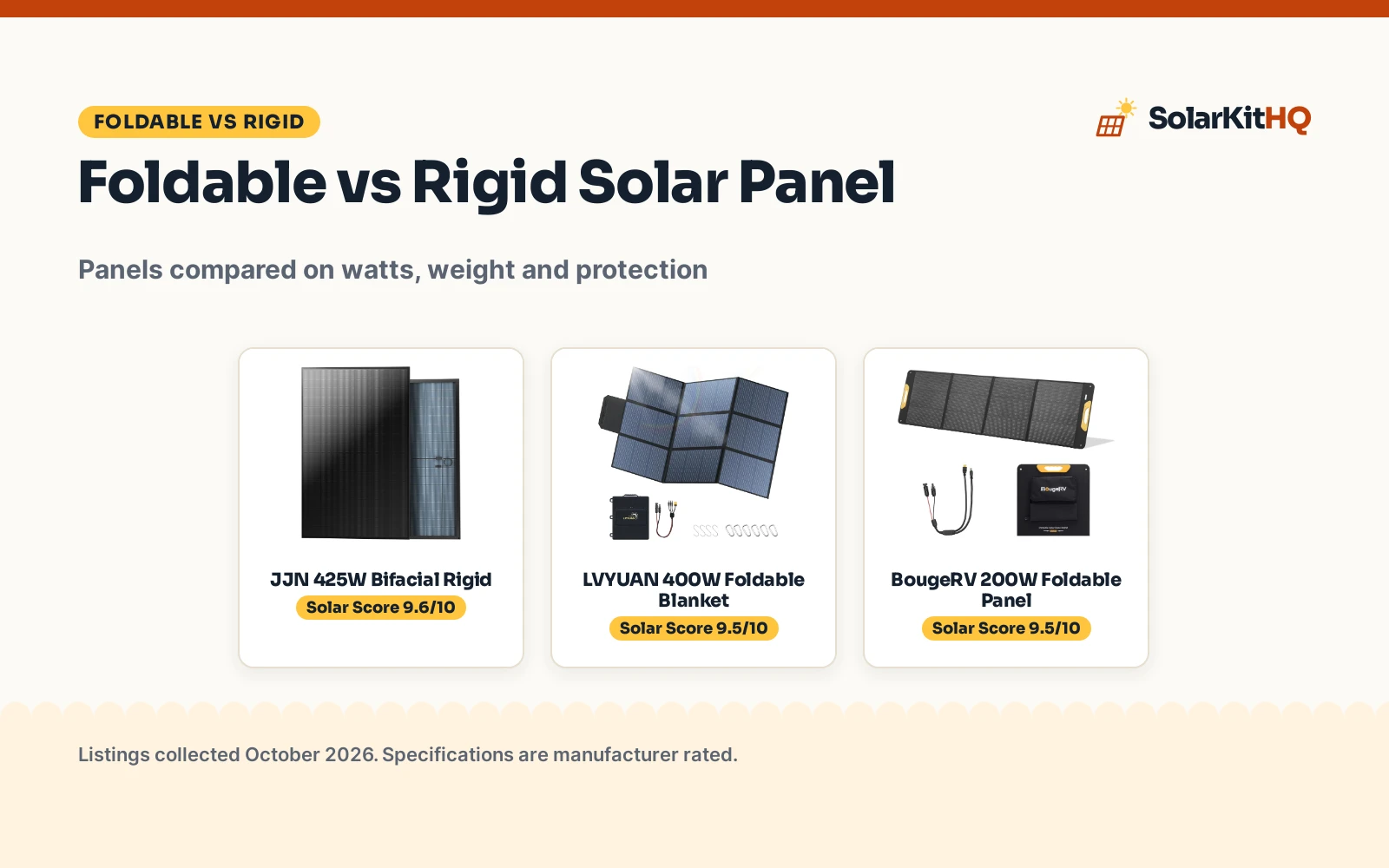
Foldable vs rigid: side by side
| Solar Panel | Solar Score | Watts | Weight | Efficiency | Protection | Amazon |
|---|---|---|---|---|---|---|
| JJN 425W Bifacial Rigid | 9.6/10 | 425 watts | 51.6 pounds | 25% | UL61730 | View on Amazon |
| LVYUAN 400W Foldable Blanket | 9.5/10 | 400 watts | 22 pounds | 23% | IP64 | View on Amazon |
| BougeRV 200W Foldable Panel | 9.5/10 | 200 watts | 13.8 pounds | 25% | IP65 | View on Amazon |
Specifications are manufacturer rated as listed, collected 25 October 2026.
Portability and size
Portability is where the foldable examples separate from the rigid example. The BougeRV example lists 13.8 pounds and side handles for hand-carry transport, and the listing states that the panel folds into a compact size, with no folded size stated. The LVYUAN example lists 22 pounds, folds to 19.5 by 23.6 by 2.36 inches, and unfolds to 84.6 by 57 inches, with 6 carabiners and 4 S-hooks included for attachment. The JJN example lists 51.6 pounds and dimensions of 67.8 by 44.6 by 1.2 inches, with no fold stated, so it reads as a panel for a fixed spot rather than a panel for moving camp.
Build and durability
Build language differs by side, and each listing states its own construction. The BougeRV example lists a fiberglass layer that the maker says helps resist cracking, for repeated setup and transport. The LVYUAN example lists fabric and monocrystalline silicon construction, with a weather-resistant build and reinforced grommets for the carabiners. The JJN example lists aluminum, monocrystalline silicon and tempered glass construction, with drainage clips included, and a 30-year lifespan figure. On stated protection codes, the BougeRV example lists an IP65 code, the LVYUAN example lists an IP64 code, and the JJN example lists a UL61730 certification, with no IP code stated.
Power and efficiency
On watts, the JJN example lists 425 watts, the LVYUAN example lists 400 watts in the title and bullets, and the BougeRV example lists 200 watts. On efficiency figures, the JJN example lists 25%, the LVYUAN example lists 23% in the title and bullets, and the BougeRV example lists 25% with N-Type cells stated. On voltage, the JJN example lists a 38 volt maximum voltage and a 31.05 volt output voltage, the LVYUAN example lists 36 volts, and the BougeRV example lists a 31.1 volt output voltage. The JJN example also lists a bifacial design that captures sunlight from the front and rear, with up to 30% more energy yield claimed. No side wins on efficiency from these figures alone, since the JJN example and the BougeRV example share a 25% figure while sitting on opposite sides.
What the listings leave unclear
The LVYUAN listing carries the clearest internal conflict: the spec table lists 450 watts and a 22.5% conversion figure, against 400 watts and 23% in the title and bullets, and this comparison uses the title and bullet figures. The BougeRV listing states no warranty term and no folded size, so a buyer cannot compare those points from the listing alone. The JJN listing states no warranty term and no IP code, so those points stay blank for that example. The LVYUAN listing also notes that compatibility depends on connector, voltage and controller figures, and that the panel is not compatible with power stations that feature proprietary technology, so the stated connector list matters when matching a device.
Three examples
| # | Product | Solar Score | Buy |
|---|---|---|---|
| 1 |  JJN 425W Bifacial Rigid | 9.6/10 | Buy on Amazon |
| 2 |  LVYUAN 400W Foldable Blanket | 9.5/10 | Buy on Amazon |
| 3 |  BougeRV 200W Foldable Panel | 9.5/10 | Buy on Amazon |

JJN 425W Bifacial Rigid
A 425 watt bifacial rigid panel with a 25% efficiency figure, tempered glass and aluminum construction, and a UL61730 certification stated in the listing.
Pros
- 425 watts stated, the highest watt figure in this group
- Bifacial design captures sunlight from the front and rear, with up to 30% more energy yield claimed
- Tempered glass and aluminum construction, with drainage clips listed
- UL61730 certification stated, plus a 30-year lifespan figure in the listing
Cons
- 51.6 pounds, the heaviest weight stated in this group
- 67.8 by 44.6 by 1.2 inches, a fixed size with no fold stated
- No warranty term is stated
- No IP code is stated
Detailed Review
The listing states a 425 watt bifacial N-Type rigid panel at 25% efficiency, with 16BB monocrystalline cells, aluminum and tempered glass construction, a 38 volt maximum voltage, a 31.05 volt output voltage, and dimensions of 67.8 by 44.6 by 1.2 inches at 51.6 pounds. It lists use for 12V, 24V and 48V systems, for rooftops, yards, farms, yachts and carports, and a 30-year lifespan figure, with drainage clips included.
Who it's for: owners who want a fixed panel with the highest watts in this group and a stated certification. Who should skip it: anyone who wants a panel that folds for transport, or a listing with a stated warranty term.
Its Solar Score of 9.6/10 comes from performance 30/35, build 22/25, value 20/25, safety 8/10 and warranty 0/5: 80 of 100 points, placed on our 9.2 to 9.8 scale.
Key Specifications
| Watts | 425 watts |
|---|---|
| Maximum voltage | 38 volts |
| Size | 67.8 by 44.6 by 1.2 inches |
| Weight | 51.6 pounds |
Figures as published on the retailer listing, collected 25 October 2026. Performance figures are manufacturer rated.
Safety and Warranty
What this listing states. UL61730 certification stated, so safety scores 8 of 10. No warranty term, so warranty scores zero. See How We Pick.
Panels make voltage in daylight. Keep connectors covered until you connect them, check the panel's stated open circuit voltage and current against your controller or power station input limits, and use cables rated for the current. Roof and permanent mounts belong to a qualified installer.
This is general buying information, not professional advice. Follow each product manual and local rules, and see our Safety Disclaimer.

LVYUAN 400W Foldable Blanket
A 400 watt foldable blanket panel with a 23% efficiency figure, a 36 volt figure, and a 2 year manufacturer warranty term stated in the spec table.
Pros
- 400 watts stated in the title and bullets
- Folds to 19.5 by 23.6 by 2.36 inches for transport, with 6 carabiners and 4 S-hooks included
- 23% efficiency figure in the title and bullets
- 2 year manufacturer warranty term stated
Cons
- Spec table lists 450 watts, against 400 watts in the title and bullets
- Spec table lists a 22.5% conversion figure, against 23% in the title and bullets
- Unfolds to 84.6 by 57 inches, a large flat size
- Not compatible with power stations that feature proprietary technology, per the listing
Detailed Review
The listing states a 400 watt foldable blanket panel at 36 volts, with up to 23% efficiency, MC4 output, a folded size of 19.5 by 23.6 by 2.36 inches, an unfolded size of 84.6 by 57 inches, and 22 pounds in the title. The spec table lists 450 watts and a 22.5% conversion figure, against the title and bullets, and this comparison uses the title and bullet figures. It includes 6 carabiners and 4 S-hooks, plus adapter cables for XT60, DC5521, DC5525 and DC7909 connectors.
Who it's for: campers and RV owners who want high watts in a panel that folds for transport. Who should skip it: anyone who wants a rigid panel for a fixed mount.
Its Solar Score of 9.5/10 comes from performance 28/35, build 20/25, value 20/25, safety 6/10 and warranty 1/5: 75 of 100 points, placed on our 9.2 to 9.8 scale.
Key Specifications
| Watts | 400 watts |
|---|---|
| Voltage | 36 volts |
| Folded size | 19.5 by 23.6 by 2.36 inches |
| Weight | 22 pounds |
Figures as published on the retailer listing, collected 25 October 2026. Performance figures are manufacturer rated.
Safety and Warranty
What this listing states. IP64 code stated, so safety scores 6 of 10. 2 Year Manufacturer warranty stated. It does not say everything a buyer needs, such as who pays return shipping, so warranty scores 1 of 5. See How We Pick.
Panels make voltage in daylight. Keep connectors covered until you connect them, check the panel's stated open circuit voltage and current against your controller or power station input limits, and use cables rated for the current. Roof and permanent mounts belong to a qualified installer.
This is general buying information, not professional advice. Follow each product manual and local rules, and see our Safety Disclaimer.

BougeRV 200W Foldable Panel
A 200 watt foldable panel with N-Type cells, a fiberglass layer, a 25% efficiency figure, and an IP65 code stated in the listing.
Pros
- 25% efficiency figure with N-Type cells stated
- Fiberglass layer listed to help resist cracking, for repeated setup and transport
- 13.8 pounds, the lowest weight stated in this group
- XT60 and DC7909 connectors listed, plus an 8.2 ft extension cable
Cons
- 200 watts, the lowest watt figure in this group
- No warranty term is stated
- No folded size is stated
- Output voltage of 31.1 volts must match the connected device input
Detailed Review
The listing states a 200 watt foldable panel with N-Type cells at 25% efficiency, a fiberglass layer, XT60 and DC7909 connectors, an 8.2 ft extension cable, side handles for hand-carry transport, and an IP65 code for water and dust protection. The spec table lists an output voltage of 31.1 volts and a weight of 13.8 pounds.
Who it's for: campers and RV owners who want a light panel that folds for transport. Who should skip it: anyone who wants the highest watts in this group or a fixed rigid panel.
Its Solar Score of 9.5/10 comes from performance 28/35, build 21/25, value 21/25, safety 7/10 and warranty 0/5: 77 of 100 points, placed on our 9.2 to 9.8 scale.
Key Specifications
| Watts | 200 watts |
|---|---|
| Output voltage | 31.1 volts |
| Weight | 13.8 pounds |
| Connector | XT60 and DC7909 |
Figures as published on the retailer listing, collected 25 October 2026. Performance figures are manufacturer rated.
Safety and Warranty
What this listing states. IP65 code stated, so safety scores 7 of 10. No warranty term, so warranty scores zero. See How We Pick.
Panels make voltage in daylight. Keep connectors covered until you connect them, check the panel's stated open circuit voltage and current against your controller or power station input limits, and use cables rated for the current. Roof and permanent mounts belong to a qualified installer.
This is general buying information, not professional advice. Follow each product manual and local rules, and see our Safety Disclaimer.
As an Amazon Associate I earn from qualifying purchases.
How we scored them
The Solar Score weighs performance, build, value, safety and warranty. For solar panels, safety means a stated certification or protection code, such as the UL61730 certification on the JJN example and the IP65 and IP64 codes on the foldable examples. One example states a warranty term, the LVYUAN example at a 2 year manufacturer term, while the other examples state no warranty term. How we pick explains the weights.
| Product | Solar Score | Perf. /35 | Build /25 | Value /25 | Safety /10 | Warranty /5 |
|---|---|---|---|---|---|---|
| JJN 425W Bifacial Rigid | 9.6 | 30 | 22 | 20 | 8 | 0 |
| LVYUAN 400W Foldable Blanket | 9.5 | 28 | 20 | 20 | 6 | 1 |
| BougeRV 200W Foldable Panel | 9.5 | 28 | 21 | 21 | 7 | 0 |
Scores run from 9.2 to 9.8: each product’s point total is placed on that range, so more points always means a higher score.
How to choose the best foldable vs rigid solar panel
Choose a foldable panel when the panel travels with camp, since the BougeRV example at 13.8 pounds and the LVYUAN example at a folded size of 19.5 by 23.6 by 2.36 inches both pack down for transport. Choose a rigid panel when the panel stays in a fixed spot, since the JJN example at 425 watts and 51.6 pounds reads as a fixed panel, not a carry panel. Check the connector list before choosing: the BougeRV example lists XT60 and DC7909, while the LVYUAN example lists MC4 output with adapters for XT60, DC5521, DC5525 and DC7909. For a fixed van setup, see the best rigid solar panels for van, and for a flexible comparison, see the flexible vs bifacial solar panel guide.
| If you need | Look at |
|---|---|
| Lowest weight stated | BougeRV 200W Foldable Panel, 13.8 pounds |
| A panel that folds for transport | LVYUAN 400W Foldable Blanket, folds to 19.5 by 23.6 by 2.36 inches |
| Highest watts stated | JJN 425W Bifacial Rigid, 425 watts |
| A stated warranty term | LVYUAN 400W Foldable Blanket, 2 year manufacturer term |
Sizing Notes
- Match panel watts and voltage against the controller or power station input: the JJN example lists 38 volts maximum, the LVYUAN example lists 36 volts, and the BougeRV example lists a 31.1 volt output voltage.
- Check folded and unfolded sizes and weights against transport and the spot: the LVYUAN example folds to 19.5 by 23.6 by 2.36 inches and unfolds to 84.6 by 57 inches, while the JJN example lists 67.8 by 44.6 by 1.2 inches at 51.6 pounds.
- Match the connectors listed to the connected device: XT60 and DC7909 on the BougeRV example, and MC4 output with adapters for XT60, DC5521, DC5525 and DC7909 on the LVYUAN example.
- Check stated protection and warranty figures before choosing: IP65 on the BougeRV example, IP64 on the LVYUAN example, UL61730 on the JJN example, and a 2 year manufacturer term stated only on the LVYUAN example.
Frequently Asked Questions
Which side packs down smaller in this group?
The foldable examples pack down. The LVYUAN example folds to 19.5 by 23.6 by 2.36 inches, and the BougeRV example folds into a compact size with no folded size stated. The JJN example lists no fold and dimensions of 67.8 by 44.6 by 1.2 inches.
Does the rigid example give more watts here?
In this group, yes. The JJN example lists 425 watts, against 400 watts for the LVYUAN example in the title and bullets and 200 watts for the BougeRV example. That figure describes these listings only, not every rigid panel.
Which listings state water and dust protection codes?
The BougeRV example states an IP65 code and the LVYUAN example states an IP64 code. The JJN example states a UL61730 certification, with no IP code stated.
Which listing states a warranty term?
Only the LVYUAN example states a warranty term, a 2 year manufacturer term in the spec table. The BougeRV example and the JJN example state no warranty term.
Related guides
See every Rigid and Flexible Panels guide and all Solar Panels and Kits guides.
More picks: see the best solar panel for RV roof, the best solar panel for pole barn, and the best portable solar panel for laptop.