On this page
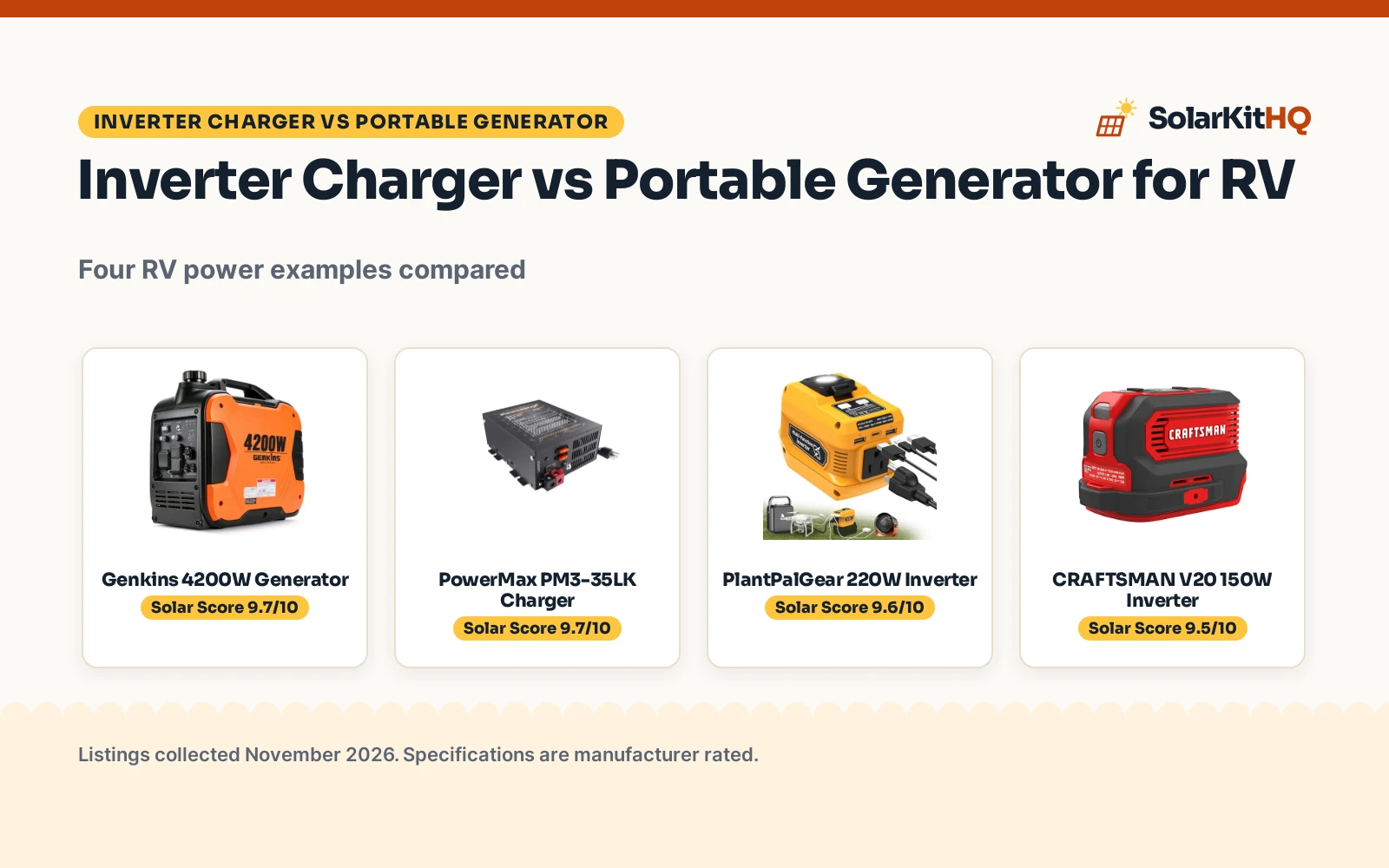
The short answer on inverter charger vs portable generator for rv use: an inverter charger draws on shore power or a battery you already own, while a portable generator makes its own AC power from fuel. This comparison covers each side with concrete examples from the listings, weighed on output, outlets, runtime, noise and warranty terms. The inverter charger side suits owners who already have shore power or a battery platform; the portable generator side suits owners who want power with no hookup at all.
SolarKitHQ earns a commission when you buy through links on this page, at no extra cost to you. As an Amazon Associate I earn from qualifying purchases. Affiliate disclosure.
Inverter charger vs portable generator: side by side
| Inverter charger vs generator | Genkins 4200W Generator | PowerMax PM3-35LK Charger | PlantPalGear 220W Inverter | CRAFTSMAN V20 150W Inverter | Amazon |
|---|---|---|---|---|---|
| Solar Score | 78 | 76 | 71 | 63 | |
| Type | Gasoline inverter generator | RV converter charger | Battery-powered inverter | Battery-powered inverter | |
| Rated output | 3200W rated, 4200W peak | 35A at 12V DC | 220W | 150W | |
| Power source | Gasoline, 1.45-gallon tank | 120V AC shore power | Dewalt 18V/20V battery | CRAFTSMAN V20 battery, bare tool only | |
| Outlets | Dual 120V outlets, 2 USB, L5-30R | 12V DC output | 1 AC outlet, 2 USB, 1 Type-C | 1 AC, 1 Type-A, 1 Type-C | |
| Runtime stated | Up to 9 hours at 25% load | Not stated | Not stated | Not stated | |
| Noise stated | 58 dBA at 23 ft | Not stated | Not stated | Not stated | |
| Weight | 46 lb | 7 lb | Not stated | Not stated | |
| Warranty | 2 years | 2 years | One year | 3 years |
Figures in this table are the manufacturer’s ratings as listed, captured 10 November 2026.
Power output
The gap in output is wide. The Genkins example lists 4200W peak power and 3200W rated power from a 149.3cc gasoline engine. The PowerMax example lists 35A at 12V DC, which is a charging current rather than an AC output figure. The PlantPalGear example lists 220W from a Dewalt battery. The CRAFTSMAN example lists 150W from a V20 battery.
What powers each one
The two sides run on different sources. The Genkins example runs on gasoline from a 1.45-gallon tank. The PowerMax example needs 120V AC from shore power or a suitable AC generator. The PlantPalGear example runs off Dewalt 18V/20V batteries, which are not included. The CRAFTSMAN example runs off a V20 battery, sold as a bare tool only. A gasoline generator runs outdoors only, far from doors and windows, because of carbon monoxide.
Outlets, runtime and noise
The Genkins example lists dual 120V NEMA 5-20R outlets, 2 USB ports and one 120V NEMA L5-30R outlet, with up to 9 hours of runtime at 25% load and 58 dBA at 23 ft. The PowerMax example lists a 12V DC output for RV loads and battery charging, with no runtime or noise figure stated. The PlantPalGear example lists one AC outlet, two 18W USB ports and one 30W PD Type-C port, with no runtime figure stated. The CRAFTSMAN example lists one Type-A, one Type-C and one AC port, with no runtime or noise figure stated.
What the listings leave unclear
The PowerMax bullets list 7.8 x 9.5 x 3.5 in at 7 lb, while the spec table lists 12.0 x 9.0 x 4.0 in, so the bullets govern the size. The PlantPalGear title calls it a portable power station generator, but the listing states the battery is not included, so it is an inverter that needs a Dewalt battery to run. The CRAFTSMAN listing states no protection features, so the safety line of its score stays empty. None of the four listings states a UL listing.
Four examples
| # | Product | Solar Score | Buy |
|---|---|---|---|
| 1 |  Genkins 4200W Generator | 9.7/10 | Buy on Amazon |
| 2 |  PowerMax PM3-35LK Charger | 9.7/10 | Buy on Amazon |
| 3 |  PlantPalGear 220W Inverter | 9.6/10 | Buy on Amazon |
| 4 |  CRAFTSMAN V20 150W Inverter | 9.5/10 | Buy on Amazon |

Genkins 4200W Generator
A gasoline inverter generator with 4200W peak and 3200W rated output, a 1.45-gallon tank, up to 9 hours of runtime at 25% load and a 58 dBA noise figure.
Pros
- 4200W peak and 3200W rated output from a 149.3cc engine
- Up to 9 hours of runtime at 25% load on a 1.45-gallon tank
- Pure sine wave output with THD of 2% or less, per the listing
- Parallel ready, with dual 120V outlets, 2 USB ports and an L5-30R outlet
Cons
- 46 lb to carry, and the parallel kit is separate
- 9-hour runtime figure applies at 25% load only
- Needs gasoline on hand, and the tank holds 1.45 gallons
- Warranty is limited and runs from the receiving date
Detailed Review
The listing states a gasoline inverter generator with a 149.3cc 4-stroke OHV engine, 4200W peak power and 3200W rated power, a 1.45-gallon fuel tank with up to 9 hours of runtime at 25% load, and 58 dBA at 23 ft. It lists pure sine wave output with THD of 2% or less, parallel operation with a separate parallel kit, dual 120V NEMA 5-20R outlets, 2 USB ports and one 120V NEMA L5-30R outlet, plus low-oil, overload, overheat and short-circuit protection. The warranty is 2 years limited from the receiving date.
Who it's for: RV owners who want the largest stated output here and a generator that runs on gasoline for longer stays off shore power. Who should skip it: anyone who wants a battery-powered option with no fuel to carry.
Its Solar Score of 9.7/10 comes from performance 32/35, build 22/25, value 21/25, safety 8/10 and warranty 1/5: 84 of 100 points, placed on our 9.2 to 9.8 scale.
Key Specifications
| Output | 4200W peak, 3200W rated |
|---|---|
| Engine | 149.3cc 4-stroke OHV gasoline |
| Runtime | Up to 9 hours at 25% load |
| Noise | 58 dBA at 23 ft |
Figures as published on the retailer listing, collected 10 November 2026. Performance figures are manufacturer rated.
Safety and Warranty
What this listing states. Low-oil, overload, overheat and short-circuit protection stated, so safety scores 8 of 10. 2 Years Limited warranty from receiving date stated. It does not say everything a buyer needs, such as who pays return shipping, so warranty scores 1 of 5. See How We Pick.
Inverter limits. Stay within the stated continuous watts (surge watts last only a moment), use the cable size and fuse the manual gives, ventilate it, and never connect an inverter to home wiring yourself; that is work for a licensed electrician.
This is general buying information, not professional advice. Follow each product manual and local rules, and see our Safety Disclaimer.
PowerMax PM3-35LK Charger
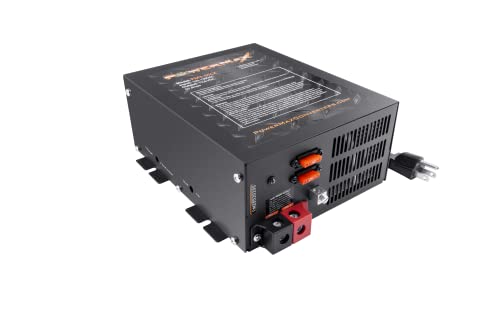
A 35A 12V RV converter charger with 3-stage smart charging, an adjustable fixed output from 13.0V to 16.5V and reverse-polarity, overload and thermal protection.
Pros
- 35A total output shared between DC loads and battery charging
- 3-stage smart charging with Boost, Normal and Storage steps at about 14.6V, 13.6V and 13.2V
- Adjustable fixed output from 13.0V to 16.5V for compatible lithium batteries
- Reverse-polarity, overload and thermal protection with a temperature-controlled fan
Cons
- Requires shore power or a suitable AC generator to run
- Does not detect battery chemistry; confirm your battery's needs
- Deck-mount fit needs 1 in of free air at each end and an outlet within 36 in
- Fixed mode drops the smart charging steps
Detailed Review
The listing states a 35A 12V RV converter charger that converts 120V AC into nominal 12V DC, up to 35A total shared between connected DC loads and battery charging, with 8A max AC input. It lists 3-stage smart charging in Boost, Normal and Storage steps at about 14.6V, 13.6V and 13.2V for lead-acid batteries, an adjustable fixed output from 13.0V to 16.5V, and reverse-polarity, overload and thermal protection with a temperature-controlled fan. The bullets give deck-mount dimensions of 7.8 x 9.5 x 3.5 in at 7 lb, while the spec table lists 12.0 x 9.0 x 4.0 in, so the bullets govern the size. The listing calls for a certified electrician install per the manual.
Who it's for: RV owners replacing a deck-mount converter charger who want 3-stage charging and a fixed-output mode for compatible lithium batteries. Who should skip it: anyone without shore power or a suitable AC generator, since it needs an AC source to run.
Its Solar Score of 9.7/10 comes from performance 30/35, build 21/25, value 21/25, safety 8/10 and warranty 1/5: 81 of 100 points, placed on our 9.2 to 9.8 scale.
Key Specifications
| Output | 35A total, 12V DC from 120V AC |
|---|---|
| Charging | 3-stage: about 14.6V, 13.6V, 13.2V |
| Fixed output | Adjustable 13.0V to 16.5V |
| Size | 7.8 x 9.5 x 3.5 in, 7 lb |
Figures as published on the retailer listing, collected 10 November 2026. Performance figures are manufacturer rated.
Safety and Warranty
What this listing states. Reverse-polarity, overload and thermal protection and a temperature-controlled fan stated, so safety scores 8 of 10. 2-year limited manufacturer warranty stated. It does not say everything a buyer needs, such as who pays return shipping, so warranty scores 1 of 5. See How We Pick.
Inverter limits. Stay within the stated continuous watts (surge watts last only a moment), use the cable size and fuse the manual gives, ventilate it, and never connect an inverter to home wiring yourself; that is work for a licensed electrician.
This is general buying information, not professional advice. Follow each product manual and local rules, and see our Safety Disclaimer.

PlantPalGear 220W Inverter
A 220W inverter that runs off Dewalt 18V/20V batteries, with 1 AC outlet, 2 USB ports, a 30W Type-C port and a 400LM LED work light.
Pros
- 220W DC to AC conversion from 18V DC to 110V-120V AC
- One AC outlet, two 18W USB ports and one 30W PD Type-C port
- 400LM LED work light with 3-level brightness, strobe and a 90-degree adjustable angle
- Protection against short circuits, overcurrent, low voltage, overheating, overload and over-discharge stated
Cons
- Battery is not included; it needs a Dewalt 18V/20V battery
- 220W suits small electronics only; no larger load figure is stated
- One-year warranty, the lowest term here
- No AC input or charging role; it only inverts battery power
Detailed Review
The listing states a 220W inverter that converts 18V DC to 110V-120V AC, built for Dewalt 18V/20V batteries such as DCB206, DCB205 and DCB204, with one AC outlet, two 18W USB QC ports and one 30W PD Type-C port. It lists a 400LM LED work light with 3-level adjustable brightness, a strobe function and a 90-degree adjustable lighting angle, plus protection against short circuits, overcurrent, low voltage, overheating, overload and over-discharge, and a built-in cooling fan. The title calls it a portable power station generator, but the listing states the battery is not included, so it is an inverter that needs a Dewalt battery to run. The warranty is one year.
Who it's for: Dewalt battery owners who want a small inverter for phones, laptops and tablets at a campsite or during an outage. Who should skip it: anyone without a Dewalt 18V/20V battery, or anyone who needs more than 220W.
Its Solar Score of 9.6/10 comes from performance 28/35, build 20/25, value 20/25, safety 8/10 and warranty 1/5: 77 of 100 points, placed on our 9.2 to 9.8 scale.
Key Specifications
| Output | 220W, 18V DC to 110V-120V AC |
|---|---|
| Ports | 1 AC outlet, 2 USB, 1 Type-C |
| Light | 400LM LED, 3-level brightness |
| Battery | Dewalt 18V/20V, not included |
Figures as published on the retailer listing, collected 10 November 2026. Performance figures are manufacturer rated.
Safety and Warranty
What this listing states. Protection against short circuits, overcurrent, low voltage, overheating, overload and over-discharge stated, so safety scores 8 of 10. 1 Year Warranty stated. It does not say everything a buyer needs, such as who pays return shipping, so warranty scores 1 of 5. See How We Pick.
Inverter limits. Stay within the stated continuous watts (surge watts last only a moment), use the cable size and fuse the manual gives, ventilate it, and never connect an inverter to home wiring yourself; that is work for a licensed electrician.
This is general buying information, not professional advice. Follow each product manual and local rules, and see our Safety Disclaimer.

CRAFTSMAN V20 150W Inverter
A 150W V20 inverter with Type-A, Type-C and AC ports, an LED flashlight and a rubber overmold, sold as a bare tool.
Pros
- 150W output with Type-A, Type-C and AC ports in one small unit
- LED flashlight for dark workspaces
- Durable rubber overmold
- 3-year warranty, the longest term here
Cons
- 150W is the lowest output here
- Bare tool only; the V20 battery is not included
- No protection features are stated
- VERSATRACK compatibility needs a mount sold separately
Detailed Review
The listing states a 150W V20 charger and power inverter with 3 charging ports, one Type-A, one Type-C and one AC, plus an LED flashlight for dark workspaces and a durable rubber overmold. It is VERSATRACK compatible with a mount sold separately, measures 3.2 x 3.0 x 4.6 inches, and lists an energy efficiency class of 85%. It is sold as a bare tool only, so the V20 battery is not included, and no protection features are stated. The warranty is 3 years.
Who it's for: CRAFTSMAN V20 battery owners who want a pocket-size inverter for charging phones and small gear. Who should skip it: anyone who needs more than 150W, or anyone without a V20 battery.
Its Solar Score of 9.5/10 comes from performance 27/35, build 21/25, value 20/25, safety 0/10 and warranty 2/5: 70 of 100 points, placed on our 9.2 to 9.8 scale.
Key Specifications
| Output | 150W |
|---|---|
| Ports | 1 Type-A, 1 Type-C, 1 AC |
| Size | 3.2 x 3.0 x 4.6 in |
| Efficiency class | 85% |
Figures as published on the retailer listing, collected 10 November 2026. Performance figures are manufacturer rated.
Safety and Warranty
What this listing states. No UL or ETL listing and no protection detail is stated, so safety scores zero. 3 Year Warranty stated. It does not say everything a buyer needs, such as who pays return shipping, so warranty scores 2 of 5. See How We Pick.
Inverter limits. Stay within the stated continuous watts (surge watts last only a moment), use the cable size and fuse the manual gives, ventilate it, and never connect an inverter to home wiring yourself; that is work for a licensed electrician.
This is general buying information, not professional advice. Follow each product manual and local rules, and see our Safety Disclaimer.
As an Amazon Associate I earn from qualifying purchases.
Where the points went
The Solar Score weighs performance, build, value, safety and warranty. For inverter chargers and portable generators, safety means protection features the listing names, such as overload, short-circuit, low-oil and thermal protection. All four listings state a warranty term, from one year to 3 years. How we pick explains the weights.
| Product | Solar Score | Perf. /35 | Build /25 | Value /25 | Safety /10 | Warranty /5 |
|---|---|---|---|---|---|---|
| Genkins 4200W Generator | 9.7 | 32 | 22 | 21 | 8 | 1 |
| PowerMax PM3-35LK Charger | 9.7 | 30 | 21 | 21 | 8 | 1 |
| PlantPalGear 220W Inverter | 9.6 | 28 | 20 | 20 | 8 | 1 |
| CRAFTSMAN V20 150W Inverter | 9.5 | 27 | 21 | 20 | 0 | 2 |
The Solar Score runs on a 9.2 minimum and a 9.8 maximum, and the weighted point total is placed on that line in proportion, so more points can only raise it.
Inverter charger vs portable generator for rv: which should you choose?
Choose an inverter charger if you have shore power or a battery platform already, and you want charging and small AC loads without fuel. The PowerMax example suits a deck-mount replacement with 3-stage charging. The CRAFTSMAN example suits V20 battery owners who want a pocket-size inverter for charging ports. Choose a portable generator if you want AC power with no hookup. The Genkins example suits owners who want the largest stated output here, a 4200W peak figure with parallel capability. The PlantPalGear example suits Dewalt battery owners who want a small inverter for phones, laptops and tablets.
| If you need | Look at |
|---|---|
| Largest stated output | Genkins 4200W Generator, 4200W peak |
| RV battery charging from shore power | PowerMax PM3-35LK Charger, 35A |
| Small inverter for Dewalt batteries | PlantPalGear 220W Inverter |
| Longest stated warranty | CRAFTSMAN V20 150W Inverter, 3 years |
Sizing Notes
- Size the load to the stated output: the Genkins example lists 3200W rated and 4200W peak.
- Match the charging source to the battery: the PowerMax example needs 120V AC from shore power or a suitable AC generator.
- Match the battery platform before buying: the PlantPalGear example runs off Dewalt 18V/20V batteries.
- Match the battery platform before buying: the CRAFTSMAN example runs off a V20 battery, sold as a bare tool only.
- Fuse the positive lead as the manual directs, and leave changes to the RV 120V system to a qualified technician.
FAQ: power away from the grid
Which side gives more output for an RV?
The Genkins example lists 4200W peak and 3200W rated, the largest figures here. The PowerMax example lists 35A at 12V DC for charging. The CRAFTSMAN example lists 150W of AC output.
Can an inverter charger run without shore power?
No. The PowerMax example requires shore power or a suitable AC generator. The battery inverters here run off a Dewalt battery or a V20 battery instead.
How long does the Genkins generator run?
Up to 9 hours at 25% load on a 1.45-gallon tank, per the listing.
How loud is the Genkins generator?
The listing states 58 dBA at 23 ft.
Which example here has the longest warranty?
The CRAFTSMAN example at 3 years. The PowerMax and Genkins examples state 2 years, and the PlantPalGear example states one year.
Does the PlantPalGear inverter include a battery?
No. The listing states the battery is not included, and it is built for Dewalt 18V/20V batteries.
Related solar guides
See every Inverter Chargers guide and all Controllers and Inverters guides. For the generator side, see all Inverter and Dual Fuel Generators guides. For RV power, see the best RV battery for boondocking and the best battery disconnect switch for RV.
More picks: best solar panel kit for RV, best portable power station for camping and best battery box for RV.