On this page
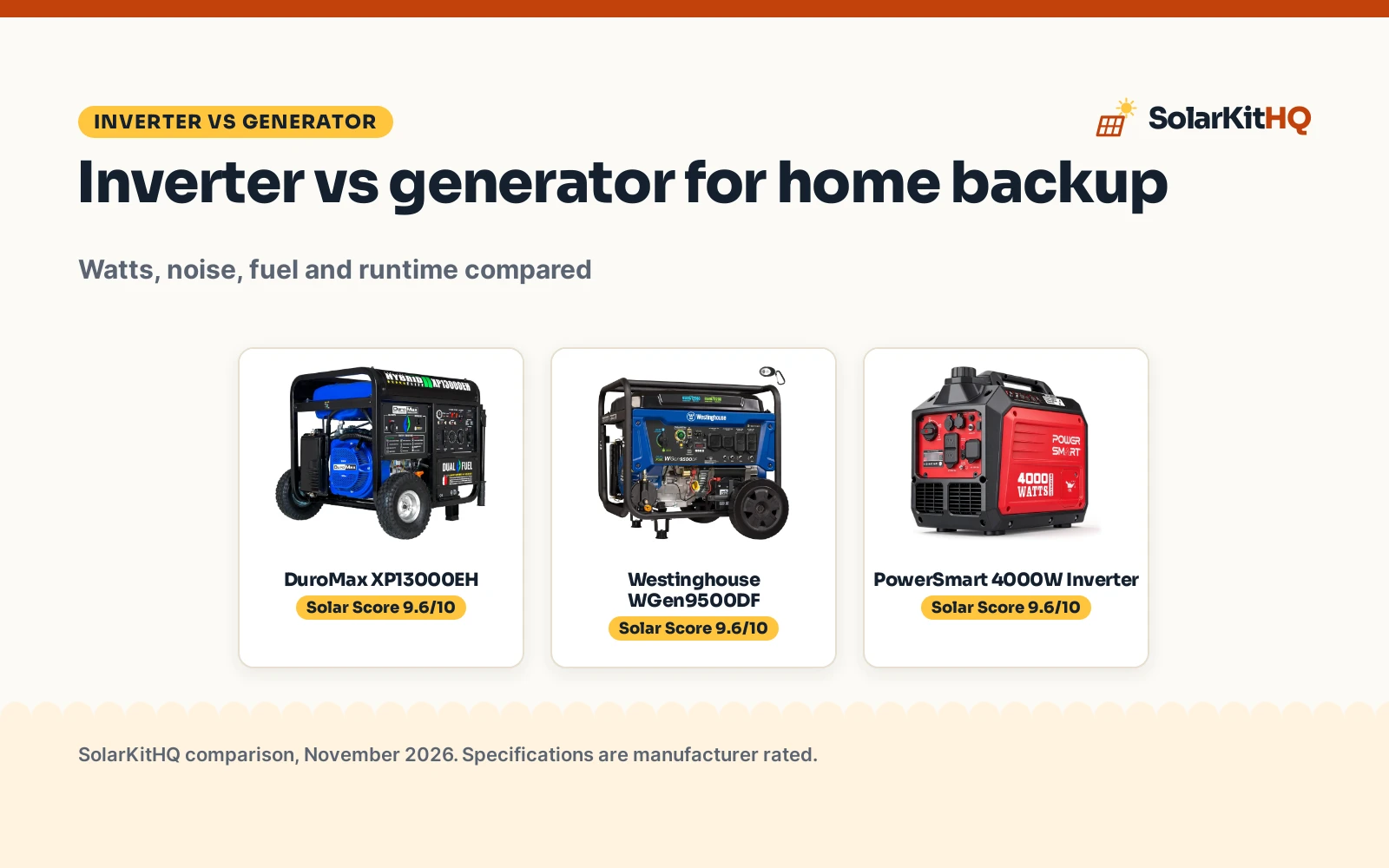
The short answer on inverter vs generator for home backup: pick the inverter if you want quiet, clean power for electronics and a unit you can carry, and pick a big dual-fuel generator if you want to run a whole home through an outage. The inverter side wins on noise and clean power, the generator side wins on watts and fuel options, and the right pick depends on the loads you need to run. The sections below compare the three listings on what each one states: watts, noise, fuel, runtime, safety and warranty.
SolarKitHQ earns a commission when you buy through links on this page, at no extra cost to you. As an Amazon Associate I earn from qualifying purchases. Affiliate disclosure.
We may earn a commission on qualifying purchases, at no extra cost to you. Prices and specifications change; check the listing before buying.
Inverter vs generator for home backup: side by side
| Inverter vs Generator | PowerSmart 4000W | Westinghouse WGen9500DF | DuroMax XP13000EH | Amazon |
|---|---|---|---|---|
| Side | Inverter | Generator for home backup | Generator for home backup | |
| Running watts (gasoline) | 3200 | 9500 | 10500 | |
| Peak watts (gasoline) | 4000 | 12500 | 13000 | |
| Noise stated | 59 dBA from 23 feet | Not stated | Not stated | |
| Clean power stated | THD under 3% | Not stated | Not stated | |
| Fuel | Gasoline | Gasoline, propane | Gasoline, propane | |
| Runtime stated | 8 hours | 12 hours | 3 hours | |
| Weight | 50.7 pounds | Not stated | 234 pounds | |
| Warranty | 2 years | 3 years | 3 years | |
| Safety stated | Low oil shutdown | Low oil shutdown | CO sensor, low oil shutdown |
These specs are rated by the maker and quoted from each listing on 21 October 2026.
Watts and clean power
This is the widest gap. The PowerSmart inverter lists 4000 starting watts and 3200 running watts, while the Westinghouse lists 9500 running watts and 12500 peak watts on gasoline, and the DuroMax lists 10500 running watts and 13000 starting watts. On propane, the Westinghouse lists 8500 running watts and 11200 peak watts. The inverter side wins on clean power: the PowerSmart lists THD under 3 percent, which the listing says can safely power laptops, mobile phones and tablets, while neither generator listing states a THD figure. The generator side wins on raw watts: the Westinghouse and DuroMax list enough running watts for a whole home, while the PowerSmart lists enough for a few loads.
Noise
Only the inverter side states a noise figure. The PowerSmart lists 59 dBA from 23 feet away, and calls itself super quiet. Neither the Westinghouse nor the DuroMax listing states a dBA figure, so the listings leave the noise gap unclear: the inverter is the only one with a figure to compare. The PowerSmart lists Eco Mode, which lets the engine slow down at light loads, while an open frame generator runs at a fixed speed. If quiet running matters, the PowerSmart is the only listing here that states it. See the benefits of an inverter generator for the wider case.
Fuel and runtime
All three run on gasoline, and both generators add propane. The Westinghouse lists 9500 running watts on gasoline and 8500 on propane, and the DuroMax lists dual fuel without splitting the watts by fuel. The PowerSmart lists a 1.3 gallon tank and an 8 hour runtime, the Westinghouse lists up to 12 hours on a 6.6 gallon tank, and the DuroMax lists a 3 hour runtime. The DuroMax spec table also lists a 0.5 gallon tank, which reads like a listing error next to the 3 hour runtime, so take the tank figure with care. Longer runtime and a bigger tank suit an outage that lasts the night, while a short runtime suits a brief outage or a jobsite. See dual fuel versus gas generators for home backup for the fuel trade-offs.
Start, outlets and safety
Starting differs across the three. The PowerSmart lists recoil start only, the Westinghouse lists remote start with a key fob plus electric and recoil start, and the DuroMax lists a push button start. Outlets differ too: the PowerSmart lists 6 outlets including 120V 20A, 120V 30A, 12V 8A and dual 5V USB ports, the Westinghouse lists 6 outlets including two GFCI 120V 20A receptacles, a transfer switch ready 120V 30A outlet and an RV ready 120/240V 50A outlet, and the DuroMax lists 2 outlets including a transfer switch ready 50 amp outlet. Safety differs as well: the DuroMax lists a CO sensor and low oil shutdown, while the PowerSmart and Westinghouse list low oil shutdown only, and the Westinghouse adds EPA compliant. The DuroMax is the only listing here that states a CO sensor.
What the listings leave unclear
Neither generator listing states a noise figure, so the noise gap between the sides is unclear. The Westinghouse listing states no weight, so its portability is unclear next to the PowerSmart at 50.7 pounds and the DuroMax at 234 pounds. The DuroMax listing states no propane watts, so its output on propane is unclear next to the Westinghouse at 8500 running watts. The PowerSmart listing states no CO sensor, and the Westinghouse listing states no parallel support. The DuroMax spec table lists a 0.5 gallon tank against a 3 hour runtime, which reads like a listing error.
The examples
| # | Product | Solar Score | Buy |
|---|---|---|---|
| 1 |  DuroMax XP13000EH | 9.6/10 | Buy on Amazon |
| 2 |  Westinghouse WGen9500DF | 9.6/10 | Buy on Amazon |
| 3 |  PowerSmart 4000W Inverter | 9.6/10 | Buy on Amazon |

DuroMax XP13000EH
A 13000W dual fuel generator with push button start, a 50 amp outlet and a CO sensor, for whole home backup.
Pros
- 13000 starting watts and 10500 running watts, the most in this group
- Dual fuel with a push button start and a front facing fuel selector
- CO sensor and low oil shutdown stated
- 100 percent copper windings and an all-metal frame stated
Cons
- 3 hour runtime is the shortest in this group
- 234 pounds, the heaviest in this group
- Only 2 outlets stated, against 6 on the other two
- Spec table lists a 0.5 gallon tank against a 3 hour runtime, which reads like a listing error
Detailed Review
DuroMax lists this as a 13000W dual fuel portable generator for whole home backup, with 13000 starting watts and 10500 running watts. The listing states a push button start, a front facing fuel selector, a transfer switch ready 50 amp outlet, a CO sensor, low oil shutdown and 100 percent copper windings in an all-metal frame. The spec table gives 234 pounds, 30 by 29 by 26 inches, a 3 hour runtime and a 3-year warranty. The spec table also lists a 0.5 gallon tank, which reads like a listing error next to the 3 hour runtime.
Who it's for: homeowners who want the most watts in this group with a CO sensor and push button start. Who should skip it: anyone who needs a long runtime or a light unit, since it runs 3 hours and weighs 234 pounds.
Its Solar Score of 9.6/10 comes from performance 33/35, build 20/25, value 19/25, safety 5/10 and warranty 3/5: 80 of 100 points, placed on our 9.2 to 9.8 scale.
Key Specifications
| Output | 13000W starting, 10500W running |
|---|---|
| Engine | 500cc |
| Weight | 234 pounds |
| Warranty | 3 years |
Taken from the seller's listing on 21 October 2026. Capacity and output figures are rated by the manufacturer.
Safety and Warranty
What this listing states. CO sensor and low oil shutdown stated, so safety scores 5 of 10. 3-year warranty stated. It does not say everything a buyer needs, such as who pays return shipping, so warranty scores 3 of 5. See How We Pick.
Inverter limits. Stay within the stated continuous watts (surge watts last only a moment), use the cable size and fuse the manual gives, ventilate it, and never connect an inverter to home wiring yourself; that is work for a licensed electrician.
This is general buying information, not professional advice. Follow each product manual and local rules, and see our Safety Disclaimer.

Westinghouse WGen9500DF
A 12500W dual fuel generator with remote start, 9500 running watts on gasoline and a 6.6 gallon tank, for home backup.
Pros
- 9500 running watts and 12500 peak watts on gasoline
- Dual fuel: 8500 running watts and 11200 peak watts on propane
- Remote start with key fob, plus electric and recoil start
- Up to 12 hours of runtime on a 6.6 gallon tank
Cons
- No noise figure is stated, unlike the PowerSmart
- No CO sensor is stated, unlike the DuroMax
- Weight is not stated in the listing
- No parallel support is stated
Detailed Review
Westinghouse lists this as a 12500W dual fuel home backup generator, with 9500 running watts and 12500 peak watts on gasoline, and 8500 running watts and 11200 peak watts on propane. The listing states remote start with a key fob, electric and recoil start, up to 12 hours of runtime on a 6.6 gallon tank, and a 457cc engine with a cast iron sleeve and automatic low oil shutdown. The outlets include two GFCI 120V 20A receptacles, a transfer switch ready 120V 30A outlet and an RV ready 120/240V 50A outlet. The spec table gives 27.2 by 26.1 by 26.5 inches and a 3-year limited warranty, with no weight stated.
Who it's for: homeowners who want a whole-home backup unit with remote start and dual fuel. Who should skip it: anyone who needs a stated noise figure, or a unit light enough to carry alone.
Its Solar Score of 9.6/10 comes from performance 33/35, build 21/25, value 20/25, safety 3/10 and warranty 3/5: 80 of 100 points, placed on our 9.2 to 9.8 scale.
Key Specifications
| Output | 12500W peak, 9500W running (gasoline) |
|---|---|
| Propane | 11200W peak, 8500W running |
| Runtime | Up to 12 hours |
| Warranty | 3 years |
Taken from the seller's listing on 21 October 2026. Capacity and output figures are rated by the manufacturer.
Safety and Warranty
What this listing states. Automatic low oil shutdown and EPA compliant stated, so safety scores 3 of 10. 3-year limited warranty stated. It does not say everything a buyer needs, such as who pays return shipping, so warranty scores 3 of 5. See How We Pick.
Inverter limits. Stay within the stated continuous watts (surge watts last only a moment), use the cable size and fuse the manual gives, ventilate it, and never connect an inverter to home wiring yourself; that is work for a licensed electrician.
This is general buying information, not professional advice. Follow each product manual and local rules, and see our Safety Disclaimer.

PowerSmart 4000W Inverter
A 4000W inverter generator with clean power under 3 percent THD, 59 dBA from 23 feet, Eco Mode and parallel support.
Pros
- 4000 starting watts and 3200 running watts with THD under 3 percent
- 59 dBA from 23 feet, the quietest figure in this group
- Eco Mode and parallel support for two 4000W units
- 120V 20A, 120V 30A, 12V 8A and dual 5V USB ports stated
Cons
- 3200 running watts suits a few loads, not a whole home
- Gasoline only, with no propane option stated
- Recoil start only, with no electric start stated
- 2-year warranty is the shortest in this group
Detailed Review
PowerSmart lists this as a 4000W portable inverter generator for home use, with 4000 starting watts and 3200 running watts of clean power at THD under 3 percent. The listing states 59 dBA from 23 feet, Eco Mode, a 1.3 gallon tank and an 8 hour runtime, plus parallel support for two 4000W units. The panel lists 120V 20A, 120V 30A, 12V 8A and dual 5V 2.1A USB ports. The spec table gives 50.7 pounds and 20.1 by 12.2 by 17.7 inches, and a 2-year limited warranty.
Who it's for: owners who want quiet, clean power for laptops, phones and tablets, and a unit light enough to carry to a campsite. Who should skip it: anyone who needs to run a whole home, since 3200 running watts covers a few loads only.
Its Solar Score of 9.6/10 comes from performance 29/35, build 21/25, value 21/25, safety 3/10 and warranty 2/5: 76 of 100 points, placed on our 9.2 to 9.8 scale.
Key Specifications
| Output | 4000W starting, 3200W running |
|---|---|
| Clean power | THD under 3% |
| Noise | 59 dBA from 23 feet |
| Warranty | 2 years |
Taken from the seller's listing on 21 October 2026. Capacity and output figures are rated by the manufacturer.
Safety and Warranty
What this listing states. Low oil shutdown stated, so safety scores 3 of 10. 2-year limited warranty stated. It does not say everything a buyer needs, such as who pays return shipping, so warranty scores 2 of 5. See How We Pick.
Inverter limits. Stay within the stated continuous watts (surge watts last only a moment), use the cable size and fuse the manual gives, ventilate it, and never connect an inverter to home wiring yourself; that is work for a licensed electrician.
This is general buying information, not professional advice. Follow each product manual and local rules, and see our Safety Disclaimer.
As an Amazon Associate I earn from qualifying purchases.
Where the points went
The Solar Score weighs performance, build, value, safety and warranty. For home backup, performance means running watts and clean power, safety means a CO sensor or low oil shutdown the listing names, and warranty means the term the listing states. The DuroMax leads on power and safety, the Westinghouse leads on runtime and fuel options, and the PowerSmart leads on noise and clean power. How we pick explains the weights.
| Product | Solar Score | Perf. /35 | Build /25 | Value /25 | Safety /10 | Warranty /5 |
|---|---|---|---|---|---|---|
| DuroMax XP13000EH | 9.6 | 33 | 20 | 19 | 5 | 3 |
| Westinghouse WGen9500DF | 9.6 | 33 | 21 | 20 | 3 | 3 |
| PowerSmart 4000W Inverter | 9.6 | 29 | 21 | 21 | 3 | 2 |
Every total is translated into a figure between 9.2 and 9.8 with a linear formula; ranking by points and ranking by score always agree.
Inverter vs generator for home backup: which should you choose?
Choose the inverter if you want quiet, clean power for laptops, phones and tablets, and a unit you can carry: the PowerSmart lists 59 dBA from 23 feet, THD under 3 percent and 50.7 pounds. Choose a generator if you want to run a whole home: the Westinghouse lists 9500 running watts on gasoline with remote start and up to 12 hours of runtime, and the DuroMax lists 10500 running watts with a CO sensor and push button start. Between the two generators, the Westinghouse suits longer outages and the DuroMax suits the biggest loads.
| If you need | Look at |
|---|---|
| Lowest noise | PowerSmart 4000W, 59 dBA |
| Clean power for electronics | PowerSmart 4000W, THD under 3 percent |
| Longest runtime | Westinghouse WGen9500DF, 12 hours |
| Most running watts | DuroMax XP13000EH, 10500 watts |
| CO sensor stated | DuroMax XP13000EH |
Sizing Notes
- Match the generator’s running watts to the loads that run at the same time, and check the surge watts for motors starting.
- Check the outlets: the PowerSmart lists 6 outlets, the Westinghouse lists 6 outlets, and the DuroMax lists 2 outlets.
- Plan the fuel: the Westinghouse lists up to 12 hours on a 6.6 gallon tank, and the DuroMax lists 3 hours.
- Run any generator outdoors, away from windows and doors, and keep a CO alarm in the home.
- Check the transfer switch and the panel before wiring a generator into the home, and leave the wiring to a qualified electrician.
FAQ: power away from the grid
Do I need an inverter generator for my house?
It depends on the loads. An inverter generator suits quiet, clean power for laptops, phones and tablets: the PowerSmart lists THD under 3 percent and 59 dBA from 23 feet. A big dual-fuel generator suits a whole home: the Westinghouse lists 9500 running watts and the DuroMax lists 10500 running watts.
What is an inverter generator?
A generator with an inverter that makes clean AC power at a steady frequency, and that lets the engine slow down at light loads. The PowerSmart lists THD under 3 percent, Eco Mode and parallel support, which is the inverter side of this comparison.
How do I choose an inverter for home backup?
Add up the running watts of the loads that run at the same time, check the surge watts for motors, and compare the outlets, runtime and warranty. The PowerSmart lists 3200 running watts, the Westinghouse lists 9500 and the DuroMax lists 10500, so the choice follows the loads.
Can a generator run a whole home?
Yes, if its running watts cover the loads. The Westinghouse lists 9500 running watts on gasoline and the DuroMax lists 10500 running watts, both with dual fuel and a transfer switch ready outlet. The PowerSmart lists 3200 running watts, which suits a few loads, not a whole home.