On this page
When the lights go out at dinner time and the fridge, the phones and a lamp all need power at once, jackery explorer 1000 v2 vs ecoflow delta 2 max comes down to a simple split: pick the Jackery listing for a lighter unit to carry, and pick the EcoFlow listing for a larger capacity and more outlets at home. This comparison weighs the two listings on what each one states: capacity, AC output, weight, charging times and warranty terms. The Jackery listing states 1070Wh and 1500W AC output at 23.8 pounds. The EcoFlow listing states 2048Wh and 2400W output at 74.6 pounds. The gap between the pair is about what each unit is built to carry, not about which brand name sits on the case.
SolarKitHQ earns a commission when you buy through links on this page, at no extra cost to you. As an Amazon Associate I earn from qualifying purchases. Affiliate disclosure.
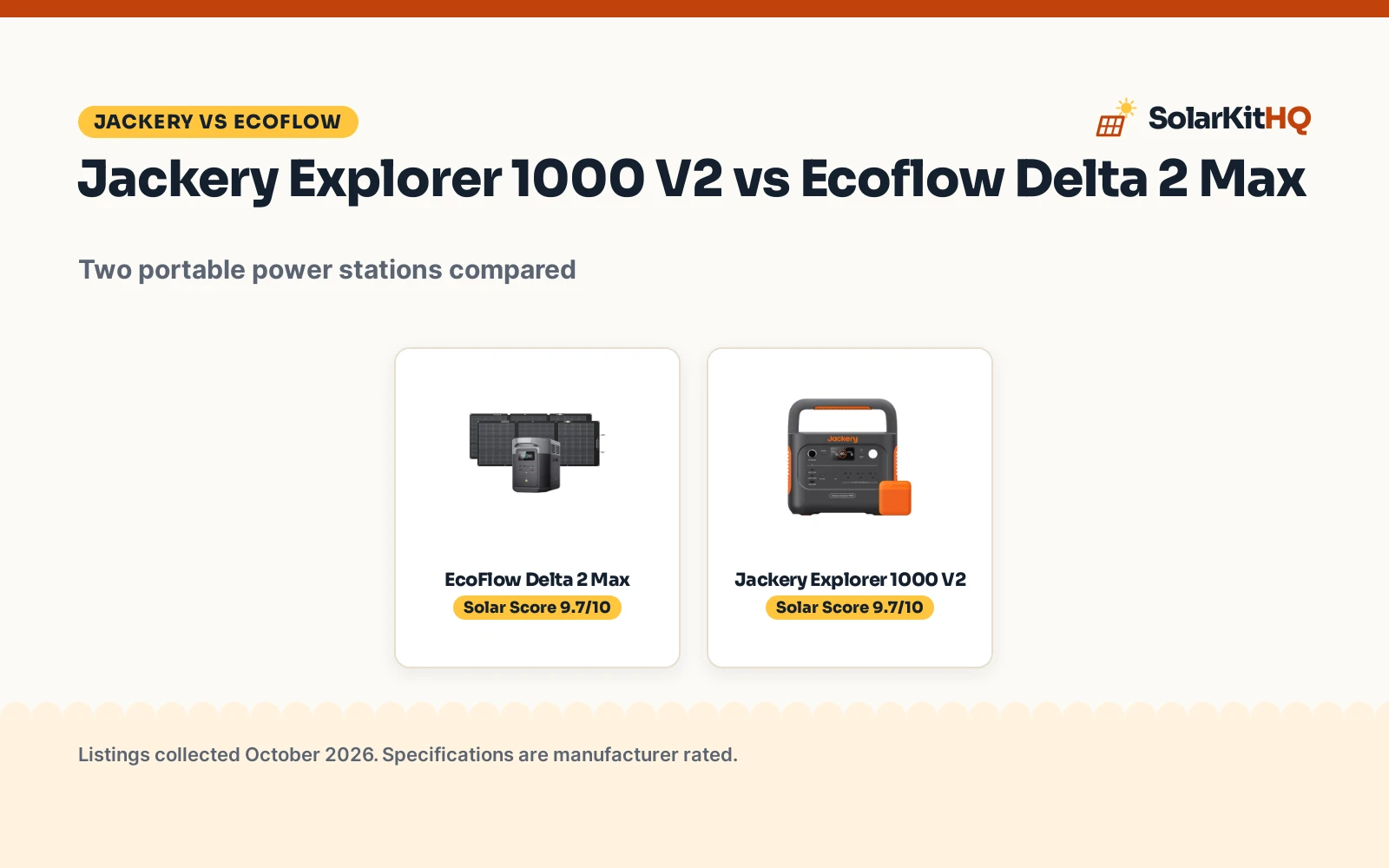
Jackery Explorer 1000 V2 vs Ecoflow Delta 2 Max: side by side
| Portable power station | Solar Score | Capacity | AC output | Weight | Warranty |
|---|---|---|---|---|---|
| EcoFlow Delta 2 Max | 9.7/10 | 2048Wh | 2400W | 74.6 pounds | 5 years |
| Jackery Explorer 1000 V2 | 9.7/10 | 1070Wh | 1500W | 23.8 pounds | 5 years |
Figures in this table are the manufacturer’s ratings as listed, captured 2 November 2026.
Capacity and AC output
The Jackery listing states 1070Wh of capacity. The EcoFlow listing states 2048Wh of capacity. On AC output, the Jackery listing states 1500W AC output with a 3000W surge peak. The EcoFlow listing states output of up to 2400W, with X-Boost mode for appliances up to 3400W. The two output figures need to stay separate: 2400W is the stated output, and 3400W is the X-Boost figure, not the continuous output.
Outlets separate the pair as well. The Jackery listing states three pure sine wave AC ports, two USB-C ports, one USB-A port and one DC car port, plus LED lights. The EcoFlow listing states 15 outlets. A reader with several household devices to plug in at once will find the outlet count on the EcoFlow listing the more generous figure, while a reader with a small set of devices may find the Jackery port set enough.
Weight and size
The Jackery listing states 23.8 pounds and dimensions of 8.82 x 12.87 x 9.27 inches, with a foldable handle. The EcoFlow listing states 74.6 pounds and dimensions of 9.5 x 19.6 x 12.0 inches. The EcoFlow listing is a bundle: it pairs the Delta 2 Max with two 160W solar panels. The Jackery listing pairs the Explorer 1000 v2 with a 3-Port 102W Fast Charger, a user manual and an AC charging cable. Weight is the clearest practical split in this comparison: the Jackery listing describes a unit built to move, and the EcoFlow listing describes a heavier home backup bundle.
Charging times
The Jackery listing states a full charge from 0 to 100 percent in one hour with emergency charging switched on in the Jackery App. The same listing states a default full charge of 1.7 hours to protect battery health. The Jackery listing also states a 30 dB quiet overnight charging mode and an energy efficiency mode in the app.
The EcoFlow listing states 0 to 80 percent in 43 minutes when AC charging is combined with up to 1000W solar input. The same listing states 80 percent in 1.1 hours on AC alone. Solar charging alone is slower in the EcoFlow listing: 0 to 100 percent in 16 hours with one set of panels, or 8 hours using two sets. Readers should compare like with like here: a combined charging figure, an AC alone figure and a solar alone figure describe different setups.
What the listings leave unclear
The Jackery title leads with a one hour charge, while the bullets say the one hour figure needs emergency charging switched on in the app and the default full charge is 1.7 hours. The Jackery title also lists a 102W charger, while the bullets list 100W USB-C charging. The bullets carry the detail in both cases, so this comparison follows the bullets.
The EcoFlow title leads with up to 3400W AC output and a 0 to 100 percent charge in one hour with AC and solar charging combined. The bullets give 2400W as the output, 3400W as the X-Boost figure, and 80 percent in 43 minutes for combined charging, with no matching full charge figure for combined charging in the bullets. The Jackery listing states no solar charging input figure, so solar input cannot be compared across the pair. Neither listing states a UL, ETL or IP figure, and neither listing states a battery management system figure.
Two examples

EcoFlow Delta 2 Max
A 2048Wh solar generator bundle with 2400W output, 15 outlets and two 160W solar panels.
Pros
- 2048Wh capacity with 2400W output and up to 3400W in X-Boost mode
- 15 outlets for household devices, per the listing
- 0 to 80 percent in 43 minutes with AC and solar charging combined
- LiFePO4 battery with 3000 or more cycles to 80 percent capacity stated
Cons
- 74.6 pounds, against 23.8 pounds for the Jackery listing
- The 3400W figure is X-Boost mode, not the 2400W output
- Solar charging to full takes 16 hours with one set of panels, per the listing
- AC charging alone reaches 80 percent in 1.1 hours, not the 43 minutes of combined charging
Detailed Review
The listing states a 2048Wh solar generator bundle with output of up to 2400W, 15 outlets, X-Boost mode up to 3400W, two 160W solar panels with N-TYPE solar technology at 25 percent conversion efficiency, up to 1000W solar input combined, a LiFePO4 battery with 3000 or more cycles to 80 percent capacity, more than 10 years of use, an ETFE coating on the panels, dimensions of 9.5 x 19.6 x 12.0 inches, a weight of 74.6 pounds and a 5 Year warranty. The title leads with up to 3400W AC output, while the bullets give 2400W as the output and 3400W as the X-Boost figure. The title also leads with a 0 to 100 percent charge in one hour with AC and solar charging combined, while the bullets give 80 percent in 43 minutes for combined charging and 80 percent in 1.1 hours on AC alone. The bullets carry the detail, so this review follows the bullets.
Who it's for: readers who want a larger capacity, more outlets and a solar panel bundle for home backup. Who should skip it: readers who need a lighter unit to carry, since the listing states 74.6 pounds.
Its Solar Score of 9.7/10 comes from performance 33/35, build 22/25, value 20/25, safety 6/10 and warranty 4/5: 85 of 100 points, placed on our 9.2 to 9.8 scale.
Key Specifications
| Capacity | 2048Wh |
|---|---|
| AC output | 2400W, up to 3400W in X-Boost mode |
| Weight | 74.6 pounds |
| Outlets | 15 outlets |
Figures as published on the retailer listing, collected 2 November 2026. Performance figures are manufacturer rated.
Safety and Warranty
What this listing states. LiFePO4 battery chemistry stated; ETFE-coated solar panels stated, so safety scores 6 of 10. 5 Year. It does not say everything a buyer needs, such as who pays return shipping, so warranty scores 4 of 5. See How We Pick.
Power station limits. Stay within the stated continuous output and solar input limits, keep the unit ventilated and dry, charge within the stated temperature range, and never connect it to home wiring except through equipment a licensed electrician installs.
This is general buying information, not professional advice. Follow each product manual and local rules, and see our Safety Disclaimer.

Jackery Explorer 1000 V2
A 1070Wh portable power station with 1500W AC output, a foldable handle and a 5 year warranty stated.
Pros
- 23.8 pounds with a foldable handle, per the listing
- 1500W AC output with a 3000W surge peak stated
- Charges from 0 to 100 percent in one hour with emergency charging through the app
- LFP battery holding over 70 percent capacity after 4,000 cycles, per the listing
Cons
- The one hour charge needs emergency charging in the app; the default full charge is 1.7 hours
- 1070Wh capacity is the smaller figure in this pair
- Three AC ports, against 15 outlets stated for the Delta 2 Max
- No solar charging input figure is stated in this listing
Detailed Review
The listing states a 1070Wh portable power station with 1500W AC output, a 3000W surge peak, three pure sine wave AC ports, two USB-C ports, one USB-A port, one DC car port, LED lights, a foldable handle, ChargeShield 2.0 technology, a 30 dB quiet overnight charging mode, an LFP battery holding over 70 percent capacity after 4,000 cycles, more than 10 years of lifespan, dimensions of 8.82 x 12.87 x 9.27 inches, a weight of 23.8 pounds and a 5 Year Manufacturer warranty. The title leads with a one hour charge, while the bullets say the one hour figure needs emergency charging switched on in the app and the default full charge is 1.7 hours. The title also lists a 102W charger, while the bullets list 100W USB-C charging. The bullets carry the detail, so this review follows the bullets.
Who it's for: readers who want a lighter portable station for camping, road trips or outages. Who should skip it: readers who need a larger capacity or more outlets, since the listing states 1070Wh and three AC ports.
Its Solar Score of 9.7/10 comes from performance 30/35, build 21/25, value 21/25, safety 7/10 and warranty 4/5: 83 of 100 points, placed on our 9.2 to 9.8 scale.
Key Specifications
| Capacity | 1070Wh |
|---|---|
| AC output | 1500W, 3000W surge peak |
| Weight | 23.8 pounds |
| Dimensions | 8.82 x 12.87 x 9.27 inches |
Figures as published on the retailer listing, collected 2 November 2026. Performance figures are manufacturer rated.
Safety and Warranty
What this listing states. ChargeShield 2.0 charging technology stated; LFP battery; pure sine wave AC ports, so safety scores 7 of 10. 5 Year Manufacturer. It does not say everything a buyer needs, such as who pays return shipping, so warranty scores 4 of 5. See How We Pick.
Power station limits. Stay within the stated continuous output and solar input limits, keep the unit ventilated and dry, charge within the stated temperature range, and never connect it to home wiring except through equipment a licensed electrician installs.
This is general buying information, not professional advice. Follow each product manual and local rules, and see our Safety Disclaimer.
As an Amazon Associate I earn from qualifying purchases.
Where the points went
The Solar Score weighs performance, build, value, safety and warranty. Safety here means the charging safeguards and battery chemistry each listing states: ChargeShield 2.0 charging technology on the Jackery listing, and LiFePO4 battery chemistry on both listings. Both listings state a warranty: each one states a 5 year term. How we pick explains the weights.
| Product | Solar Score | Perf. /35 | Build /25 | Value /25 | Safety /10 | Warranty /5 |
|---|---|---|---|---|---|---|
| EcoFlow Delta 2 Max | 9.7 | 33 | 22 | 20 | 6 | 4 |
| Jackery Explorer 1000 V2 | 9.7 | 30 | 21 | 21 | 7 | 4 |
The Solar Score runs on a 9.2 minimum and a 9.8 maximum, and the weighted point total is placed on that line in proportion, so more points can only raise it.
How to choose the best jackery explorer 1000 v2 vs ecoflow delta 2 max
Match capacity to the loads you plan
Start from the loads, not from the brand. The Jackery listing states 1070Wh. The EcoFlow listing states 2048Wh. A reader whose loads are phones, lights and a small fridge for a short outage has a different capacity need from a reader planning to run several household appliances, and the two capacity figures give that reader a concrete pair to weigh.
Match AC output to the appliance
Check the appliance draw against the stated output before anything else. The Jackery listing states 1500W AC output with a 3000W surge peak. The EcoFlow listing states output of up to 2400W, with X-Boost mode up to 3400W. Keep continuous output and surge or boost figures separate when comparing, since the listings state them separately.
Match weight to how far it moves
Weight decides where each unit realistically lives. The Jackery listing states 23.8 pounds with a foldable handle. The EcoFlow listing states 74.6 pounds as part of a bundle with two 160W solar panels. A unit that moves between a campsite, a vehicle and a porch wants the lighter figure, while a unit that stays in one place for home backup can carry the heavier figure.
| If you need | Look at |
|---|---|
| A lighter unit to carry | Jackery Explorer 1000 V2 at 23.8 pounds |
| More capacity and outlets at home | EcoFlow Delta 2 Max at 2048Wh and 15 outlets |
| Faster combined charging to 80 percent | EcoFlow Delta 2 Max at 43 minutes with AC and solar charging combined |
Sizing Notes
- Match the watt-hours against the loads you plan: the Jackery listing states 1070Wh and the EcoFlow listing states 2048Wh.
- Match AC output to appliance draw: 1500W with a 3000W surge peak on the Jackery listing, and up to 2400W with X-Boost mode up to 3400W on the EcoFlow listing.
- Match panel watts to the stated solar input: the EcoFlow listing states up to 1000W solar input combined with 160W panels, while the Jackery listing states no solar input figure.
- Use the cable and fuse guidance the manual gives, and leave changes to home wiring to a licensed electrician.
FAQ: power away from the grid
Which station here holds more capacity?
The EcoFlow listing states 2048Wh. The Jackery listing states 1070Wh.
Which listing is lighter to carry?
The Jackery listing states 23.8 pounds with a foldable handle. The EcoFlow listing states 74.6 pounds.
How fast does each listing charge?
The Jackery listing states a full charge from 0 to 100 percent in one hour with emergency charging in the app, and 1.7 hours by default. The EcoFlow listing states 0 to 80 percent in 43 minutes with AC and solar charging combined, and 80 percent in 1.1 hours on AC alone.
What warranty does each listing state?
Both listings state a 5 year term. The Jackery listing states 5 Year Manufacturer. The EcoFlow listing states 5 Year.
Related solar guides
See every Portable Power Stations guide and all Power Stations and Generators guides.
More picks: best portable power station for camping, best portable power station for home backup, best portable power station for road trip.