On this page
The lights go out at dinner, the fridge hums down to silence, and the phone on the counter is the only screen still lit in the house. That moment is the short verdict behind jackery solar generator 1000 vs delta 3: pick the Delta 3 Plus example for higher stated AC output, a stated IP65 battery pack and stated expansion, and pick the Jackery example for a lighter bundle that includes a 200W solar panel and a larger stated capacity. The comparison below uses only what each listing states, on capacity, AC output, weight, charging figures, expansion and warranty terms, so the stated figures decide each point rather than a general claim about either side.
SolarKitHQ earns a commission when you buy through links on this page, at no extra cost to you. As an Amazon Associate I earn from qualifying purchases. Affiliate disclosure.
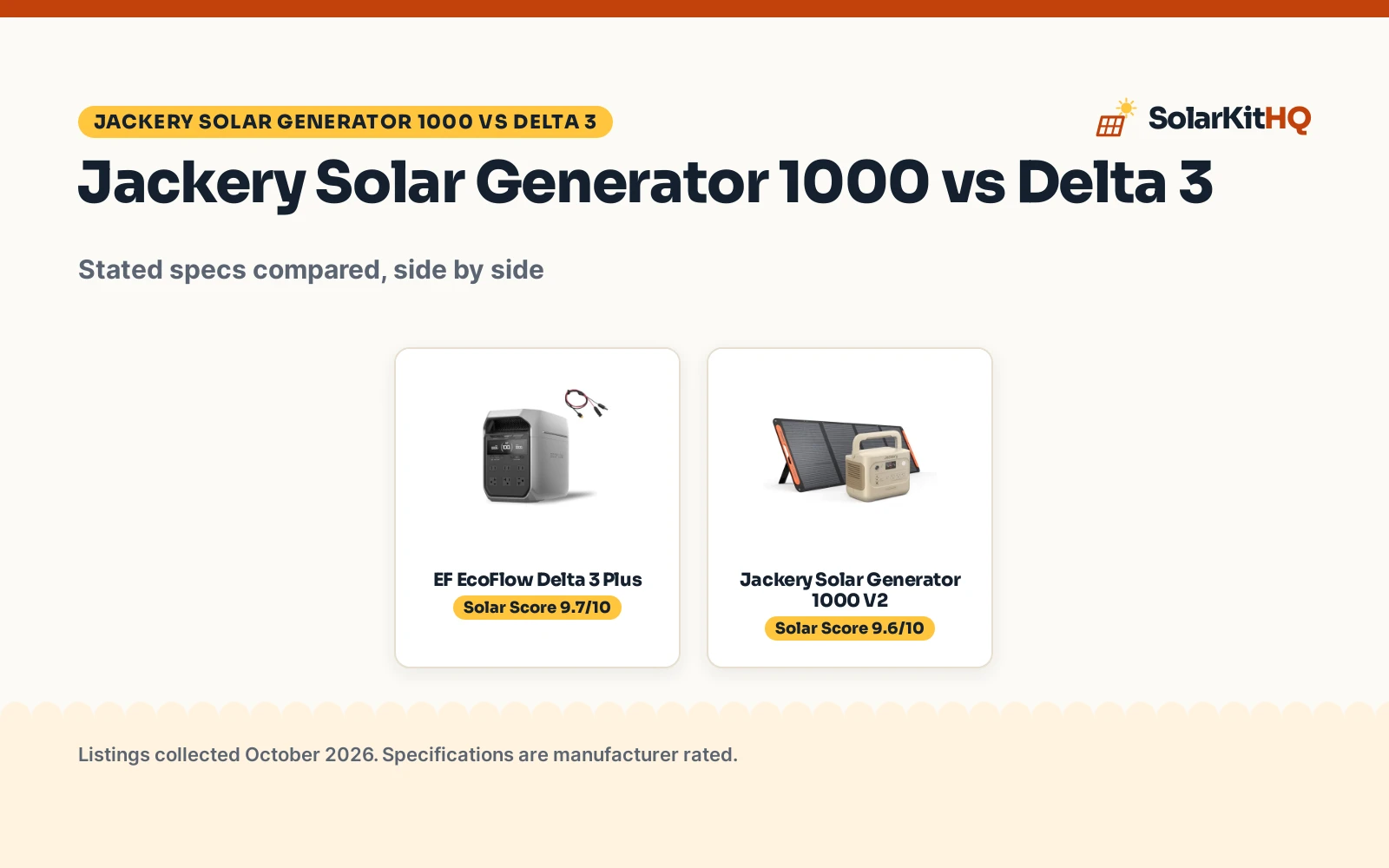
Jackery vs Delta 3: side by side
| Solar Generator | Solar Score | Capacity | AC output | Weight | Stated warranty |
|---|---|---|---|---|---|
| EF EcoFlow Delta 3 Plus | 9.7/10 | 1024Wh | 1800W | 27.0 pounds | 5-Year |
| Jackery Solar Generator 1000 V2 | 9.6/10 | 1070Wh | 1500W | 23.8 pounds | 5 Years of Coverage |
We copied each rating from the seller’s listing as the brand states it; data date 1 November 2026.
Capacity and AC output
The Jackery example states a 1070Wh capacity, a 1500W AC output and a 3,000W surge peak, with a LiFePO4 battery holding over 70% of its original capacity after 4000 cycles. The Delta 3 Plus example states a 1024Wh capacity, an 1800W AC output and a 140W USB-C output, with a LiFePO4 battery rated at 4000 cycles to 80%. On stated capacity alone, the Jackery example lists the larger figure, while on stated AC output alone, the Delta 3 Plus example lists the higher figure. Neither listing states a surge figure in the same form as the other: the Jackery listing states a 3,000W surge peak, while the Delta listing states X-Boost support for resistive appliances with power demands over 2200W continuously, so those two figures are not treated as the same spec here.
Weight and size
The Jackery example states 23.8 pounds and a case of 13.1 by 9.2 by 11.1 inches, with a foldable handle stated for moving it. The Delta 3 Plus example states 27.0 pounds and a case of 16.0 by 8.0 by 11.0 inches. On stated weight, the Jackery example is the lighter of the two, and on stated case length, the Delta 3 Plus example is the longer of the two. A buyer who carries the station often will feel that weight gap in the hand, while a buyer who parks it in one place will care less about it.
Charging and ports
Charging is where the two listings differ in method. The Jackery example states a full charge in 1 hour with emergency charging enabled in the app, a 1.7 hour default for a full charge, a full charge in 3 hours with a 600W alternator charger, and a charge to 80% in 6 hours using the included 200W solar panel. The Delta 3 Plus example states a charge to 80% in 40 minutes from a 1500W AC input, a solar charge to 80% in 1 hour and to 100% in 70 minutes, an 800W alternator charge to 80% in 1 hour and to 100% in 1.3 hours, and a full charge in 56 minutes with the smart generator. For ports, the Jackery example states two USB-C ports, one USB-A port, one DC car port and three pure sine wave AC ports, with PD 100W USB-C charging and LED lights, plus app modes that include a 30 dB quiet overnight charging mode. The Delta 3 Plus example states power for 13 appliances at once, a 10 ms switch-over UPS function, and an app with 12-hour storm and outage alerts, low battery and storage reminders, and a usage dashboard.
Expansion and protection
Only the Delta 3 Plus example states expansion. It states expansion to 5kWh with DELTA 3, DELTA Pro 3 or DELTA 2 Max battery packs, and it states an IP65 battery pack. The Jackery listing states no expansion figure and no IP code, so a buyer who wants to add capacity later has a stated path only on the Delta side. The Delta listing also states a 10 ms switch-over UPS function for NAS, servers, POS systems and critical backups, while the Jackery listing states no UPS switch-over figure. The Jackery listing does state a LiFePO4 battery with a lifespan exceeding 10 years, and the Delta listing states a 10-year lifespan for daily use, so both listings state a long stated lifespan for the battery chemistry, without stating the same cycle endpoint: the Jackery figure is over 70% after 4000 cycles, and the Delta figure is 4000 cycles to 80%.
What the listings leave unclear
The Jackery listing needs care on two points. The title states Dune White, while the spec table lists Black, Orange, and the bullets state 5 Years of Coverage, while the spec table lists a 2 year manufacturer warranty. This article follows the title and bullets on both points, as the site rules direct. The Jackery title also states a 1 hour fast charge, while the bullets make clear that the 1 hour figure needs emergency charging enabled in the app, against a 1.7 hour default. On the Delta side, the title states a full charge in 56 minutes, while the bullets make clear that the 56 minute figure is stated for the smart generator, with AC input stated to 80% in 40 minutes and solar charging stated to 100% in 70 minutes. The Delta listing also states 25% more durability than industry standards, without naming the baseline figure, so that claim is reported here as the maker states it, not as a measured comparison.
The kits we chose

EF EcoFlow Delta 3 Plus
A portable power station with a 1024Wh capacity, an 1800W AC output, an IP65 battery pack and stated expansion to 5kWh.
Pros
- 1800W AC output with a 140W USB-C output stated
- IP65 battery pack stated
- Full charge in 56 minutes with the smart generator stated, and 80% in 40 minutes from a 1500W AC input stated
- Expansion to 5kWh stated with DELTA 3, DELTA Pro 3 or DELTA 2 Max battery packs
Cons
- 27.0 pounds stated, against 23.8 pounds for the Jackery example
- A solar panel is not listed among what the listing includes; a solar charge cable is stated as included
- The 56 minute full charge figure is stated for the smart generator, not for AC input alone
- X-Boost support over 2200W is stated for resistive appliances continuously
Detailed Review
The listing states an EF EcoFlow Delta 3 Plus portable power station with a 1024Wh capacity, an 1800W AC output and a 140W USB-C output, a LiFePO4 battery with 4000 cycles to 80%, and a 10-year lifespan for daily use. The listing states an IP65 battery pack, expansion to 5kWh with DELTA 3, DELTA Pro 3 or DELTA 2 Max battery packs, a 10 ms switch-over UPS function, and power for 13 appliances at once. Charging figures differ by source: a 1500W AC input reaches 80% in 40 minutes, solar charging reaches 80% in 1 hour and 100% in 70 minutes, an 800W alternator charger reaches 80% in 1 hour and to 100% in 1.3 hours, and the smart generator reaches a full charge in 56 minutes.
Who it's for: home backup, camping and RV users who want higher stated AC output, a stated UPS switch-over figure and room to expand. Who should skip it: anyone who wants a panel included in the box or the lighter stated weight of the Jackery example.
Its Solar Score of 9.7/10 comes from performance 32/35, build 21/25, value 21/25, safety 8/10 and warranty 3/5: 85 of 100 points, placed on our 9.2 to 9.8 scale.
Key Specifications
| Capacity | 1024Wh |
|---|---|
| AC output | 1800W, 140W USB-C |
| Weight | 27.0 pounds |
| Expansion | Up to 5kWh |
Figures as published on the retailer listing, collected 1 November 2026. Performance figures are manufacturer rated.
Safety and Warranty
What this listing states. IP65 battery pack stated, so safety scores 8 of 10. 5-Year warranty stated. It does not say everything a buyer needs, such as who pays return shipping, so warranty scores 3 of 5. See How We Pick.
Power station limits. Stay within the stated continuous output and solar input limits, keep the unit ventilated and dry, charge within the stated temperature range, and never connect it to home wiring except through equipment a licensed electrician installs.
This is general buying information, not professional advice. Follow each product manual and local rules, and see our Safety Disclaimer.

Jackery Solar Generator 1000 V2
A solar generator bundle with a 1070Wh station, a 200W solar panel, a 1500W AC output and a stated weight of 23.8 pounds.
Pros
- 1070Wh capacity with a 1500W AC output and a 3,000W surge peak stated
- 200W solar panel included, with a charge to 80% in 6 hours from that panel stated
- 23.8 pounds with a foldable handle stated
- Two USB-C ports, one USB-A port, one DC car port and three pure sine wave AC ports stated
Cons
- No IP code is stated in the Jackery listing
- A full charge in 1 hour needs emergency charging enabled in the app, against a 1.7 hour default
Detailed Review
The listing states a Jackery Solar Generator 1000 v2 bundle with a 1070Wh Explorer 1000 v2 station and a 200W solar panel, a 1500W AC output with a 3,000W surge peak, a LiFePO4 battery holding over 70% of its original capacity after 4000 cycles, and a stated lifespan exceeding 10 years. The title states Dune White while the spec table lists Black, Orange, and the bullets state 5 Years of Coverage while the spec table lists a 2 year manufacturer warranty, so the title and bullets are used here. The listing states two USB-C ports, one USB-A port, one DC car port and three pure sine wave AC ports, with PD 100W USB-C charging, and a full charge in 1 hour only with emergency charging enabled in the app, against a 1.7 hour default.
Who it's for: campers, RV owners and households that want a lighter bundle with a panel included and a larger stated capacity. Who should skip it: anyone who wants a stated IP code, a UPS switch-over figure or expansion to a larger capacity, none of which the Jackery listing states.
Its Solar Score of 9.6/10 comes from performance 29/35, build 21/25, value 22/25, safety 0/10 and warranty 3/5: 75 of 100 points, placed on our 9.2 to 9.8 scale.
Key Specifications
| Capacity | 1070Wh |
|---|---|
| AC output | 1500W, 3,000W surge peak |
| Weight | 23.8 pounds |
| Solar panel | 200W, included |
Figures as published on the retailer listing, collected 1 November 2026. Performance figures are manufacturer rated.
Safety and Warranty
What this listing states. No UL, FCC or battery management statement is stated, so safety scores zero. 5 Years of Coverage stated. It does not say everything a buyer needs, such as who pays return shipping, so warranty scores 3 of 5. See How We Pick.
Power station limits. Stay within the stated continuous output and solar input limits, keep the unit ventilated and dry, charge within the stated temperature range, and never connect it to home wiring except through equipment a licensed electrician installs.
This is general buying information, not professional advice. Follow each product manual and local rules, and see our Safety Disclaimer.
As an Amazon Associate I earn from qualifying purchases.
Where the points went
The Solar Score weighs performance, build, value, safety and warranty. For portable power stations, safety means a stated IP code, a stated UPS switch-over figure or another protection the listing names; the Delta 3 Plus example states an IP65 battery pack and a 10 ms switch-over UPS function, while the Jackery listing states no IP code. Each listing states a warranty term. How we pick explains the weights.
| Product | Solar Score | Perf. /35 | Build /25 | Value /25 | Safety /10 | Warranty /5 |
|---|---|---|---|---|---|---|
| EF EcoFlow Delta 3 Plus | 9.7 | 32 | 21 | 21 | 8 | 3 |
| Jackery Solar Generator 1000 V2 | 9.6 | 29 | 21 | 22 | 0 | 3 |
We place weighted points on a scale whose ends are 9.2 and 9.8. Because the mapping is straight, a unit with more points never shows less.
How to choose the best jackery solar generator 1000 vs delta 3
Choose the Delta 3 Plus example for higher stated AC output, a stated IP65 battery pack, a stated UPS switch-over figure and stated expansion to 5kWh. Choose the Jackery example for a lighter stated weight, a larger stated capacity and a 200W panel included in the bundle. If the panel matters more than expansion, the Jackery bundle fits; if expansion and UPS protection matter more, the Delta 3 Plus example fits.
| If you need | Look at |
|---|---|
| Larger stated capacity | Jackery Solar Generator 1000 V2, 1070Wh |
| Higher stated AC output | EF EcoFlow Delta 3 Plus, 1800W |
| Lighter stated weight | Jackery Solar Generator 1000 V2, 23.8 pounds |
| Stated IP code | EF EcoFlow Delta 3 Plus, IP65 |
| Room to expand | EF EcoFlow Delta 3 Plus, up to 5kWh |
Sizing Notes
- Match watt-hours to the loads you plan: the Jackery example states 1070Wh and the Delta 3 Plus example states 1024Wh.
- Match AC output to the load: the Jackery example states 1500W and the Delta 3 Plus example states 1800W.
- Check case size and weight against the space you have: the Jackery example states 13.1 by 9.2 by 11.1 inches at 23.8 pounds, and the Delta 3 Plus example states 16.0 by 8.0 by 11.0 inches at 27.0 pounds.
- Check expansion before you buy: the Delta 3 Plus example states expansion to 5kWh, while the Jackery listing states no expansion figure.
- Use the cable and fuse figures the manual gives for each station.
FAQ: power away from the grid
Which example has the larger stated capacity?
The Jackery example, at 1070Wh, against the Delta 3 Plus example at 1024Wh.
Which example has the higher stated AC output?
The Delta 3 Plus example, at 1800W, against the Jackery example at 1500W.
Which example states an IP code?
The Delta 3 Plus example states an IP65 battery pack. The Jackery listing states no IP code.
What full-charge figures do the listings state?
The Delta 3 Plus example states a full charge in 56 minutes with the smart generator. The Jackery example states a full charge in 1 hour with emergency charging enabled in the app.
Related solar guides
See every Solar Generators guide and all Power Stations and Generators guides. Also see the Portable Power Station vs Gas Generator for Tailgating guide, the Solar Generator vs Gas Generator Home Backup guide, the Inverter vs Generator for Cabin guide and the Solar Generator vs Ups guide.