On this page
The short answer on lifepo4 vs agm battery for solar: a LiFePO4 battery states 4000+ deep cycles and a built-in BMS with low-temperature protection at a fraction of the weight, while an AGM battery is UL certified and asks less of your charger settings. We compared two lithium and two AGM listings on what each publishes: weight, protections, temperature limits and warranty terms. The lithium pair wins on weight and warranty; the AGM pair suits existing lead-acid charging setups.
SolarKitHQ earns a commission when you buy through links on this page, at no extra cost to you. As an Amazon Associate I earn from qualifying purchases. Affiliate disclosure.
LiFePO4 vs AGM battery for solar: side by side
| Battery | Side | Capacity | Weight | Warranty | Amazon |
|---|---|---|---|---|---|
| Dyness 12V 100Ah Bluetooth | LiFePO4 | 100Ah | 25.3 pounds | 5 Year Manufacturer | View on Amazon |
| HQST 12V 100Ah Mini | LiFePO4 | 100Ah | 22 pounds | 4-Year material warranty | View on Amazon |
| Mighty Max 12V 200Ah 2-Pack | AGM | 200Ah | 240 pounds | 1 Year Manufacturers Warranty | View on Amazon |
| Mighty Max 12V 100Ah | AGM | 100Ah | 28 pounds | 1 Year Manufacturers Warranty | View on Amazon |
Specifications are manufacturer rated as listed, collected 21 October 2026.
Weight and size
This is the clearest gap. The Dyness lithium battery is listed at 25.3 pounds and the HQST at 22 pounds in its spec table, both for a 12V 100Ah rating. The Mighty Max 100Ah AGM lists a Battery Weight of 28 pounds, and the 200Ah AGM 2-pack lists 240 pounds. Case sizes follow: the HQST is 13.07 by 6.77 by 8.66 inches, the Dyness 6.77 by 12.99 by 8.43 inches, and the Mighty Max 100Ah 12.09 by 6.65 by 8.48 inches.
Protection and monitoring
The lithium pair states electronic protection. The Dyness has a 100A BMS with full protection against overcharging, over-discharging, over-current, overheating and short circuits, plus Bluetooth 5.0 monitoring of voltage, current and capacity through an app within 10 meters. The HQST has a built-in BMS managing cell balance against over-current, over-charge, over-discharge and short circuits, plus an LED meter. The AGM pair states no electronics: both Mighty Max listings are UL certified, spill proof, maintenance free and can be mounted in any position.
Cold weather
Only the lithium listings state temperature cutoffs. The HQST suspends charging below 23°F or above 140°F, and stops discharging below 5°F or above 158°F. The Dyness disconnects charging below 32°F, resumes at 41°F, and cuts power at -4°F. Both Mighty Max listings claim wide operating temperatures and long life in high and low temperatures, but state no figures, so we cannot compare the AGM side on cold charging from these listings.
What the listings leave unclear
Several figures conflict within their own listings. The HQST title states 25.11 lb, the bullets state 21 lbs, and the spec table states 22 pounds; we used the spec table figure. The HQST bullets promise a 10-year commitment to product quality and service life, while the spec table states a 4-Year material warranty; we scored the 4-year figure. The Mighty Max 100Ah spec table lists a Battery Weight of 28 pounds and an Item Weight of 61 pounds; we used 28 pounds. The Mighty Max 200Ah spec table lists an Amperage of 200 A, which reads as the capacity figure restated. In each case we trusted the spec table over the title and bullets.
Four examples
| # | Product | Solar Score | Buy |
|---|---|---|---|
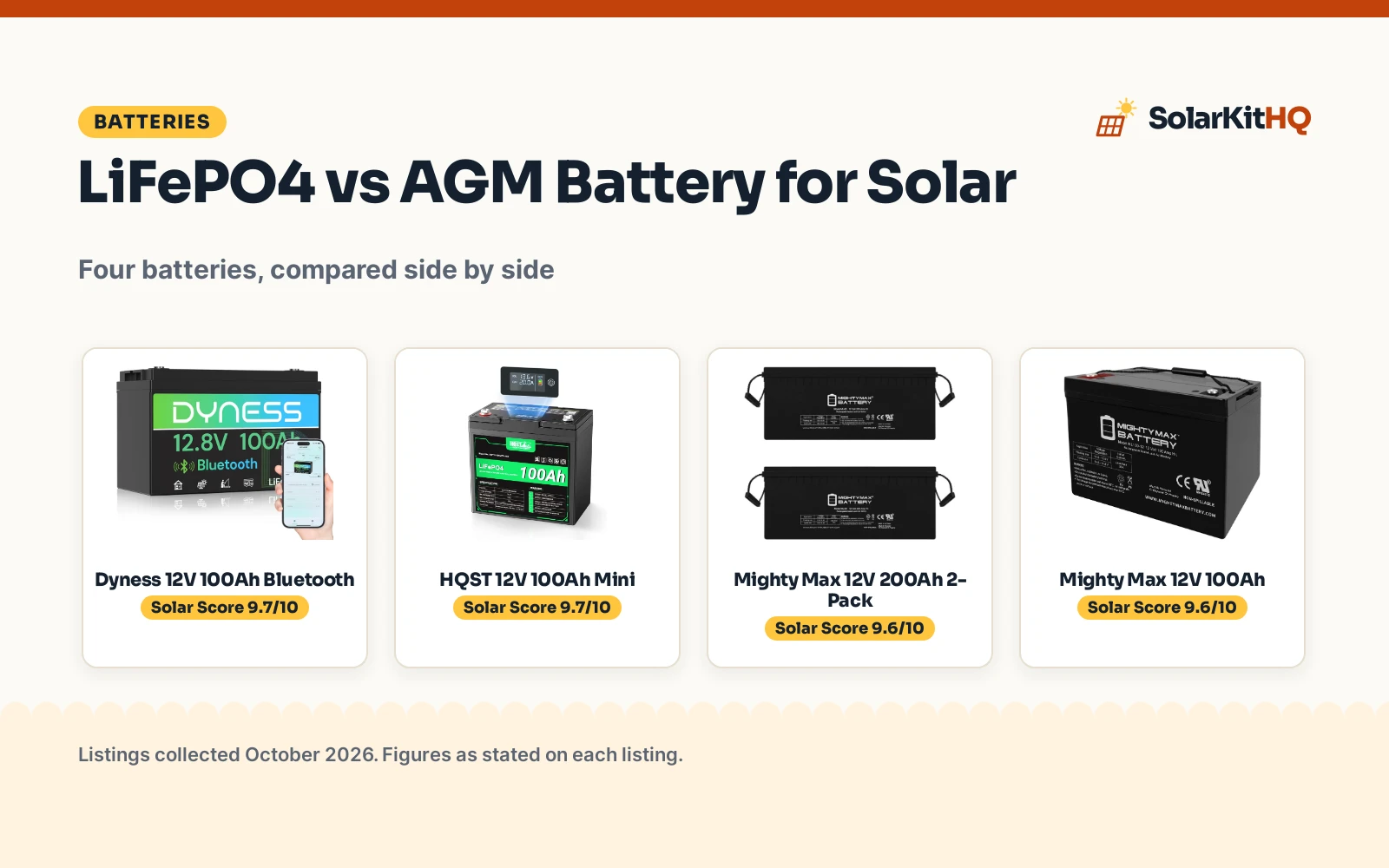
| 1 |  Dyness 12V 100Ah Bluetooth | 9.7/10 | Buy on Amazon |
| 2 |  HQST 12V 100Ah Mini | 9.7/10 | Buy on Amazon |
| 3 |  Mighty Max 12V 200Ah 2-Pack | 9.6/10 | Buy on Amazon |
| 4 |  Mighty Max 12V 100Ah | 9.6/10 | Buy on Amazon |

Dyness 12V 100Ah Bluetooth
Fits solar owners who want phone monitoring; skip it if your charger lacks a lithium setting.
Pros
- Bluetooth 5.0 monitoring of voltage, current and capacity via app.
- 100A BMS with low-temperature cutoff, per the listing.
- 4000+ deep cycles with A+ grade cells, per the bullets.
- 5 Year Manufacturer warranty, the longest here.
Cons
- 25.3 pounds, heavier than the HQST at 22 pounds.
- App monitoring works within 10 meters only.
- Recommends a LiFePO4-specific charger for fastest charging.
- Expandable bank needs up to 16 batteries for 20.48kWh.
Detailed Review
The Dyness is the monitoring pick: Bluetooth 5.0 reports voltage, current, capacity and system performance through the Dyness app, within 10 meters. The 100A BMS guards against overcharging, over-discharging, over-current, overheating and short circuits, with a low-temperature cutoff that disconnects charging below 32°F and resumes at 41°F.
With 4000+ deep cycles and a 5-year manufacturer warranty, it leads this list on longevity claims. It can expand to a 51.2V 400Ah system with 16 batteries. The listing recommends a LiFePO4-specific charger and 0.2C recharging for battery health.
Its Solar Score of 9.7/10 comes from performance 32/35, build 20/25, value 19/25, safety 10/10 and warranty 5/5: 86 of 100 points, placed on our 9.2 to 9.8 scale.
Key Specifications
| Capacity | 100Ah |
|---|---|
| Voltage | 12.8V |
| Weight | 25.3 pounds |
| BMS | 100A |
Figures as published on the retailer listing, collected 21 October 2026. Performance figures are manufacturer rated.
Safety and Warranty
What this listing states. 100A BMS with low-temp protection, so safety scores 10 of 10. 5 Year Manufacturer, so warranty scores 5 of 5. See How We Pick.
Battery safety. Charge with a charger and settings that match the stated chemistry, fuse the positive lead as the manual directs, cover terminals, keep within the stated temperature range, and never charge a damaged battery.
This is general buying information, not professional advice. Follow each product manual and local rules, and see our Safety Disclaimer.

HQST 12V 100Ah Mini
Fits weight-sensitive installs; skip it if you need Bluetooth monitoring.
Pros
- 4000+ deep cycles from A-grade cells, per the listing.
- 22 pounds in the spec table, the lightest here.
- BMS with low and high temperature protection.
- Supports series and parallel up to 16 batteries.
Cons
- No Bluetooth monitoring; the Dyness has it.
- Weight conflicts: 25.11 lb title, 21 lb bullets, 22 lb spec.
- Warranty conflicts: 10-year bullets claim vs 4-year spec.
- Not suitable for golf carts, per the listing.
Detailed Review
The HQST is the lightweight pick: 22 pounds in the spec table for 12V 100Ah with 1280Wh, against 28 pounds for the AGM of the same rating. The built-in BMS manages cell balance and guards against over-current, over-charge, over-discharge and short circuits, with charging suspended below 23°F or above 140°F.
It claims 4000+ deep cycles and 6x the life of lead-acid, and expands to 20.48 kWh with 16 batteries. The listing's own figures disagree on weight and warranty, which we flagged above; we scored the spec table's 4-year material warranty.
Its Solar Score of 9.7/10 comes from performance 30/35, build 20/25, value 19/25, safety 10/10 and warranty 5/5: 84 of 100 points, placed on our 9.2 to 9.8 scale.
Key Specifications
| Capacity | 100Ah |
|---|---|
| Voltage | 12V |
| Weight | 22 pounds |
| Cycles | 4000+ |
Figures as published on the retailer listing, collected 21 October 2026. Performance figures are manufacturer rated.
Safety and Warranty
What this listing states. BMS with low and high temp protection, so safety scores 10 of 10. 4-Year material warranty, so warranty scores 5 of 5. See How We Pick.
Battery safety. Charge with a charger and settings that match the stated chemistry, fuse the positive lead as the manual directs, cover terminals, keep within the stated temperature range, and never charge a damaged battery.
This is general buying information, not professional advice. Follow each product manual and local rules, and see our Safety Disclaimer.

Mighty Max 12V 200Ah 2-Pack
Fits large solar banks on lead-acid chargers; skip it if weight matters.
Pros
- 200Ah per battery, the most capacity in one listing.
- UL certified, per the listing.
- Spill proof and maintenance free, mounts in any position.
- High discharge rate with deep discharge recover, per the bullets.
Cons
- 240 pounds for the 2-pack, the heaviest here by far.
- 1-year warranty against 4 to 5 years on the lithium pair.
- No stated cycle count; the lithium pair state 4000+.
- No wire harness or mounting accessories included.
Detailed Review
The Mighty Max 200Ah 2-pack is the capacity pick: two 12V 200Ah sealed lead-acid AGM batteries for large solar banks that already charge on lead-acid settings. It is UL certified, spill proof and maintenance free, and mounts in any position with resistance to shocks and vibration.
The trade is weight: 240 pounds for the pair, against 22 to 25.3 pounds for the lithium 100Ah examples. The 1-year warranty is also the shortest here. For a fixed install with lead-acid charging, the capacity per listing is unmatched.
Its Solar Score of 9.6/10 comes from performance 28/35, build 19/25, value 20/25, safety 9/10 and warranty 4/5: 80 of 100 points, placed on our 9.2 to 9.8 scale.
Key Specifications
| Capacity | 200Ah |
|---|---|
| Voltage | 12V |
| Weight | 240 pounds |
| Certification | UL Certified |
Figures as published on the retailer listing, collected 21 October 2026. Performance figures are manufacturer rated.
Safety and Warranty
What this listing states. UL Certified, so safety scores 9 of 10. 1 Year Manufacturers Warranty. It does not say everything a buyer needs, such as who pays return shipping, so warranty scores 4 of 5. See How We Pick.
Battery safety. Charge with a charger and settings that match the stated chemistry, fuse the positive lead as the manual directs, cover terminals, keep within the stated temperature range, and never charge a damaged battery.
This is general buying information, not professional advice. Follow each product manual and local rules, and see our Safety Disclaimer.

Mighty Max 12V 100Ah
Fits simple 12V solar setups; skip it if you want long cycle life.
Pros
- UL certified, per the listing.
- Spill proof and maintenance free, mounts in any position.
- Group 27 size fits standard battery boxes.
- 1-year warranty stated clearly.
Cons
- 28 pounds, heavier than both lithium 100Ah examples.
- No stated cycle count; the lithium pair state 4000+.
- 1-year warranty against 4 to 5 years on the lithium pair.
- No wire harness or mounting accessories included.
Detailed Review
The Mighty Max 100Ah is the straightforward AGM: a 12V 100Ah sealed lead-acid battery for off-grid solar panels, UL certified and maintenance free. It mounts in any position and resists shocks and vibration, with high performance claimed in high and low temperatures.
Against the lithium pair it loses on weight and warranty: 28 pounds against 22 to 25.3, and 1 year against 4 to 5. Its case is simplicity: no BMS settings, no lithium charger needed, just a standard 12V solar setup.
Its Solar Score of 9.6/10 comes from performance 27/35, build 19/25, value 19/25, safety 9/10 and warranty 4/5: 78 of 100 points, placed on our 9.2 to 9.8 scale.
Key Specifications
| Capacity | 100Ah |
|---|---|
| Voltage | 12V |
| Weight | 28 pounds |
| Certification | UL Certified |
Figures as published on the retailer listing, collected 21 October 2026. Performance figures are manufacturer rated.
Safety and Warranty
What this listing states. UL Certified, so safety scores 9 of 10. 1 Year Manufacturers Warranty. It does not say everything a buyer needs, such as who pays return shipping, so warranty scores 4 of 5. See How We Pick.
Battery safety. Charge with a charger and settings that match the stated chemistry, fuse the positive lead as the manual directs, cover terminals, keep within the stated temperature range, and never charge a damaged battery.
This is general buying information, not professional advice. Follow each product manual and local rules, and see our Safety Disclaimer.
As an Amazon Associate I earn from qualifying purchases.
How we scored them
| Product | Solar Score | Perf. /35 | Build /25 | Value /25 | Safety /10 | Warranty /5 |
|---|---|---|---|---|---|---|
| Dyness 12V 100Ah Bluetooth | 9.7 | 32 | 20 | 19 | 10 | 5 |
| HQST 12V 100Ah Mini | 9.7 | 30 | 20 | 19 | 10 | 5 |
| Mighty Max 12V 200Ah 2-Pack | 9.6 | 28 | 19 | 20 | 9 | 4 |
| Mighty Max 12V 100Ah | 9.6 | 27 | 19 | 19 | 9 | 4 |
Scores run from 9.2 to 9.8: each product’s point total is placed on that range, so more points always means a higher score.
The Solar Score weighs performance, build, value, safety and warranty. For batteries, safety means the stated protections: the BMS and low-temperature cutoffs on the lithium pair, the UL certification on the AGM pair. The Dyness leads on monitoring with Bluetooth and the longest stated warranty at 5 years; the HQST matches it on cycles with a 4-year material warranty. Both AGM examples state a 1-year warranty. How we pick explains the weights.
LiFePO4 vs AGM battery for solar: which should you choose?
Choose LiFePO4 if weight matters, if you want the longest stated warranty, and if your charger and solar controller have a lithium setting. The Dyness suits owners who want Bluetooth monitoring; the HQST suits weight-sensitive installs at 22 pounds. Choose AGM if your charging equipment is set for lead acid and you want to keep it, or if you need the most amp-hours in one listing: the Mighty Max 2-pack is 200Ah per battery.
| If you need | Look at |
|---|---|
| Lowest weight | HQST 12V 100Ah, 22 lb |
| Phone monitoring | Dyness 12V 100Ah Bluetooth |
| Most amp-hours per listing | Mighty Max 12V 200Ah 2-pack |
| Longest stated warranty | Dyness, 5 years |
Sizing Notes
- Match the battery’s stated voltage and chemistry to the solar controller and charger before buying.
- Keep your total draw under the 100A BMS limit on the lithium examples.
- The 200Ah AGM 2-pack weighs 240 pounds; plan the install location before it arrives.
- Size the bank in amp-hours first: the 200Ah AGM 2-pack holds twice the rated capacity of the 100Ah examples.
Frequently Asked Questions
Is LiFePO4 lighter than AGM for the same rating?
Yes, in these listings. The HQST is listed at 22 pounds and the Dyness at 25.3 pounds for 12V 100Ah, against 28 pounds for the Mighty Max 100Ah AGM.
Can you charge a LiFePO4 battery below freezing?
Not according to these listings. The HQST suspends charging below 23°F and the Dyness disconnects charging below 32°F. Neither AGM listing states a low-temperature charging limit.
Do the AGM batteries need maintenance?
No. Both Mighty Max listings state maintenance free, spill proof SLA/AGM construction that can be mounted in any position.
Which battery has the longest warranty?
The Dyness at 5 years. The HQST spec table states a 4-year material warranty, and both Mighty Max listings state 1 year.
Related guides
See every Deep Cycle and RV Batteries guide and all Batteries and Charging guides. Also see our best lithium battery for solar. Also see our lithium vs lead acid battery for solar. Also see our best 12v battery for solar panel.