On this page
During an outage at dinner time, with the fridge running from a battery bank on the porch, the choice of a modified sine vs pure sine inverter for refrigerator use decides whether the compressor starts cleanly or strains against the wrong waveform. For a refrigerator, a pure sine wave inverter is the safer pick, because a compressor fridge and its electronic controls are built for the smooth sine wave that comes from a household outlet. This guide compares pure sine wave inverters and modified sine wave inverters for a refrigerator, using only the figures their makers state. Both sides are covered below, with a clear which-to-choose answer.
SolarKitHQ earns a commission when you buy through links on this page, at no extra cost to you. As an Amazon Associate I earn from qualifying purchases. Affiliate disclosure.
Modified sine vs pure sine inverter for refrigerator: the quick answer
Choose a pure sine wave inverter for a refrigerator. The pure sine wave picks here are rated at 2000W continuous with 4000W peak and 4000W continuous with 8000W surge, and their makers list refrigerators, motor startups and AC compressor inrush among the loads they handle. The modified sine wave picks are rated at 3000W continuous with 6000W surge and 500W continuous with 1000W peak, and only the 3000W unit lists refrigerators as a load, while the 500W unit says to check waveform compatibility before use. Match continuous watts to running watts and surge watts to startup draw.
What a modified sine wave does to a fridge
A modified sine wave inverter makes a stepped waveform that approximates a sine wave, and the maker wording decides whether a fridge fits it. Go Power lists refrigerators, microwaves and air conditioners among the loads its 3000W continuous, 6000W surge modified sine wave unit runs. POTEK takes a narrower line: its 500W continuous, 1000W peak unit is listed for lights, chargers, small appliances and tools, and the maker says to check waveform compatibility before use, noting it is not recommended for devices requiring pure sine wave power. Where the maker lists refrigerators, the unit is aimed at them; where the maker warns about compatibility, the fridge belongs on pure sine.
What a pure sine wave does for a fridge
A pure sine wave inverter makes the smooth waveform of household AC, which is what a compressor fridge and its controls are built to run on. EFFORTWAY rates its unit at 4000W continuous with 8000W surge and lists refrigerators, coffee makers and microwaves among the high-inductive loads it handles, with 3 AC outlets and a 16.5ft wired remote. Renogy rates its inverter charger at 2000W continuous, with 4000W peak for 100ms, 3000W for 3s and 2400W for 30s, and lists motor startups and AC compressor inrush, with a built-in 80A battery charger and a transfer switch under 20ms.
The 4 inverters for a refrigerator, ranked
The 4 inverters below are ranked by performance, build, value, safety and warranty, using only the figures their makers state. The pure sine wave units rank at the top for a refrigerator.
| Inverter | Waveform | Continuous watts | Surge watts | AC outlets | Warranty |
|---|---|---|---|---|---|
| Renogy 2000W Pure Sine Wave Inverter Charger | Pure sine | 2000 | 4000 | Not stated | 2 Year Manufacturer |
| EFFORTWAY 4000W Pure Sine Wave Inverter | Pure sine | 4000 | 8000 | 3 | 1 Year |
| Go Power 3000 Watt Heavy-Duty Modified Sine Wave Power Inverter | Modified sine | 3000 | 6000 | 4 | Not stated |
| POTEK 500W Modified Sine Wave Power Inverter | Modified sine | 500 | 1000 | 2 | 18 months |
1. Renogy 2000W Pure Sine Wave Inverter Charger
The Renogy unit is a 3-in-1 pure sine wave inverter, battery charger and UPS backup, rated at 2000W continuous with 4000W peak, which the maker lists as handling motor startups and AC compressor inrush. It has a built-in 80A battery charger, a transfer switch under 20ms, Bluetooth monitoring with an LCD remote, and a 2 year manufacturer warranty. It states UL458 and CSA C22.2 No. 107.1, with FCC certification. A licensed electrician should install it.
2. EFFORTWAY 4000W Pure Sine Wave Inverter
The EFFORTWAY unit is a pure sine wave inverter rated at 4000W continuous with 8000W surge, and the maker lists refrigerators, coffee makers and microwaves among the high-inductive loads it handles. It converts 12V DC to 110V or 120V AC, with 3 AC outlets, 2 20W USB-C ports and 2 20W USB-A ports, and a 16.5ft wired remote. Efficiency is listed at up to 90 percent, and it carries a 1 year warranty.
3. Go Power 3000 Watt Heavy-Duty Modified Sine Wave Power Inverter
The Go Power unit is a modified sine wave inverter rated at 3000W continuous with 6000W surge, and the maker lists refrigerators, microwaves and air conditioners among the loads it runs. It converts 12V to 120V AC, has 4 AC outlets, and works with the optional Go Power transfer switch. Its energy efficiency class is listed at 80 percent or higher. No warranty term is stated. A licensed electrician should install it.
4. POTEK 500W Modified Sine Wave Power Inverter
The POTEK unit is a modified sine wave inverter rated at 500W continuous with 1000W peak, with 2 AC outlets and a 5V/2A USB-A port. It connects with battery clamps, and the maker lists overload, overvoltage, undervoltage, over-temperature and short-circuit protection. It carries an 18 month warranty. The maker lists lights, chargers, small appliances and tools as its uses, and says to check waveform compatibility before use.
How to choose a modified sine vs pure sine inverter for refrigerator
Match continuous watts and surge to the fridge
Continuous watts set what the fridge draws while it runs, and surge watts set whether the compressor starts. The picks run from 500W continuous with 1000W peak to 4000W continuous with 8000W surge, so the fridge label decides the fit. A watt meter between the fridge and the outlet measures real use over a day, which gives the running watts to match.
Weigh the waveform against the fridge controls
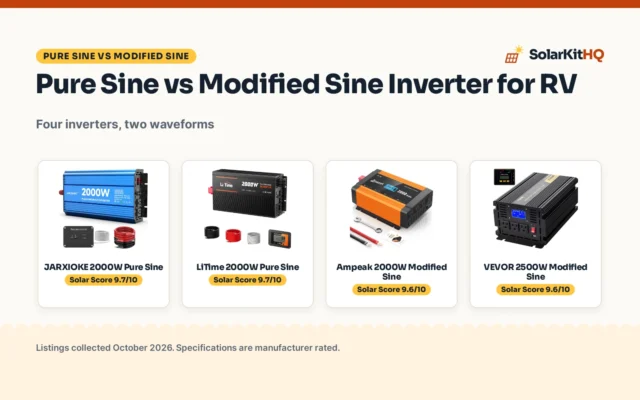
A fridge with a compressor and electronic controls is built for the smooth sine wave of household AC, so the pure sine wave picks rank at the top here. A modified sine wave unit is worth a look only where its maker lists refrigerators as a load, as Go Power does for its 3000W unit, and not where the maker warns to check compatibility, as POTEK does. See the pure sine vs modified sine inverter for RV comparison for the same choice in a camper.
Count the outlets and check the extras
Outlets set how many loads run at once: the Go Power unit has 4 AC outlets, the EFFORTWAY unit has 3, and the POTEK unit has 2, while the Renogy unit does not state an outlet count. The EFFORTWAY unit adds 2 20W USB-C ports and 2 20W USB-A ports, the POTEK unit adds a 5V/2A USB-A port, and the Renogy unit adds a built-in 80A battery charger with a transfer switch under 20ms. See the best inverters for a refrigerator for more units.
FAQ: power away from the grid
Can a modified sine wave inverter run a refrigerator?
It depends on the maker. Go Power lists refrigerators among the loads for its 3000W continuous, 6000W surge modified sine wave unit, while POTEK says to check waveform compatibility before use. For a fridge with a compressor, a pure sine wave inverter is the safer pick.
What size pure sine wave inverter does a refrigerator need?
Match the continuous rating to the fridge running watts and the surge rating to its startup draw. The pure sine wave picks here are rated at 2000W continuous with 4000W peak and 4000W continuous with 8000W surge, so check the fridge label.
Can a 500W inverter run a refrigerator?
The POTEK unit is rated at 500W continuous with 1000W peak, and its maker lists lights, chargers, small appliances and tools as its uses, not refrigerators, and says to check waveform compatibility before use. A refrigerator belongs on a unit whose maker lists it, such as the 3000W Go Power or a pure sine wave pick.
Will a modified sine wave inverter damage a refrigerator?
The listings do not settle that for every fridge. POTEK says to check waveform compatibility and warns about devices that need pure sine wave power, while Go Power lists refrigerators as a load for its modified sine wave unit. A pure sine wave inverter matches household AC, so it avoids the question entirely.
Related solar guides
See the best inverters for a refrigerator, the pure sine vs modified sine inverter for RV, the pure sine vs modified sine for camper, the best deep cycle batteries for a refrigerator and the best watt meters.
More picks: best 2000 watt pure sine inverter for camping, dual zone vs single zone 12V refrigerator, compressor vs thermoelectric 12V fridge.