On this page
At dinner time in an outage, a portable generator that will not start is the whole problem, and power generator repair starts with finding which part of the machine stopped doing its job. Most no-start and rough-running faults trace to stale fuel, a dirty carburetor, a fouled spark plug or a damaged cord end, and each fault has a simple check before parts come off. Fuel generators run outdoors only, far from doors and windows, because of carbon monoxide. The steps below work through those checks in order.
SolarKitHQ earns a commission when you buy through links on this page, at no extra cost to you. As an Amazon Associate I earn from qualifying purchases. Affiliate disclosure.
Power generator repair: the quick answer
Start with fuel, spark and air. Drain stale fuel from the tank and the carburetor bowl, and refill with fresh fuel. Check the spark plug for fouling and fit a fresh plug if the old plug is black or wet. Clean the air filter and the carburetor jets, and look over the cord ends for cracks, loose prongs or heat marks. Match any replacement part to the model the maker names: a carburetor kit for Champion 3500 and 4000 watt generators fits a long list of Champion models, while kits for Honda GX240, GX270, GX340 and GX390 engines cover a different set. If the engine still will not start after those checks, the fault sits deeper than routine service, and a licensed technician should take over.
Step 1: Check the fuel
Stale fuel is a common cause of a generator that will not start after storage. Drain the tank and the carburetor bowl, and refill with fresh fuel. A fuel tank shut off valve lets you stop fuel flow while you work: a carburetor kit for Champion generators includes a shut off valve for an M10X1.25 tank port with a 1/4 fuel line. Work in a well-ventilated area and wear work gloves while you handle fuel and carburetor parts. See the how to remove gas from a generator guide for the draining steps, and the fuel stabilizer guide before the generator goes back into storage.
Step 2: Clean or rebuild the carburetor
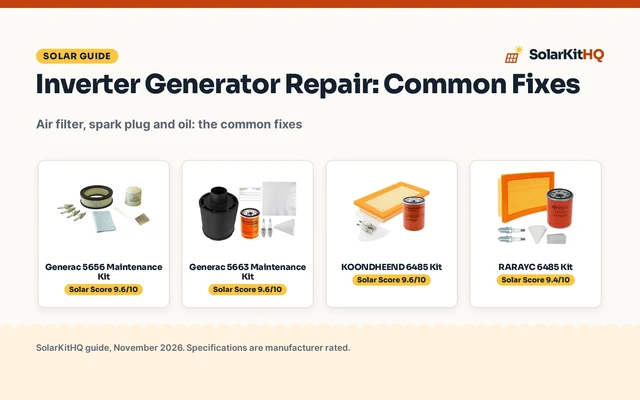
A carburetor that sat with stale fuel in it clogs at the jets, and the engine runs rough, surges or will not start. Take the carburetor off the engine, open the bowl and clean the jets and passages, and replace the gasket when you rebuild the float. A rebuild kit for Honda GX240, GX270, GX340 and GX390 engines includes a needle, bowl, float, gasket, seal, pin, bolt and washer, while a kit for Honda GX200, GX160 and GX120 engines covers 5.5HP and 6.5HP engines. A carburetor kit for Champion 3500 and 4000 watt generators includes 3 gaskets, 1 fuel line, 1 spark plug and 1 fuel filter. Keep the parts in order as they come off, so the rebuild goes back together the same way. Match the kit to the engine model before you order.
Step 3: Check the spark plug
A fouled spark plug gives a weak spark or no spark, and the engine cranks without catching. Pull the plug, look at the electrode and the insulator, and fit a fresh plug if the old plug is black, wet or cracked. A carburetor kit for Champion 3500 and 4000 watt generators includes 1 spark plug, so a plug often arrives with the kit. Check the plug cap and the wire for cracks and a firm fit, and keep the plug gap as the manual gives it.
Step 4: Check the cord ends and connections
A generator that runs but powers nothing often has a fault at the cord end, not in the engine. Look over the plug ends for cracks, loose prongs, heat marks and a cord grip that no longer holds the cord. A 15A 125V UL Listed replacement plug end in NEMA 5-15P and 5-15R fits the household style plug, with a cord grip that adjusts to 18-12 AWG wires and a lighted indicator that shows power flow. Anything that ties into home wiring should go to a licensed electrician. See the types of generator plugs guide to match the plug to the outlet.
When to stop and call a technician
Routine service covers fuel, the carburetor, the spark plug and the cord ends. Stop and call a licensed technician when the engine has low compression, knocks, smokes heavily or leaks fuel after the carburetor work, or when the generator still will not start after the fuel, carburetor, spark and cord checks. Internal engine work sits beyond routine service, and a technician has the tools to open the engine without doing more damage. See the portable generator troubleshooting guide to narrow the fault before you call.
Ways to keep a generator ready
- Run the generator with fresh fuel, and drain the tank and carburetor bowl before long storage.
- Keep a spare spark plug and a gasket set matched to the engine model on the shelf.
- Check the cord ends for cracks and a firm cord grip before each use.
- Keep the manual with the generator, so the model and the part numbers stay at hand.
FAQ: power away from the grid
Why does a generator start and then stop?
Stale fuel and a clogged carburetor jet cause a generator to start and then stop. Drain the tank and the carburetor bowl, refill with fresh fuel, and clean the carburetor jets. If the fault stays, check the spark plug and the fuel shut off valve before you order parts.
How do I match a carburetor kit to my generator?
Match the kit to the engine model the maker names. A kit for Honda GX240, GX270, GX340 and GX390 engines fits those engines, a kit for Honda GX200, GX160 and GX120 engines covers 5.5HP and 6.5HP engines, and a carburetor kit for Champion 3500 and 4000 watt generators fits the Champion models the kit names. Check the model on the engine before you order.
Can a damaged plug end be replaced?
Yes. A 15A 125V UL Listed replacement plug end in NEMA 5-15P and 5-15R fits the household style plug, with a cord grip that adjusts to 18-12 AWG wires. Anything that ties into home wiring should go to a licensed electrician.
When should a generator go to a technician?
When routine service does not fix it. If the engine still will not start after the fuel, carburetor, spark and cord checks, or if it knocks, smokes heavily or leaks fuel, the fault sits deeper than routine service. A licensed technician should take over from there.
Related solar guides
See the how to start a portable generator, the gas generator repair guide, the RV generator parts guide and the portable generator safety tips.