On this page
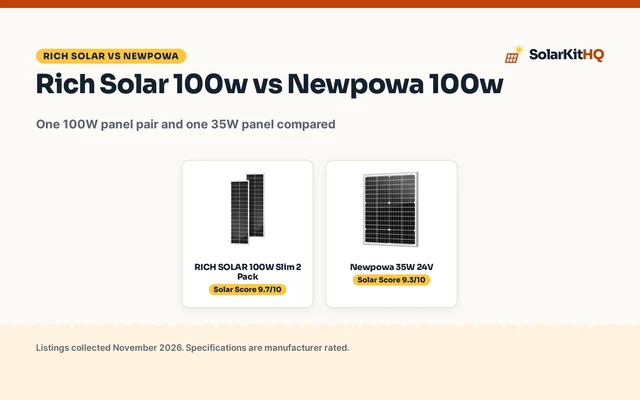
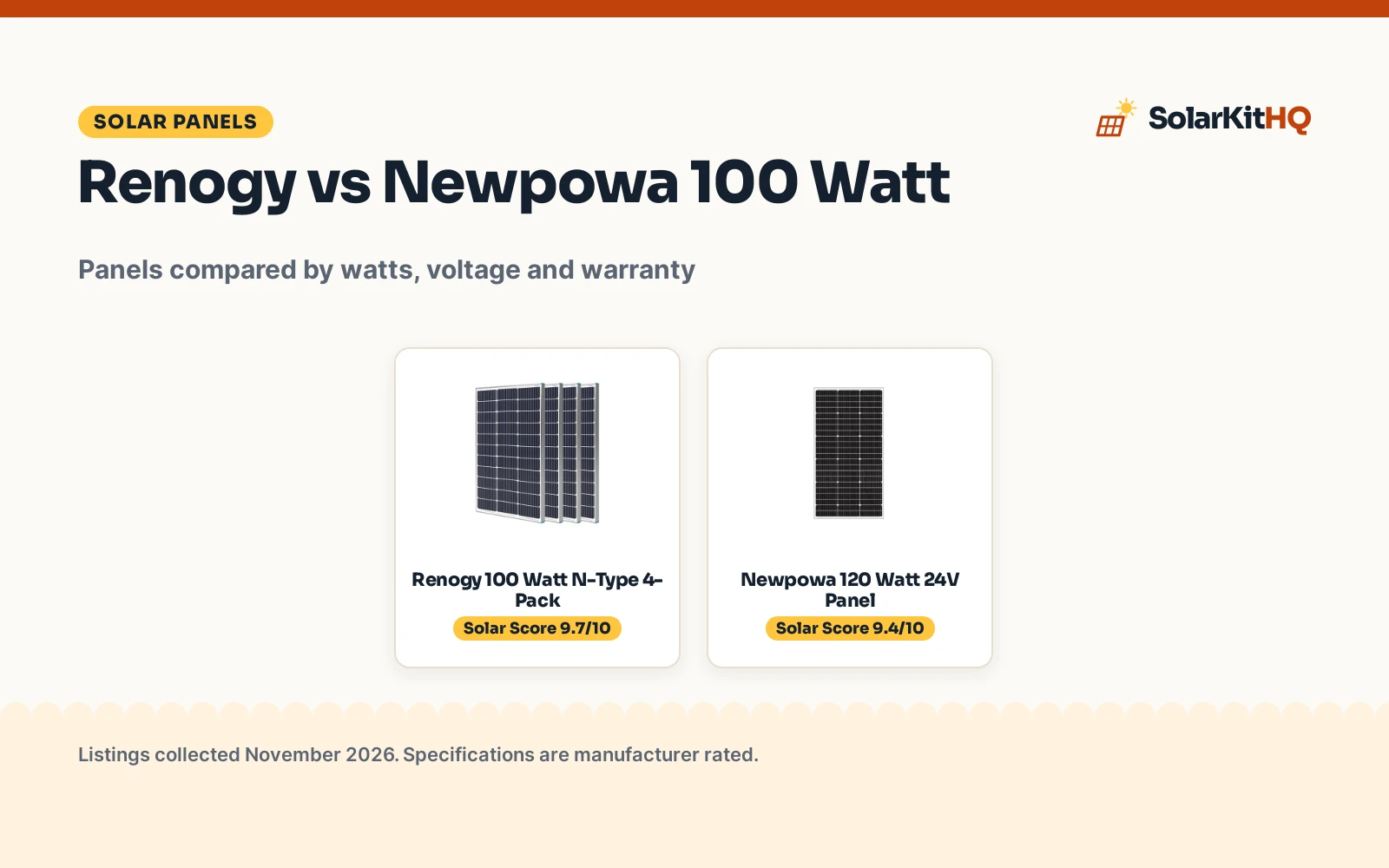
At dusk in a campsite with a dead phone, the renogy 100 watt vs newpowa 100 watt choice comes down to system voltage, not brand loyalty. The short answer: pick the Renogy side for a 12V setup with 4 panels, and pick the Newpowa side for a 24V setup with a single panel. The comparison covers a 4-pack of Renogy 100W panels against a single Newpowa 120W panel on watts, voltage, cells, size, protection and warranty terms, using only what each listing states.
SolarKitHQ earns a commission when you buy through links on this page, at no extra cost to you. As an Amazon Associate I earn from qualifying purchases. Affiliate disclosure.
Renogy vs Newpowa: side by side
| Panel | Solar Score | Watts | Voltage | Cells | Warranty |
|---|---|---|---|---|---|
| Renogy 100 Watt N-Type 4-Pack | 9.7/10 | 100 per panel | 12V | 16BB N-Type | 10 years |
| Newpowa 120 Watt 24V Panel | 9.4/10 | 120 | 24V | 10BB monocrystalline | 2 years |
Figures in this table are the manufacturer’s ratings as listed, captured 3 November 2026.
Watts and system voltage
Voltage is the first split. The Renogy panels state 12V, while the Newpowa panel states 24V, so the two sides fit different system inputs: match the panel voltage to the input the controller or power station lists. Wattage is the second split. Each Renogy panel states 100W in a 4-pack, while the Newpowa example states 120W as a single panel, so the Renogy side gives a pack of panels and the Newpowa side gives one higher-watt panel. Do not read the 120W figure as a win on its own: the panels run at different voltages, and the listings state no shared output condition. Count the panels as well as the watts: the Renogy listing is a 4-pack, and the Newpowa listing is a single panel, so the Renogy side suits spreading panels across a roof or rack, while the Newpowa side suits a single-panel setup.
Output claims need the same care. The Renogy listing states 20W more power output compared to conventional PERC panels of the same design, which is a comparison against PERC panels, not against the Newpowa panel. The Newpowa listing states maximum power of 120W with voltage at Pmax of 38.16V and current at Pmax of 3.15A, which are the figures to match against the controller input. Neither listing states an efficiency percentage for the Newpowa panel, so efficiency comparisons stop at the Renogy side: 25% conversion efficiency with grade A+ cells.
Cells and build
Cell technology differs by busbar count. The Renogy panels use 16BB N-Type cells with 25% conversion efficiency stated, plus grade A+ cells, while the Newpowa panel uses 10BB 182mm monocrystalline cells with higher cell efficiency stated but no efficiency percentage. Build materials differ too. The Renogy panels list low-iron tempered glass and corrosion-resistant aluminum frames with IP67 protection, while the Newpowa panel lists pre-installed diodes in the junction box and pre-attached 3ft MC4 cables. Heat behavior is stated only on the Renogy side: a low temperature coefficient for less power loss in high temperatures, stated without a figure. The Newpowa side states no temperature coefficient and no IP rating, so those two points stay with the Renogy listing.
Degradation and output promises also differ in shape. The Renogy listing states degradation of 1% or less in the first year and 0.4% or less annually, with 80% output at 25 years and a 10-year warranty. The Newpowa listing states power output greater than 90% at 10 years and greater than 80% at 25 years, with a 2-year material and parts workmanship assurance. Read both as maker figures for their own panels: the Renogy figures cover a 4-pack of 100W panels, and the Newpowa figures cover a single 120W panel.
What the listings leave unclear
The Newpowa size is the biggest gap. Its bullets give 42.91 x 22.83 x 1.18 inches, while its spec table gives 35.83 x 27.76 x 1.18 inches, so the listing leaves the size unclear; do not plan a rack space from either figure alone. The wattage label is the second gap. The keyword names a 100 watt Newpowa panel, but the Newpowa listing states 120W, so the two sides are not watt-for-watt equals: 100W per Renogy panel against 120W for the Newpowa panel. Weight is stated differently too. The Renogy listing gives 52.0 pounds without saying whether that figure covers the pack or a panel, and the Newpowa listing gives 16.0 pounds for its single panel, so the two weight figures do not compare directly. The Newpowa part number and model also differ by one letter, NPA120S-24I against NPA120S-24J, so check the model on arrival.
The panels

Renogy 100 Watt N-Type 4-Pack
A 4-pack of 100W N-Type panels with 16BB cells, 25% efficiency and IP67 protection for RV, marine and off-grid use.
Pros
- 25% conversion efficiency with grade A+ cells
- 16BB cell technology for higher conversion efficiency and longer service life
- IP67 protection with low-iron tempered glass and corrosion-resistant aluminum frames
- 10-year warranty with 25-year 80% output
Cons
- No per-panel weight is stated, only the 52.0 pound figure
- The 20W advantage is stated against conventional PERC panels, not against the Newpowa panel
- No cable length or connector detail is stated
- Low temperature coefficient is stated without a figure
Detailed Review
The listing states a 4-pack of 100W N-Type panels with 16BB cells, 25% conversion efficiency, 12V operation, IP67 protection, low-iron tempered glass and corrosion-resistant aluminum frames, plus a 10-year warranty, degradation of 1% or less in the first year and 0.4% or less annually, and 80% output at 25 years.
Who it's for: RV, marine and off-grid owners building a 12V system who want a 4-pack of panels. Who should skip it: anyone building a 24V system or wanting a single panel.
Its Solar Score of 9.7/10 comes from performance 32/35, build 22/25, value 21/25, safety 7/10 and warranty 3/5: 85 of 100 points, placed on our 9.2 to 9.8 scale.
Key Specifications
| Watts | 100W per panel, 400W pack |
|---|---|
| Voltage | 12V |
| Cells | 16BB N-Type, 25% efficiency |
| Protection | IP67 |
Figures as published on the retailer listing, collected 3 November 2026. Performance figures are manufacturer rated.
Safety and Warranty
What this listing states. IP67 protection, so safety scores 7 of 10. 10-year warranty. It does not say everything a buyer needs, such as who pays return shipping, so warranty scores 3 of 5. See How We Pick.
Panels make voltage in daylight. Keep connectors covered until you connect them, check the panel's stated open circuit voltage and current against your controller or power station input limits, and use cables rated for the current. Roof and permanent mounts belong to a qualified installer.
This is general buying information, not professional advice. Follow each product manual and local rules, and see our Safety Disclaimer.

Newpowa 120 Watt 24V Panel
A single 120W monocrystalline panel with 10BB cells for 24V off-grid systems, with pre-installed diodes and pre-attached MC4 cables.
Pros
- 120W maximum power with Vmp of 38.16V and Imp of 3.15A
- 10BB 182mm cells with higher cell efficiency stated
- Diodes pre-installed in the junction box with pre-attached 3ft MC4 cables
- Power output greater than 90% at 10 years and greater than 80% at 25 years
Cons
- No IP rating is stated
- No efficiency percentage is stated
- The listing is a 120W panel, not the 100W panel the keyword names
Detailed Review
The listing states a single 120W monocrystalline panel for 24V off-grid systems, with 10BB 182mm cells, maximum power voltage of 38.16V, current of 3.15A, diodes pre-installed in the junction box and pre-attached 3ft MC4 cables, plus a 2-year material and parts workmanship assurance and power output greater than 90% at 10 years and greater than 80% at 25 years. The bullets give 42.91 x 22.83 x 1.18 inches while the spec table gives 35.83 x 27.76 x 1.18 inches; the listing leaves the size unclear.
Who it's for: owners building a 24V off-grid system who want a single panel with pre-attached cables. Who should skip it: anyone building a 12V system or wanting a 100W panel.
Its Solar Score of 9.4/10 comes from performance 28/35, build 20/25, value 20/25, safety 0/10 and warranty 1/5: 69 of 100 points, placed on our 9.2 to 9.8 scale.
Key Specifications
| Watts | 120W |
|---|---|
| Voltage | 24V, Vmp 38.16V, Imp 3.15A |
| Cells | 10BB monocrystalline |
| Cables | Pre-attached 3ft MC4 cables |
Figures as published on the retailer listing, collected 3 November 2026. Performance figures are manufacturer rated.
Safety and Warranty
What this listing states. No UL, TÜV or IEC listing and no weather rating is stated, so safety scores zero. 2-year material and parts workmanship assurance. It does not say everything a buyer needs, such as who pays return shipping, so warranty scores 1 of 5. See How We Pick.
Panels make voltage in daylight. Keep connectors covered until you connect them, check the panel's stated open circuit voltage and current against your controller or power station input limits, and use cables rated for the current. Roof and permanent mounts belong to a qualified installer.
This is general buying information, not professional advice. Follow each product manual and local rules, and see our Safety Disclaimer.
As an Amazon Associate I earn from qualifying purchases.
Where the points went
The Solar Score weighs performance, build, value, safety and warranty. For panels, safety means a stated IP rating or protection the listing names; the Renogy listing states IP67, and the Newpowa listing states none. Both state a warranty term, 10 years and 2 years. How we pick explains the weights.
| Product | Solar Score | Perf. /35 | Build /25 | Value /25 | Safety /10 | Warranty /5 |
|---|---|---|---|---|---|---|
| Renogy 100 Watt N-Type 4-Pack | 9.7 | 32 | 22 | 21 | 7 | 3 |
| Newpowa 120 Watt 24V Panel | 9.4 | 28 | 20 | 20 | 0 | 1 |
The Solar Score runs on a 9.2 minimum and a 9.8 maximum, and the weighted point total is placed on that line in proportion, so more points can only raise it.
Renogy 100 watt vs newpowa 100 watt: which should you choose?
Choose the Renogy side if the system input is 12V and the plan calls for a pack of panels with IP67 protection and a 10-year warranty. Choose the Newpowa side if the system input is 24V and the plan calls for a single panel with pre-attached cables and a 2-year assurance. If the panel size matters for the rack, note that the Newpowa size is unclear, while the Renogy panels list 34.1 x 22.8 x 1.2 inches.
| If you need | Look at |
|---|---|
| 12V system | Renogy 100 Watt N-Type 4-Pack |
| 24V system | Newpowa 120 Watt 24V Panel |
| A pack of panels | Renogy 100 Watt N-Type 4-Pack |
| A single panel with pre-attached cables | Newpowa 120 Watt 24V Panel |
Sizing Notes
- Match the panel voltage to the controller or power station input: 12V on the Renogy side, 24V on the Newpowa side.
- Match panel watts to the input the controller or power station lists: 100W per Renogy panel, 120W for the Newpowa panel.
- Check the panel size against the roof or rack space: the Renogy panels list 34.1 x 22.8 x 1.2 inches, while the Newpowa size is unclear between its bullets and spec table.
- Count the panels: the Renogy listing is a 4-pack, while the Newpowa listing is a single panel.
FAQ: power away from the grid
Is the Newpowa panel really 100 watts?
No. The Newpowa listing states 120W, while the Renogy panels state 100W each. The comparison keyword names 100 watts, but the Newpowa example is a 120W panel.
Can the Renogy panels run a 24V system?
The Renogy panels state 12V, while the Newpowa panel states 24V. Match the panel voltage to the system input the controller or power station lists.
Which panel lists an IP rating?
The Renogy listing states IP67 protection. The Newpowa listing states no IP rating.
What warranties do the listings state?
The Renogy listing states a 10-year warranty with 25-year 80% output. The Newpowa listing states a 2-year material and parts workmanship assurance.
Related solar guides
See every Rigid and Flexible Panels guide and all Solar Panels and Kits guides.
More picks: browse 12v vs 24v solar panels, 100 watt solar panels for tiny houses and solar panels for camper trailers.