On this page
The short answer on rv converter charger vs inverter charger: pick the converter charger for charging RV batteries from shore power with multi-stage modes, and pick the inverter charger for making AC outlets and USB charging from a battery in a vehicle. The examples below show why the jobs differ, and where each listing leaves figures unclear.
SolarKitHQ earns a commission when you buy through links on this page, at no extra cost to you. As an Amazon Associate I earn from qualifying purchases. Affiliate disclosure.
Rv converter charger vs inverter charger: side by side
| Spec | WAVLINK converter example | FOVAL inverter example | Takeaway |
|---|---|---|---|
| Direction | 120V AC to 12V DC | 12V DC to 110V AC | Opposite directions |
| Output | 55A, 800 watts | 150 watts continuous, 300 peak | Figures describe different jobs |
| Charging modes | Lead-acid, lithium, fixed voltage | Not stated | Only the converter states modes |
| Outlets and USB | Not stated | 1 AC outlet, 2 USB ports, 3.1A total | Only the inverter states outlets |
| Waveform | Pure Sine Wave (spec table) | Modified Sine Wave | Spec-table figures differ |
| Protections | Short circuit, over voltage, thermal, current limiting, reverse polarity | Fuse, overheating, under and over voltage, short circuit, overload, overcharging | Both list protections |
| Certifications | UL | ETL, FCC | Different listings stated |
| Warranty | 12 Months | 2 year manufacturer | Both state a term |
Specifications are manufacturer rated as listed, collected 25 October 2026.
What each side does
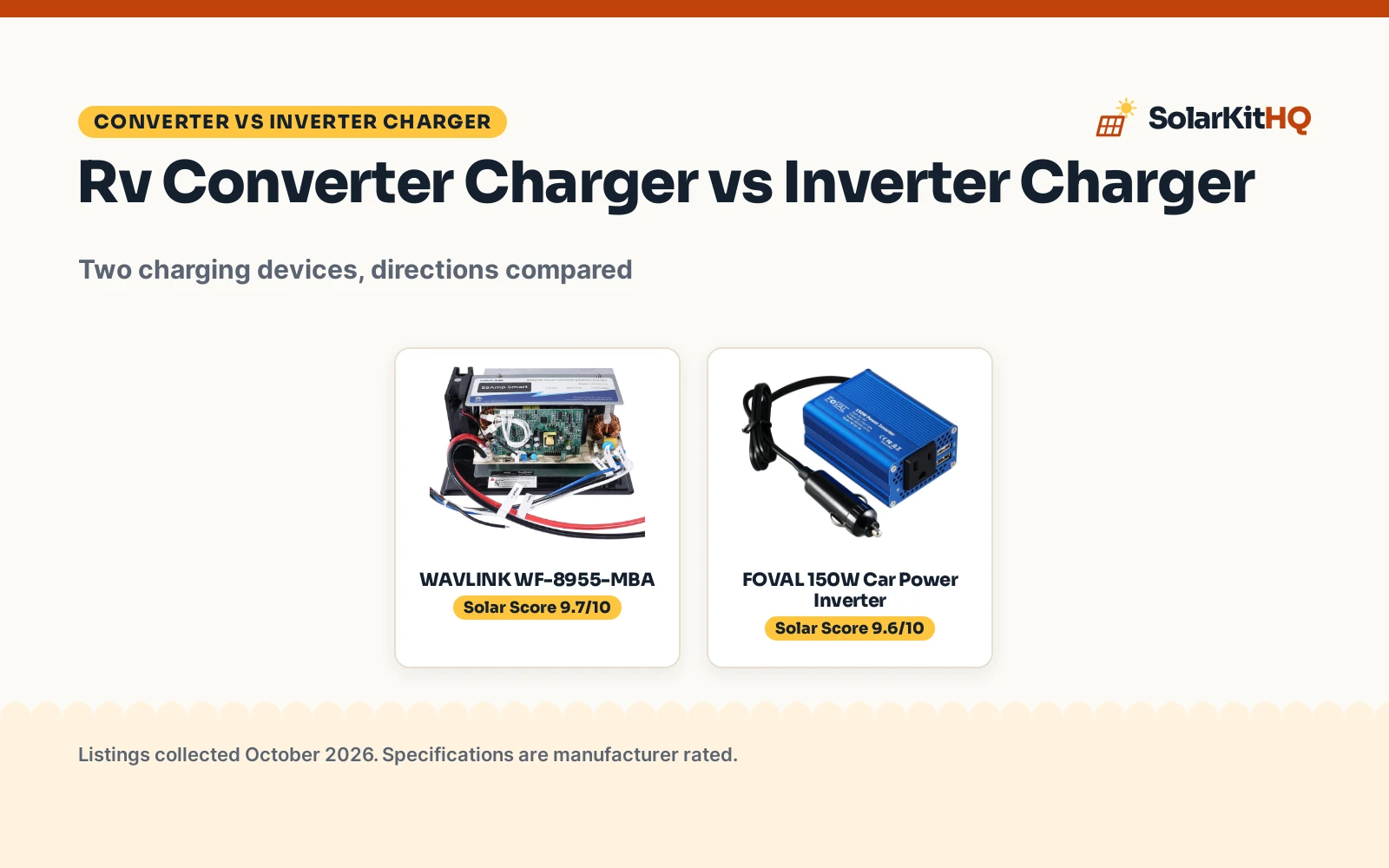
The WAVLINK converter example takes 120V AC and makes 12V DC, for charging RV batteries or running devices on the road, with an output of up to 55A. Its three charging modes cover lead-acid batteries, lithium batteries and a fixed voltage setting from 13.0V to 16.5V, with a smart temperature-controlled fan and a metal body for heat dissipation. The FOVAL inverter example works the other way: it takes 12V DC from a vehicle and makes 110V AC, with 150 watts of continuous output, 300 watts of peak output, 2 USB ports and 1 AC outlet for laptops, phones and other devices. The two jobs run in opposite directions, so their headline figures do not compete directly.
Output and charging modes
On output, the listings describe different things. The WAVLINK example states 55A of output current and 800 watts of output power, with charging modes tailored to battery type. The FOVAL example states 150 watts continuous and 300 watts peak, with dual USB ports at 3.1A total output, but it states no battery charging modes at all. A converter charger is judged on how it charges a battery, while an inverter charger is judged on the AC and USB power it makes available, and only the WAVLINK listing speaks to charging modes.
Protections and listings
Both listings state protections, with different certifications. The WAVLINK example states UL, with short circuit, software over voltage, thermal, current limiting and reverse polarity protection. The FOVAL example states ETL and FCC, with a built-in fuse and protection against overheating, under and over voltage charging, short circuiting, overloads and overcharging. Neither listing states the other side’s certification, so the protection lists are a point of comparison, not a shared standard.
What the listings leave unclear
Several figures need care. The WAVLINK spec table lists output voltage as 120 volts of alternating current against a title and bullets describing 120V AC to 12V DC conversion, so trust the title and bullets on the 12V DC output. The same spec table lists 800 watts of output power against a peak output power of 660 watts, and names a model GS800RVP against the WF-8955-MBA in the title. The FOVAL listing, meanwhile, describes a car power inverter for vehicle use, not a dedicated RV charging unit, and it states no charging modes, no converter output current and no dimensions beyond its 3.2 by 2.5 by 1.5 inch size. Where a figure is missing on one side, this comparison says so rather than awarding the point to the other side.
Two examples

WAVLINK WF-8955-MBA
An RV converter that turns 120V AC into 12V DC with 55A output and three charging modes for lead-acid and lithium batteries.
Pros
- 55A output for RV batteries and onboard devices
- Three modes: lead-acid, lithium and fixed voltage from 13.0V to 16.5V
- Smart temperature-controlled fan and metal body for heat dissipation
- UL stated, with five protections listed
Cons
- Spec table lists output voltage as 120V AC against the 12V DC title and bullets
- Spec table lists 660 watts peak against 800 watts output power
- Title names WF-8955-MBA while the spec table names GS800RVP
- No dimensions or weight are stated
Detailed Review
WAVLINK lists an RV converter that turns 120V AC into 12V DC, with up to 55A of output, three charging modes for lead-acid and lithium batteries and a fixed voltage range from 13.0V to 16.5V, a smart temperature-controlled fan and a metal body. The listing states UL, with short circuit, software over voltage, thermal, current limiting and reverse polarity protection, and a warranty description of 12 Months. The spec table lists output voltage as 120 volts of alternating current against the 12V DC output in the title and bullets, lists a peak output power of 660 watts against 800 watts of output power, and names a model GS800RVP against WF-8955-MBA in the title, so trust the title and bullets on output and model.
Who it's for: RV owners charging batteries from shore power who want multi-stage modes and an adjustable voltage range. Who should skip it: buyers needing AC outlets, USB charging or stated dimensions and weight.
Its Solar Score of 9.7/10 comes from performance 30/35, build 21/25, value 20/25, safety 8/10 and warranty 3/5: 82 of 100 points, placed on our 9.2 to 9.8 scale.
Key Specifications
| Output | 55A |
|---|---|
| Conversion | 120V AC to 12V DC |
| Charging modes | Lead-acid, lithium, fixed voltage |
| Warranty | 12 Months |
Figures as published on the retailer listing, collected 25 October 2026. Performance figures are manufacturer rated.
Safety and Warranty
What this listing states. UL stated, with short circuit, over voltage, thermal, current limiting and reverse polarity protection stated, so safety scores 8 of 10. 12 Months. It does not say everything a buyer needs, such as who pays return shipping, so warranty scores 3 of 5. See How We Pick.
Match the charger. Use a charger mode that matches your battery's stated chemistry and voltage, connect in the order the manual gives, and keep it ventilated and dry.
This is general buying information, not professional advice. Follow each product manual and local rules, and see our Safety Disclaimer.

FOVAL 150W Car Power Inverter
A car power inverter giving 150 watts of 110V AC power with dual USB ports at 3.1A total output.
Pros
- 150 watts continuous and 300 watts peak output
- 2 USB ports and 1 AC outlet for several devices
- Compact size of 3.2 by 2.5 by 1.5 inches for vehicle use
- Aluminum shell with a silent cooling fan
Cons
- No battery charging modes are stated
- Modified Sine Wave per the spec table
- Built around a vehicle cigarette lighter plug, per the listing
- AC output is limited to 150 watts continuous
Detailed Review
FOVAL lists a car power inverter that turns 12V DC into 110V AC, with 150 watts of continuous output, 300 watts of peak output, 2 USB ports at 3.1A total output and 1 AC outlet, in a 3.2 by 2.5 by 1.5 inch aluminum shell weighing 226 g. The listing states ETL and FCC, a built-in fuse, protection against overheating, under and over voltage charging, short circuiting, overloads and overcharging, and a warranty description of 2 year manufacturer. The spec table lists a Modified Sine Wave, and the listing describes vehicle use through a cigarette lighter plug, with no battery charging modes stated.
Who it's for: vehicle users needing AC outlets and USB charging from a 12V battery for laptops, phones and small devices. Who should skip it: buyers needing battery charging modes, converter output current or a dedicated RV charging unit.
Its Solar Score of 9.6/10 comes from performance 28/35, build 20/25, value 20/25, safety 7/10 and warranty 4/5: 79 of 100 points, placed on our 9.2 to 9.8 scale.
Key Specifications
| Output | 150 watts continuous |
|---|---|
| Peak | 300 watts |
| Outlets | 1 AC outlet, 2 USB ports |
| Size | 3.2 by 2.5 by 1.5 inches |
Figures as published on the retailer listing, collected 25 October 2026. Performance figures are manufacturer rated.
Safety and Warranty
What this listing states. ETL and FCC stated, with fuse, overheating, under and over voltage, short circuit, overload and overcharging protection stated, so safety scores 7 of 10. 2 year manufacturer. It does not say everything a buyer needs, such as who pays return shipping, so warranty scores 4 of 5. See How We Pick.
Match the charger. Use a charger mode that matches your battery's stated chemistry and voltage, connect in the order the manual gives, and keep it ventilated and dry.
This is general buying information, not professional advice. Follow each product manual and local rules, and see our Safety Disclaimer.
As an Amazon Associate I earn from qualifying purchases.
How we scored them
The Solar Score weighs performance, build, value, safety and warranty. For chargers, safety means stated certifications and protections, and both listings state both, so both earned safety points. Both listings also state a warranty term: 12 Months for the WAVLINK example and 2 year manufacturer for the FOVAL example. How we pick explains the weights.
| Product | Solar Score | Perf. /35 | Build /25 | Value /25 | Safety /10 | Warranty /5 |
|---|---|---|---|---|---|---|
| WAVLINK WF-8955-MBA | 9.7 | 30 | 21 | 20 | 8 | 3 |
| FOVAL 150W Car Power Inverter | 9.6 | 28 | 20 | 20 | 7 | 4 |
Scores run from 9.2 to 9.8: each product’s point total is placed on that range, so more points always means a higher score.
Rv converter charger vs inverter charger: which should you choose?
Choose the converter charger if the job is charging RV batteries from shore power, with modes for lead-acid and lithium batteries and an adjustable voltage range. The WAVLINK example suits that job, with 55A of output and three charging modes. Choose the inverter charger if the job is making AC power and USB charging from a 12V battery in a vehicle, for laptops, phones and small devices. The FOVAL example suits that job, with 150 watts continuous, 300 watts peak and a compact vehicle size.
| If you need | Look at |
|---|---|
| Shore-power battery charging | WAVLINK converter example, 55A output |
| AC outlets and USB from a battery | FOVAL inverter example, 150 watts continuous |
| Multi-stage battery modes | WAVLINK converter example, three modes |
| Compact vehicle use | FOVAL inverter example, 3.2 by 2.5 by 1.5 inches |
Sizing Notes
- Match the converter output to the battery: 55A, with a fixed voltage range from 13.0V to 16.5V, and a mode for the battery type.
- Match the inverter output to the loads: 150 watts continuous and 300 watts peak, with dual USB ports at 3.1A total output.
- Match the waveform wording to the load: the WAVLINK spec table lists Pure Sine Wave, while the FOVAL spec table lists Modified Sine Wave.
- Match the warranty term to the purchase: 12 Months for the WAVLINK example, and 2 year manufacturer for the FOVAL example.
Frequently Asked Questions
Can a converter charger run AC devices?
The WAVLINK listing describes converting 120V AC to 12V DC for charging batteries or running devices, and it states no AC outlets. It is a charging device, not an AC outlet source.
Can an inverter charger charge a battery?
The FOVAL listing describes making 110V AC power from 12V DC for devices, and it states no battery charging modes. Its job is powering devices, not charging a battery bank.
Which example states more protections?
Both state several. The WAVLINK example states UL with short circuit, over voltage, thermal, current limiting and reverse polarity protection. The FOVAL example states ETL and FCC with a fuse and protection against overheating, under and over voltage, short circuiting, overloads and overcharging.
Do both examples state a warranty term?
Yes. The WAVLINK example states 12 Months, and the FOVAL example states 2 year manufacturer.
Related guides
See every controllers and inverters guide and all solar guides guides. Also see our RV converter charger for travel trailer, our pure sine vs modified sine inverter for RV and our MPPT charge controller vs inverter charger comparison.
More picks: small power inverters, pure sine vs modified sine inverters and RV converter chargers for travel trailers.