On this page
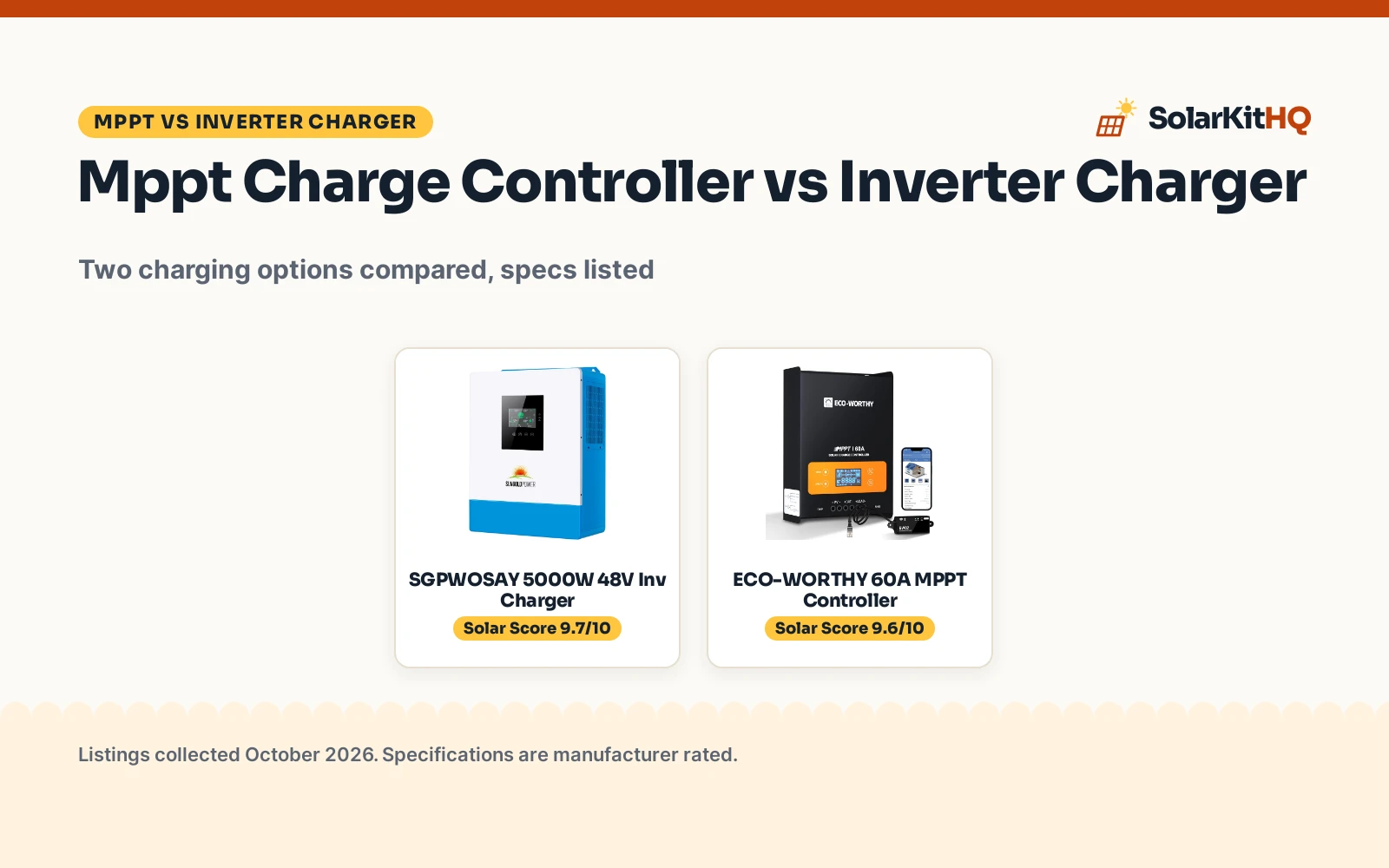
The power is out at dinner time and the fridge is humming on its last cold: that is when the question of mppt charge controller vs inverter charger stops being abstract. An MPPT charge controller moves solar power into the batteries; an inverter charger adds an AC output so the same box can also run household loads. We compared one of each on what the listings state, side by side on charging, output and system fit, so you can see which side your setup actually needs.
SolarKitHQ earns a commission when you buy through links on this page, at no extra cost to you. As an Amazon Associate I earn from qualifying purchases. Affiliate disclosure.
Mppt charge controller vs inverter charger: side by side
| Charging Gear | Solar Score | Charging | AC Output | Battery Volts |
|---|---|---|---|---|
| SGPWOSAY 5000W 48V Inv Charger | 9.7/10 | 100A solar, 40A AC | 120V pure sine wave | 48V |
| ECO-WORTHY 60A MPPT Controller | 9.6/10 | 60A MPPT | None, DC only | 12/24/36/48V |
Specifications are manufacturer rated as listed, collected 21 October 2026.
Charging or converting: the core split
The ECO-WORTHY is charging gear: its listing states a 60A MPPT charge controller with a 150V max PV input, automatic detection of 12/24/36/48V systems, and 99.5% tracking efficiency with 98% peak conversion efficiency. The SGPWOSAY is an all-in-one: its listing states a 5000W pure sine wave inverter with a 120V AC output plus up to 100A of solar and AC battery charging from one unit. Buy the controller when you already have an inverter handling AC loads; buy the inverter charger when you want charging and AC output in a single box.
Voltage fit and battery types
The controller adapts: it detects 12/24/36/48V systems automatically and lists lead acid and LiFePO4 battery support with 4-stage and 2-stage charging. The inverter charger commits: it lists 48V only, with a battery charging voltage range of 40 to 60V and support for 48V AGM, Sealed, Gel, Flooded and Lithium batteries. Match your existing bank first: the inverter charger lists 48V only, so a smaller bank leaves it out of the running.
Monitoring and extras
The ECO-WORTHY lists Bluetooth and WiFi app monitoring up to 33 feet away with 30 days of performance history, plus 3 load control modes: normal on/off, optical control and fixed time light control. The SGPWOSAY lists an LCD screen, RS485 for BMS communication, 4 charging modes and 4 output modes, and parallel operation of up to 6 units for 30kW. The extras tell you the intended user: the controller is built for watching one bank from a phone, the inverter charger for scaling a 48V system.
What the listings leave unclear
The SGPWOSAY bullets state a 110V AC output in one line while the title and spec table state 120V, so read the output figure as 120V with one stray line. The ECO-WORTHY listing states no warranty term and no weight. Neither listing states a standby draw figure.
Two examples

SGPWOSAY 5000W 48V Inv Charger
An all-in-one 48V inverter charger rated at 5000W with a 100A MPPT solar charger and a 40A AC battery charger, plus a stated 2 year manufacturer warranty.
Pros
- 100A MPPT solar charging plus 40A AC battery charging, per the listing
- 5000W pure sine wave 120V AC output with a 12000 volt-amp inverter capacity stated
- Parallel up to 6 units for 30kW, with 120V/240V split phase and 208V 3-phase stated
- UL1741 and CE certifications stated
Cons
- One bullet line says 110V AC output while the title and spec table say 120V
- Weighs 28 pounds and measures 17.3 by 13.8 by 5.1 inches, per the listing
- 48V system only, with no 12V or 24V support
- The 120V AC side should be wired by a licensed electrician
Detailed Review
The listing states a 5000W DC 48V pure sine wave inverter charger that combines up to 100A of solar plus AC battery charging, a maximum 5500W 500V PV array, a 120V AC output, 4 charging modes and 4 output modes, compatibility with 48V AGM, Sealed, Gel, Flooded and Lithium batteries with a 40 to 60V charging voltage range, RS485 for BMS communication, and a 28-pound unit measuring 17.3 by 13.8 by 5.1 inches. The bullets state a 110V AC output in one line while the title and spec table state 120V, and the spec table lists both a 5000W peak output and a 12000 volt-amp inverter capacity.
Who it's for: owners building a 48V solar system who want charging and 120V AC output from one box, with the option to parallel up to 6 units for 30kW. Who should skip it: anyone whose battery bank is not 48V, since this unit lists 48V only.
Its Solar Score of 9.7/10 comes from performance 32/35, build 22/25, value 20/25, safety 8/10 and warranty 1/5: 83 of 100 points, placed on our 9.2 to 9.8 scale.
Key Specifications
| Power | 5000W, 120V AC output, pure sine wave |
|---|---|
| Charging | 100A MPPT solar, 40A AC charger |
| PV input | 5500W max, 500V max |
| Battery | 48V, charging voltage range 40 to 60V |
Figures as published on the retailer listing, collected 21 October 2026. Performance figures are manufacturer rated.
Safety and Warranty
What this listing states. UL1741, UL and CE stated, with overload protection and RS485 BMS communication stated, so safety scores 8 of 10. 2 year manufacturer stated. It does not say everything a buyer needs, such as who pays return shipping, so warranty scores 1 of 5. See How We Pick.
Stay under the input limit. Keep your panels' combined open circuit voltage, with cold weather margin, under the controller's stated maximum PV input, connect the battery first unless the manual says otherwise, and fuse both sides as the manual directs.
This is general buying information, not professional advice. Follow each product manual and local rules, and see our Safety Disclaimer.

ECO-WORTHY 60A MPPT Controller
A 60A MPPT solar charge controller with a 150V max PV input, automatic 12/24/36/48V detection, Bluetooth and WiFi app monitoring, and 3 load control modes.
Pros
- 99.5% tracking efficiency and 98% peak conversion efficiency, per the listing
- Automatic detection of 12/24/36/48V systems
- Bluetooth and WiFi monitoring up to 33 feet, plus 30 days of performance history
- 3 load control modes: normal on/off, optical control and fixed time light control
Cons
- No warranty term is stated
- Charges batteries only, with no AC output
- The 150V max PV input limits panel string voltage
- The Bluetooth and WiFi module may ship separately
Detailed Review
The listing states a 60A MPPT solar charge controller with up to 99.5% tracking efficiency and up to 98% peak conversion efficiency, a maximum PV input of 150V, automatic detection of 12/24/36/48V systems, a Bluetooth and WiFi module for app monitoring up to 33 feet and 30 days of performance history, 3 load control modes (normal on/off, optical control and fixed time light control), compatibility with lead acid and LiFePO4 batteries with 4-stage and 2-stage charging plus LiFePO4 activation, and protection against reverse connection, short circuit, high temperature and load overcurrent. No warranty term is stated.
Who it's for: solar owners who already have an inverter and need an MPPT controller for a 12/24/36/48V battery bank with phone monitoring. Who should skip it: anyone who wants AC output from the same box.
Its Solar Score of 9.6/10 comes from performance 30/35, build 21/25, value 21/25, safety 8/10 and warranty 0/5: 80 of 100 points, placed on our 9.2 to 9.8 scale.
Key Specifications
| Charge current | 60A MPPT |
|---|---|
| PV input | 150V max, 12/24/36/48V auto detect |
| Efficiency | 99.5% tracking, 98% peak conversion |
| Monitoring | Bluetooth and WiFi up to 33 ft, 30-day history |
Figures as published on the retailer listing, collected 21 October 2026. Performance figures are manufacturer rated.
Safety and Warranty
What this listing states. Stated protection against reverse connection, short circuit, high temperature and load overcurrent, so safety scores 8 of 10. No warranty term, so warranty scores zero. See How We Pick.
Stay under the input limit. Keep your panels' combined open circuit voltage, with cold weather margin, under the controller's stated maximum PV input, connect the battery first unless the manual says otherwise, and fuse both sides as the manual directs.
This is general buying information, not professional advice. Follow each product manual and local rules, and see our Safety Disclaimer.
As an Amazon Associate I earn from qualifying purchases.
Where the points went
The Solar Score weighs performance, build, value, safety and warranty. For charging and conversion gear, safety means stated protections, overload protection or certifications the listing names, and both listings state these. One of the two states a warranty: the SGPWOSAY lists a 2 year manufacturer warranty, while the ECO-WORTHY listing states no warranty term. How we pick explains the weights.
| Product | Solar Score | Perf. /35 | Build /25 | Value /25 | Safety /10 | Warranty /5 |
|---|---|---|---|---|---|---|
| SGPWOSAY 5000W 48V Inv Charger | 9.7 | 32 | 22 | 20 | 8 | 1 |
| ECO-WORTHY 60A MPPT Controller | 9.6 | 30 | 21 | 21 | 8 | 0 |
Scores run from 9.2 to 9.8: each product’s point total is placed on that range, so more points always means a higher score.
Mppt charge controller vs inverter charger: which should you choose?
Choose the MPPT charge controller when an inverter already covers your AC loads: the ECO-WORTHY example charges at 60A with app monitoring and 3 load control modes. Choose the inverter charger when one box must charge and power 120V loads: the SGPWOSAY example pairs 100A of solar plus AC charging with 5000W of pure sine wave output. For panel-side reading, see our mppt vs pwm charge controller comparison. A licensed electrician should handle any wiring tied to 120V AC.
| If you need | Look at |
|---|---|
| Charging only, with phone monitoring | ECO-WORTHY 60A MPPT Controller |
| Charging plus 120V AC output | SGPWOSAY 5000W 48V Inv Charger |
| Automatic voltage detection | ECO-WORTHY, 12/24/36/48V |
| Scaling to 30kW in parallel | SGPWOSAY, up to 6 units |
Sizing Notes
- Keep the panel string voltage under the controller’s 150V max PV input.
- Size the array to the inverter charger’s stated 5500W max and 500V max PV input.
- Match the battery bank to the gear: the inverter charger lists 48V only, with a 40 to 60V charging range.
- Fuse the DC side and size cables as the manual directs; leave 120V AC wiring to a licensed electrician.
FAQ: power away from the grid
Can an MPPT charge controller run AC appliances?
No. The ECO-WORTHY example charges batteries at 60A but states no AC output. The SGPWOSAY inverter charger is the side that states a 120V AC output.
Which side charges batteries faster, by the listings?
The SGPWOSAY states up to 100A of solar plus AC charging, against the ECO-WORTHY’s stated 60A of MPPT charging.
Does the inverter charger need a separate controller?
No. Its listing states a 100A MPPT solar charger and a 40A AC battery charger built in, so a separate controller is not needed for the same bank.
Which battery voltages fit each side?
The ECO-WORTHY detects 12/24/36/48V systems automatically. The SGPWOSAY lists 48V only, with a stated 40 to 60V charging range.
Which listing states a warranty?
The SGPWOSAY states a 2 year manufacturer warranty. The ECO-WORTHY listing states no warranty term.
Related solar guides
See every Controllers and Inverters guide and all Charge Controllers guides. Also see our best mppt charge controller for 24v system and our best inverter for home backup.
More picks: best mppt charge controller under 100, Inverter Chargers, best solar charge controller for boat.