On this page
Parked off the grid with the fresh tank low and the nearest dump station a drive away, the choice between an rv toilet vs composting toilet comes down to water and waste. A gravity-flush RV toilet rinses waste into a black tank with fresh water, while a composting toilet separates liquids from solids and needs no flush water and no black tank. The toilets in the gear section below are all gravity-flush RV toilets, with no composting toilet among them, so this guide compares the types in words and the gravity-flush models on stated specs. If your rig already has a black tank and a water supply, a gravity-flush toilet is the simpler fit, while a composting toilet suits a rig without a black tank or a camper who wants to stretch fresh water.
SolarKitHQ earns a commission when you buy through links on this page, at no extra cost to you. As an Amazon Associate I earn from qualifying purchases. Affiliate disclosure.
The quick answer
Pick a gravity-flush RV toilet when the rig has a black tank and regular access to water and a dump station, since it flushes and cleans like the toilet at home. Pick a composting toilet when the rig has no black tank, when fresh water is scarce, or when dump stations are hard to reach, since it needs no flush water and no black tank. Among the gravity-flush models below, the SEAFLO leads on warranty and weight, the Dometic on bowl material.
rv toilet vs composting toilet: how they differ
A gravity-flush toilet works like the toilet at home: a foot pedal opens a valve, fresh water rinses the bowl, and waste drops into a black tank under the floor. A composting toilet works dry: it separates liquids from solids into separate containers, and the solids compartment uses a dry medium to keep the contents from staying wet. The difference shapes everything else about living with the toilet, from water use to emptying day.
Water is the sharpest split. A gravity-flush toilet draws on the fresh tank with every flush, so dry camping means watching the fresh water gauge and the black tank gauge together. A composting toilet needs no flush water at all, which leaves the fresh tank for drinking, cooking and washing. On the other side, a composting toilet needs a vent to the outside and a level spot for the unit, and its solids bin and liquid bottle need emptying on their own schedule. See the does a composting toilet smell guide for odor control.
| Point | Gravity-flush RV toilet | Composting toilet |
|---|---|---|
| Flush water | Fresh water per flush | No flush water |
| Waste goes to | Black tank | Separate liquid and solid containers |
| Emptying | Dump station | Liquid bottle and solids bin |
| Needs in the rig | Floor flange and black tank | Vent and floor space for the unit |
| Suits | Rigs with a black tank and water hookups | Rigs without a black tank, or dry camping |
The RV toilets in this guide
The models below are gravity-flush RV toilets, listed in ranked order, with the figures the makers state.
| Toilet | Seat height | Bowl | Flush | Warranty |
|---|---|---|---|---|
| SEAFLO SFRTPH-01-01 | 18.4 in | Oversized anti-stick plastic | Foot pedal gravity, tri-directional jets | 4 years |
| Dometic 410 | 18 in | Round porcelain | Foot pedal gravity, 360-degree rimless | Not stated |
| Thetford Aqua-Magic Style II | High profile | Full china | Single-pedal gravity, full bowl coverage | 3 years |
| Kohree KR3141 | 18.5 in | Deepened anti-stick, oversized | Foot pedal gravity, triple-jet, sprayer included | 2 years |
The SEAFLO SFRTPH-01-01 leads the ranking as the lightest toilet here at 12.0 pounds, with an 18.4 inch residential height, a 9.5 inch rough-in, and a 4-year warranty, the longest warranty among the models below. Built to IAPMO TS 1 and Z124, it pairs an oversized anti-stick bowl with tri-directional flush jets and a soft-close seat. The maker gives differing dimensions, 17.8 by 15.3 by 18.4 inches and 16.0 by 17.0 by 18.0 inches; the gear table uses the 17.8 by 15.3 by 18.4 inch set, so measure before ordering.
The Dometic 410 is the only porcelain bowl here, with an 18 inch chair-height seat, a 7.625 inch rear fit, and a 2-bolt mount. The maker lists a 10,000-flush figure, and the 360-degree rimless flush gives full bowl coverage with less water. The dual-action foot pedal adds water or flushes, and the soft-close lid keeps the seat quiet while the rig is moving. At 27.0 pounds with dimensions of 22.0 by 21.8 by 18.3 inches it is heavier than the SEAFLO, and no warranty term is stated.
The Thetford Aqua-Magic Style II pairs a full china bowl with a polymer body, a full-size residential seat, and a 3-year manufacturer warranty. Its single-pedal flush gives 100 percent bowl coverage, and the ball valve wipes clean with every flush. At 33.9 pounds with dimensions of 22.5 by 22.5 by 18.0 inches it is the heaviest toilet here.
The Kohree KR3141 stands 18.5 inches tall with a deepened anti-stick bowl and a longer seat, the tallest stated seat height here. Its dual-action foot pedal is listed at 10,000 pedal presses, and the triple-jet rinse gives 360-degree bowl coverage. A sprayer attachment with a mounting bracket is included, with a floor flange, a toilet seal, screws, and torque-marked bolts in the package. The warranty is 2 years, and the dimensions are 17.1 by 15.0 by 18.5 inches.
How to choose
- Measure the fit. The SEAFLO needs a 9.5 inch rough-in, measured from the wall to the center of the floor flange, while the Dometic needs a 7.625 inch rear fit. Measure the old toilet’s mounting bolts for a close estimate, and remove the old toilet for the most precise measurement.
- Pick the bowl. Porcelain on the Dometic cleans easier than plastic and resists scratches, stains, and odors, while the Thetford china bowl is easy to clean and the SEAFLO plastic bowl keeps the weight at 12.0 pounds.
- Weigh weight against warranty. The SEAFLO pairs 12.0 pounds with a 4-year warranty, the Thetford pairs 33.9 pounds with a 3-year warranty, the Kohree carries a 2-year warranty, and the Dometic states no warranty term.
- Check what arrives in the box. The SEAFLO floor flange is sold separately, while the Kohree arrives with a floor flange, a toilet seal, screws, and a sprayer attachment with a mounting bracket.
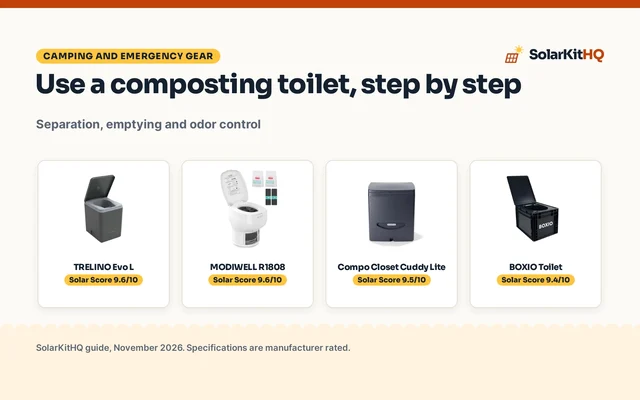
- No black tank means a different type. A gravity-flush toilet needs a black tank and a floor flange. When the rig has neither, a composting toilet fits better; see the how to use a composting toilet guide for the routine.
FAQ: power away from the grid
Which is better, an RV toilet or a composting toilet?
It turns on the rig. A gravity-flush RV toilet is the simpler fit when the rig has a black tank, a water supply and a dump station nearby. A composting toilet is the better fit when the rig has no black tank or fresh water is scarce, since it needs no flush water and no black tank.
Does a composting toilet need water to flush?
No. A composting toilet separates liquids from solids and uses no flush water, while a gravity-flush toilet rinses the bowl with fresh water on every flush. See the how a composting toilet works guide for the parts and the routine.
What rough-in does the SEAFLO toilet need?
A 9.5 inch rough-in, measured from the wall to the center of the floor flange. Measure from the wall to the mounting bolts for a close estimate.
Which of these RV toilets has a porcelain bowl?
The Dometic 410, with a round porcelain bowl and an 18 inch chair-height seat. The Thetford Aqua-Magic Style II has a full china bowl, and the SEAFLO has an oversized anti-stick plastic bowl.
Which is the lightest RV toilet here?
The SEAFLO at 12.0 pounds, against 27.0 pounds for the Dometic and 33.9 pounds for the Thetford.
Can a gravity-flush toilet fit in a rig without a black tank?
No. A gravity-flush toilet needs a floor flange and a black tank to receive the waste. A rig without a black tank suits a composting toilet instead; see the best composting toilets for a van for models built for small rigs.
Related solar guides
See the how a composting toilet works, the how to use a composting toilet, the best portable toilets for an RV.