On this page
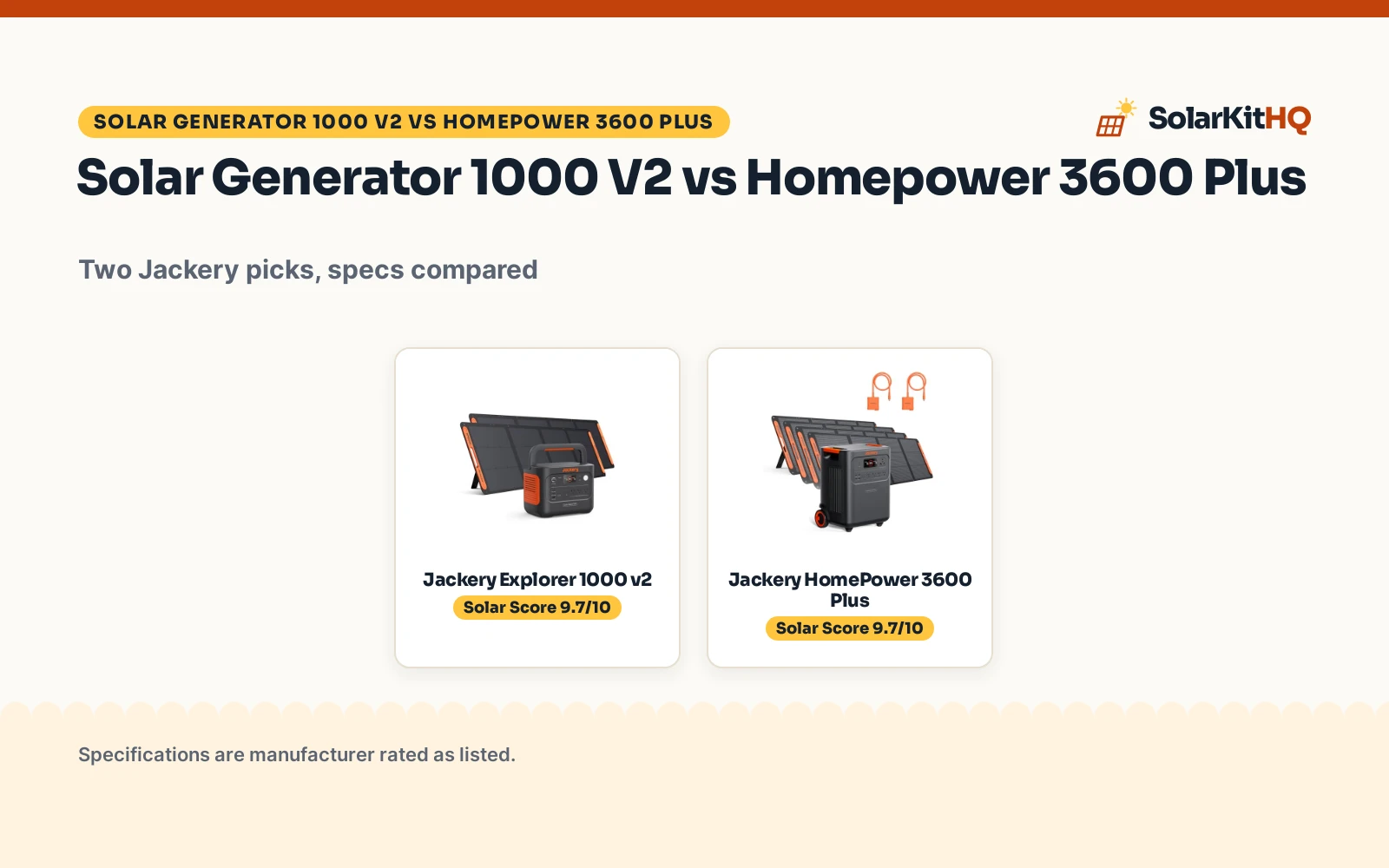
The lights go out during dinner, the fridge hums to a stop, and the phones start their slow slide toward empty. That is the kind of evening solar generator 1000 v2 vs homepower 3600 plus is built around: two Jackery bundles, one portable station and one home backup station, compared on what each listing actually states. The smaller bundle suits carrying to a campsite or an RV, while the larger bundle suits holding up a household, and the stated figures draw that line clearly.
SolarKitHQ earns a commission when you buy through links on this page, at no extra cost to you. As an Amazon Associate I earn from qualifying purchases. Affiliate disclosure.
Solar generator 1000 v2 vs homepower 3600 plus: side by side
| Solar generator | Solar Score | Capacity | AC output | Weight | Solar panels included |
|---|---|---|---|---|---|
| Jackery Explorer 1000 v2 | 9.7/10 | 1070Wh | 1500W | 23.8 pounds | 2x200W |
| Jackery HomePower 3600 Plus | 9.7/10 | 3584Wh | 3600W | 77.16 pounds | 4x200W |
Figures in this table are the manufacturer’s ratings as listed, captured 1 November 2026.
Capacity and output
Capacity is the widest gap. The Explorer 1000 v2 listing states 1070Wh and 1500W AC output with a 3000W surge peak. The HomePower 3600 Plus listing states 3584Wh and 3600W AC output, with 7200W in parallel. The HomePower listing also states expansion to 21kWh per unit and 43kWh with multiple units. The Explorer listing states no expansion figure. On capacity and output alone, the HomePower listing states the larger figures. The Explorer listing states the smaller figures.
Weight and size
The Explorer 1000 v2 listing states 23.8 pounds and 12.9 inches x 8.8 inches x 9.7 inches, with a foldable handle. The HomePower 3600 Plus listing states 77.16 pounds and 15.2 inches x 12.2 inches x 19.3 inches, with wheels and a telescopic handle. The Explorer listing describes a station meant to be carried. The HomePower listing describes a station meant to be rolled. Weight and size decide how each bundle moves, and the figures leave little doubt about which bundle suits carrying and which suits rolling.
Charging and outlets
The Explorer 1000 v2 listing states 400W solar charging from two 200W panels, with a charge from 0-80% via solar in 3 hours. The Explorer listing also states a 1-hour Emergency Charge and a 30dB Quiet Charging mode through the Jackery App. The Explorer listing states two USB-C ports including 100W PD, one USB-A, a DC car port, and three pure sine wave AC outlets. The HomePower 3600 Plus listing states 4 charging options, with a full recharge from 0-100% in 2 hours via hybrid AC+DC, in 2.5 hours via AC, in 4 hours via solar, and in 2.5 hours via a gas generator. The HomePower listing states no outlet count. The two solar figures cover different charge ranges, so a direct solar-to-solar comparison needs the range each listing gives.
What the listings leave unclear
The HomePower 3600 Plus listing rounds capacity to 3.6kWh in its prose while its title states 3584Wh, so this comparison uses the title figure. The HomePower listing states no warranty term. The HomePower listing states no outlet count. The Explorer 1000 v2 listing states no expansion figure. The HomePower listing calls itself 29.3% lighter than other models without naming a comparison model, so that percentage cannot be checked against a stated figure. The Explorer listing states a 5-year coverage term. Where a listing stays silent, this comparison says so rather than filling the gap.
Two examples

Jackery Explorer 1000 v2
A portable Jackery bundle with 1070Wh capacity, 1500W AC output, and two 200W panels for camping, RV, off-grid and emergency use.
Pros
- 1500W AC output with a 3000W surge peak for fridges, AC units, and electric pots.
- 1070Wh capacity with two 200W panels and 400W solar charging.
- 1-hour Emergency Charge plus a 30dB Quiet Charging mode through the Jackery App.
- LiFePO4 cells holding over 70% capacity after 4,000 charge cycles, with 5-year coverage.
Cons
- Solar charging reaches 0-80% in 3 hours, with no full-charge solar figure stated.
- No expansion figure is stated.
- No dual-voltage figure is stated.
- The station and the 200W panels ship separately.
Detailed Review
The Explorer 1000 v2 listing states 1070Wh capacity, 1500W AC output, and a 3000W surge peak, with two 200W panels and 400W solar charging. The listing states two USB-C ports including 100W PD, one USB-A, a DC car port, and three pure sine wave AC outlets. The bullets and the spec table agree on 23.8 pounds, and no contradiction stands out in the listing.
Who it's for: campers, RV owners, and off-grid users who want a portable bundle with app control. Who should skip it: households looking for home backup capacity and output above 1070Wh and 1500W.
Its Solar Score of 9.7/10 comes from performance 30/35, build 21/25, value 21/25, safety 7/10 and warranty 3/5: 82 of 100 points, placed on our 9.2 to 9.8 scale.
Key Specifications
| Capacity | 1070Wh |
|---|---|
| AC output | 1500W, 3000W surge peak |
| Weight | 23.8 pounds |
| Size | 12.9 x 8.8 x 9.7 inches |
Figures as published on the retailer listing, collected 1 November 2026. Performance figures are manufacturer rated.
Safety and Warranty
What this listing states. LiFePO4 battery cells stated, so safety scores 7 of 10. 5-year coverage stated. It does not say everything a buyer needs, such as who pays return shipping, so warranty scores 3 of 5. See How We Pick.
Power station limits. Stay within the stated continuous output and solar input limits, keep the unit ventilated and dry, charge within the stated temperature range, and never connect it to home wiring except through equipment a licensed electrician installs.
This is general buying information, not professional advice. Follow each product manual and local rules, and see our Safety Disclaimer.

Jackery HomePower 3600 Plus
A home backup Jackery bundle with 3584Wh capacity, 3600W AC output, and four 200W panels for household use during outages.
Pros
- 3600W AC output with 7200W in parallel and dual voltage at 120V and 240V in parallel.
- 3584Wh capacity expandable to 21kWh per unit and 43kWh with multiple units.
- 4 charging options, including a full recharge in 2 hours via hybrid AC+DC.
- High-temp resistant ceramic membrane battery cells, with wheels and a telescopic handle for rolling.
Cons
- No warranty term is stated.
- The station and the solar panels ship separately.
- 240V output is stated only in parallel.
- No outlet count is stated.
Detailed Review
The HomePower 3600 Plus listing states 3584Wh capacity and 3600W AC output, with 7200W in parallel and dual voltage at 120V and 240V in parallel. The listing states 4 charging options, with a full recharge in 2 hours via hybrid AC+DC, in 2.5 hours via AC, in 4 hours via solar, and in 2.5 hours via a gas generator. The prose rounds capacity to 3.6kWh while the title states 3584Wh, so this comparison uses the title figure. The listing describes home backup use with MTS, so a licensed electrician should install any home connection.
Who it's for: households looking for home backup capacity with expansion room and multiple charging options. Who should skip it: campers and RV owners who want a light bundle to carry by hand.
Its Solar Score of 9.7/10 comes from performance 33/35, build 22/25, value 21/25, safety 8/10 and warranty 0/5: 84 of 100 points, placed on our 9.2 to 9.8 scale.
Key Specifications
| Capacity | 3584Wh |
|---|---|
| AC output | 3600W, 7200W in parallel |
| Weight | 77.16 pounds |
| Size | 15.2 x 12.2 x 19.3 inches |
Figures as published on the retailer listing, collected 1 November 2026. Performance figures are manufacturer rated.
Safety and Warranty
What this listing states. High-temp resistant ceramic membrane battery cells stated, so safety scores 8 of 10. No warranty term, so warranty scores zero. See How We Pick.
Power station limits. Stay within the stated continuous output and solar input limits, keep the unit ventilated and dry, charge within the stated temperature range, and never connect it to home wiring except through equipment a licensed electrician installs.
This is general buying information, not professional advice. Follow each product manual and local rules, and see our Safety Disclaimer.
As an Amazon Associate I earn from qualifying purchases.
Where the points went
The Solar Score weighs performance, build, value, safety and warranty. For solar generators, safety means stated cell protection features. The Explorer 1000 v2 listing states LiFePO4 battery cells. The HomePower 3600 Plus listing states high-temp resistant ceramic membrane battery cells that prevent thermal runaway. The Explorer listing states a 5-year coverage term. The HomePower listing states no warranty term, so its warranty line stays empty. How we pick explains the weights.
| Product | Solar Score | Perf. /35 | Build /25 | Value /25 | Safety /10 | Warranty /5 |
|---|---|---|---|---|---|---|
| Jackery Explorer 1000 v2 | 9.7 | 30 | 21 | 21 | 7 | 3 |
| Jackery HomePower 3600 Plus | 9.7 | 33 | 22 | 21 | 8 | 0 |
The Solar Score runs on a 9.2 minimum and a 9.8 maximum, and the weighted point total is placed on that line in proportion, so more points can only raise it.
Solar generator 1000 v2 vs homepower 3600 plus: which should you choose?
Pick the Explorer 1000 v2 for camping, RV use, and off-grid trips where weight and carrying matter. Pick the HomePower 3600 Plus for home backup where capacity and output matter. The Explorer listing suits a campsite at dusk with a dead phone. The HomePower listing suits an outage at dinner time with a household to keep running. The HomePower listing describes home backup use with MTS, so a licensed electrician should install any home connection.
| If you need | Look at |
|---|---|
| Portable carrying | Jackery Explorer 1000 v2, 23.8 pounds |
| Home backup capacity | Jackery HomePower 3600 Plus, 3584Wh |
| Stated coverage term | Jackery Explorer 1000 v2, 5-year coverage |
| Rolling around the home | Jackery HomePower 3600 Plus, wheels and telescopic handle |
Sizing Notes
- Match the bundled panel watts to the station input: the Explorer bundle lists two 200W panels with 400W solar charging.
- Match watt-hours to the loads you plan: the HomePower listing states 3584Wh with expansion to 21kWh per unit.
- Check weight and size against where the station will sit: the Explorer listing states 23.8 pounds with a foldable handle.
- Size cables and fuses as the manual gives.
FAQ: power away from the grid
Which bundle weighs less?
The Explorer 1000 v2 listing states 23.8 pounds. The HomePower 3600 Plus listing states 77.16 pounds.
Which bundle states the larger capacity?
The HomePower 3600 Plus listing states 3584Wh. The Explorer 1000 v2 listing states 1070Wh.
How long does each listing say solar charging takes?
The Explorer listing states a charge from 0-80% via solar in 3 hours. The HomePower listing states a full recharge via solar in 4 hours. The two figures cover different charge ranges.
Does either listing state a warranty term?
The Explorer listing states 5-year coverage. The HomePower listing states no warranty term.
Related solar guides
See every Solar Generators guide and all Power Stations and Generators guides. Also see the best portable power station for home backup guide, the solar generator vs gas generator home backup guide, and the best portable power station for camping guide.