On this page
Solar water heater vs propane tankless water heater comes down to sun, space and fuel: a solar heater warms water with the sun and needs panels, a tank and sunny roof space, while a propane tankless heater warms water on demand with gas and needs a propane supply and venting. A sunny off-grid cabin with room for panels suits solar, while a home that needs steady hot water through cloudy weeks suits propane. The electric tankless units in the gear section below show another option: on-demand hot water from household power, with no sun and no gas needed.
SolarKitHQ earns a commission when you buy through links on this page, at no extra cost to you. As an Amazon Associate I earn from qualifying purchases. Affiliate disclosure.
The quick answer: solar water heater vs propane tankless water heater
Pick solar when the site gets steady sun and has room for panels and a tank, and pick propane tankless when hot water must be there on demand through cloudy weeks. Solar heat comes from the sun, so it needs clear sky and space; propane heat comes from a tank you refill, so it works whenever the burner runs. If neither fits, the electric tankless units below heat water on demand from household power, with no sun and no gas needed.
How solar heating works
A solar water heater puts panels in the sun and moves that heat into water, either straight into a tank or through a heat exchanger. It needs roof or ground space that faces the sun for most of the day, and a tank to hold the heated water until you need it. Output follows the weather: strong sun gives hot water, and cloudy stretches give less. None of the listings in the gear section is a solar unit, so the figures below come from the electric tankless units instead.
How propane tankless heating works
A propane tankless water heater fires a burner when a hot water tap opens and heats water as it flows through, so there is no tank to keep hot. It needs a propane supply and venting, which the Rheem listing notes when it says its electric units need no venting. Flow sets the limit: a unit sized for one tap at a time will run short if two taps open together, so match the flow figure to the fixtures you plan to run at once.
The gear: electric tankless units
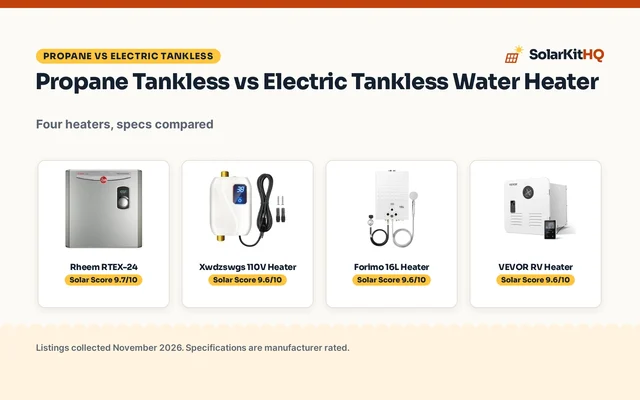
The gear in this roundup is electric, not solar or propane: all 4 listings are electric tankless water heaters, so they show another option rather than either side of the headline comparison. Ranked by flow, warranty and stated certification, the Rheem RTEX-11 leads, followed by the Rheem RTEX-08, the Jflapil 3000W unit and the xwdzswgs 3000W unit.
| Unit | Power | Flow | Temperature range | Warranty |
|---|---|---|---|---|
| Rheem RTEX-11 | 11kW, 240V | Up to 2.68 GPM | 80 to 140°F | 5-year leak, 1-year parts |
| Rheem RTEX-08 | 8kW, 240V | Up to 1.95 GPM | 80 to 140°F | 5-year leak, 1-year parts |
| Jflapil 3000W | 3000W, 110V | 0.3 to 0.5 GPM | 82 to 131°F | 24-month |
| xwdzswgs 3000W | 3000W, 110V | 0.3 to 0.5 GPM | 82 to 131°F | 24-month |
The Rheem RTEX-11 is an 11kW tankless electric water heater for 240V single-phase power, providing up to 2.68 GPM for multiple fixtures. Digital thermostatic controls adjust in 1-degree increments from 80°F to 140°F, and the unit is 90% smaller than a traditional tank water heater with no venting required. It needs one 50-amp double-pole breaker, one set of #8 AWG copper conductors with ground and a recommended minimum 100-amp household electrical service panel. The maker gives two warranty terms, a 5-year leak and 1-year parts warranty and a limited lifetime warranty; check before ordering.
The Rheem RTEX-08 is the 8kW version of the same design, providing up to 1.95 GPM for multiple fixtures on 240V single-phase power. It uses the same digital thermostatic controls from 80°F to 140°F in 1-degree increments and the same compact no-venting design. It needs one 40-amp double-pole breaker with #8 AWG copper conductors and a recommended minimum 100-amp household panel. The maker lists a 5-year leak and 1-year parts warranty.
The Jflapil unit is a 110V 3000W tankless electric water heater for under-sink use, with a digital display and a temperature range of 82°F at 0.3 GPM to 131°F at 0.5 GPM. It is ETL certified, carries IPX4 stated protection with water-electric isolation, leakage protection, dry-burn protection and overheating protection, and runs at 98% thermal efficiency. It mounts vertically only, uses standard 1/2 inch NPT connectors and needs 2.5mm² wires with 32A+ circuit breakers. It is not for shower use, which needs a minimum 1.8 GPM flow. The maker provides a 24-month warranty and 24/7 online customer service.
The xwdzswgs unit matches the Jflapil unit on power and flow: 3000W and 110V, with 82°F at 0.3 GPM to 131°F at 0.5 GPM and an LED display with Fahrenheit or Celsius switching by holding the power button for 6 seconds. It also states IPX4 protection, water and electricity isolation, leakage protection, dry boil protection and automatic power off under overheating and inactivity, with 98% thermal efficiency and ETL standard qualification. It uses 1/2 inch NPT connections, vertical installation only and 2.5mm² wires with 32 amp breakers, and it is not suitable for shower use, which normally requires at least 1.8 GPM. The maker offers a 30-day money-back guarantee and a 24-month warranty.
What to check before you choose
- Flow: the Rheem 11kW unit provides up to 2.68 GPM, the 8kW unit up to 1.95 GPM, and the 3000W units 0.3 to 0.5 GPM.
- Power: the Rheem units need 240V single-phase power, while the 3000W units run on 110V.
- Shower use: the 3000W units are not for shower use, which needs a minimum 1.8 GPM flow.
- Warranty: the Rheem units list 5-year leak and 1-year parts coverage, while the 3000W units list a 24-month warranty.
- Install: a licensed electrician should install or check the circuit for any unit that connects to home wiring.
FAQ: power away from the grid
Can a solar water heater work on cloudy days?
A solar heater warms water with the sun, so cloudy weather cuts output and the tank holds less hot water. A propane tankless heater warms water on demand whatever the weather, which is why homes with long cloudy stretches lean toward propane.
Does a propane tankless water heater need venting?
Yes. Tankless gas water heaters need venting, which the Rheem listing notes when it says its electric units need no venting to operate.
What size tankless electric water heater do I need?
Match flow to fixtures. The Rheem 11kW unit provides up to 2.68 GPM for multiple fixtures, while the 8kW unit provides up to 1.95 GPM. The 3000W units provide 0.3 to 0.5 GPM and are not for shower use, which needs a minimum 1.8 GPM flow.
Do electric tankless water heaters need a special circuit?
The Rheem 11kW unit requires 240V single-phase power with a 50-amp double-pole breaker and a 100-amp household panel, while the 3000W units run on 110V with 32A+ circuit breakers. A licensed electrician should install or check the circuit.
Related solar guides
See the solar water heater vs electric water heater, the best propane tankless water heater, the solar water heater maintenance and the propane tankless vs tank water heater. Also see the best RV hot water heater for solar, the best portable hot water heater for camping and the how long does electric water heater last.