On this page
The cabin lights dim at dusk, the phone dies just as the map is needed, and the fridge hums on a battery bank that no one has watched all day. The question behind that moment is what is battery management system protection, and the short answer is that it is the circuit inside a lithium battery that watches voltage, current, temperature and remaining capacity, and raises an alarm before over-charge or deep discharge, protecting the battery. This guide explains what that watch covers, and compares 4 battery monitors that put those readings on a screen.
SolarKitHQ earns a commission when you buy through links on this page, at no extra cost to you. As an Amazon Associate I earn from qualifying purchases. Affiliate disclosure.
What is battery management system protection?
A battery management system watches the pack the way a gauge watches a fuel tank, but with more readings at once. The Coolschmax listing describes the job plainly: count charge in and out to find remaining capacity, watch voltage, current, power and temperature, and sound an alarm when voltage leaves the set range or capacity falls to 20%. The DROK listing adds a backlight alarm for the same low-capacity point. Together they show the core of the job: know how much charge is left, know when it is falling, and stop the slide before the battery is empty.
What a battery management system watches
Each reading answers a separate question about the pack. Voltage shows the push behind the current, current shows the flow in and out, capacity shows what is left, and temperature shows how warm the pack runs. The monitors below cover these readings in different combinations, so match the readings you need to the monitor that states them.
| Reading | What it shows | Stated range | Amazon |
|---|---|---|---|
| Voltage | The push behind the current | 8 to 100V on the DROK listing | |
| Current | Charge flowing in and out | 0.05 to 100A on the DROK listing; 300A shunt on the Coolschmax listing | |
| Capacity | Charge left in the pack | 0.1 to 99999 Ah on the DROK listing; percent and Ah on the Coolschmax listing | |
| Temperature | How warm the pack runs | Shown in C and F on the Coolschmax listing |
Battery monitors that show the readings
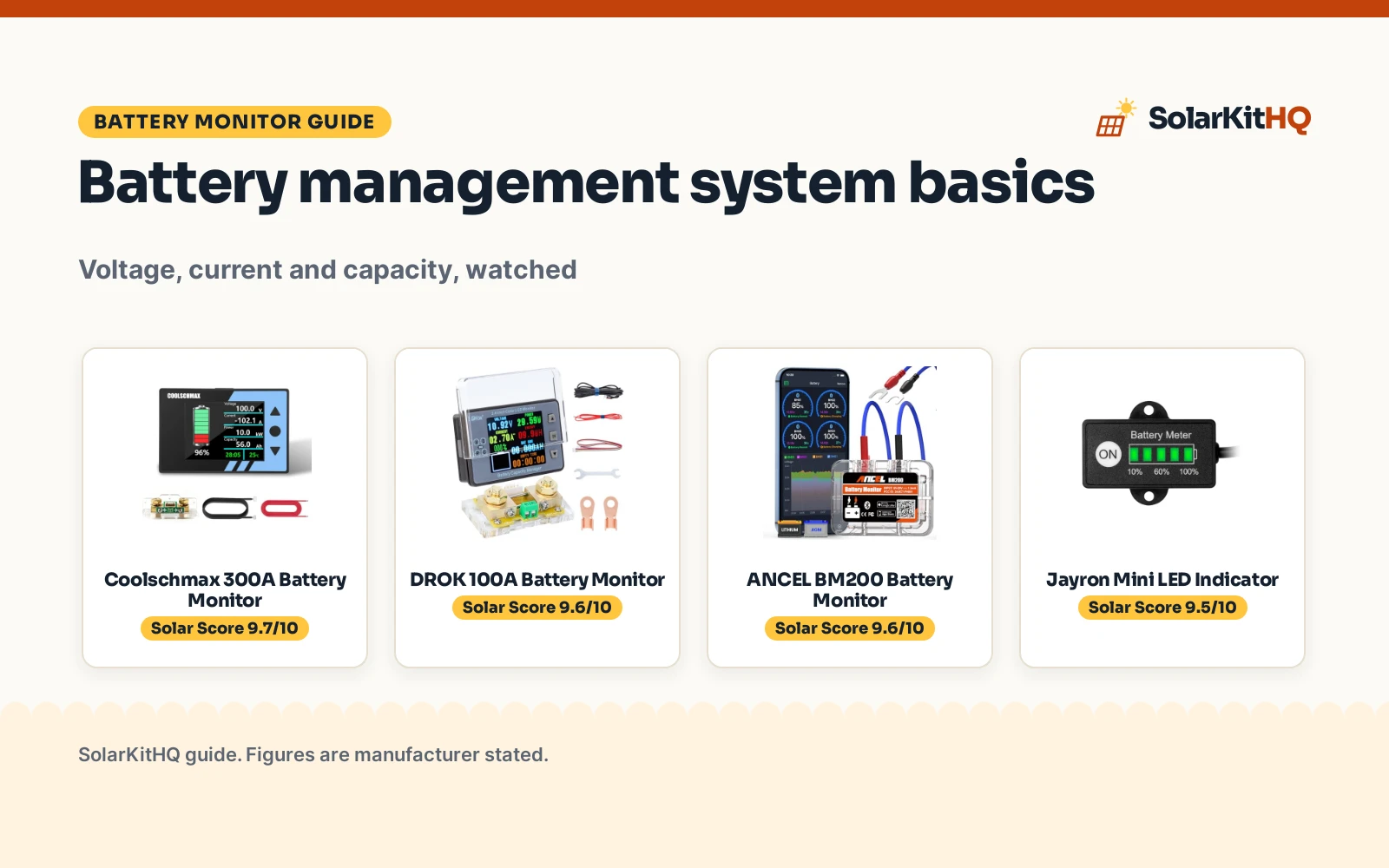
Reading voltage, current and remaining capacity is the step that needs a monitor in the loop, so the 4 monitors below carry that part of the job, from a full shunt monitor to a simple LED gauge.
| # | Product | Solar Score | Buy |
|---|---|---|---|
| 1 |  Coolschmax 300A Battery Monitor | 9.7/10 | Buy on Amazon |
| 2 |  DROK 100A Battery Monitor | 9.6/10 | Buy on Amazon |
| 3 |  ANCEL BM200 Bluetooth | 9.6/10 | Buy on Amazon |
| 4 |  Jayron Mini LED Indicator | 9.5/10 | Buy on Amazon |

Coolschmax 300A Battery Monitor
A 300A shunt monitor that counts charge in and out for a live remaining-capacity reading on 12V to 100V systems.
Pros
- 300A shunt with 75mV stated, covering 12V to 100V systems
- CZSOC counting gives remaining capacity in Ah and percent, not a voltage guess
- Programmable high and low voltage alarms plus a 20% low-capacity alarm
- Temperature, power and remaining time shown on a 2.4-inch screen
Cons
- Setup needs a full-battery sync to reach 100% SOC
- Screen-off current stays under 100mA, so it still draws power
- No cell-level voltage detail is stated
- 1 year warranty, shorter than the 2-year term on the Jayron pick
Detailed Review
The listing states a 300A/75mV shunt, a 2nd-gen CZSOC system with a 16-bit ADC, 1% accuracy, and readings for SOC, voltage, current, power and temperature, with remaining time in hours and minutes. It lists programmable voltage thresholds from 0.1 to 500V, a buzzer and red flash when a threshold is passed, a 20% low-capacity alarm, 10-level brightness, standby current of 1mA, and compatibility with lithium, LiFePO4, lead-acid, gel and AGM batteries. The title gives 8V to 100V while the bullets give 12V to 100V for system compatibility; the narrower 12V lower bound is the safer reading.
Who it's for: RV, boat, golf cart and solar owners who want a live percent reading and alarms on a large bank. Who should skip it: owners who only need a basic LED gauge and do not want to sync a full battery at setup.
Its Solar Score of 9.7/10 comes from performance 32/35, build 22/25, value 21/25, safety 8/10 and warranty 4/5: 87 of 100 points, placed on our 9.2 to 9.8 scale.
Key Specifications
| Range | 8V to 100V, 300A shunt |
|---|---|
| Display | 2.4-inch TFT LCD, 10-level brightness |
| Accuracy | 1% SOC, 16-bit ADC |
| Alarms | High/low voltage, 20% low capacity |
Taken from the seller's listing on 13 November 2026. Capacity and output figures are rated by the manufacturer.
Safety and Warranty
What this listing states. Programmable high and low voltage alarms and a 20% low-capacity alarm stated, to help prevent over-charging and deep-discharging, so safety scores 8 of 10. 1 Year Manufacturer warranty stated. It does not say everything a buyer needs, such as who pays return shipping, so warranty scores 4 of 5. See How We Pick.
Install it right. Fit shunts, bus bars and fuses within their stated current ratings, follow the wiring order in the manual, and disconnect the battery before you work on any connection.
This is general buying information, not professional advice. Follow each product manual and local rules, and see our Safety Disclaimer.

DROK 100A Battery Monitor
An 8 to 100V monitor that reads volts, amps, watts, capacity and time on a 2.4-inch color screen.
Pros
- Voltage range 8 to 100V covers 12V, 24V, 36V, 48V and 60V systems
- Measure speed of 20 Time/s stated, with 0.05 to 100A current range
- Backlight alarm when capacity falls below 20% or voltage falls below LVP
- 2.4-inch color screen reads in sun and at night, indoors and outside
Cons
- No temperature reading is stated
- Voltage accuracy is plus or minus 1% plus 2 digits
- No external shunt is listed in the box
- The backlight alarm only works after the LBR function is turned on
Detailed Review
The listing states a voltage range of 8 to 100V, a current range of 0.05 to 100A, power from 0 to 50 kW, capacity from 0.1 to 99999 Ah, and a measure speed of 20 Time/s, with voltage accuracy of plus or minus 1% plus 2 digits and current precision of plus or minus 0.5% plus 2 digits. It lists a 2.4-inch color LCD screen, a backlight alarm when remaining capacity is lower than 20% or voltage is lower than LVP, use as a battery capacity monitor for solar panels and as a meter for RV and boat batteries, a mounting base, and a one-year warranty.
Who it's for: RV and solar owners who want volts, amps, watts and capacity on a color screen across a wide voltage range. Who should skip it: owners who need a temperature reading or a shunt in the box.
Its Solar Score of 9.6/10 comes from performance 29/35, build 21/25, value 20/25, safety 7/10 and warranty 0/5: 77 of 100 points, placed on our 9.2 to 9.8 scale.
Key Specifications
| Range | 8 to 100V, 0.05 to 100A |
|---|---|
| Display | 2.4-inch color LCD |
| Power | 0 to 50 kW, 0.1 to 99999 Ah |
| Alarm | Backlight alarm below 20% capacity |
Taken from the seller's listing on 13 November 2026. Capacity and output figures are rated by the manufacturer.
Safety and Warranty
What this listing states. Backlight alarm when remaining capacity is lower than 20% or voltage is lower than LVP stated, so safety scores 7 of 10. No warranty term, so warranty scores zero. See How We Pick.
Install it right. Fit shunts, bus bars and fuses within their stated current ratings, follow the wiring order in the manual, and disconnect the battery before you work on any connection.
This is general buying information, not professional advice. Follow each product manual and local rules, and see our Safety Disclaimer.

ANCEL BM200 Bluetooth
A 12V Bluetooth battery monitor with cranking and charging readings, 70 days of history and app alerts for abnormal voltage.
Pros
- Bluetooth 4.2 shows voltage, cranking and charging readings on a phone within 15 to 30 feet
- Records voltage every 2 minutes and keeps 70 days of history
- Reverse polarity and short-circuit protection stated, with an IP67 rating
- App alerts for abnormal voltage stated
Cons
- No warranty term is stated
- Needs a phone app; no built-in display
- Draws 1.5mA while connected, per the listing
Detailed Review
The listing states a 12V Bluetooth monitor with Bluetooth 4.2, cranking and charging readings, an app that records voltage every 2 minutes and keeps 70 days of history, reverse polarity and short-circuit protection, an IP67 rating and a 3M adhesive mount. It monitors up to 4 devices at once, draws 1.5mA, and sends an app alert when voltage turns abnormal. The title describes the unit as a load checker while the bullets describe a monitor, so read it as a monitor.
Who it's for: drivers who want phone alerts and a long voltage history on a 12V system. Who should skip it: anyone who wants a reading on the panel without opening an app.
Its Solar Score of 9.6/10 comes from performance 30/35, build 21/25, value 21/25, safety 8/10 and warranty 0/5: 80 of 100 points, placed on our 9.2 to 9.8 scale.
Key Specifications
| Voltage | 12V |
|---|---|
| Connection | Bluetooth 4.2 |
| History | 70 days, recorded every 2 minutes |
| Rating | IP67 |
Figures as published on the retailer listing, collected 9 November 2026. Performance figures are manufacturer rated.
Safety and Warranty
What this listing states. Reverse polarity and short-circuit protection, IP67 rating stated, so safety scores 8 of 10. No warranty term, so warranty scores zero. See How We Pick.
Install it right. Fit shunts, bus bars and fuses within their stated current ratings, follow the wiring order in the manual, and disconnect the battery before you work on any connection.
This is general buying information, not professional advice. Follow each product manual and local rules, and see our Safety Disclaimer.
Jayron Mini LED Indicator
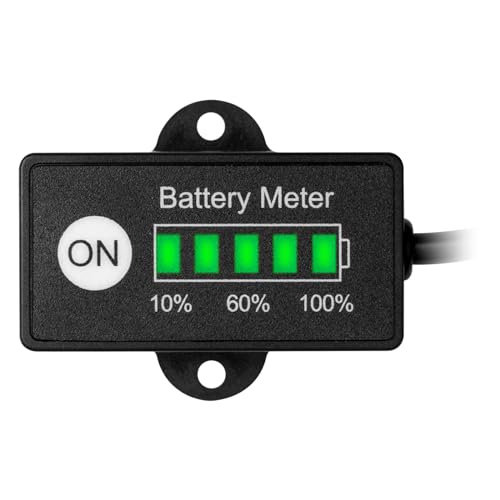
A 5-column LED gauge that shows remaining power in 20% steps and fits 12V and 24V equipment.
Pros
- Recognizes 12V and 24V automatically, with no setup step stated
- 5-column LED chart reads at a glance, with 20% per segment
- Independent on/off button avoids battery loss between checks
- IP 65 stated with CE certification
Cons
- No volts, amps or watts figure is shown, only LED columns
- No remaining time or capacity figure is stated
- LED steps of 20% hide small changes in charge
- No shunt is stated
Detailed Review
The listing states a 5-column LED chart with green indicator lights, a resolution of 20% per LED segment, automatic recognition of 12V and 24V, 2 connection methods with a key switch or none, a black wire to the negative pole and a red wire to the positive pole, an independent on and off button, IP 65 stated with CE ROHS certification, and a two-year after-sales term. It is made for golf carts, forklifts and other DC 12/24V battery-powered equipment.
Who it's for: owners who want a cheap, simple gauge on a 12V or 24V cart, forklift or piece of equipment. Who should skip it: anyone who needs volts, amps, watts or a percent reading.
Its Solar Score of 9.5/10 comes from performance 26/35, build 20/25, value 20/25, safety 7/10 and warranty 0/5: 73 of 100 points, placed on our 9.2 to 9.8 scale.
Key Specifications
| Display | 5-column LED, 20% per segment |
|---|---|
| Systems | DC 12V and 24V, auto recognition |
| Install | 2 connection methods, key switch or none |
| Protection | IP 65 stated, CE certification |
Taken from the seller's listing on 13 November 2026. Capacity and output figures are rated by the manufacturer.
Safety and Warranty
What this listing states. IP 65 stated with CE certification, so safety scores 7 of 10. No warranty term, so warranty scores zero. See How We Pick.
Install it right. Fit shunts, bus bars and fuses within their stated current ratings, follow the wiring order in the manual, and disconnect the battery before you work on any connection.
This is general buying information, not professional advice. Follow each product manual and local rules, and see our Safety Disclaimer.
As an Amazon Associate I earn from qualifying purchases.
How to choose a battery management system monitor
Match the monitor to the bank it will watch: voltage range, current range, and the display and alarms you will actually look at.
Match the voltage range to the bank
The DROK listing covers 8 to 100V, and the Coolschmax title covers 8V to 100V with its bullets giving 12V to 100V, so both cover 12V, 24V, 36V, 48V and 60V banks. The Jayron gauge (on Amazon) only states 12V and 24V, so it suits a smaller bank. See the 12V vs 24V lithium battery comparison when the bank voltage is still undecided.
Match the current range to the load
Current range decides whether the monitor can read the biggest draw on the bank. The DROK listing reads 0.05 to 100A, while the Coolschmax listing includes a 300A shunt for larger loads. See the 100 amp vs 300 amp battery shunt comparison for the difference between those shunt sizes.
Pick the display and alarms you will actually watch
A 2.4-inch screen shows volts, amps, watts and capacity at once, while a 5-column LED gauge shows charge in 20% steps and suits a quick glance. Alarms matter when no one is watching: the Coolschmax and DROK listings both alarm at 20% remaining capacity. See the analog vs digital battery monitor guide and the best battery monitors for LiFePO4 for more display options.
FAQ: power away from the grid
What does a battery management system do?
It watches voltage, current, temperature and remaining capacity in a lithium battery, and raises an alarm when voltage leaves the set range or capacity falls to 20%, to help prevent over-charge and deep discharge.
What is SOC on a battery monitor?
SOC is remaining capacity as a percent. The Coolschmax listing counts charge in and out with a 16-bit ADC to find it, with 1% accuracy stated, instead of guessing from voltage, and shows it in Ah and percent with remaining time in hours and minutes.
Do these monitors work with LiFePO4 batteries?
Yes. The Coolschmax listing states LiFePO4, lithium, lead-acid, gel and AGM, the Jayron gauge is made for LiFePO4 at 12V and 24V, and the DROK listing covers RV and solar battery banks.
What happens when a battery reaches 20% capacity?
On the Coolschmax and DROK listings, 20% is the low-capacity alarm point: the buzzer sounds and the reading flashes red on the Coolschmax listing, and the backlight flashes on the DROK listing. Charge the bank when the alarm shows.
Related solar guides
See every batteries guide and all battery monitor guides.
More picks: best battery monitors for a solar system, best battery monitors for a camper, best battery monitors for a van.