On this page
The lights go out at dinner time, the fridge hums to a stop, and the question is which backup box on the porch can carry the house until morning. That choice comes down to 120v vs 240v power station output, and the sides are not interchangeable. We compared the listings on what each one states: capacity, output, charging, protections and warranty terms. The 240v examples suit homes with heavy appliances, while the 120v station suits smaller loads and a lighter carry.
SolarKitHQ earns a commission when you buy through links on this page, at no extra cost to you. As an Amazon Associate I earn from qualifying purchases. Affiliate disclosure.
120v vs 240v power station: side by side
| 120v vs 240v power station | AFERIY P280 4096Wh | OSCAL PowerMax 6000 | EcoVolt PowerMax 6000 | Amazon |
|---|---|---|---|---|
| Side | 120v | 240v power station | 240v power station | |
| Capacity | 2048Wh, expandable to 4096Wh | 3600Wh, expandable to 57.6kWh | 3600Wh, expandable to 57.6kWh | |
| AC output | 2800W, 120V | 6000W, 9000W peak, 120/240V | 6000W, 9000W peak, 120/240V | |
| Charging input | 1800W AC, 1200W PV | 2200W AC, 2400W solar | AC input watts not stated | |
| Cycle life | 4000+ cycles | Up to 3500 cycles | Up to 3,500 cycles | |
| Warranty | 5+2 Years | 5 Year | 5 Year | |
| Weight | 88.0 pounds | 100.31 pounds | 101.0 pounds |
These specs are rated by the maker and quoted from each listing on 6 November 2026.
Capacity and output
The gap in capacity is wide. The AFERIY example lists 2048Wh and expands to 4096Wh with 1 extra battery, and to 10.24kWh with extra batteries, while the OSCAL and EcoVolt examples each list 3600Wh expandable to 57.6kWh. Output follows the same split: the AFERIY example states 2800W of AC output at 120V, and each 240v example states 6000W of AC output with 9000W peak at 120/240V. The AFERIY example states 300W DC output through its XT60 port, and the OSCAL example states 14 outlet sources against the AFERIY example’s 15 ports. On capacity and output alone, the 240v examples cover larger loads, and the AFERIY example covers the 120V loads in a home. For home backup planning, see the best portable power station for home backup.
Charging and switchover
Charging speed is where the listings differ in detail. The AFERIY example states 1800W AC input and 1200W PV input, with 0% to 80% in 38 minutes. The OSCAL example states 2200W AC input and 2400W solar input, and gives two charging times that do not agree: 1.44 hours and 1.96 hours to full. The EcoVolt example states about 1.96 hours to a full charge from AC input, and lists no AC input watts. For switchover, the OSCAL example states 5-8 ms through its EPS supply, and the EcoVolt example states about 0.01 seconds through its UPS function. The AFERIY example states no switchover time. For campsite charging, see the best portable power station for camping.
What the listings leave unclear
Each listing leaves something unclear. The AFERIY example lists 15 ports and charging for up to 16 devices at the same time, and the counts do not match. The OSCAL example states 1.44 hours in one line and 1.96 hours in another for a full charge, so the charging time is unsettled. The EcoVolt example lists capacity as 3600Wh in the title and as 3600Wh and 7200Wh in the bullets, so the capacity that ships is unsettled. The AFERIY warranty reads ‘5+2 Years’, which leaves the split between the two figures unclear. None of the listings states a UL or ETL listing.
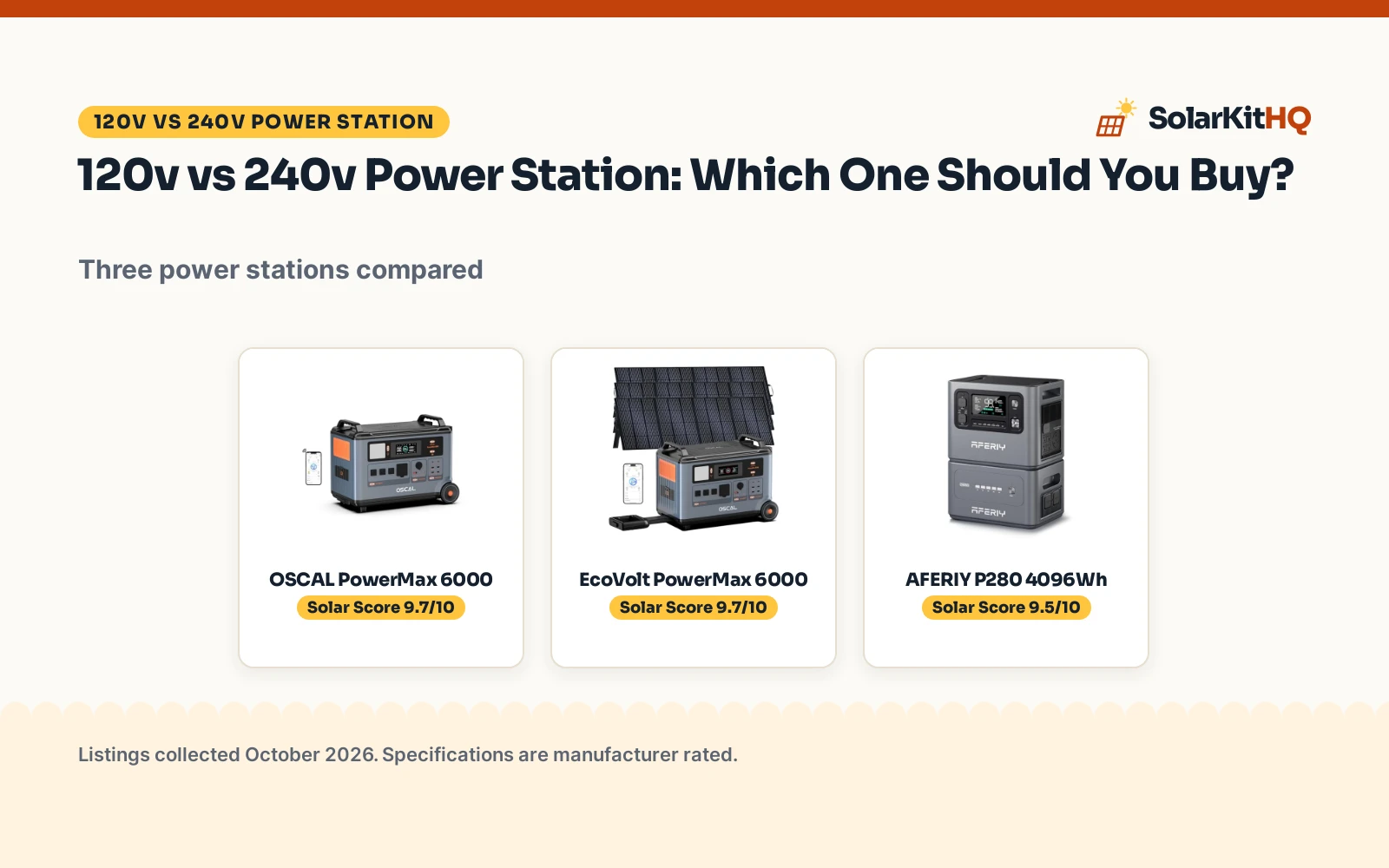
Three examples
| # | Product | Solar Score | Buy |
|---|---|---|---|
| 1 |  OSCAL PowerMax 6000 | 9.7/10 | Buy on Amazon |
| 2 |  EcoVolt PowerMax 6000 | 9.7/10 | Buy on Amazon |
| 3 |  AFERIY P280 4096Wh | 9.5/10 | Buy on Amazon |

OSCAL PowerMax 6000
A 120/240V split phase solar generator with 3600Wh of LiFePO4 capacity, 6000W of AC output with 9000W peak, and 2200W AC input.
Pros
- 6000W AC output with 9000W peak, plus 120/240V split phase output
- 3600Wh LiFePO4 capacity expandable to 57.6kWh
- 2200W AC input and 2400W solar input for fast charging
- Eight-layer safety BMS with stated protections, up to 3500 cycles and a service life of up to 25 years
Cons
- Charging time is stated in two places and the two figures disagree: 1.44 hours and 1.96 hours
- 14 outlet sources, fewer than the AFERIY example's 15 ports
- No solar panel is included in the listed contents
Detailed Review
The listing states a 120/240V split phase solar generator with 3600Wh of LiFePO4 capacity, expandable to 57.6kWh, 6000W of AC output with 9000W peak, 2200W AC input and 2400W solar input, and 14 outlet sources. It states a 5-8 ms switchover through its EPS supply, an eight-layer safety BMS with protection against overcharge, over-discharge, over-voltage, over-current, short-circuit and temperature fluctuations, up to 3500 charge and discharge cycles and a service life of up to 25 years. The unit weighs 100.31 pounds, measures 23.2 by 13.8 by 17.5 inches, and carries a 5 Year warranty. The charging time is stated as 1.44 hours in one line and 1.96 hours in another.
Who it's for: homeowners who want 240V backup with 6000W of output and 2200W AC input. Who should skip it: anyone who wants a solar panel in the box or a settled charging time.
Its Solar Score of 9.7/10 comes from performance 32/35, build 22/25, value 21/25, safety 8/10 and warranty 3/5: 86 of 100 points, placed on our 9.2 to 9.8 scale.
Key Specifications
| Capacity | 3600Wh, expandable to 57.6kWh |
|---|---|
| AC output | 6000W, 9000W peak, 120/240V |
| Charging | 2200W AC input, 2400W solar input |
| Weight | 100.31 pounds |
Figures as published on the retailer listing, collected 6 November 2026. Performance figures are manufacturer rated.
Safety and Warranty
What this listing states. Eight-layer safety BMS with protection against overcharge, over-discharge, over-voltage, over-current, short-circuit and temperature fluctuations stated, so safety scores 8 of 10. 5 Year warranty stated. It does not say everything a buyer needs, such as who pays return shipping, so warranty scores 3 of 5. See How We Pick.
Power station limits. Stay within the stated continuous output and solar input limits, keep the unit ventilated and dry, charge within the stated temperature range, and never connect it to home wiring except through equipment a licensed electrician installs.
This is general buying information, not professional advice. Follow each product manual and local rules, and see our Safety Disclaimer.

EcoVolt PowerMax 6000
A 120/240V split phase solar generator with 3600Wh of capacity, 6000W of AC output with 9000W peak, bundled with 3 200W solar panels.
Pros
- 6000W AC output with 9000W peak and 120/240V split phase output
- Bundled with 3x200W solar panels
- 3600Wh LiFePO4 capacity expandable to 57.6kWh, with up to 3,500 cycles
- App control over Wi-Fi and Bluetooth, plus a UPS transfer time of about 0.01 seconds
Cons
- Capacity is stated as both 3600Wh and 7200Wh, and the listing does not settle which one ships
- Solar panel and power station ship in separate packages, so part of the order can arrive later
- 101.0 pounds stated, the heaviest of the three
- Runtime examples are rough: a 60W refrigerator for roughly 1 to 2 days
Detailed Review
The listing states a 120/240V split phase solar generator with 3600Wh of capacity, expandable to 57.6kWh, 6000W of AC output with 9000W peak, and 3x200W solar panels. It states a full charge in about 1.96 hours from AC input, a LiFePO4 battery with up to 3,500 charge cycles, a built-in Battery Management System (BMS) with protection against overcharge, overvoltage, overcurrent and overheating, app control over Wi-Fi and Bluetooth, a UPS transfer time of about 0.01 seconds and a built-in surge protector. The unit weighs 101.0 pounds, measures 13.8 by 17.5 by 23.2 inches, and carries a 5 Year warranty. The bullets also list a 7200Wh capacity, which conflicts with the 3600Wh title figure, and the panels ship in a separate package from the station.
Who it's for: homeowners who want 240V backup with panels bundled in and app control. Who should skip it: anyone who wants the capacity figure settled before ordering.
Its Solar Score of 9.7/10 comes from performance 30/35, build 21/25, value 21/25, safety 7/10 and warranty 3/5: 82 of 100 points, placed on our 9.2 to 9.8 scale.
Key Specifications
| Capacity | 3600Wh, expandable to 57.6kWh |
|---|---|
| AC output | 6000W, 9000W peak, 120/240V |
| Solar panels | 3x200W solar panels |
| Weight | 101.0 pounds |
Figures as published on the retailer listing, collected 6 November 2026. Performance figures are manufacturer rated.
Safety and Warranty
What this listing states. Built-in Battery Management System (BMS) helps protect against overcharge, overvoltage, overcurrent and overheating stated, so safety scores 7 of 10. 5 Year warranty stated. It does not say everything a buyer needs, such as who pays return shipping, so warranty scores 3 of 5. See How We Pick.
Power station limits. Stay within the stated continuous output and solar input limits, keep the unit ventilated and dry, charge within the stated temperature range, and never connect it to home wiring except through equipment a licensed electrician installs.
This is general buying information, not professional advice. Follow each product manual and local rules, and see our Safety Disclaimer.

AFERIY P280 4096Wh
A 120V portable power station with 2048Wh of LiFePO4 capacity that expands to 4096Wh with 1 extra battery, 2800W of AC output and 15 ports.
Pros
- Expands from 2048Wh to 4096Wh with 1 extra battery, and to 10.24kWh with extra batteries
- 2800W AC output stated to power 95% of large home equipment
- 1800W AC input and 1200W PV input, with 0% to 80% in 38 minutes
- 15 ports, including a NEMA TT-30 outlet, 4 USB-C ports and a 300W XT60 port
Cons
- States 120V AC output only, with no 240V output stated
- Listing says 15 ports and up to 16 devices at once, and the two counts do not match
- Base capacity is 2048Wh; the 4096Wh figure needs the extra battery
- Warranty description reads '5+2 Years', which leaves the split between the two figures unclear
Detailed Review
The listing states a 120V portable power station with 2048Wh of LiFePO4 capacity, expandable to 4096Wh with 1 extra battery and to 10.24kWh with extra batteries, 2800W of AC output, 300W DC output, 1800W AC input and 1200W PV input, and a charge from 0% to 80% in 38 minutes. It lists 15 ports, including a NEMA TT-30 outlet, 4 20Ah AC outlets, 2 USB-A ports, 4 USB-C ports, 2 DC5521 ports, a car charging outlet and a 300W XT60 port, and states 4000+ cycle life with 10-year durability. The unit weighs 88.0 pounds and measures 12.7 by 11.0 by 15.6 inches. The listing says 15 ports and up to 16 devices charged at the same time, and the warranty description reads '5+2 Years'.
Who it's for: homeowners and campers who need 120V backup with 15 ports stated and a battery that expands to 4096Wh. Who should skip it: anyone who runs 240V appliances or wants a stated battery management system.
Its Solar Score of 9.5/10 comes from performance 28/35, build 21/25, value 20/25, safety 0/10 and warranty 3/5: 72 of 100 points, placed on our 9.2 to 9.8 scale.
Key Specifications
| Capacity | 2048Wh, expandable to 4096Wh with 1 extra battery |
|---|---|
| AC output | 2800W, 120V |
| Charging | 1800W AC input, 1200W PV input |
| Weight | 88.0 pounds |
Figures as published on the retailer listing, collected 6 November 2026. Performance figures are manufacturer rated.
Safety and Warranty
What this listing states. No UL, FCC or battery management statement is stated, so safety scores zero. 5+2 Years stated. It does not say everything a buyer needs, such as who pays return shipping, so warranty scores 3 of 5. See How We Pick.
Power station limits. Stay within the stated continuous output and solar input limits, keep the unit ventilated and dry, charge within the stated temperature range, and never connect it to home wiring except through equipment a licensed electrician installs.
This is general buying information, not professional advice. Follow each product manual and local rules, and see our Safety Disclaimer.
As an Amazon Associate I earn from qualifying purchases.
Where the points went
The Solar Score weighs performance, build, value, safety and warranty. For power stations, safety means a battery management system or another protection the listing names; the OSCAL and EcoVolt examples state a BMS, and the AFERIY example states none. All three state a warranty term, from 5 Year terms to the AFERIY ‘5+2 Years’ description. How we pick explains the weights.
| Product | Solar Score | Perf. /35 | Build /25 | Value /25 | Safety /10 | Warranty /5 |
|---|---|---|---|---|---|---|
| OSCAL PowerMax 6000 | 9.7 | 32 | 22 | 21 | 8 | 3 |
| EcoVolt PowerMax 6000 | 9.7 | 30 | 21 | 21 | 7 | 3 |
| AFERIY P280 4096Wh | 9.5 | 28 | 21 | 20 | 0 | 3 |
Every total is translated into a figure between 9.2 and 9.8 with a linear formula; ranking by points and ranking by score always agree.
120v vs 240v power station: which should you choose?
Choose the 120v side if your loads run on 120V outlets and you want the lighter unit: the AFERIY example weighs 88.0 pounds and lists 15 ports. Choose the 240v side if you run appliances that need 240V, or if you want 6000W of output: the OSCAL and EcoVolt examples each state 6000W AC output with 9000W peak. Between the 240v examples, the OSCAL example states 2200W AC input and 2400W solar input, and the EcoVolt example bundles 3 200W solar panels. If a station feeds a home panel, a licensed electrician should install it.
| If you need | Look at |
|---|---|
| 120V loads only | AFERIY P280 4096Wh, 2800W AC output at 120V |
| 240V appliances | OSCAL PowerMax 6000 or EcoVolt PowerMax 6000, 120/240V split phase output |
| Highest charging input | OSCAL PowerMax 6000, 2200W AC input and 2400W solar input |
| Panels included | EcoVolt PowerMax 6000, with 3 200W solar panels |
Sizing Notes
- Match the station’s stated AC output and voltage to the appliances you plan to run: 120V loads to the AFERIY example, 240V loads to the OSCAL or EcoVolt examples.
- Match watt-hours to the loads you plan: 2048Wh in the AFERIY example, 3600Wh in the OSCAL and EcoVolt examples, before expansion.
- Check the charging inputs against your panels and outlets: 1800W AC and 1200W PV for the AFERIY example, 2200W AC and 2400W solar for the OSCAL example.
- Fuse the DC leads as the manual directs, and leave any connection to a home panel to a licensed electrician.
FAQ: power away from the grid
Which side suits a home with 240V appliances?
The 240v side. The OSCAL and EcoVolt examples state 120/240V split phase output with 6000W AC output, while the AFERIY example states 120V output only.
How much capacity do the 240v examples state?
Each states 3600Wh, expandable to 57.6kWh. The AFERIY example states 2048Wh, expandable to 4096Wh with 1 extra battery.
How fast do these stations charge?
The AFERIY example states 0% to 80% in 38 minutes from 1800W AC input and 1200W PV input. The OSCAL example states 2200W AC input and 2400W solar input but gives two full-charge times, 1.44 hours and 1.96 hours. The EcoVolt example states about 1.96 hours from AC input.
What warranty does each station state?
The OSCAL and EcoVolt examples each state a 5 Year warranty, and the AFERIY example lists a ‘5+2 Years’ warranty description.
Related solar guides
See every Portable Power Stations guide and all Power Stations and Generators guides. For camping power, see the best portable power station for camping, and for home backup, the best portable power station for home backup.
More picks: best home backup power station for hurricane, best solar generator for freezer, best portable power station for air conditioner, best portable power station for off grid living.