On this page
MPPT vs PWM charge controller is the question that decides how much of your panel’s power actually reaches the battery: the MPPT examples here track at up to 99% efficiency, the PWM examples switch simpler and cheaper. We compared four listings, two MPPT and two PWM controllers, on current, PV input, battery support and warranty, using each listing’s own figures. Verdict: MPPT for bigger arrays and lithium, PWM for small 12/24V lead-acid systems.
SolarKitHQ earns a commission when you buy through links on this page, at no extra cost to you. As an Amazon Associate I earn from qualifying purchases. Affiliate disclosure.
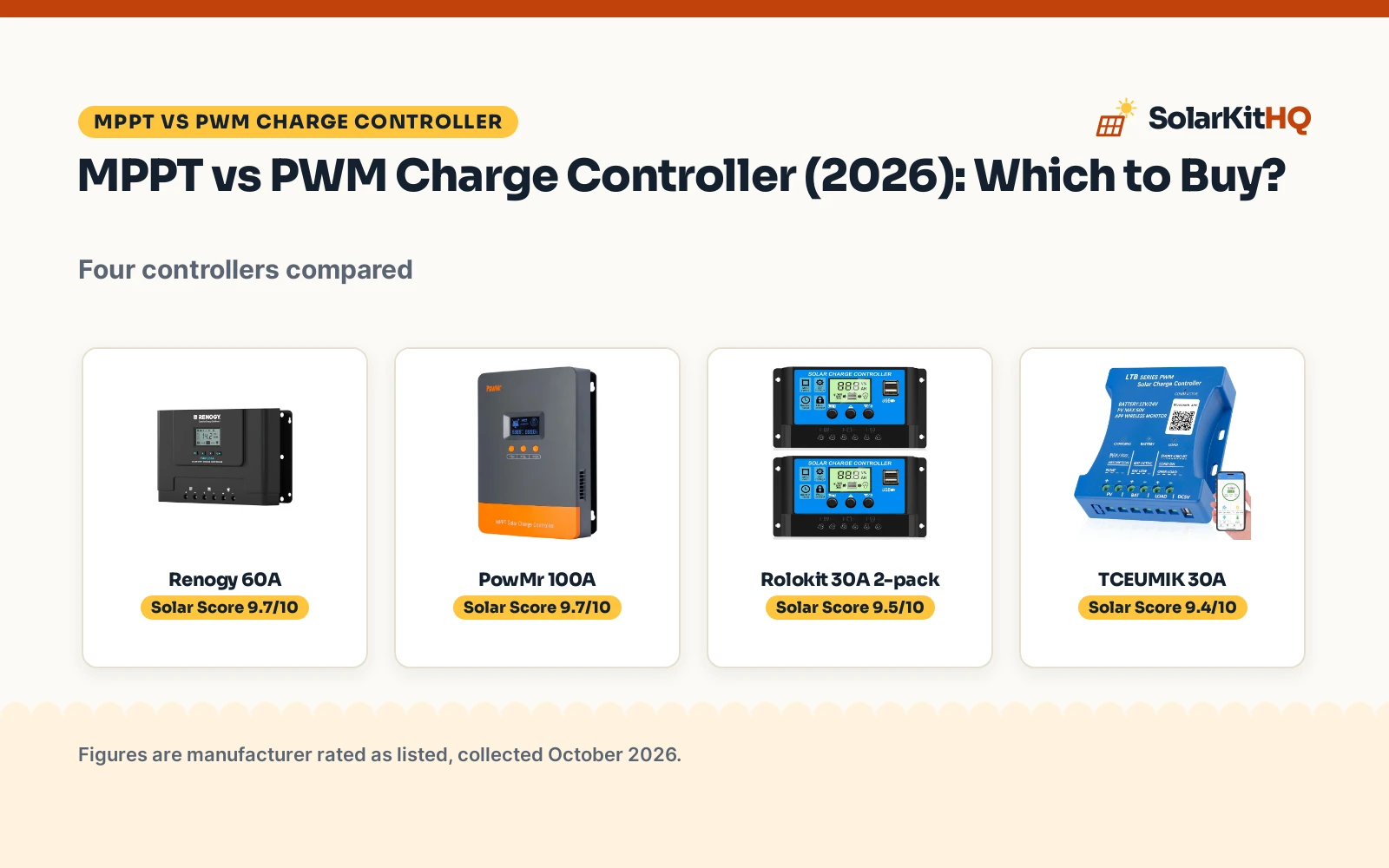
MPPT vs PWM charge controller: side by side
| Controller | Solar Score | Current | Max PV input | Battery types | Warranty | Amazon |
|---|---|---|---|---|---|---|
| Renogy 60A | 9.7/10 | 60A | 150V | Gel, flooded, lithium | 2-year stated | View on Amazon |
| PowMr 100A | 9.7/10 | 100A | 160V | Lead-acid, lithium | Not stated | View on Amazon |
| Rolokit 30A 2-pack | 9.5/10 | 30A x2 | Not stated | Lead-acid only | 12-month stated | View on Amazon |
| TCEUMIK 30A | 9.4/10 | 30A | 50V | 5 types, lithium ok | Not stated | View on Amazon |
Specifications are manufacturer rated as listed, collected 21 October 2026.
The contenders
| # | Product | Solar Score | Buy |
|---|---|---|---|
| 1 |  Renogy 60A | 9.7/10 | Buy on Amazon |
| 2 |  PowMr 100A | 9.7/10 | Buy on Amazon |
| 3 |  Rolokit 30A 2-pack | 9.5/10 | Buy on Amazon |
| 4 |  TCEUMIK 30A | 9.4/10 | Buy on Amazon |

Renogy 60A
A 60A MPPT controller with 150V input, FCC/RoHS/CE and 2-year warranty.
Pros
- 60A with 150V max solar input
- 12/24/36/48V auto with lithium
- FCC, RoHS and CE stated
- 2-year warranty stated
Cons
- BT2 module sold separately
- No efficiency percentage stated
- Metal body, no dimensions stated
- Six panels in series is maker claim
Detailed Review
The listing states a 60A MPPT solar charge controller for 12/24/36/48V auto systems, 150V maximum solar input, gel, sealed, flooded and lithium battery support, low-temperature protection for lithium, self-cooling design, LCD screen, FCC, RoHS and CE certifications, and a 2-year material and workmanship warranty. A BT2 Bluetooth module is sold separately.
Who it's for: mid-size systems that need certified MPPT with lithium support. Who should skip it: anyone who needs stated efficiency figures.
Its Solar Score of 9.7/10 comes from performance 30/35, build 21/25, value 21/25, safety 7/10 and warranty 5/5: 84 of 100 points, placed on our 9.2 to 9.8 scale.
Key Specifications
| Current | 60A |
|---|---|
| PV input | 150V max |
| Systems | 12-48V auto |
Figures as published on the retailer listing, collected 21 October 2026. Performance figures are manufacturer rated.
Safety and Warranty
What this listing states. FCC, RoHS and CE stated, so safety scores 7 of 10. 2-year warranty stated, so warranty scores 5 of 5. See How We Pick.
Stay under the input limit. Keep your panels' combined open circuit voltage, with cold weather margin, under the controller's stated maximum PV input, connect the battery first unless the manual says otherwise, and fuse both sides as the manual directs.
This is general buying information, not professional advice. Follow each product manual and local rules, and see our Safety Disclaimer.

PowMr 100A
A 100A MPPT controller with 99% tracking, 97% conversion and 160V input.
Pros
- 100A with 99% tracking stated
- 97% peak conversion stated
- 160V max PV input stated
- Up to 4800W at 48V stated
Cons
- No warranty term is stated
- Parallel setup adds complexity
- 12 units parallel is maker claim
- No dimensions stated
Detailed Review
The listing states a 100A MPPT solar charge controller for 12/24/36/48V systems, tracking efficiency up to 99% and peak conversion up to 97%, 160V max solar input, up to 4800W at 48V, 3-stage charging with adaptive boost, lead-acid and lithium support with lithium activation, full battery protections including reverse polarity, and parallel use of up to 12 units. No warranty term is stated.
Who it's for: large systems that need the most current and stated efficiency. Who should skip it: anyone who wants a stated warranty.
Its Solar Score of 9.7/10 comes from performance 34/35, build 22/25, value 22/25, safety 8/10 and warranty 0/5: 86 of 100 points, placed on our 9.2 to 9.8 scale.
Key Specifications
| Current | 100A |
|---|---|
| Tracking | 99% stated |
| PV input | 160V max |
Figures as published on the retailer listing, collected 21 October 2026. Performance figures are manufacturer rated.
Safety and Warranty
What this listing states. PV short-circuit, over-current, reverse polarity protection stated, so safety scores 8 of 10. No warranty term, so warranty scores zero. See How We Pick.
Stay under the input limit. Keep your panels' combined open circuit voltage, with cold weather margin, under the controller's stated maximum PV input, connect the battery first unless the manual says otherwise, and fuse both sides as the manual directs.
This is general buying information, not professional advice. Follow each product manual and local rules, and see our Safety Disclaimer.

Rolokit 30A 2-pack
A 2-pack of 30A PWM controllers with LCD, USB and 12-month guarantee.
Pros
- 2-pack of 30A controllers
- Dual USB 5V/3A output ports
- LCD with timer and load modes
- 12-month guarantee stated
Cons
- Lead-acid only, not for lithium
- No PV input figure stated
- 12/24V only, no 48V
- Industrial microcontroller is claim
Detailed Review
The listing states a 2-pack of 30A PWM solar charge controllers for 12/24V auto systems, lead-acid batteries only with an explicit note that they are not suitable for lithium, dual USB 5V/3A ports, LCD display with timer and load modes, overcurrent, short circuit, reverse connection and open circuit protection with auto recovery, and a 12-month guarantee for quality issues. No PV input figure is stated.
Who it's for: small lead-acid systems that need two cheap controllers. Who should skip it: anyone with a lithium battery.
Its Solar Score of 9.5/10 comes from performance 23/35, build 18/25, value 20/25, safety 5/10 and warranty 5/5: 71 of 100 points, placed on our 9.2 to 9.8 scale.
Key Specifications
| Current | 30A x2 |
|---|---|
| USB | 5V/3A dual |
| Systems | 12/24V |
Figures as published on the retailer listing, collected 21 October 2026. Performance figures are manufacturer rated.
Safety and Warranty
What this listing states. overcurrent, short circuit, reverse connection protection stated, so safety scores 5 of 10. 12-month guarantee stated, so warranty scores 5 of 5. See How We Pick.
Stay under the input limit. Keep your panels' combined open circuit voltage, with cold weather margin, under the controller's stated maximum PV input, connect the battery first unless the manual says otherwise, and fuse both sides as the manual directs.
This is general buying information, not professional advice. Follow each product manual and local rules, and see our Safety Disclaimer.

TCEUMIK 30A
A 30A PWM controller with Bluetooth app, 7 load modes and lithium support.
Pros
- 30A with Bluetooth app stated
- 7 load modes stated
- LiFePO4 and lithium supported
- 50V max PV input stated
Cons
- No warranty term is stated
- 0.51 lb but plastic build
- Initial password in listing
- App-only for some settings
Detailed Review
The listing states a 30A PWM solar charge controller for 12/24V auto with Bluetooth app monitoring, 50V max PV input, 5 battery types including LiFePO4 and lithium, 7 load modes, USB 5V/1.5A port, protections including lightning and reverse connection, and a compact 4.5 by 3.7 by 1.2 inch body at 0.51 pounds. No warranty term is stated.
Who it's for: small systems that want app monitoring with lithium support. Who should skip it: anyone who wants a stated warranty.
Its Solar Score of 9.4/10 comes from performance 24/35, build 18/25, value 20/25, safety 6/10 and warranty 0/5: 68 of 100 points, placed on our 9.2 to 9.8 scale.
Key Specifications
| Current | 30A |
|---|---|
| PV input | 50V max |
| App | Bluetooth stated |
Figures as published on the retailer listing, collected 21 October 2026. Performance figures are manufacturer rated.
Safety and Warranty
What this listing states. overvoltage, overcurrent, lightning protection stated, so safety scores 6 of 10. No warranty term, so warranty scores zero. See How We Pick.
Stay under the input limit. Keep your panels' combined open circuit voltage, with cold weather margin, under the controller's stated maximum PV input, connect the battery first unless the manual says otherwise, and fuse both sides as the manual directs.
This is general buying information, not professional advice. Follow each product manual and local rules, and see our Safety Disclaimer.
As an Amazon Associate I earn from qualifying purchases.
How we scored them
The Solar Score weighs performance, build, value, safety and warranty. For controllers, safety means stated protections and certifications; all four listings state some. Two of the four state a warranty term. How we pick explains the weights.
| Product | Solar Score | Perf. /35 | Build /25 | Value /25 | Safety /10 | Warranty /5 |
|---|---|---|---|---|---|---|
| Renogy 60A | 9.7 | 30 | 21 | 21 | 7 | 5 |
| PowMr 100A | 9.7 | 34 | 22 | 22 | 8 | 0 |
| Rolokit 30A 2-pack | 9.5 | 23 | 18 | 20 | 5 | 5 |
| TCEUMIK 30A | 9.4 | 24 | 18 | 20 | 6 | 0 |
Scores run from 9.2 to 9.8: each product’s point total is placed on that range, so more points always means a higher score.
How to choose: MPPT vs PWM charge controller
Tracking efficiency
The PowMr example states tracking efficiency up to 99% and peak conversion up to 97%: the MPPT advantage in one line. The Renogy example states no efficiency percentage. Neither PWM example states an efficiency figure, so the article cannot rank PWM efficiency from these listings; the gap is visible only because the MPPT side states its number. For RV picks, see our best MPPT solar charge controller for RV guide.
Current and PV input
The PowMr example handles 100A with up to 160V solar input and 4800W at 48V. The Renogy example handles 60A with 150V max input, six 200W panels in series per the listing. The Rolokit and TCEUMIK examples handle 30A each at 12/24V auto, with the TCEUMIK stating a 50V max PV input. The MPPT examples are built for bigger arrays; the PWM examples for small systems.
Battery support
The Renogy example supports gel, sealed, flooded and lithium from 12V to 48V. The PowMr example supports lead-acid and lithium families. The TCEUMIK example supports five battery types including LiFePO4 and lithium. The Rolokit example is lead-acid only and states it is not suitable for lithium batteries: read that line twice before buying. For lithium picks, see our best MPPT solar charge controller for lithium batteries guide.
Warranties
The Renogy example states a 2-year warranty. The Rolokit example offers a 12-month guarantee. The PowMr and TCEUMIK examples state no warranty term, so buy them on specs and protections alone.
Who should choose which?
Choose MPPT when the array is big or the battery is lithium: the PowMr 100A suits large systems up to 4800W, and the Renogy 60A suits 12V to 48V systems with full certifications. Choose PWM when the system is a small 12/24V lead-acid setup: the Rolokit 30A 2-pack covers two banks with USB ports, and the TCEUMIK 30A adds Bluetooth monitoring and lithium support. Do not put the Rolokit on a lithium battery.
Frequently Asked Questions
Which side states an efficiency figure?
The MPPT side: the PowMr example states 99% tracking and 97% peak conversion. The PWM examples state none.
Which handles the most current?
The PowMr example at 100A. The Renogy states 60A, and the PWM examples state 30A each.
Which PWM supports lithium?
The TCEUMIK example. The Rolokit example states it is not suitable for lithium batteries.
Which state a warranty term?
The Renogy at 2 years and the Rolokit at 12 months. The PowMr and TCEUMIK state none.
Which has Bluetooth?
The TCEUMIK example with its app. The Renogy needs a BT2 module sold separately.
Related guides
See every Charge Controllers guide and all Controllers and Inverters guides.
More guides: best MPPT solar charge controller for RV, best MPPT solar charge controller for lithium batteries and best MPPT solar charge controller for LiFePO4 batteries.