On this page
The verdict on jackery explorer 500 vs explorer 1000 is simple: pick the Explorer 500 v2 if you want the lighter station, and pick the Explorer 1000 v2 if you need more power. We compared the two listings on what each states: capacity, output, outlets, charging and warranty terms. Every figure below comes from the listings. Both listings here are the v2 models.
SolarKitHQ earns a commission when you buy through links on this page, at no extra cost to you. As an Amazon Associate I earn from qualifying purchases. Affiliate disclosure.
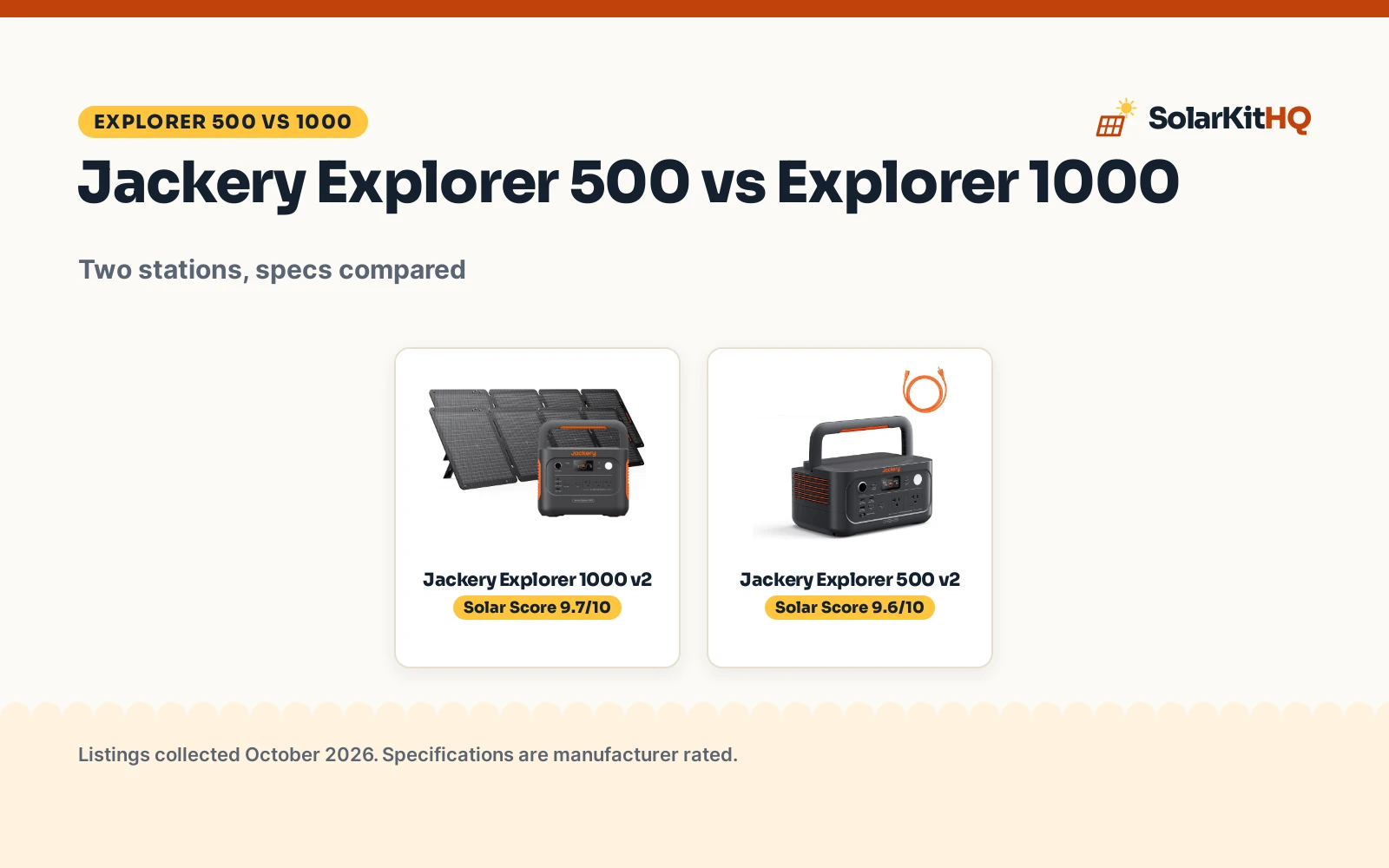
Jackery Explorer 500 vs Explorer 1000: side by side
| Explorer 500 vs 1000 | Jackery Explorer 500 v2 | Jackery Explorer 1000 v2 |
|---|---|---|
| Side | jackery explorer 500 | explorer 1000 |
| Capacity | 512Wh | 1070Wh |
| Output | 500W (1000W surge) | 1500W (3000W surge) |
| Outlets | 2 AC | 3 AC, 2 USB-C, USB-A, DC car |
| Weight | 14 lb | 23.8 lb |
| Warranty | 5 years | 5 years |
Specifications are manufacturer rated as listed, collected 21 October 2026.
Capacity and output
This is the gap that decides the pick. The Explorer 1000 v2 listing states 1070Wh of LiFePO4 capacity with 1500W AC output and 3000W surge peak, plus 100W USB-C PD input and output. The Explorer 500 v2 listing states 512Wh with 500W rated power, 1000W surge and two pure sine wave AC outlets. The 1000 v2 lists 23.8 pounds and 8.82 by 12.87 by 9.27 inches; the 500 v2 lists 14 pounds and 11.8 by 7.6 by 9.5 inches. On longevity, the 500 v2 states 6000 charge cycles while the 1000 v2 states 4000 cycles remaining at 70% capacity. Do not call one side more efficient: neither listing states an efficiency figure.
Charging and ports
Both listings push charging speed. The Explorer 1000 v2 states a full recharge in 1 hour with app-managed 1-hour and 1.7-hour modes, and two 100W solar panels come in the box. The Explorer 500 v2 states 0-80% in 52 minutes on AC, with solar panels sold separately and 12V car charging supported. The 1000 v2 also states ChargeShield 2.0 with UL certification and a 30 dB quiet overnight mode, while the 500 v2 states a 10ms UPS with bypass charging at 28 dB. If you are still deciding on station size generally, our portable power station vs power bank comparison frames the choice.
What the listings leave unclear
The 1000 v2 bullets say 6 charging ports but list 7 (2 USB-C, 1 USB-A, 1 DC car port, 3 AC), so count the list, not the headline. Its bullets state 5 years of coverage while the spec table states a 2-year manufacturer warranty; trust the bullets. The 500 v2 spec table lists 1 total power outlet against the two AC outlets in the bullets, and 13.3 pounds against 14 pounds in the title; trust the bullets on both.
Two examples

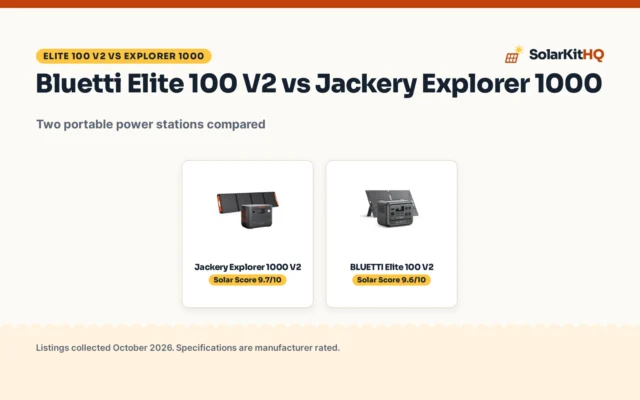
Jackery Explorer 1000 v2
A 1070Wh LiFePO4 portable power station with 1500W output, 1-hour recharging and two 100W solar panels included, per the listing.
Pros
- 1070Wh with 1500W AC and 3000W surge stated
- Full recharge in 1 hour stated, with app-managed charging modes
- Two 100W solar panels included in the box
- ChargeShield 2.0 with UL certification stated
Cons
- Bullets say 6 ports but list 7
- Spec table states a 2-year warranty against 5 years in the bullets
- 23.8 pounds stated, the heavier unit here
- 4000 cycles to 70% is below the 500 v2's 6000 cycles
Detailed Review
The listing states a 1070Wh LiFePO4 power station with 1500W AC output, 3000W surge peak and 100W USB-C PD input and output. It states a full recharge in 1 hour, ChargeShield 2.0 with UL certification, 4000 cycles remaining at 70% capacity, app control with 1-hour and 1.7-hour charging modes, 23.8 pounds and 8.82 by 12.87 by 9.27 inches, with two 100W solar panels in the box. The bullets say 6 charging ports but list 7 (2 USB-C, 1 USB-A, 1 DC car port, 3 AC); the bullets also state 5 years of coverage while the spec table states a 2-year manufacturer warranty, so trust the bullets for the warranty.
Who it's for: campers, RVers and home backup buyers who want 1kWh-plus capacity with panels included and a 1-hour recharge. Who should skip it: anyone who wants the lowest-weight station here.
Its Solar Score of 9.7/10 comes from performance 33/35, build 21/25, value 21/25, safety 8/10 and warranty 4/5: 87 of 100 points, placed on our 9.2 to 9.8 scale.
Key Specifications
| Capacity | 1070Wh LiFePO4 |
|---|---|
| Output | 1500W (3000W surge) |
| Charge | 0-100% in 1 hour |
| Solar | 2x100W panels included |
Figures as published on the retailer listing, collected 21 October 2026. Performance figures are manufacturer rated.
Safety and Warranty
What this listing states. ChargeShield 2.0 with UL certification stated, so safety scores 8 of 10. 5 Years of Coverage stated. It does not say everything a buyer needs, such as who pays return shipping, so warranty scores 4 of 5. See How We Pick.
Power station limits. Stay within the stated continuous output and solar input limits, keep the unit ventilated and dry, charge within the stated temperature range, and never connect it to home wiring except through equipment a licensed electrician installs.
This is general buying information, not professional advice. Follow each product manual and local rules, and see our Safety Disclaimer.

Jackery Explorer 500 v2
A 512Wh LiFePO4 portable power station with 500W output, two AC outlets and a 10ms UPS, per the listing.
Pros
- 6000 charge cycles stated, the most here
- 10ms UPS with bypass charging stated
- 0-80% in 52 minutes on AC stated
- 14 pounds stated, the lighter unit here
Cons
- 500W continuous output, below the 1000 v2's 1500W
- 512Wh with no expansion stated
- Solar panels sold separately, per the listing
- Spec table lists 1 outlet against two AC outlets in the bullets
Detailed Review
The listing states a 512Wh LiFePO4 power station with 500W rated power, 1000W surge and two pure sine wave AC outlets. It states 6000 charge cycles, 0-80% in 52 minutes on AC, a 10ms UPS, 28 dB operation, 14 pounds and 11.8 by 7.6 by 9.5 inches, with an AC cable and manual in the box and a 5-year manufacturer warranty. The spec table lists 1 total power outlet against the two AC outlets in the bullets, and 13.3 pounds against 14 pounds; trust the bullets on both.
Who it's for: campers and outage prep on a smaller scale who want a light 512Wh station with UPS backup. Who should skip it: anyone who needs more than 500W continuous.
Its Solar Score of 9.6/10 comes from performance 29/35, build 21/25, value 21/25, safety 5/10 and warranty 4/5: 80 of 100 points, placed on our 9.2 to 9.8 scale.
Key Specifications
| Capacity | 512Wh LiFePO4 |
|---|---|
| Output | 500W (1000W surge) |
| Outlets | 2 AC, pure sine wave |
| Charge | 0-80% in 52 min AC |
Figures as published on the retailer listing, collected 21 October 2026. Performance figures are manufacturer rated.
Safety and Warranty
What this listing states. 10ms UPS stated, so safety scores 5 of 10. 5 year manufacturer warranty stated. It does not say everything a buyer needs, such as who pays return shipping, so warranty scores 4 of 5. See How We Pick.
Power station limits. Stay within the stated continuous output and solar input limits, keep the unit ventilated and dry, charge within the stated temperature range, and never connect it to home wiring except through equipment a licensed electrician installs.
This is general buying information, not professional advice. Follow each product manual and local rules, and see our Safety Disclaimer.
As an Amazon Associate I earn from qualifying purchases.
How we scored them
The Solar Score weighs performance, build, value, safety and warranty. For power stations, safety means the protections the listing actually states, such as a battery management system, a UPS function or a certification; the 1000 v2 states ChargeShield 2.0 with UL certification, and the 500 v2 states a 10ms UPS. Both listings state a 5-year warranty in the title and bullets.
| Product | Solar Score | Perf. /35 | Build /25 | Value /25 | Safety /10 | Warranty /5 |
|---|---|---|---|---|---|---|
| Jackery Explorer 1000 v2 | 9.7 | 33 | 21 | 21 | 8 | 4 |
| Jackery Explorer 500 v2 | 9.6 | 29 | 21 | 21 | 5 | 4 |
Scores run from 9.2 to 9.8: each product’s point total is placed on that range, so more points always means a higher score.
Jackery Explorer 500 vs Explorer 1000: which should you choose?
Choose the Explorer 500 v2 if the station travels with you: the listing states 512Wh, 500W output and 14 pounds with a 10ms UPS for outages. Choose the Explorer 1000 v2 if you need to run bigger loads: the listing states 1070Wh, 1500W output with 3000W surge, two 100W panels in the box and a 1-hour full recharge. For outage planning at larger sizes, see our best home backup power station roundup roundup, and for campsite use, our best portable power station for camping roundup.
| If you need | Look at |
|---|---|
| Lowest-weight station here | Jackery Explorer 500 v2, 14 lb |
| 1070Wh with panels included | Jackery Explorer 1000 v2 |
| 1500W output with 3000W surge | Jackery Explorer 1000 v2 |
| 10ms UPS backup | Jackery Explorer 500 v2 |
Sizing Notes
- Capacity: 512Wh against 1070Wh stated; only the 1000 v2 listing includes solar panels.
- Match output to your loads: 500W continuous with 1000W surge against 1500W with 3000W surge.
- Weights are 14 pounds and 23.8 pounds stated.
- The 500 v2 states 6000 cycles; the 1000 v2 states 4000 cycles remaining at 70% capacity.
Frequently Asked Questions
Which is bigger, the Explorer 500 v2 or the 1000 v2?
The 1000 v2: the listing states 1070Wh and 23.8 pounds against the 500 v2’s 512Wh and 14 pounds.
Can the Explorer 1000 v2 run an air conditioner?
The listing states 1500W AC output with 3000W surge and names AC units, fridges and electric pots among the loads. Check your unit’s draw against the stated output.
How fast do they charge?
The 500 v2 listing states 0-80% in 52 minutes on AC, and the 1000 v2 listing states a full recharge in 1 hour.
Do both include solar panels?
The 1000 v2 listing includes two 100W solar panels. The 500 v2 listing states panels are sold separately.
What warranty do the listings state?
Both state 5 years in the title and bullets; the 1000 v2 spec table states 2 years, so trust the bullets.
Related guides
See every Portable Power Stations guide and all Power Stations and Generators guides. Also see our portable power station vs power bank comparison. Also see our best home backup power station roundup roundup. Also see our best portable power station for camping roundup.
More picks: portable power station for off grid living, home backup power station for hurricane and dc to dc charger for power station.