On this page
A campsite at dusk with a dead phone and a cooler warming up is where lifepo4 vs lithium ion battery for camping stops being a chemistry debate and starts being a packing decision. This comparison looks at options from both sides, LiFePO4 power for campsite loads and lithium-ion power for lighter packs, using each listing only for what it publishes. The short verdict: the LiFePO4 side suits bigger loads and longer trips, with the battery here stating the longest warranty and the clearest cycle figures; the lithium-ion side suits lighter packs and single-device duty, with the power bank here stating the lowest weight.
SolarKitHQ earns a commission when you buy through links on this page, at no extra cost to you. As an Amazon Associate I earn from qualifying purchases. Affiliate disclosure.
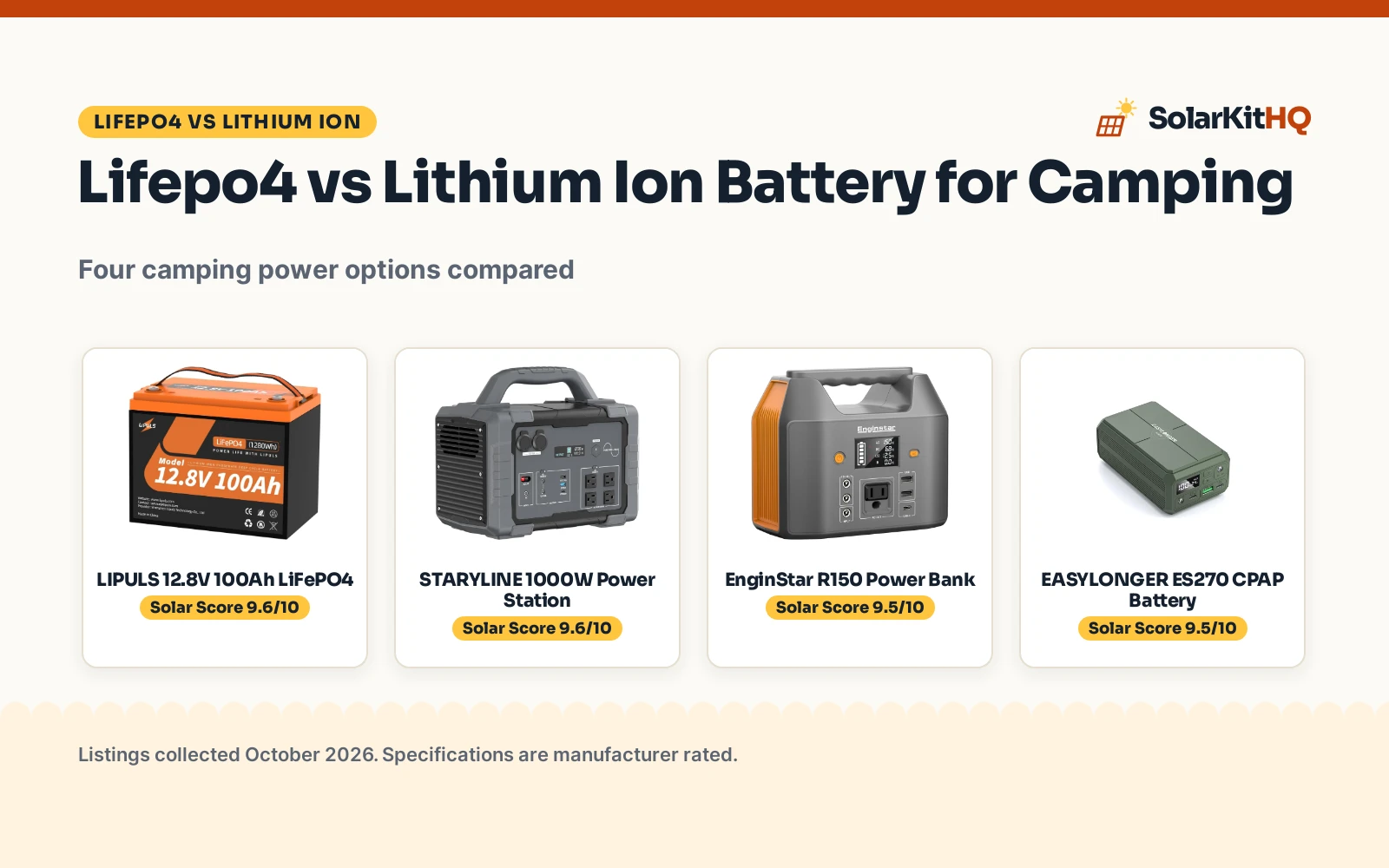
Lifepo4 vs lithium ion battery for camping: side by side
| Lifepo4 vs Lithium Ion | LIPULS 12.8V 100Ah LiFePO4 | STARYLINE 1000W Power Station | EnginStar R150 Power Bank | EASYLONGER ES270 CPAP Battery | Amazon |
|---|---|---|---|---|---|
| Type | LiFePO4 battery | LiFePO4 power station | Lithium-ion power bank | Lithium-ion CPAP battery | |
| Capacity stated | 1280Wh | 1024Wh | 155Wh | 99.9Wh | |
| Output stated | 12.8V, 100A BMS | 1000W, 2000W peak | 150W AC | 100W USB-C PD | |
| Cycle figures | 4000 / 6000 / 15000 by DOD | 3000+ | 1000 | Not stated | |
| Weight | 22.6 pounds | 27.7 pounds | 4 pounds | 1.3 pounds | |
| Safety stated | 100A smart BMS | 6-layer smart BMS | Smart battery management | BMS protection | |
| Warranty stated | Five Years Warranty | Not stated | One year warranty | Not stated |
Specifications are manufacturer rated as listed, collected 22 October 2026.
What each side states
The LiFePO4 side pairs the LIPULS battery with the STARYLINE power station. The LIPULS states a 12.8V 100Ah battery with 1280Wh maximum energy, a 100A smart BMS, Grade A cylindrical cells and a five-year warranty in a Group 24 case at 22.6 pounds. The STARYLINE states a 1000W portable power station with 1024Wh, 2000W peak output, a 60W USB-C PD port, 3000+ cycles retaining 80% capacity and a 6-layer smart BMS at 27.7 pounds. The lithium-ion side pairs the EnginStar power bank with the EASYLONGER CPAP battery. The EnginStar states a 150W AC outlet, a 155Wh / 42000mAh pack, 1000 charge and discharge cycles and a one-year warranty at 4 pounds. The EASYLONGER states a 99.9Wh pack, a 100W USB-C PD port, a 2-hour full recharge and TSA and FAA approval for air travel at 1.3 pounds. Neither side wins on a spec the other side leaves out: the STARYLINE states no warranty term, and the EASYLONGER states no cycle figure.
Capacity, output and cycles
Capacity is the clearest split. The LIPULS states 1280Wh and the STARYLINE 1024Wh, while the EnginStar states 155Wh and the EASYLONGER 99.9Wh. Output follows: the STARYLINE states 1000W continuous with 2000W peak and AC outlets, the LIPULS is a 12.8V battery with a 100A BMS and no outlets, the EnginStar states a 150W AC outlet, and the EASYLONGER states 100W USB-C PD. On cycles, the LIPULS gives three figures by depth of discharge, the STARYLINE states 3000+ and the EnginStar states 1000; the EASYLONGER states none, so that side cannot claim the longer-lived listing here.
What the listings leave unclear
The LIPULS title says 15000 cycles, which is the 60% depth-of-discharge figure; use the 4000-cycle figure at 100% depth of discharge when you compare. The STARYLINE bullets say the solar input supports a maximum of 300W while the section header says 200W solar compatible; the bullet text wins. The EnginStar spec table lists a 31-hour runtime with no load stated, which does not match the 25+ hours for a 5W lamp in the bullets. The LIPULS spec table labels the cell type ‘Lithium Ion’ while the title and bullets say LiFePO4. None of the four states a UL or ETL listing.
Four examples
| # | Product | Solar Score | Buy |
|---|---|---|---|
| 1 |  LIPULS 12.8V 100Ah LiFePO4 | 9.6/10 | Buy on Amazon |
| 2 |  STARYLINE 1000W Power Station | 9.6/10 | Buy on Amazon |
| 3 |  EnginStar R150 Power Bank | 9.5/10 | Buy on Amazon |
| 4 |  EASYLONGER ES270 CPAP Battery | 9.5/10 | Buy on Amazon |

LIPULS 12.8V 100Ah LiFePO4
A 12.8V 100Ah LiFePO4 battery with 1280Wh maximum energy, a 100A smart BMS and a stated five-year warranty.
Pros
- 12.8V 100Ah with 1280Wh maximum energy stated
- 100A smart BMS against overcharge, overcurrent, over-discharge, short circuit and over-temperature stated
- Cycle figures by depth of discharge: 4000 at 100%, 6000 at 80%, 15000 at 60%
- Five-year warranty stated, the longest term here
Cons
- Title's 15000 cycles is the 60% depth-of-discharge figure, not the 100% figure
- Spec table labels the cell type 'Lithium Ion' while the title and bullets say LiFePO4
- 22.6 pounds, heavier than both lithium-ion options
- Not for engine starting or golf cart use, per the listing
Detailed Review
The listing states a 12.8V 100Ah LiFePO4 battery with 1280Wh maximum energy, a 100A smart BMS, Grade A cylindrical cells and a Group 24 case of 10.23 by 6.61 by 8.3 inches at 22.6 pounds. The cycle claims are 4000 cycles at 100% depth of discharge, 6000+ at 80% and 15000+ at 60%, and the warranty is five years. The title says 15000 cycles, which is the 60% depth-of-discharge figure, and the spec table labels the cell type 'Lithium Ion' while the title and bullets say LiFePO4.
Who it's for: campers and RVers who want a drop-in Group 24 battery with a stated 5-year warranty and the clearest cycle figures here. Who should skip it: anyone who needs AC outlets built in, or who wants to start an engine.
Its Solar Score of 9.6/10 comes from performance 30/35, build 21/25, value 21/25, safety 8/10 and warranty 0/5: 80 of 100 points, placed on our 9.2 to 9.8 scale.
Key Specifications
| Capacity | 12.8V, 100Ah, 1280Wh |
|---|---|
| BMS | 100A smart BMS |
| Cycles | 4000 / 6000 / 15000 by depth of discharge |
| Warranty | Five Years Warranty |
Figures as published on the retailer listing, collected 22 October 2026. Performance figures are manufacturer rated.
Safety and Warranty
What this listing states. 100A smart BMS with overcharge, overcurrent, over-discharge, short circuit and over-temperature protection stated, so safety scores 8 of 10. No warranty term, so warranty scores zero. See How We Pick.
Power station limits. Stay within the stated continuous output and solar input limits, keep the unit ventilated and dry, charge within the stated temperature range, and never connect it to home wiring except through equipment a licensed electrician installs.
This is general buying information, not professional advice. Follow each product manual and local rules, and see our Safety Disclaimer.

STARYLINE 1000W Power Station
A 1000W portable power station with 1024Wh of LiFePO4 capacity, 2000W peak output and a stated 6-layer smart BMS.
Pros
- 1000W continuous output with 2000W peak and 1024Wh stated
- 6-layer smart BMS and 3000+ cycles retaining 80% capacity stated
- 60W USB-C PD plus 2 AC outlets and 2 USB-A ports
- Up to 300W solar input stated for off-grid charging
Cons
- No warranty term is stated
- Spec table lists a 2-minute runtime with no load stated
- Bullets say max 300W solar input while the section header says 200W solar compatible
- 27.7 pounds, the heaviest option here
Detailed Review
The listing states a 1000W portable power station with 1024Wh of LiFePO4 capacity, 2000W peak output, a 60W USB-C PD port, 2 AC outlets and 2 USB-A ports, a 6-layer smart BMS, 3000+ cycles retaining 80% capacity and a weight of 27.7 pounds. The bullets say the solar input supports a maximum of 300W while the section header says 200W solar compatible, so use the 300W figure from the bullet text; the spec table also lists a 2-minute runtime with no load stated, which reads as an incomplete entry.
Who it's for: campers who want AC outlets and the highest stated output here for fridges, routers and laptops. Who should skip it: anyone counting grams, or anyone who wants a stated warranty term.
Its Solar Score of 9.6/10 comes from performance 30/35, build 21/25, value 20/25, safety 8/10 and warranty 0/5: 79 of 100 points, placed on our 9.2 to 9.8 scale.
Key Specifications
| Capacity | 1024Wh LiFePO4 |
|---|---|
| Output | 1000W continuous, 2000W peak |
| Solar input | Max 300W |
| Weight | 27.7 pounds |
Figures as published on the retailer listing, collected 22 October 2026. Performance figures are manufacturer rated.
Safety and Warranty
What this listing states. 6-layer smart BMS guarding against overcharge, overload, short circuit and high temperature stated, so safety scores 8 of 10. No warranty term, so warranty scores zero. See How We Pick.
Power station limits. Stay within the stated continuous output and solar input limits, keep the unit ventilated and dry, charge within the stated temperature range, and never connect it to home wiring except through equipment a licensed electrician installs.
This is general buying information, not professional advice. Follow each product manual and local rules, and see our Safety Disclaimer.

EnginStar R150 Power Bank
A 150W power bank with a 110V AC outlet, a 155Wh / 42000mAh lithium-ion pack and a stated one-year warranty.
Pros
- 150W AC outlet plus DC, USB and USB-C ports for up to 6 devices
- 155Wh / 42000mAh lithium-ion pack stated
- 1000 charge and discharge cycles with smart battery management stated
- 4 pounds, the second lowest weight here
Cons
- One-year warranty, the least of the stated terms here
- AC output supports only devices under 150W
- Spec table lists a 31-hour runtime with no load stated, which does not match the bullet claims
- Solar panel not included for the 12-25V solar charging
Detailed Review
The listing states a 150W power bank with a 110V AC outlet, a 155Wh / 42000mAh lithium-ion pack, 2 DC sockets, 2 USB ports and a USB-C port, plus 1000 charge and discharge cycles with a smart battery management system. The maker claims a smartphone charges over 10 times and a 5W LED lamp runs 25+ hours. The spec table lists a 31-hour runtime with no load stated, which does not match any bullet claim, and the warranty is one year.
Who it's for: campers who want a light AC outlet for laptops and phones without carrying a full station. Who should skip it: anyone running loads near or above 150W.
Its Solar Score of 9.5/10 comes from performance 26/35, build 20/25, value 21/25, safety 7/10 and warranty 0/5: 74 of 100 points, placed on our 9.2 to 9.8 scale.
Key Specifications
| Capacity | 155Wh / 42000mAh |
|---|---|
| AC output | 150W, 110V |
| Cycles | 1000 charge/discharge |
| Weight | 4 pounds |
Figures as published on the retailer listing, collected 22 October 2026. Performance figures are manufacturer rated.
Safety and Warranty
What this listing states. Smart battery management system against overloading, overcharging, over-discharging, overheating and short circuits stated, so safety scores 7 of 10. No warranty term, so warranty scores zero. See How We Pick.
Power station limits. Stay within the stated continuous output and solar input limits, keep the unit ventilated and dry, charge within the stated temperature range, and never connect it to home wiring except through equipment a licensed electrician installs.
This is general buying information, not professional advice. Follow each product manual and local rules, and see our Safety Disclaimer.

EASYLONGER ES270 CPAP Battery
A 99.9Wh lithium-ion CPAP battery with 100W USB-C PD, a 2-hour full recharge and a stated 1.3-pound weight.
Pros
- 99.9Wh lithium-ion pack, TSA and FAA approved for air travel per the listing
- 100W USB-C PD port with 2-hour full recharge stated
- 1.3 pounds and 5.1 by 2.9 by 1.9 inches, the smallest and lowest-weight option here
- 4 CPAP cables included for ResMed, Philips and Luna models
Cons
- No warranty term is stated
- 99.9Wh is the smallest capacity here
- Up to 8 hours of CPAP use is for low-power machines with humidification off
- Solar or car recharge takes up to 1.5 hours, panel not included
Detailed Review
The listing states a 99.9Wh lithium-ion power bank aimed at CPAP users, with a 100W USB-C PD port, wireless phone charging, a smart display, 4 CPAP cables, a 65W USB-C adapter and a 1.3-pound body at 5.1 by 2.9 by 1.9 inches. The maker claims up to 8 hours for a ResMed AirMini or Luna TravelPAP with humidification and heating off, a 2-hour full recharge on the included adapter, and TSA and FAA approval for air travel. No warranty term is stated.
Who it's for: campers who use a CPAP and want the lowest-weight stated option with air-travel approval. Who should skip it: anyone who needs AC outlets or a stated warranty term.
Its Solar Score of 9.5/10 comes from performance 26/35, build 20/25, value 19/25, safety 7/10 and warranty 0/5: 72 of 100 points, placed on our 9.2 to 9.8 scale.
Key Specifications
| Capacity | 99.9Wh lithium-ion |
|---|---|
| USB-C PD | 100W |
| Recharge | 2 hours on included 65W adapter |
| Weight | 1.3 pounds |
Figures as published on the retailer listing, collected 22 October 2026. Performance figures are manufacturer rated.
Safety and Warranty
What this listing states. Advanced BMS protection against overcurrent, overheating, overcharging, overdischarge, overvoltage and short circuits stated, so safety scores 7 of 10. No warranty term, so warranty scores zero. See How We Pick.
Power station limits. Stay within the stated continuous output and solar input limits, keep the unit ventilated and dry, charge within the stated temperature range, and never connect it to home wiring except through equipment a licensed electrician installs.
This is general buying information, not professional advice. Follow each product manual and local rules, and see our Safety Disclaimer.
As an Amazon Associate I earn from qualifying purchases.
How we scored them
The Solar Score weighs performance, build, value, safety and warranty. For camping power, safety means a stated battery management system or protective construction; all four listings state a BMS. Two listings state a warranty with a concrete term, five years and one year; the other two state no warranty term, so they earn no warranty points. How we pick explains the weights.
| Product | Solar Score | Perf. /35 | Build /25 | Value /25 | Safety /10 | Warranty /5 |
|---|---|---|---|---|---|---|
| LIPULS 12.8V 100Ah LiFePO4 | 9.6 | 30 | 21 | 21 | 8 | 0 |
| STARYLINE 1000W Power Station | 9.6 | 30 | 21 | 20 | 8 | 0 |
| EnginStar R150 Power Bank | 9.5 | 26 | 20 | 21 | 7 | 0 |
| EASYLONGER ES270 CPAP Battery | 9.5 | 26 | 20 | 19 | 7 | 0 |
Scores run from 9.2 to 9.8: each product’s point total is placed on that range, so more points always means a higher score.
Lifepo4 vs lithium ion battery for camping: which should you choose?
Choose the LiFePO4 side for bigger loads and longer trips. The LIPULS battery states the longest warranty and the clearest cycle figures here, and the STARYLINE station states the highest output with AC outlets for fridges and laptops; see our best portable power station for camping roundup for similar stations. Choose the lithium-ion side for lighter packs: the EnginStar gives an AC outlet at 4 pounds, and the EASYLONGER gives 100W USB-C at 1.3 pounds with air-travel approval. For another chemistry pair, our lifepo4 vs agm battery for rv guide compares LiFePO4 with AGM.
| If you need | Look at |
|---|---|
| Longest stated warranty | LIPULS 12.8V 100Ah LiFePO4, five years |
| Highest stated output | STARYLINE 1000W Power Station, 1000W continuous, 2000W peak |
| Lowest stated weight | EASYLONGER ES270 CPAP Battery, 1.3 pounds |
| AC outlet in a light pack | EnginStar R150 Power Bank, 150W AC at 4 pounds |
| Clearest cycle figures | LIPULS 12.8V 100Ah LiFePO4, three figures by depth of discharge |
Sizing Notes
- Match the stated capacity to the loads: 1280Wh for the LIPULS, 1024Wh for the STARYLINE, 155Wh for the EnginStar and 99.9Wh for the EASYLONGER.
- Match the output to the device: the STARYLINE states 1000W continuous with 2000W peak, the EnginStar supports devices under 150W, and the EASYLONGER states 100W USB-C PD.
- Check the solar input against your panel: the STARYLINE states a maximum of 300W solar input, and the EnginStar charges from a 12-25V panel, panel not included.
- Match the warranty to the trip: the LIPULS states five years and the EnginStar one year, while the STARYLINE and EASYLONGER state no term.
Frequently Asked Questions
Which option holds the most energy?
The LIPULS at 1280Wh, then the STARYLINE at 1024Wh, the EnginStar at 155Wh and the EASYLONGER at 99.9Wh.
Which listings state a warranty?
The LIPULS states five years and the EnginStar states one year. The STARYLINE and EASYLONGER state no warranty term.
Can the lithium-ion options charge from solar?
The EnginStar charges from a 12-25V solar panel, panel not included, and the EASYLONGER supports recharging via solar panel or car charger in as fast as 1.5 hours. The STARYLINE states a maximum of 300W solar input.
Which option weighs the least?
The EASYLONGER at 1.3 pounds, then the EnginStar at 4 pounds, the LIPULS at 22.6 pounds and the STARYLINE at 27.7 pounds.
Related guides
See every Portable Power Stations guide and all Power Stations and Generators guides. Also see every Solar Chargers and Power Banks guide.
More picks: best portable power station for off-grid camping, best solar power bank for camping, lifepo4 vs agm battery for solar.