On this page
The cabin goes dark at dinner time and the fridge keeps humming on the battery bank in the corner. The best lithium battery for solar is the one that holds the day’s sun for the night’s loads: we compared five LiFePO4 batteries on capacity, BMS protection, cycle life and warranty terms. Every figure below comes from the listings themselves, and the HumsiENK 640Ah leads with 8192Wh and a 250A BMS.
SolarKitHQ earns a commission when you buy through links on this page, at no extra cost to you. As an Amazon Associate I earn from qualifying purchases. Affiliate disclosure.
Quick picks
 Best Overall HumsiENK 640Ah LiFePO4: 640Ah and 8192Wh with a 250A BMS and Bluetooth Check price on Amazon
 Best 300Ah yeagulch 314Ah LiFePO4: 314Ah with a 200A BMS, IP65 and 5-year warranty Check price on Amazon
 Best 24V Dyness 24V 100Ah LiFePO4: 24V 100Ah with a smart 100A BMS and 5-year warranty Check price on Amazon
 Best Bluetooth BUKNUWO 150Ah LiFePO4: 150Ah with Bluetooth monitoring and 5-year warranty Check price on Amazon
 Best Expandable yeagulch 200Ah LiFePO4: 200Ah with 4S4P expansion and a 200A BMS Check price on Amazon
The kits we chose
| # | Product | Solar Score | Buy |
|---|---|---|---|
| 1 | HumsiENK 640Ah LiFePO4 | 9.8/10 | Buy on Amazon |
| 2 | yeagulch 314Ah LiFePO4 | 9.7/10 | Buy on Amazon |
| 3 | Dyness 24V 100Ah LiFePO4 | 9.6/10 | Buy on Amazon |
| 4 | BUKNUWO 150Ah LiFePO4 | 9.6/10 | Buy on Amazon |
| 5 | yeagulch 200Ah LiFePO4 | 9.6/10 | Buy on Amazon |

HumsiENK 640Ah LiFePO4
A 12V 640Ah LiFePO4 battery with 8192Wh of stated energy and a 250A BMS.
Pros
- 640Ah and 8192Wh, the largest here
- 250A BMS with 3200W stated output
- Bluetooth monitoring and low-temp cut-off
- 5-year warranty stated
Cons
- 109 pounds, the heaviest here
- Safety certifications are named as elite but not listed
- 8.19kWh versus 8192Wh is a small mismatch
- Single 12V unit; 48V needs four in series
Detailed Review
The listing states a 12V 640Ah LiFePO4 battery at 8192Wh and 8.19kWh, a 250A BMS with 3200W of stated continuous output, Bluetooth monitoring, low-temperature charge cut-off below 32 degrees F, EV-grade A cells, 6000-plus deep cycles with up to a 10-year service life, 109 pounds, M8 terminals and 4S4P expansion to 51.2V 2560Ah. It states a 5-year warranty. The listing mentions elite safety certifications without naming them.
Who it's for: off-grid cabins and big RVs that want one battery instead of six 100Ah units. Who should skip it: buyers who want named certifications; this listing does not state them.
Its Solar Score of 9.8/10 comes from performance 34/35, build 22/25, value 21/25, safety 7/10 and warranty 4/5: 88 of 100 points, placed on our 9.2 to 9.8 scale.
Key Specifications
| Capacity | 640Ah, 12V |
|---|---|
| Energy | 8192Wh |
| BMS | 250A, 3200W output |
| Warranty | 5-year warranty stated |
Figures as published on the retailer listing, collected 20 October 2026. Performance figures are manufacturer rated.
Safety and Warranty
What this listing states. 250A BMS with low-temperature cut-off stated, so safety scores 7 of 10. 5-year warranty stated. It does not say everything a buyer needs, such as who pays return shipping, so warranty scores 4 of 5. See How We Pick.
Battery safety. Charge with a charger and settings that match the stated chemistry, fuse the positive lead as the manual directs, cover terminals, keep within the stated temperature range, and never charge a damaged battery.
This is general buying information, not professional advice. Follow each product manual and local rules, and see our Safety Disclaimer.

yeagulch 314Ah LiFePO4
A 12V 314Ah LiFePO4 battery with 4019Wh of stated energy, a 200A BMS and IP65 sealing.
Pros
- 314Ah and 4019Wh with a 200A BMS
- IP65 dust and water resistance stated
- Automatic cell balancing above 14.1V
- 5-year warranty stated
Cons
- Spec table lists 3840 amp-hours against 314Ah elsewhere
- Not for starting engines, golf carts or jacks
- 57.3 pounds to place
- Title hedges between 300Ah and 314Ah
Detailed Review
The listing states a 12V 314Ah LiFePO4 battery at 4019Wh and 12.8V with a 200A BMS, low-temperature protection, automatic balancing above 14.1V, IP65 dust and water resistance, 57.3 pounds and a 5-year warranty. It states over 6000 cycles to 80% depth of discharge. The title says 300Ah (314Ah) and the bullets say 314Ah, but the spec table lists 3840 amp-hours; trust the title and bullets. The listing says it is not for starting gasoline engines, golf carts or jacks.
Who it's for: RV and marine solar setups that want a big 12V bank with IP65 sealing. Who should skip it: buyers who need a clean spec table; the 3840 amp-hour line is an error.
Its Solar Score of 9.7/10 comes from performance 32/35, build 21/25, value 21/25, safety 7/10 and warranty 4/5: 85 of 100 points, placed on our 9.2 to 9.8 scale.
Key Specifications
| Capacity | 314Ah, 12.8V |
|---|---|
| Energy | 4019Wh |
| BMS | 200A |
| Weather | IP65 |
Figures as published on the retailer listing, collected 20 October 2026. Performance figures are manufacturer rated.
Safety and Warranty
What this listing states. 200A BMS protection and IP65 dust and water resistance stated, so safety scores 7 of 10. 5 year stated. It does not say everything a buyer needs, such as who pays return shipping, so warranty scores 4 of 5. See How We Pick.
Battery safety. Charge with a charger and settings that match the stated chemistry, fuse the positive lead as the manual directs, cover terminals, keep within the stated temperature range, and never charge a damaged battery.
This is general buying information, not professional advice. Follow each product manual and local rules, and see our Safety Disclaimer.

Dyness 24V 100Ah LiFePO4
A native 24V 100Ah LiFePO4 battery with 2560Wh and a smart 100A BMS.
Pros
- Native 24V at 2560Wh
- Smart 100A BMS with low-temp cut-off
- 4P2S expansion to 20.48kWh
- 5-year warranty stated
Cons
- 24V only; no 12V option in this listing
- 4000-plus cycles is the lowest cycle figure here
- Not for engine starting or golf carts
- Marine terminals only
Detailed Review
The listing states a 24V 100Ah LiFePO4 battery at 2560Wh and 25.6V with a smart 100A BMS, low-temperature cut-off, A+ grade cells, 4000-plus deep cycles with a 10-year lifetime, 9.9 kg, marine terminals and 4P2S expansion to 20.48kWh. It states a 5-year warranty. The listing carries a fire and burn caution with handling instructions, and says it is not for engine starting or golf carts.
Who it's for: 24V solar and marine systems that want a native 24V battery with expansion headroom. Who should skip it: buyers building a 12V system; this is a 24V battery.
Its Solar Score of 9.6/10 comes from performance 29/35, build 21/25, value 20/25, safety 7/10 and warranty 4/5: 81 of 100 points, placed on our 9.2 to 9.8 scale.
Key Specifications
| Capacity | 100Ah, 25.6V |
|---|---|
| Energy | 2560Wh |
| BMS | 100A smart |
| Expansion | 4P2S to 20.48kWh |
Figures as published on the retailer listing, collected 20 October 2026. Performance figures are manufacturer rated.
Safety and Warranty
What this listing states. 100A smart BMS with low-temperature cut-off stated, so safety scores 7 of 10. 5 Year Manufacturer stated. It does not say everything a buyer needs, such as who pays return shipping, so warranty scores 4 of 5. See How We Pick.
Battery safety. Charge with a charger and settings that match the stated chemistry, fuse the positive lead as the manual directs, cover terminals, keep within the stated temperature range, and never charge a damaged battery.
This is general buying information, not professional advice. Follow each product manual and local rules, and see our Safety Disclaimer.
BUKNUWO 150Ah LiFePO4
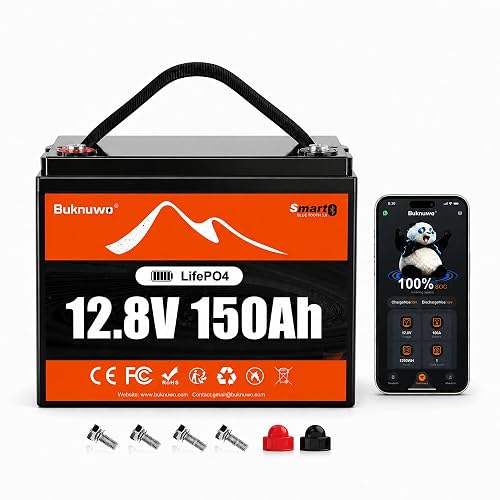
A 12.8V 150Ah LiFePO4 battery with Bluetooth monitoring and a 100A BMS.
Pros
- Bluetooth 5.0 real-time monitoring
- 6000 cycles at 80% DOD stated
- 4S4P expansion to 51.2V 600Ah
- 5-year warranty stated
Cons
- Spec table lists Lithium Metal cells against the LiFePO4 title
- 150Ah is the smallest capacity here
- 100A BMS is the smallest here
- ABS casing with light water protection only
Detailed Review
The listing states a 12.8V 150Ah LiFePO4 battery at 1920Wh with Bluetooth 5.0 monitoring, a 100A BMS, Grade A cells, 4000 cycles at 100% DOD, 6000 at 80% and 15000 at 60%, 4S4P expansion to a 51.2V 600Ah system, an ABS casing, 41.5 pounds and a 5-year warranty. The spec table lists the cell type as Lithium Metal against the LiFePO4 title; trust the title.
Who it's for: RVers who want phone-based monitoring of SOC, voltage and temperature. Who should skip it: buyers who need more than 150Ah in one box.
Its Solar Score of 9.6/10 comes from performance 28/35, build 20/25, value 20/25, safety 6/10 and warranty 4/5: 78 of 100 points, placed on our 9.2 to 9.8 scale.
Key Specifications
| Capacity | 150Ah, 12.8V |
|---|---|
| Energy | 1920Wh |
| BMS | 100A |
| Monitoring | Bluetooth 5.0 |
Figures as published on the retailer listing, collected 20 October 2026. Performance figures are manufacturer rated.
Safety and Warranty
What this listing states. 100A BMS with high/low temperature cut-off stated, so safety scores 6 of 10. 5-Year Warranty stated. It does not say everything a buyer needs, such as who pays return shipping, so warranty scores 4 of 5. See How We Pick.
Battery safety. Charge with a charger and settings that match the stated chemistry, fuse the positive lead as the manual directs, cover terminals, keep within the stated temperature range, and never charge a damaged battery.
This is general buying information, not professional advice. Follow each product manual and local rules, and see our Safety Disclaimer.
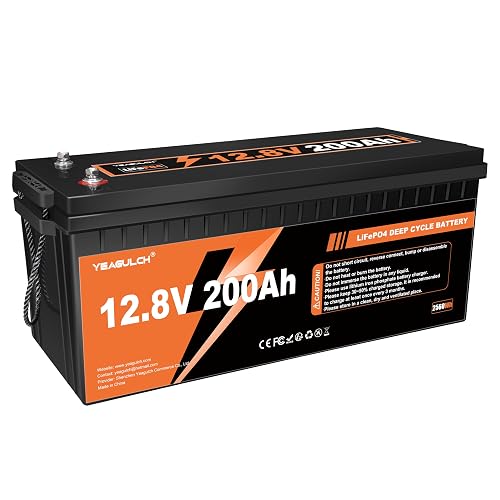
yeagulch 200Ah LiFePO4
A 12V 200Ah LiFePO4 battery with a 200A BMS and 4S4P expansion.
Pros
- 200Ah with a 200A BMS
- 15000 cycles at 60% DOD stated
- 4S4P expansion to about 10.24kWh
- High and low temperature cut-off stated
Cons
- No warranty term is stated
- 58.86 pounds, heavier than the 314Ah pick
- Not for car, starting or golf cart use
- Thinnest listing of the five
Detailed Review
The listing states a 12V 200Ah LiFePO4 battery at 2560Wh with a built-in 200A BMS, high and low temperature cut-off, 4000 cycles at 100% DOD, 6000 at 80% and up to 15000 at 60%, about 58.86 pounds, 20.08 by 8.07 by 8.46 inches and 4S4P expansion to about 10.24kWh. No warranty term is stated. The listing says not to use it as a car, starting or golf cart battery.
Who it's for: off-grid solar builders who want 200Ah blocks with series and parallel expansion. Who should skip it: buyers who want a stated warranty; this listing gives none.
Its Solar Score of 9.6/10 comes from performance 29/35, build 21/25, value 21/25, safety 7/10 and warranty 0/5: 78 of 100 points, placed on our 9.2 to 9.8 scale.
Key Specifications
| Capacity | 200Ah, 12.8V |
|---|---|
| Energy | 2560Wh |
| BMS | 200A |
| Expansion | 4S4P to 10.24kWh |
Figures as published on the retailer listing, collected 20 October 2026. Performance figures are manufacturer rated.
Safety and Warranty
What this listing states. 200A BMS with high/low temperature cut-off stated, so safety scores 7 of 10. No warranty term, so warranty scores zero. See How We Pick.
Battery safety. Charge with a charger and settings that match the stated chemistry, fuse the positive lead as the manual directs, cover terminals, keep within the stated temperature range, and never charge a damaged battery.
This is general buying information, not professional advice. Follow each product manual and local rules, and see our Safety Disclaimer.
As an Amazon Associate I earn from qualifying purchases.
More picks to compare
 HumsiENK 48V 100Ah LiFePO4 Lithium BatteryCheck on Amazon
 Dyness 12V 100Ah Bluetooth LiFePO4Check on Amazon
 ECO-WORTHY Powermega 48V 314Ah LiFePO4Check on Amazon
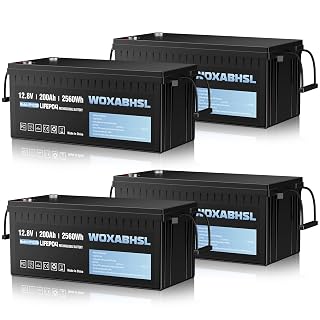 WOXABHSL 4 PCS 12V 200Ah LiFePO4 LithiumCheck on Amazon
Numbers side by side
| Battery | Solar Score | Capacity | Energy | BMS | Cycle life | Warranty | Amazon |
|---|---|---|---|---|---|---|---|
| HumsiENK 640Ah LiFePO4 | 9.8/10 | 640Ah | 8192Wh | 250A | 6000+ cycles | 5 years | View on Amazon |
| yeagulch 314Ah LiFePO4 | 9.7/10 | 314Ah | 4019Wh | 200A | 6000 @ 80% | 5 years | View on Amazon |
| Dyness 24V 100Ah LiFePO4 | 9.6/10 | 100Ah | 2560Wh | 100A | 4000+ cycles | 5 years | View on Amazon |
| BUKNUWO 150Ah LiFePO4 | 9.6/10 | 150Ah | 1920Wh | 100A | 6000 @ 80% | 5 years | View on Amazon |
| yeagulch 200Ah LiFePO4 | 9.6/10 | 200Ah | 2560Wh | 200A | 6000 @ 80% | Not stated | View on Amazon |
Specifications are manufacturer rated as listed, collected 20 October 2026.
Where the points went
The Solar Score weighs performance, build, value, safety and warranty. For lithium batteries, safety means the BMS protections, temperature cut-offs and weather ratings the listing actually states. Four of the five state a 5-year warranty term. How we pick explains the weights.
| Product | Solar Score | Perf. /35 | Build /25 | Value /25 | Safety /10 | Warranty /5 |
|---|---|---|---|---|---|---|
| HumsiENK 640Ah LiFePO4 | 9.8 | 34 | 22 | 21 | 7 | 4 |
| yeagulch 314Ah LiFePO4 | 9.7 | 32 | 21 | 21 | 7 | 4 |
| Dyness 24V 100Ah LiFePO4 | 9.6 | 29 | 21 | 20 | 7 | 4 |
| BUKNUWO 150Ah LiFePO4 | 9.6 | 28 | 20 | 20 | 6 | 4 |
| yeagulch 200Ah LiFePO4 | 9.6 | 29 | 21 | 21 | 7 | 0 |
Scores run from 9.2 to 9.8: each product’s point total is placed on that range, so more points always means a higher score.
How to choose the best lithium battery for solar
Size the bank in watt-hours, not just amp-hours
Amp-hours only compare within one voltage, so read the stated watt-hours:
| Battery | Stated capacity | Stated energy | Voltage |
|---|---|---|---|
| HumsiENK 640Ah LiFePO4 | 640Ah | 8192Wh | 12.8V |
| yeagulch 314Ah LiFePO4 | 314Ah | 4019Wh | 12.8V |
| yeagulch 200Ah LiFePO4 | 200Ah | 2560Wh | 12.8V |
| Dyness 24V 100Ah LiFePO4 | 100Ah | 2560Wh | 25.6V |
| BUKNUWO 150Ah LiFePO4 | 150Ah | 1920Wh | 12.8V |
The 24V Dyness shows why voltage matters: 100Ah at 25.6V stores the same stated 2560Wh as 200Ah at 12.8V. Match the voltage to your system first, then the energy to your loads. See our best lithium battery for RV boondocking guide for more 12V options.
Read the BMS like a spec sheet
The BMS is the battery’s guardian, and the listings state its current plainly: 250A on the HumsiENK with 3200W of stated output, 200A on both yeagulch batteries, and 100A on the BUKNUWO and Dyness. Read the protection list with it: overcharge, over-discharge, overcurrent, short circuit and high/low temperature cut-off appear across these listings. The HumsiENK and Dyness state low-temperature charge cut-offs, which matter for winter cabins. For inverter pairing see our best LiFePO4 battery for inverter guide.
Count cycles at the same depth of discharge
Cycle figures only compare at the same depth of discharge. At 80% DOD the listings state 6000 cycles on the yeagulch 314Ah, the BUKNUWO and the HumsiENK (6000-plus), while the yeagulch 200Ah and BUKNUWO also state 4000 at 100% and 15000 at 60%. The Dyness states 4000-plus cycles without a DOD figure, so it sits apart.
Check the warranty and the contradictions
Four of the five state a 5-year warranty: the HumsiENK, the yeagulch 314Ah, the BUKNUWO and the Dyness. The yeagulch 200Ah states no term. The contradictions: the yeagulch 314Ah spec table lists 3840 amp-hours against 314Ah in the title and bullets, and the BUKNUWO spec table lists Lithium Metal cells against its LiFePO4 title. Trust the title and bullets both times.
Sizing Notes
- Match battery voltage to the system the listing states: 12.8V on four picks, 25.6V on the Dyness.
- Check the BMS current against the loads: 250A on the HumsiENK with 3200W stated output, 200A or 100A elsewhere.
- Count series and parallel limits as stated: 4S4P on the yeagulch 200Ah, BUKNUWO and HumsiENK, 4P2S on the Dyness.
- Read cycle life at the same depth of discharge: 6000 cycles at 80% DOD is the comparable figure here.
FAQ: power away from the grid
Which battery stores the most energy?
The HumsiENK 640Ah at a stated 8192Wh, followed by the yeagulch 314Ah at 4019Wh.
Which batteries state a 5-year warranty?
The HumsiENK, the yeagulch 314Ah, the BUKNUWO and the Dyness. The yeagulch 200Ah states no warranty term.
Can these start an engine?
No. The yeagulch 314Ah listing says not for starting gasoline engines, golf carts or jacks, and the Dyness says not for engine starting or golf carts.
Which have Bluetooth monitoring?
The BUKNUWO with Bluetooth 5.0 and the HumsiENK with its app, both stating real-time voltage, current and SOC data.
What protections do the BMS units state?
Overcharge, over-discharge, overcurrent, short circuit and high/low temperature cut-off appear across these listings, with the exact list varying by battery.
Related solar guides
See every LiFePO4 Batteries guide and all Batteries and Charging guides. Also see our best lithium battery for RV boondocking. Also see our best LiFePO4 battery for inverter.
More picks: best lithium battery for off-grid solar, best 12 volt deep cycle battery for RV, best lithium battery for an RV. Also considered: the HumsiENK 48V 100Ah wall-mount battery, the Dyness 12V 100Ah Bluetooth battery, the ECO-WORTHY 48V 314Ah battery and the WOXABHSL 12V 200Ah 4-pack.