On this page
The panels are on the roof and the batteries are wired in, but the lights stay dark until the inverter turns stored DC power into household AC. Pick the wrong size or the wrong battery voltage and the system never runs the loads it was built for. The best inverter for off grid solar system use is the one whose output, battery voltage and solar input match the system around it, and the inverters here show how wide that choice runs. This article compares what each listing states: output watts, surge, battery voltage, MPPT and charge current, stated protections and warranty terms. The largest all-in-one leads on stated features, and the complete kit earns its place for buyers who want panels and batteries in the same box.
SolarKitHQ earns a commission when you buy through links on this page, at no extra cost to you. As an Amazon Associate I earn from qualifying purchases. Affiliate disclosure.
Quick picks
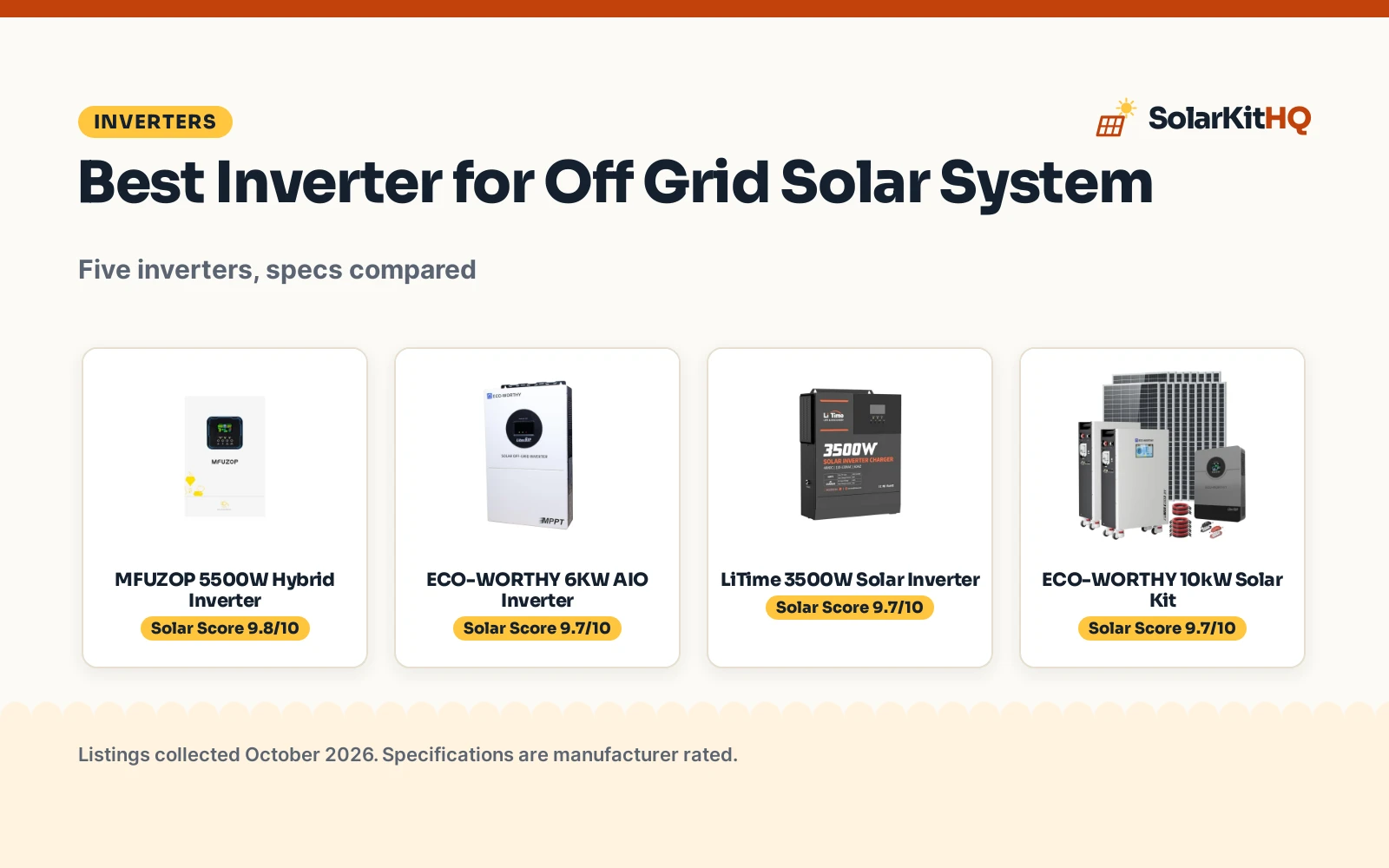
 Best Overall ECO-WORTHY 6KW AIO Inverter: 6000W split-phase AIO with 9000W MPPT input Check price on Amazon
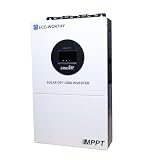
 Best All-in-One LiTime 3500W Solar Inverter: 3500W AIO with 80A MPPT, UPS and RS485 Check price on Amazon
 Largest System ECO-WORTHY 10kW Solar Kit: 10000W inverter with 10620W of panels and 32.2kWh storage Check price on Amazon
 Best 24V Pick VEVOR 3000W Inverter Charger: 3000W inverter charger with 5 modes and a remote control Check price on Amazon
 Mid-Range Pick MFUZOP 5500W Hybrid Inverter: 5500W hybrid inverter with a 100A MPPT charger Check price on Amazon
The kits we chose
| # | Product | Solar Score | Buy |
|---|---|---|---|
| 1 | MFUZOP 5500W Hybrid Inverter | 9.8/10 | Buy on Amazon |
| 2 | ECO-WORTHY 6KW AIO Inverter | 9.7/10 | Buy on Amazon |
| 3 | LiTime 3500W Solar Inverter | 9.7/10 | Buy on Amazon |
| 4 | ECO-WORTHY 10kW Solar Kit | 9.7/10 | Buy on Amazon |
| 5 | VEVOR 3000W Inverter Charger | 9.6/10 | Buy on Amazon |

MFUZOP 5500W Hybrid Inverter
A 48V hybrid inverter charger with 5500W output, a 100A MPPT controller and 8500W of PV input for home backup and off-grid systems.
Pros
- 5500W pure sine wave output with 8500W maximum PV input stated
- 100A MPPT controller with 99% solar conversion efficiency stated
- IEC 62109-1, EN IEC 60335-1 and EN IEC 60335-2-29 safety standards stated
- Supports AGM, gel, lead-acid and LiFePO4 batteries, plus battery-free operation
Cons
- 25.0 pounds stated, the heaviest weight stated in this group
- WiFi monitoring needs an external module, per the listing
- 48V system only, so a 24V battery bank does not fit
- No parallel capacity is stated
Detailed Review
The listing states a 5500W pure sine wave output at 110/120V AC, a 100A MPPT controller with up to 8500W PV input across a 60V to 500V DC range, and 99% solar conversion efficiency. It lists short-circuit, overcurrent, overvoltage, undervoltage, overload and overheat protection, support for AGM, gel, lead-acid and LiFePO4 batteries, battery-free operation, an RS485 interface for BMS communication and a 3-year warranty. The spec table gives 25.0 pounds and 22.0 by 7.0 by 14.0 inches.
Who it's for: homeowners and cabin owners building a 48V off-grid system with a large PV array. Who should skip it: anyone on a 24V battery bank, or anyone who wants WiFi monitoring in the box.
Its Solar Score of 9.8/10 comes from performance 33/35, build 22/25, value 21/25, safety 9/10 and warranty 4/5: 89 of 100 points, placed on our 9.2 to 9.8 scale.
Key Specifications
| Output | 5500W pure sine wave, 110/120V AC |
|---|---|
| MPPT charger | 100A, 8500W max PV input |
| Battery | 48V, AGM, gel, lead-acid, LiFePO4 |
| Warranty | 3-year warranty stated |
Figures as published on the retailer listing, collected 8 November 2026. Performance figures are manufacturer rated.
Safety and Warranty
What this listing states. IEC 62109-1, EN IEC 60335-1 and EN IEC 60335-2-29 stated, plus short-circuit, overcurrent, overvoltage, undervoltage, overload and overheat protection stated, so safety scores 9 of 10. 3-year warranty stated. It does not say everything a buyer needs, such as who pays return shipping, so warranty scores 4 of 5. See How We Pick.
Inverter limits. Stay within the stated continuous watts (surge watts last only a moment), use the cable size and fuse the manual gives, ventilate it, and never connect an inverter to home wiring yourself; that is work for a licensed electrician.
This is general buying information, not professional advice. Follow each product manual and local rules, and see our Safety Disclaimer.
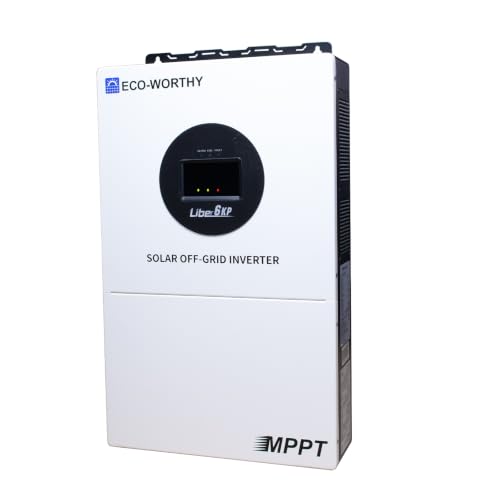
ECO-WORTHY 6KW AIO Inverter
A 6000W split-phase all-in-one inverter with 9000W MPPT solar input, a touchscreen and WiFi monitoring.
Pros
- 6000W split-phase output at 120V and 240V
- 9000W MPPT solar input with a 500V maximum PV voltage
- 120A solar charging and 100A AC charging stated
- Touchscreen control with WiFi monitoring and BMS communication
Cons
- 48V battery system only, not 24V or 12V
- MPPT operating range starts at 125V
- Ships in Grid Priority mode, so off-grid use needs a mode change
- 1-year warranty stated
Detailed Review
The listing states a 6000W split-phase all-in-one inverter that converts 48V DC to 120V and 240V AC, with a 9000W MPPT solar charge controller, a maximum PV open-circuit voltage of 500V, an MPPT range of 125V to 425V, 120A maximum solar charging current and 100A maximum AC charging current. It lists a touchscreen, 3 LED indicators, a built-in WiFi module, 4 output modes and 3 charging modes, plus BMS communication and multiple protection functions. The listing names air conditioners, water heaters and washing machines among the appliances it powers, and home backup systems and off-grid cabins among its uses. It measures 18.58 by 16.22 by 5.12 inches and carries a 1-year warranty. A licensed electrician should install it.
Who it's for: owners building a 48V off-grid system who want split-phase 240V output and a large solar input in one unit. Who should skip it: buyers on a 24V battery system, or buyers who want a longer warranty term.
Its Solar Score of 9.7/10 comes from performance 32/35, build 22/25, value 21/25, safety 8/10 and warranty 3/5: 86 of 100 points, placed on our 9.2 to 9.8 scale.
Key Specifications
| Output | 6000W split-phase |
|---|---|
| PV input | 9000W MPPT, 500V max |
| Battery | 48V DC |
| Size | 18.58 x 16.22 x 5.12 in |
Taken from the seller's listing on 18 November 2026. Capacity and output figures are rated by the manufacturer.
Safety and Warranty
What this listing states. BMS communication and multiple protection functions stated, so safety scores 8 of 10. 1-year warranty stated. It does not say everything a buyer needs, such as who pays return shipping, so warranty scores 3 of 5. See How We Pick.
Inverter limits. Stay within the stated continuous watts (surge watts last only a moment), use the cable size and fuse the manual gives, ventilate it, and never connect an inverter to home wiring yourself; that is work for a licensed electrician.
This is general buying information, not professional advice. Follow each product manual and local rules, and see our Safety Disclaimer.

LiTime 3500W Solar Inverter
A 3500W all-in-one inverter charger with 80A MPPT, a built-in UPS and RS485 communication.
Pros
- 3500W pure sine wave output with a 7000W surge stated
- 80A MPPT controller built into the same unit
- Built-in UPS that changes to battery backup in milliseconds
- RS485 communication and an LCD display for monitoring
Cons
- 48V battery systems only
- Maximum charge current is 40A, below the 80A MPPT figure
- 1-year warranty stated
- Hardwire terminal suits fixed installs, not quick portable setups
Detailed Review
The listing states a 3500W pure sine wave all-in-one inverter charger for 48V DC to 120V AC, with an 80A MPPT controller, a maximum charge current of 40A, a built-in UPS and RS485 communication. It lists 4 charging modes, 3 output modes, an LCD display, intelligent cooling fans and protection against short-circuit, over-temperature and overload. It is compatible with lead-acid, lithium and user-mode 48V batteries, plus the LiTime 51.2V 100Ah ComFlex Edition battery. The maker gives two surge figures, 7000W and 6000W; check before ordering. It measures 16.77 by 13.22 by 4.88 inches, weighs 23.14 pounds and carries a 1-year warranty. A licensed electrician should install it.
Who it's for: owners of a 48V off-grid system who want an inverter, MPPT controller and charger in one unit with UPS cover for outages. Who should skip it: buyers on a 24V battery system, or buyers who want a longer warranty term.
Its Solar Score of 9.7/10 comes from performance 30/35, build 21/25, value 21/25, safety 7/10 and warranty 3/5: 82 of 100 points, placed on our 9.2 to 9.8 scale.
Key Specifications
| Output | 3500W, 7000W surge |
|---|---|
| MPPT | 80A |
| Battery | 48V DC |
| Size | 16.77 x 13.22 x 4.88 in |
Taken from the seller's listing on 18 November 2026. Capacity and output figures are rated by the manufacturer.
Safety and Warranty
What this listing states. Short-circuit, over-temperature and overload protection stated, plus built-in UPS, so safety scores 7 of 10. 1-year warranty stated. It does not say everything a buyer needs, such as who pays return shipping, so warranty scores 3 of 5. See How We Pick.
Inverter limits. Stay within the stated continuous watts (surge watts last only a moment), use the cable size and fuse the manual gives, ventilate it, and never connect an inverter to home wiring yourself; that is work for a licensed electrician.
This is general buying information, not professional advice. Follow each product manual and local rules, and see our Safety Disclaimer.

ECO-WORTHY 10kW Solar Kit
A complete 10kW off-grid kit with a 10000W inverter, 18 590W panels and 32.2kWh of battery storage.
Pros
- 10000W continuous output with 20000W peak
- 10620W of panels across 18 590W panels
- 32.2kWh of storage from 2 48V 314Ah batteries
- Dual MPPT controllers with 200A battery charging and parallel support for up to 6 units
Cons
- No warranty term is stated for the inverter
- Ships on a pallet by truck, so delivery needs truck access
- Professional installation is recommended
- 18 panels and 2 batteries suit a fixed home install, not a portable setup
Detailed Review
The listing states a complete off-grid kit with a 10kW all-in-one inverter, 18 590W solar panels for 10620W of PV capacity and 2 48V 314Ah batteries for 32.2kWh of storage. The inverter lists 10000W continuous power, 20000W peak output, 120V or 120V/240V split-phase support, dual MPPT controllers, 200A battery charging, WiFi monitoring and parallel connection of up to 6 units. The panels are listed at up to 39.36 kWh per day under optimal conditions, and each battery lists 16.076 kWh of capacity with a PACE 200A Battery Management System, dual breakers and a 7-inch display. The 10-year warranty term stated covers the 48V 314Ah battery. A licensed electrician should install it.
Who it's for: owners building a fixed off-grid home system who want panels, batteries and a 10kW inverter in one kit. Who should skip it: buyers who want a standalone inverter, or buyers who need a portable setup.
Its Solar Score of 9.7/10 comes from performance 33/35, build 22/25, value 21/25, safety 9/10 and warranty 0/5: 85 of 100 points, placed on our 9.2 to 9.8 scale.
Key Specifications
| Output | 10000W, 20000W peak |
|---|---|
| PV | 10620W, 18 x 590W |
| Storage | 32.2kWh, 2 x 48V 314Ah |
| Battery charging | 200A |
Taken from the seller's listing on 18 November 2026. Capacity and output figures are rated by the manufacturer.
Safety and Warranty
What this listing states. PACE 200A BMS with multi-layer protection, dual breakers and comprehensive protection functions, so safety scores 9 of 10. No warranty term, so warranty scores zero. See How We Pick.
Inverter limits. Stay within the stated continuous watts (surge watts last only a moment), use the cable size and fuse the manual gives, ventilate it, and never connect an inverter to home wiring yourself; that is work for a licensed electrician.
This is general buying information, not professional advice. Follow each product manual and local rules, and see our Safety Disclaimer.

VEVOR 3000W Inverter Charger
A 3000W pure sine wave inverter charger for 24V systems, with 5 working modes and a remote control.
Pros
- 3000W pure sine wave output for refrigerators and medical equipment
- 5 working modes including Grid Priority, Battery Priority and Generator Mode
- Remote control on a 32.8ft cable for remote monitoring
- Compatible with LiFePO4, lithium-ion, AGM, sealed lead-acid and flooded lead-acid batteries
Cons
- No warranty term is stated
- 24V battery systems only
- Each outlet should stay below a 1.2kW load
- 39.68 pounds, heavier than the 23.14-pound LiTime
Detailed Review
The listing states a 3000W pure sine wave inverter charger for 24V DC to 120V AC, with 5 working modes, an LCD display and a remote control on a 32.8ft cable. It lists protection against overload, short-circuit, over-temperature, over-current, battery high and low voltage, and grid high and low voltage. It is compatible with LiFePO4, lithium-ion, AGM, sealed lead-acid and flooded lead-acid batteries, and it recommends keeping the load on each outlet below 1.2kW. It measures 19.5 by 8.66 by 7.28 inches, weighs 39.68 pounds and states 92% efficiency. A licensed electrician should install it.
Who it's for: owners of a 24V off-grid, RV or boat system who want an inverter charger with a remote control. Who should skip it: buyers on a 48V battery system, or buyers who want a stated warranty term.
Its Solar Score of 9.6/10 comes from performance 29/35, build 21/25, value 20/25, safety 8/10 and warranty 0/5: 78 of 100 points, placed on our 9.2 to 9.8 scale.
Key Specifications
| Output | 3000W pure sine wave |
|---|---|
| Battery | 24V DC |
| Modes | 5 working modes |
| Weight | 39.68 lb |
Taken from the seller's listing on 18 November 2026. Capacity and output figures are rated by the manufacturer.
Safety and Warranty
What this listing states. Overload, short-circuit, over-temperature, over-current and high/low voltage protection stated, so safety scores 8 of 10. No warranty term, so warranty scores zero. See How We Pick.
Inverter limits. Stay within the stated continuous watts (surge watts last only a moment), use the cable size and fuse the manual gives, ventilate it, and never connect an inverter to home wiring yourself; that is work for a licensed electrician.
This is general buying information, not professional advice. Follow each product manual and local rules, and see our Safety Disclaimer.
As an Amazon Associate I earn from qualifying purchases.
More picks to compare
- Ampinvt 5000W Hybrid InverterA 5000W hybrid inverter with WiFi, 100A solar charger and 5500W PV input.Check on Amazon
- ZXDZTZ 4000W/6000W Inverter KitComplete inverter kit with 4000W or 6000W inverter, 100W panels and 50A controller.Check on Amazon
Numbers side by side
| Inverter | Solar Score | Output | Surge | Battery | Warranty | Amazon |
|---|---|---|---|---|---|---|
| ECO-WORTHY 6KW AIO Inverter | 9.7/10 | 6000W | Not stated | 48V | 1 year | View on Amazon |
| LiTime 3500W Solar Inverter | 9.7/10 | 3500W | 7000W | 48V | 1 year | View on Amazon |
| ECO-WORTHY 10kW Solar Kit | 9.7/10 | 10000W | 20,000W | 48V | Not stated | View on Amazon |
| VEVOR 3000W Inverter Charger | 9.6/10 | 3000W | Not stated | 24V | Not stated | View on Amazon |
| MFUZOP 5500W Hybrid Inverter | 9.8/10 | 5500W | Not stated | 48V | Not stated | View on Amazon |
These specs are rated by the maker and quoted from each listing on 18 November 2026.
Where the points went
The Solar Score weighs performance, build, value, safety and warranty. For an inverter, safety means the protections and battery management the listing actually states; an inverter that states none scores zero on that line, whatever its watts. Two of the five inverters state a warranty term, and only the ECO-WORTHY 6KW and the 10kW kit state a battery management system. How we pick explains the weights.
| Product | Solar Score | Perf. /35 | Build /25 | Value /25 | Safety /10 | Warranty /5 |
|---|---|---|---|---|---|---|
| ECO-WORTHY 6KW AIO Inverter | 9.7 | 32 | 22 | 21 | 8 | 3 |
| LiTime 3500W Solar Inverter | 9.7 | 30 | 21 | 21 | 7 | 3 |
| ECO-WORTHY 10kW Solar Kit | 9.7 | 33 | 22 | 21 | 9 | 0 |
| VEVOR 3000W Inverter Charger | 9.6 | 29 | 21 | 20 | 8 | 0 |
Every total is translated into a figure between 9.2 and 9.8 with a linear formula; ranking by points and ranking by score always agree.
How to choose the best inverter for off grid solar system
Start from battery voltage
Battery voltage is the first filter, and four of the five inverters here are built for 48V battery systems. The ECO-WORTHY 6KW, the LiTime, the 10kW kit and the MFUZOP all list 48V, and only the VEVOR is built for a 24V battery system. Match the inverter to the battery bank you already own, since the voltage has to agree across the system. The LiFePO4 battery guides cover the battery side, and 12v vs 24v solar system covers the voltage choice in more detail.
Size the output to the load
Output watts decide what the inverter can run at once, and the range here runs from 3000W to 10000W. The VEVOR lists 3000W and recommends keeping the load on each outlet below 1.2kW, the LiTime lists 3500W, the MFUZOP lists 5500W, the ECO-WORTHY 6KW lists 6000W, and the 10kW kit lists 10000W continuous with 20000W peak. Match the inverter to the largest load you plan to run, not the average one, and keep the surge figure in mind when you size it. See can a solar generator power a whole house for the larger end.
Compare solar input and charge current
Solar input and charge current decide how fast the array refills the battery bank. The ECO-WORTHY 6KW lists 9000W MPPT solar input with a 500V maximum PV voltage, 120A solar charging and 100A AC charging. The 10kW kit lists 10620W of panels, dual MPPT controllers and 200A battery charging. The LiTime lists an 80A MPPT controller with a 40A maximum charge current, and the MFUZOP lists a 100A MPPT charger. The VEVOR lists no solar input figure, so compare it on output and modes alone.
| Inverter | PV input | Charge current | Modes |
|---|---|---|---|
| ECO-WORTHY 6KW AIO Inverter | 9000W MPPT | 120A solar, 100A AC | 4 output, 3 charging |
| LiTime 3500W Solar Inverter | Not stated | 80A MPPT, 40A max | 4 charging, 3 output |
| ECO-WORTHY 10kW Solar Kit | 10620W panels | 200A battery charging | Dual MPPT |
| VEVOR 3000W Inverter Charger | Not stated | Not stated | 5 working modes |
| MFUZOP 5500W Hybrid Inverter | Not stated | 100A MPPT charger | Not stated |
Check protections and monitoring
Protections and monitoring decide how much the inverter tells you when something goes wrong. The ECO-WORTHY 6KW lists a touchscreen, 3 LED indicators, a WiFi module and BMS communication. The LiTime lists an LCD display, RS485 communication and a built-in UPS. The VEVOR lists an LCD display, a remote control on a 32.8ft cable and protection against overload, short-circuit, over-temperature, over-current and high and low voltage. The 10kW kit lists WiFi monitoring, a 7-inch display, Bluetooth and RS485 and CAN communication. The MFUZOP lists no monitoring figure, so buyers who want remote monitoring should weigh that gap.
Read the warranty lines closely
Coverage varies more than output does. The ECO-WORTHY 6KW states a 1-year warranty and the LiTime states a 1-year warranty. The 10-year term on the kit covers the 48V 314Ah battery, not the inverter. Neither the VEVOR nor the MFUZOP states a warranty term, so buyers who value written coverage should weigh that before ordering.
Sizing Notes
- Match the inverter to your battery voltage first: 48V on four picks here, 24V on the VEVOR.
- Check the solar input against your array: the 6KW lists 9000W MPPT input at up to 500V, and the kit lists 10620W of panels.
- Match output watts to the largest load: 3000W on the VEVOR, 10000W continuous on the kit.
- Check the charge current the unit allows: 120A solar and 100A AC on the 6KW, 200A battery charging on the kit.
- Confirm the warranty term before ordering: 1 year on the 6KW and the LiTime, and no inverter term stated for the kit, the VEVOR or the MFUZOP.
FAQ: power away from the grid
Which inverter here has the largest output?
The ECO-WORTHY 10kW Solar Kit, at 10000W continuous with 20000W peak. The ECO-WORTHY 6KW follows at 6000W, then the MFUZOP at 5500W, the LiTime at 3500W and the VEVOR at 3000W.
Which inverters are built for 48V battery systems?
The ECO-WORTHY 6KW, the LiTime, the 10kW kit and the MFUZOP all list 48V. The VEVOR is the only pick here built for a 24V battery system.
Which inverters state a UPS function?
Only the LiTime, which lists a built-in UPS that changes to battery backup in milliseconds. The other four inverters list no UPS figure.
What surge figure does the LiTime list?
Two figures are given, 7000W and 6000W. Check before ordering.
Which inverters state a warranty term?
The ECO-WORTHY 6KW states 1 year and the LiTime states 1 year. The 10-year term on the kit covers the 48V 314Ah battery, not the inverter. The VEVOR and the MFUZOP state no warranty term.
Related solar guides
See every Power Inverters guide and all Controllers and Inverters guides. Also see our off grid solar system price. Also see our types of solar systems. Also see our inverter vs generator for home backup. Also see our who makes the best inverters.
More picks: solar generator maintenance, can a solar generator power a whole house, power station sizes.