On this page
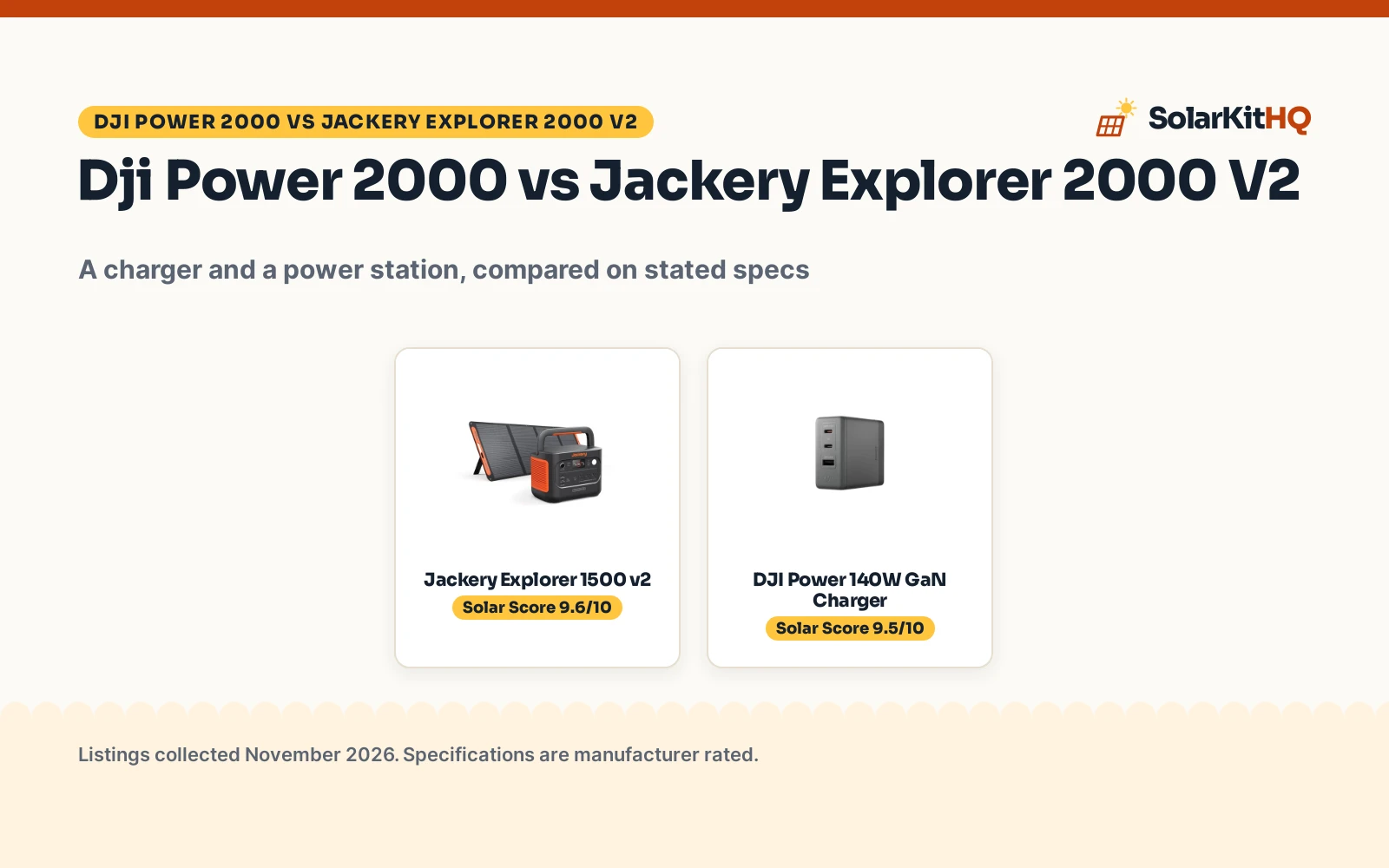
A campsite at dusk with a dead phone and a fridge warming up is the moment a portable power setup earns its keep, and that is where dji power 2000 vs jackery explorer 2000 v2 starts. The DJI listing in this comparison is a compact charger, while the Jackery listing is a full power station with a battery inside, so the two sides are not the same kind of product at all. This article compares what each listing states, side by side, so the choice comes down to the job at hand rather than the name on the box.
SolarKitHQ earns a commission when you buy through links on this page, at no extra cost to you. As an Amazon Associate I earn from qualifying purchases. Affiliate disclosure.
Dji Power 2000 vs Jackery Explorer 2000 V2: side by side
| Dji Power 2000 vs Jackery Explorer 2000 V2 | DJI Power 140W GaN Charger | Jackery Explorer 1500 v2 | Takeaway |
|---|---|---|---|
| Product type | GaN charger | Power station | Different product types, not rivals on the same job |
| Capacity | Not stated | 1536Wh | Only the Jackery listing states watt-hours |
| Rated output | 140W | 2000W | The Jackery listing states the higher rated output |
| Peak output | Not stated | 4000W | Only the Jackery listing states a peak figure |
| Ports | 3 | Not stated | Only the DJI listing states a port count |
| Fast charge stated | Not stated | 1 hour with emergency charging | Only the Jackery listing states a charge time |
| Weight | 0.53 pounds | Approximately 31.97 lbs | The DJI listing states the lighter carry |
| Warranty | 18 Months | 5 years | The Jackery listing states the longer term |
We copied each rating from the seller’s listing as the brand states it; data date 6 November 2026.
What each listing actually is
The DJI listing is a 140W GaN charger with 3 ports, not a power station. It takes power in through a wall outlet and sends it out through dual USB-C ports and one USB-A port, with PD 3.1 and dynamic power allocation that prioritizes DJI devices. The Jackery listing is a power station: a 1536Wh LiFePO4 battery with 2000W rated AC output and a 4000W surge peak, built to run appliances and tools away from an outlet. That difference shapes the whole comparison: the DJI listing charges devices, while the Jackery listing powers them.
Output and capacity
The Jackery listing states the capacity and output figures a power station buyer looks for: 1536Wh, 2000W rated output and a 4000W peak, and the maker claims it handles 99% of devices. The DJI listing states no watt-hours and no AC output, because a charger has no battery inside; its output figure is 140W across 3 ports. Do not call the DJI side better on capacity: the listing leaves it unstated, since the product stores no energy of its own.
Charging
Charging speed is where the Jackery listing gives the most detail. It states a full charge in 1 hour with emergency charging through the Jackery App, and 100% in 80 minutes on standard AC wall charging. With a 400W solar setup, the listing states 0-80% in 4 hours, and a SolarSaga 200W solar panel is included. The DJI listing states 140W output with PD 3.1 and a cable that supports up to 7A, with a digital display cable that shows charging status. No cable is included with the DJI charger, so the cable the listing describes must already be on hand.
Weight and size
The DJI listing states 0.53 pounds and dimensions of 2.69 x 2.52 x 1.27 inches, which fits a pocket or a small bag next to a laptop. The Jackery listing states approximately 31.97 lbs and dimensions of 12.99 x 8.7 x 9.53 inches, while the spec table lists 32.0 pounds; trust the bullets here, per the listing’s own figures. The Jackery is a station to carry with both hands, and the DJI is a pocket charger, so the weight gap is the product type gap, not a design flaw on either side.
What the listings leave unclear
The listing names do not match the article topic on either side. The DJI listing is a 140W GaN charger, not a DJI Power 2000 station, and the Jackery listing is titled Explorer 1500 v2, not Explorer 2000 v2. Neither listing states a protection rating, and the DJI listing states no capacity figure, no AC output and no solar input. The Jackery listing states no port count, so the number of outlets stays unstated. The DJI listing states a digital display cable in its bullets while the title says no cable is included, so read the title as the packing list.
The kits we chose

Jackery Explorer 1500 v2
A 1536Wh LiFePO4 power station with 2000W rated output, a 4000W peak, 1-hour fast charging and a 5-year warranty.
Pros
- 1536Wh LiFePO4 battery with 2000W rated output and 4000W peak stated
- 6000+ charge cycles with over 70% capacity retained, per the listing
- Full charge in 1 hour with emergency charging, or 80 minutes on standard AC wall charging
- 5 years of coverage stated
Cons
- Listing title names the Explorer 1500 v2, not the 2000 v2 in the article topic
- Approximately 31.97 lbs stated, so it is a heavy carry
- Power station and solar panel ship separately, per the listing note
- No port count is stated in the listing
Detailed Review
The listing states a Jackery Explorer 1500 v2 power station with a 1536Wh LiFePO4 battery, 2000W rated AC output and a 4000W surge peak, with a 10ms UPS and a SolarSaga 200W solar panel included. It states a full charge in 1 hour with emergency charging through the Jackery App, 100% in 80 minutes on standard AC wall charging, and 0-80% in 4 hours with a 400W solar setup. The listing states 6000+ charge cycles with over 70% of capacity retained, an 11-year lifespan, approximately 31.97 lbs at 12.99 x 8.7 x 9.53 inches, and 5 years of coverage. The title names the Explorer 1500 v2 while the article topic names the Explorer 2000 v2, so trust the listing: this is the 1500 v2. The bullets give approximately 31.97 lbs while the spec table lists 32.0 pounds.
Who it's for: RV and cabin owners who want a 1536Wh station with 2000W output, stated solar charging and a 5-year warranty. Who should skip it: anyone looking for a pocket-size charger, or anyone who needs the listing to state a port count.
Its Solar Score of 9.6/10 comes from performance 30/35, build 21/25, value 20/25, safety 6/10 and warranty 3/5: 80 of 100 points, placed on our 9.2 to 9.8 scale.
Key Specifications
| Capacity | 1536Wh LiFePO4 |
|---|---|
| Output | 2000W rated, 4000W peak |
| Charging | 1 hour fast charge, 80 minutes standard AC |
| Size | 12.99 x 8.7 x 9.53 in, approximately 31.97 lbs |
Figures as published on the retailer listing, collected 6 November 2026. Performance figures are manufacturer rated.
Safety and Warranty
What this listing states. 10ms UPS stated; LiFePO4 battery chemistry stated, so safety scores 6 of 10. 5 Year Manufacturer stated. It does not say everything a buyer needs, such as who pays return shipping, so warranty scores 3 of 5. See How We Pick.
Power station limits. Stay within the stated continuous output and solar input limits, keep the unit ventilated and dry, charge within the stated temperature range, and never connect it to home wiring except through equipment a licensed electrician installs.
This is general buying information, not professional advice. Follow each product manual and local rules, and see our Safety Disclaimer.

DJI Power 140W GaN Charger
A 140W GaN charger with 3 ports, PD 3.1 and dynamic power allocation, with no cable included.
Pros
- 140W output across 3 ports with PD 3.1 stated
- Dynamic power allocation prioritizes DJI devices, per the listing
- Smart temperature control and LED status indicator stated
- 18 Months warranty stated
Cons
- No cable is included, per the title
- A charger, not a power station: no watt-hours or AC output is stated
- No AC outlets are stated
- No protection rating is stated in the listing
Detailed Review
The listing states a DJI Power 140W GaN charger with dual USB-C ports and one USB-A port, up to 140W charging power with PD 3.1, dynamic power allocation that prioritizes DJI devices, smart temperature control and an LED status indicator. It states a cable that supports up to 7A with a digital display for real-time power readout, and dimensions of 2.69 x 2.52 x 1.27 inches at 0.53 pounds, with an 18 Months warranty. The title says no cable is included, so the cable the bullets describe must already be on hand. The listing is a charger, not a DJI Power 2000 station, so it cannot be compared on watt-hours or AC output.
Who it's for: DJI device owners who want a compact 140W charger with PD 3.1 for laptops, phones and batteries. Who should skip it: anyone who needs a power station with watt-hours and AC outlets.
Its Solar Score of 9.5/10 comes from performance 26/35, build 20/25, value 19/25, safety 5/10 and warranty 2/5: 72 of 100 points, placed on our 9.2 to 9.8 scale.
Key Specifications
| Output | 140W, 3 ports, PD 3.1 |
|---|---|
| Ports | Dual USB-C and one USB-A |
| Size | 2.69 x 2.52 x 1.27 in |
| Weight | 0.53 pounds |
Figures as published on the retailer listing, collected 6 November 2026. Performance figures are manufacturer rated.
Safety and Warranty
What this listing states. Smart temperature control and LED status indicator stated, so safety scores 5 of 10. 18 Months stated. It does not say everything a buyer needs, such as who pays return shipping, so warranty scores 2 of 5. See How We Pick.
Power station limits. Stay within the stated continuous output and solar input limits, keep the unit ventilated and dry, charge within the stated temperature range, and never connect it to home wiring except through equipment a licensed electrician installs.
This is general buying information, not professional advice. Follow each product manual and local rules, and see our Safety Disclaimer.
As an Amazon Associate I earn from qualifying purchases.
Where the points went
The Solar Score weighs performance, build, value, safety and warranty. For power stations, safety means a protection or switchover feature the listing names; the Jackery listing states a 10ms UPS and the DJI listing states smart temperature control. Both listings state a warranty term: 5 years on the Jackery and 18 Months on the DJI. How we pick explains the weights.
| Product | Solar Score | Perf. /35 | Build /25 | Value /25 | Safety /10 | Warranty /5 |
|---|---|---|---|---|---|---|
| Jackery Explorer 1500 v2 | 9.6 | 30 | 21 | 20 | 6 | 3 |
| DJI Power 140W GaN Charger | 9.5 | 26 | 20 | 19 | 5 | 2 |
We place weighted points on a scale whose ends are 9.2 and 9.8. Because the mapping is straight, a unit with more points never shows less.
How to choose the best dji power 2000 vs jackery explorer 2000 v2
Start from the job, not the name. The DJI listing charges devices and the Jackery listing powers them, so the right pick follows the load. The sections below use the stated figures to sort that out.
Match the product type to the job
A charger and a power station solve different problems. The DJI listing suits charging laptops, phones and DJI devices from a wall outlet, with 140W across 3 ports and PD 3.1. The Jackery listing suits running appliances and tools away from an outlet, with 1536Wh and 2000W rated output. Pick the charger when the job is topping up devices; pick the station when the job is keeping loads running. For more portable power ideas, see the best portable power station for camping.
Read the watt-hours before the watts
Watts say how much a load can draw at once; watt-hours say how long the station can keep it going. The Jackery listing states 1536Wh, 2000W rated output and a 4000W peak, so it covers both figures. The DJI listing states 140W and no watt-hours, because a charger stores nothing. When the listing leaves watt-hours unstated, treat the product as a charger, not a station. For full time off-grid setups, see the best solar generator for full time RV living.
Check charging time and solar input
The Jackery listing states a full charge in 1 hour with emergency charging through the Jackery App, 100% in 80 minutes on standard AC wall charging, and 0-80% in 4 hours with a 400W solar setup, with a SolarSaga 200W solar panel included. The DJI listing states 140W output with PD 3.1 and a cable that supports up to 7A. Match the stated charge figures to the time you have between uses, and check the panel watts against the station input before buying a panel. For van setups, see the best power inverter for camper van.
Weigh the carry
The DJI listing states 0.53 pounds, so it rides in a pocket or a small bag. The Jackery listing states approximately 31.97 lbs, so it needs a planned spot in the RV or on the porch. Weight follows the product type here, and the lighter pick is the one with no battery inside.
| If you need | Look at |
|---|---|
| To charge laptops, phones and DJI devices | DJI Power 140W GaN Charger, 140W across 3 ports |
| To run appliances away from an outlet | Jackery Explorer 1500 v2, 1536Wh and 2000W output |
| The quickest stated full charge | Jackery Explorer 1500 v2, 1 hour with emergency charging |
| The longest stated warranty | Jackery Explorer 1500 v2, 5 years |
Sizing Notes
- Match the station’s stated watt-hours against the loads you plan to run: the Jackery listing states 1536Wh and 2000W rated output with a 4000W peak.
- Match the charger’s stated output to the device: the DJI listing states 140W across 3 ports with PD 3.1.
- Check solar input figures against the panel you own: the Jackery listing states a 400W solar setup reaches 0-80% in 4 hours and includes a SolarSaga 200W solar panel.
- Check the carry weight before you pack: the DJI listing states 0.53 pounds and the Jackery listing states approximately 31.97 lbs.
- Fuse the positive lead as the manual directs, and leave changes to the RV’s wiring to a qualified technician.
FAQ: power away from the grid
Is the DJI Power 2000 listing a power station?
No. The listing is a DJI Power 140W GaN charger with 3 ports and PD 3.1, and it states no watt-hours or AC output. The Jackery listing is the power station in this comparison.
How much power does the Jackery Explorer 1500 v2 deliver?
The listing states 1536Wh, 2000W rated AC output and a 4000W surge peak, with a LiFePO4 battery.
How fast does the Jackery Explorer 1500 v2 charge?
The listing states a full charge in 1 hour with emergency charging through the Jackery App, and 100% in 80 minutes on standard AC wall charging. With a 400W solar setup, the listing states 0-80% in 4 hours.
Which listing has the longer warranty?
The Jackery listing states 5 years of coverage, and the DJI listing states 18 Months.
Does the Jackery listing include a solar panel?
The listing states a SolarSaga 200W solar panel is included, and notes that the power station and the panel ship separately.
Related solar guides
See every Portable Power Stations guide and all Power Stations and Generators guides. For the panel side, see the best solar panel kit for RV, and for portable power, the best portable power station for camping. Also see our best solar generator for full time RV living. Also see our best solar panel for Jackery. Also see our best solar panel for EcoFlow. Also see our best power inverter for camper.
More picks: best solar flood light with CCTV camera, best portable power station for home backup, best solar panel for Anker Solix C2000 Gen 2, best portable power station for a shed.