On this page
At a campsite at dusk, with a dead phone and a panel that stopped charging hours ago, the question is how to select solar charge controller hardware that fits the system you have. A controller sits between the panels and the battery, and its voltage and current limits decide what panels and batteries it can serve. The steps below work from the panel, to the battery, to the controller type, and the controllers at the end show what those limits look like in practice.
SolarKitHQ earns a commission when you buy through links on this page, at no extra cost to you. As an Amazon Associate I earn from qualifying purchases. Affiliate disclosure.
The quick answer
Match the controller to the panel voltage and current, then to the battery voltage and type, then pick MPPT or PWM. The panel array sets the PV input voltage and the charge current, the battery sets the system voltage, and the controller must cover the panel and the battery with room to spare. A 100A controller with 250V PV input covers a large array, while a 30A controller suits a smaller array, and the controllers below show that range.
How to select solar charge controller: start with the panel
The panel array sets the PV voltage the controller must accept. The VUICCI controller (on Amazon) accepts up to 100V of PV input, while the Victron accepts up to 250V, so a high-voltage array needs the higher limit. Charge current is the other limit: the VUICCI and Victron controllers are rated at 100A, while the smaller controllers are rated at 30A. See the solar charge controller size guide to work through the sizing for your own array.
| Controller | Max PV input | Charge current | Battery voltage | Amazon |
|---|---|---|---|---|
| Victron SmartSolar MPPT 250V | 250V | 100A | 12/24/36/48V | View on Amazon |
| VUICCI 100A Solar Controller | 100V | 100A | 12/24/36/48V | View on Amazon |
| Renogy Rover 30A MPPT | Not stated | 30A | 12V/24V | |
| Depvko 30A MPPT Controller | Not stated | 30A | Not stated |
These are the stated figures only. A controller with no PV voltage limit stated leaves the array voltage unchecked, so confirm it with the maker before choosing.
Match the battery voltage and type
A controller must suit the battery voltage: 12V, 24V, 36V and 48V systems all appear here. The VUICCI controller recognizes 12V, 24V, 36V and 48V systems automatically, and the Victron controller covers the same range, while the Renogy Rover (on Amazon) suits 12V and 24V systems. Battery type matters as well: the VUICCI controller lists LiFePO4, AGM, GEL, sealed and flooded lead-acid batteries, so check that your battery type is on the list before choosing.
The dual 5V USB ports on the VUICCI controller charge small devices straight from the controller, which suits a cabin or an RV where small devices share the same battery.
MPPT or PWM
MPPT controllers track the panel’s best power point as light changes, while PWM controllers charge at the battery voltage. The Victron, Renogy and Depvko controllers (on Amazon) are MPPT, and the VUICCI controller combines MPPT-based optimization with PWM charging control. See what a PWM controller is if your array is small and the panel voltage stays close to the battery voltage.
Load control and protections
A controller with load terminals can run lights and small loads straight from the battery, and the VUICCI controller offers light control, manual operation, timed operation, and light plus time-delay control. Protections matter when the sun is strong and the battery is full: the VUICCI controller lists protection against overcharge, over-discharge, over-voltage, over-current, overheating, short circuit and reverse connection, and the Victron controller disconnects loads when the battery voltage drops too low. See how to set a solar charge controller for the settings that go with these protections.
The controllers
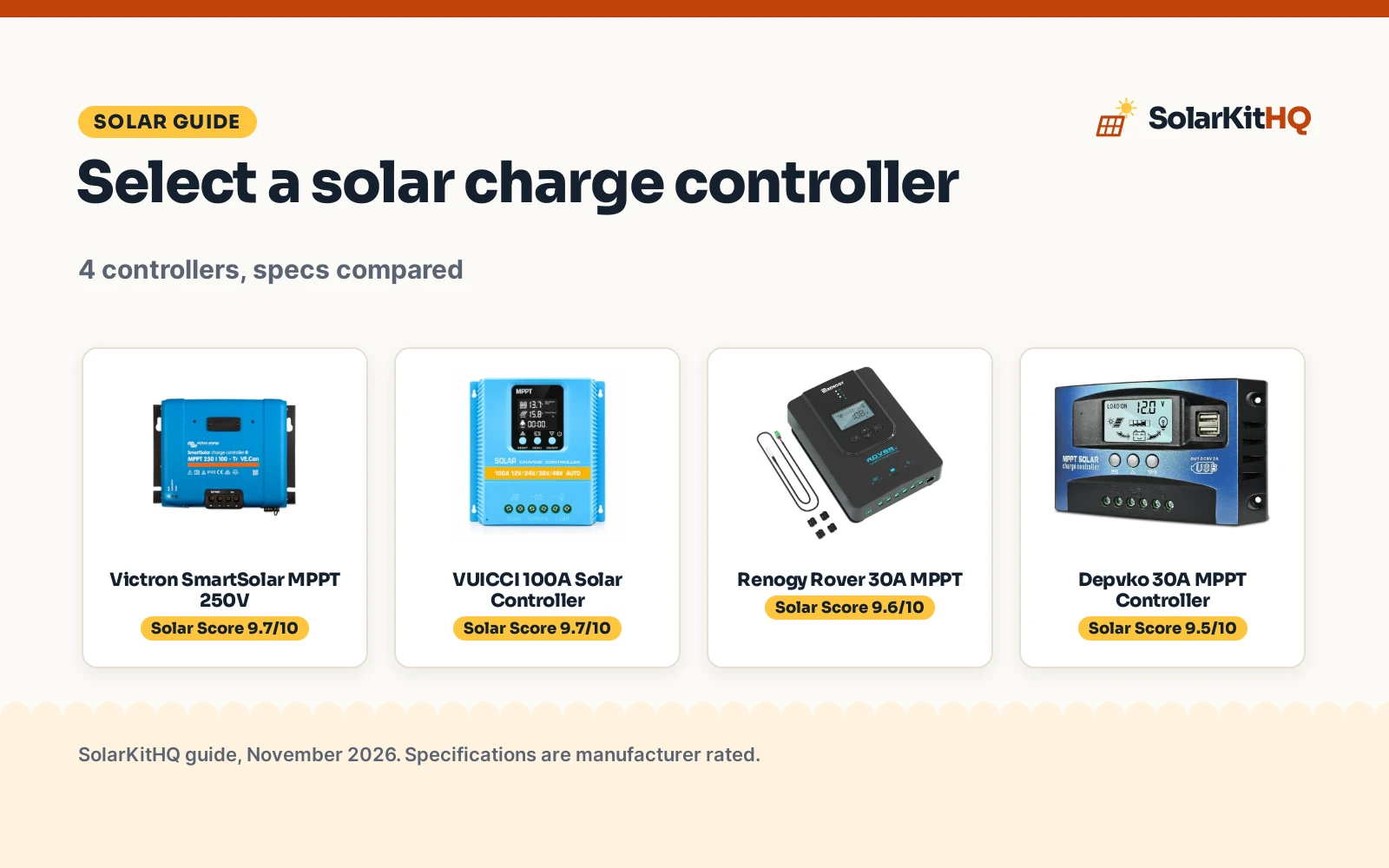
The panel voltage and current from the steps above point to the controller size you need, and these controllers show that range from 100A down to 30A.
| # | Product | Solar Score | Buy |
|---|---|---|---|
| 1 |  Victron SmartSolar MPPT 250V | 9.7/10 | Buy on Amazon |
| 2 |  VUICCI 100A Solar Controller | 9.7/10 | Buy on Amazon |
| 3 |  Renogy Rover 30A | 9.6/10 | Buy on Amazon |
| 4 |  Depvko 30A | 9.5/10 | Buy on Amazon |

Victron SmartSolar MPPT 250V
A 100A MPPT controller with 250V PV input, Bluetooth app control and synchronized charging for 12V, 24V, 36V and 48V battery systems.
Pros
- 250V max PV input, the highest here
- Bluetooth app with 30-day performance history
- Multiple controllers can synchronize charging
- Intelligent load output disconnects loads at low battery voltage
Cons
- No warranty term is stated
- No panel wattage limit stated
- No USB ports stated
- 100A size is more than a small system needs
Detailed Review
The maker lists a SmartSolar MPPT controller with 250V PV input, 100A charge current and 12/24/36/48V battery systems, with Bluetooth and the VictronConnect app for real-time data and 30-day performance history. Multiple controllers can synchronize charging, and the intelligent load output disconnects loads when the battery voltage drops too low. It handles the high-voltage array and the app monitoring part of the task.
Who it's for: a large array on a 12V, 24V, 36V or 48V battery system with app monitoring. Who should skip it: a small array that needs only a 30A controller, or a system with no need for Bluetooth.
Its Solar Score of 9.7/10 comes from performance 34/35, build 22/25, value 21/25, safety 9/10 and warranty 0/5: 86 of 100 points, placed on our 9.2 to 9.8 scale.
Key Specifications
| Max PV voltage | 250V |
|---|---|
| Charge current | 100A |
| Battery voltage | 12/24/36/48V |
| App | VictronConnect with Bluetooth |
Taken from the seller's listing on 14 November 2026. Capacity and output figures are rated by the manufacturer.
Safety and Warranty
What this listing states. Intelligent load output disconnects loads when battery voltage drops too low, so safety scores 9 of 10. No warranty term, so warranty scores zero. See How We Pick.
Stay under the input limit. Keep your panels' combined open circuit voltage, with cold weather margin, under the controller's stated maximum PV input, connect the battery first unless the manual says otherwise, and fuse both sides as the manual directs.
This is general buying information, not professional advice. Follow each product manual and local rules, and see our Safety Disclaimer.

VUICCI 100A Solar Controller
A 100A controller with auto voltage recognition, up to 4800W, a backlit LCD and dual USB ports for 12V, 24V, 36V and 48V battery systems.
Pros
- 100A charging with up to 4800W
- Auto recognition for 12V, 24V, 36V and 48V systems
- Backlit LCD shows battery voltage, PV voltage and charging current
- Dual 5V USB ports for small devices
Cons
- No warranty term is stated
- 100V max PV input is lower than the 250V Victron
- No app or Bluetooth control stated
- 7.2 by 7.6 by 2.6 inches and 1.8 pounds need wall space
Detailed Review
The maker lists a 100A controller with auto recognition for 12V, 24V, 36V and 48V battery systems, up to 4800W and a max 100V PV input, with MPPT-based optimization and PWM charging control. A large backlit LCD shows battery voltage, PV voltage, charging current, discharging current and working mode, and dual 5V USB ports charge small devices. The maker lists 7.2 by 7.6 by 2.6 inches and 1.8 pounds. It handles the multi-voltage battery and the LCD monitoring part of the task.
Who it's for: a multi-voltage battery system that needs 100A charging with LCD monitoring. Who should skip it: a high-voltage array above 100V PV input, or a system that needs app control.
Its Solar Score of 9.7/10 comes from performance 32/35, build 21/25, value 22/25, safety 9/10 and warranty 0/5: 84 of 100 points, placed on our 9.2 to 9.8 scale.
Key Specifications
| Charge current | 100A |
|---|---|
| Max PV input | 100V |
| Max power | 4800W |
| Battery voltage | 12/24/36/48V |
Taken from the seller's listing on 14 November 2026. Capacity and output figures are rated by the manufacturer.
Safety and Warranty
What this listing states. Overcharge, over-discharge, over-voltage, over-current, overheating, short circuit and reverse connection protection, so safety scores 9 of 10. No warranty term, so warranty scores zero. See How We Pick.
Stay under the input limit. Keep your panels' combined open circuit voltage, with cold weather margin, under the controller's stated maximum PV input, connect the battery first unless the manual says otherwise, and fuse both sides as the manual directs.
This is general buying information, not professional advice. Follow each product manual and local rules, and see our Safety Disclaimer.

Renogy Rover 30A
A 30A 12V/24V auto DC input MPPT solar charge controller with LCD display.
Pros
- 30A, per the listing
- 12V/24V, per the listing
- 3-year warranty, per the listing
- LCD display, per the listing
Cons
- 30A is mid-range
- 3-year only
- LCD only
- Auto DC only
Detailed Review
The Renogy Rover 30A is the overall pick: a 30A 12V/24V auto DC input MPPT solar charge controller.
The parameter adjustable LCD display suits gel, sealed, flooded and lithium batteries. A 3-year material and workmanship warranty is stated.
Who it's for: the RV classic. Who should skip it: 48V systems.
Its Solar Score of 9.6/10 comes from performance 33/35, build 22/25, value 21/25, safety 0/10 and warranty 1/5: 77 of 100 points, placed on our 9.2 to 9.8 scale.
Key Specifications
| Amps | 30 |
|---|---|
| Volts | 12V/24V |
| Display | LCD |
| Warranty | 3-year |
Figures as published on the retailer listing, collected 20 October 2026. Performance figures are manufacturer rated.
Safety and Warranty
What this listing states. No protection feature or safety listing is stated, so safety scores zero. 3-year material and workmanship warranty. It does not say everything a buyer needs, such as who pays return shipping, so warranty scores 1 of 5. See How We Pick.
Stay under the input limit. Keep your panels' combined open circuit voltage, with cold weather margin, under the controller's stated maximum PV input, connect the battery first unless the manual says otherwise, and fuse both sides as the manual directs.
This is general buying information, not professional advice. Follow each product manual and local rules, and see our Safety Disclaimer.

Pros
- 30A for 12/24V systems
- Dual USB 5V/2.5A ports
- 12-month warranty stated
- Lifetime technical support stated
Cons
- No PV input figure stated
- No efficiency figure stated
- 30A, the smallest here
- Memory function is maker claim
Detailed Review
The listing states a 30A MPPT solar charge controller for 12/24V auto systems, dual USB ports at 5V/2.5A max, LCD display with timer setting, protection against overcharging, short-circuits, reverse polarity and low voltage, a 12-month warranty and lifetime technical support. No PV input figure and no efficiency figure are stated.
Who it's for: small 12/24V systems that want USB charging and a warranty. Who should skip it: anyone with a big array.
Its Solar Score of 9.5/10 comes from performance 24/35, build 18/25, value 20/25, safety 6/10 and warranty 5/5: 73 of 100 points, placed on our 9.2 to 9.8 scale.
Key Specifications
| Current | 30A |
|---|---|
| USB | 5V/2.5A dual |
| Systems | 12/24V |
Figures as published on the retailer listing, collected 21 October 2026. Performance figures are manufacturer rated.
Safety and Warranty
What this listing states. overcharging, short-circuit, reverse polarity protection stated, so safety scores 6 of 10. 12-month warranty stated, so warranty scores 5 of 5. See How We Pick.
Stay under the input limit. Keep your panels' combined open circuit voltage, with cold weather margin, under the controller's stated maximum PV input, connect the battery first unless the manual says otherwise, and fuse both sides as the manual directs.
This is general buying information, not professional advice. Follow each product manual and local rules, and see our Safety Disclaimer.
As an Amazon Associate I earn from qualifying purchases.
Ways to get more from your controller
- Keep the panel voltage within the controller’s PV input limit.
- Match the battery type setting to your battery before the sun hits the panels.
- Use the LCD or the app to watch battery voltage and charging current.
- Use the load terminals for lights where the controller offers them.
- Check the charge current against the array before adding panels.
FAQ: power away from the grid
What size solar charge controller do I need?
Size it from the panel array: the PV input voltage and the charge current must cover the array, and the battery voltage must match the system. A 100A controller suits a large array, while a 30A controller suits a smaller array.
Is MPPT better than PWM?
MPPT tracks the panel’s best power point as light changes, so it makes better use of the panels than PWM in most systems. The Victron, Renogy and Depvko controllers here are MPPT, and the VUICCI controller combines MPPT-based optimization with PWM charging control.
Can a charge controller work with a lithium battery?
It can when the controller lists your battery type. The VUICCI controller lists LiFePO4, AGM, GEL, sealed and flooded lead-acid batteries, so check the list before choosing.
Do I need a charge controller for a small panel?
Yes, when the panel feeds a battery: a controller stops the battery from overcharging and manages the charge. A 30A controller is enough for a small array, while a larger array needs a 100A controller.
Related solar guides
See every charge controller guide and all controllers and inverters guides.
More picks: charge controllers for a tiny house, MPPT vs PWM for an RV and MPPT charge controllers for a boat.