On this page
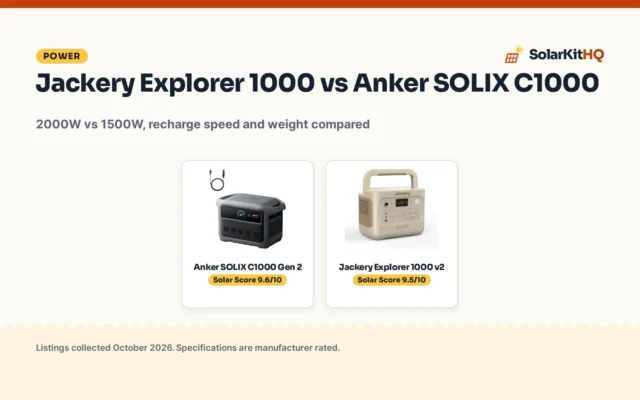
The short answer on jackery solar generator 1000 vs anker solix c1000: pick the Anker side for a longer stated warranty and more ports, and pick the Jackery side for a lighter station and flexible panels that bend over curved surfaces. A campsite at dusk with a dead phone, an RV roof with room for panels, and a porch during an outage all ask the same question: which kit keeps the essentials running without asking for more gear than the listing promises. We compared the two kits on what each listing states: capacity, output, recharge speed, panels, ports and warranty terms.
SolarKitHQ earns a commission when you buy through links on this page, at no extra cost to you. As an Amazon Associate I earn from qualifying purchases. Affiliate disclosure.
Jackery solar generator 1000 vs anker solix c1000: side by side
| Spec | Jackery Solar Generator 1000 | Anker SOLIX C1000 | Takeaway |
|---|---|---|---|
| Capacity | 1070Wh | 1,056Wh | Jackery states the higher capacity figure |
| AC output | 1500W | 1,800W | Anker states the higher AC output figure |
| Surge output | 3000W | Up to 2,400W | Jackery states the higher surge figure |
| Solar input | Two 100W panels included | Up to 600W | Anker states the higher solar input figure |
| Ports or devices | 8 devices at once | 11 ports | Anker states more ports |
| AC recharge | 1-hour emergency charging, 1.7-hour default | 100% in 58 minutes | Anker states the faster full recharge |
| Station weight | 23.8 pounds | 27.59 pounds | Jackery states the lighter station |
| Warranty | Not stated | 5 years | Anker states a warranty term |
Figures in this table are the manufacturer’s ratings as listed, captured 2 November 2026.
Output and capacity
The capacity figures sit close together. The Jackery listing states 1070Wh, a 1500W AC output and a 3000W surge, while the Anker listing states 1,056Wh, 1,800W and up to 2,400W with SurgePad technology. Read side by side, the Jackery listing states the higher capacity figure and the higher surge figure, and the Anker listing states the higher headline AC output figure. Neither listing converts watt-hours into run times for a named load, so the figures describe the stations, not a promise about how long a fridge or a fan will run.
Both stations use a LiFePO4 battery, and both kits pair the station with a panel. The Jackery kit includes two 100W Light panels, and the Anker kit includes a 100W bifacial panel. That pairing matters because the station figures alone say nothing about how the kit refills, which is where the two listings pull apart.
Charging speed and solar input
On AC charging, the Anker listing states the faster full recharge: 80% in 43 minutes and 100% in 58 minutes, using UltraFast recharging through the Anker app. The Jackery listing states 1-hour emergency fast charging through an AC wall outlet, with a note that the emergency charging function must be enabled in the Jackery app before charging each time, and that the station defaults to a 1.7-hour charging mode to protect battery health. A buyer who wants the quickest stated AC recharge without an extra app step should weigh that default against the emergency mode.
On solar input, the Anker listing states up to 600W of solar input and a solar recharge to 100% in 1.8 hours. The Jackery listing states two 100W Light panels with 25% conversion efficiency, and describes their all-black front design as maximizing sunlight absorption. The Jackery listing does not state a station solar input limit in the same form, so the two solar figures are not directly comparable: one is a station input limit, the other is the wattage of the panels in the box.
Panels, ports and weight
The panels differ in shape and handling. The Jackery panels carry an IP68 rating, bend up to 221 degrees, and weigh 4.52 pounds each, and the listing describes them as 56% lighter than traditional rigid panels. The Anker panel is a bifacial design with a dual-sided surface for up to 10% more power, a reinforced aluminium frame, an IP68 rating, and a weight of 7 lb including the stand. The Anker listing describes the panel as 10% lighter than the previous version and over 30% lighter than typical 100W panels.
On ports and weight, the Anker station lists 11 ports and a station weight of 27.59 pounds, with dimensions of 14.8 inches by 8.07 inches by 10.5 inches. The Jackery station powers up to 8 devices at once, weighs 23.8 pounds, and measures 12.9 inches by 8.8 inches by 9.7 inches, with a USB-C port rated at 100W PD and a 30dB quiet charging mode for sleep. The Jackery station is the lighter carry, and the Anker station is the one with more places to plug in.
What the listings leave unclear
The Jackery listing states no warranty term, so a buyer cannot compare warranty cover from the listing alone. The Anker listing states a 5-year warranty, which is the only warranty term stated across the two kits. The Jackery listing does state a long battery life claim, with the LiFePO4 battery retaining 70% or more capacity after 4,000 charge cycles, plus ChargeShield 2.0 protection and IEC-certified panel durability.
The Anker title pairs 1,800W with up to 2,400W output, and the bullets credit SurgePad technology with delivering 2,400W, but the listing does not label the two figures as continuous and surge in so many words. Neither station listing states a UL or ETL listing. The Jackery station listing also gives a wide operating range for the kit, from -40 degrees Fahrenheit to 185 degrees Fahrenheit, without breaking that range down by station and panel, so readers should treat it as a kit-level claim rather than a station-only figure.
Two examples

Anker SOLIX C1000
A portable power station kit with a 1,056Wh LiFePO4 battery, 11 ports, SurgePad output up to 2,400W and a 5-year warranty.
Pros
- 1,056Wh LiFePO4 battery with 11 ports
- 80% recharge in 43 minutes and 100% in 58 minutes on AC with UltraFast recharging
- Up to 600W solar input, with solar recharge to 100% in 1.8 hours
- 5-year warranty stated
Cons
- Station weighs 27.59 pounds, heavier than the Jackery station
- Title pairs 1,800W with up to 2,400W without labeling continuous and surge in so many words
- Panel ships in a separate package from the station
- No UL or ETL listing is stated
Detailed Review
The listing states a 1,056Wh LiFePO4 portable power station with 1,800W output and up to 2,400W with SurgePad technology, 11 ports, up to 600W solar input, and a 100W bifacial panel with an IP68 rating, a reinforced aluminium frame and a dual-sided design for up to 10% more power. The panel weighs 7 lb including the stand. The title pairs 1,800W with up to 2,400W output while the bullets credit SurgePad technology with delivering 2,400W, without labeling the two figures as continuous and surge in so many words, so the split is left to the reader. The two packages are dispatched separately, and the warranty description is 5 years.
Who it's for: buyers who want many ports, fast stated AC recharging and a stated warranty term in one kit. Who should skip it: buyers who want the lower station weight in this pair, or a single-package delivery.
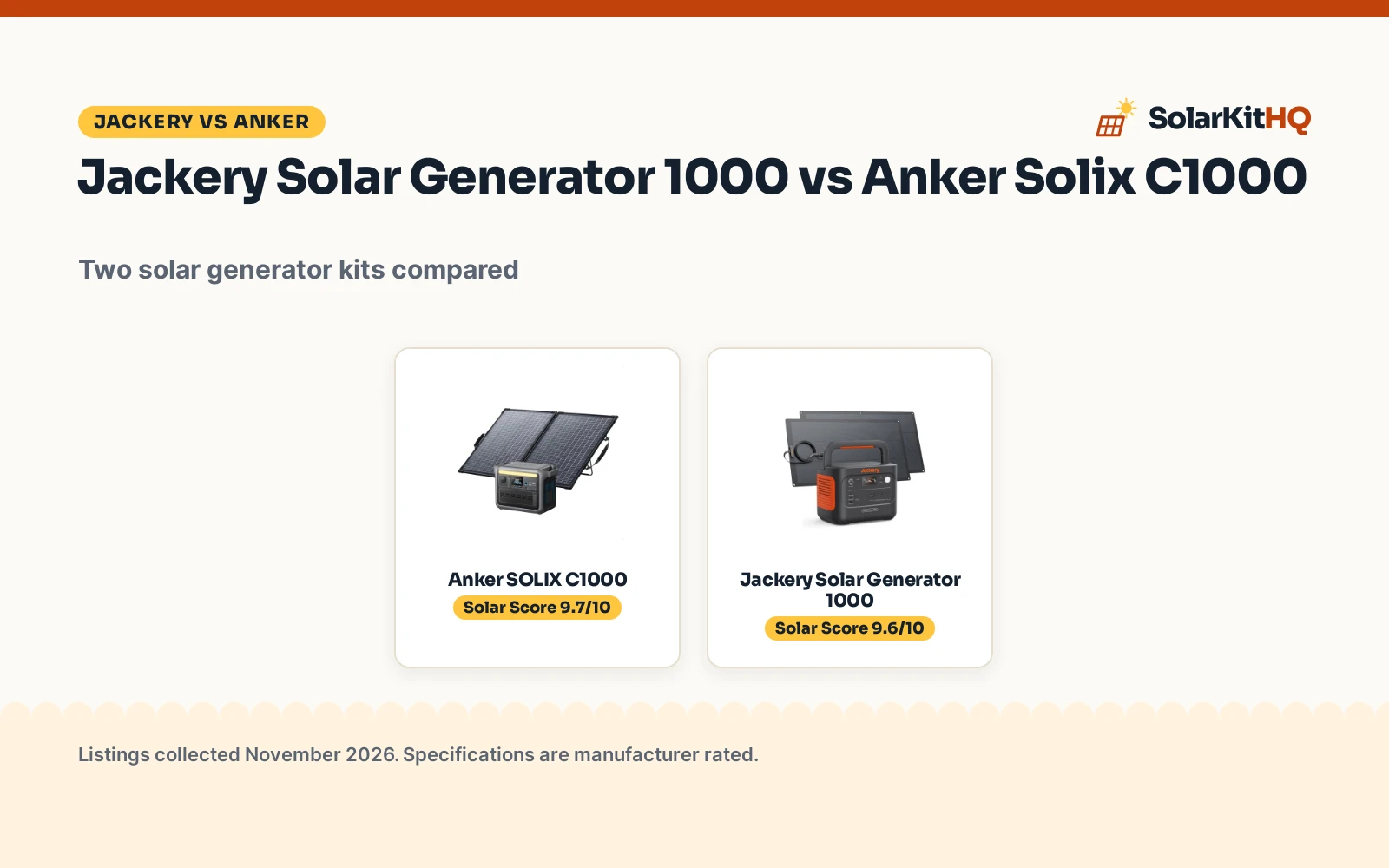
Its Solar Score of 9.7/10 comes from performance 32/35, build 21/25, value 21/25, safety 8/10 and warranty 3/5: 85 of 100 points, placed on our 9.2 to 9.8 scale.
Key Specifications
| Capacity | 1,056Wh |
|---|---|
| AC output | 1,800W, up to 2,400W with SurgePad |
| Solar input | Up to 600W |
| Station weight | 27.59 pounds |
Figures as published on the retailer listing, collected 2 November 2026. Performance figures are manufacturer rated.
Safety and Warranty
What this listing states. IP68-rated panel with reinforced aluminium frame and impact-resistant design, so safety scores 8 of 10. 5 years. It does not say everything a buyer needs, such as who pays return shipping, so warranty scores 3 of 5. See How We Pick.
Power station limits. Stay within the stated continuous output and solar input limits, keep the unit ventilated and dry, charge within the stated temperature range, and never connect it to home wiring except through equipment a licensed electrician installs.
This is general buying information, not professional advice. Follow each product manual and local rules, and see our Safety Disclaimer.

Jackery Solar Generator 1000
A solar generator kit with a 1070Wh LiFePO4 station, 1500W AC output and two flexible 100W Light panels.
Pros
- 1070Wh capacity with 1500W AC output and 3000W surge
- Station weighs 23.8 pounds, lighter than the Anker station
- Flexible panels bend up to 221 degrees and carry an IP68 rating
- LiFePO4 battery retains 70% or more capacity after 4,000 charge cycles, per the listing
Cons
- No warranty term is stated in the listing
- 1-hour charging needs the emergency charging function enabled in the app, and the default mode is 1.7-hour
- No panel stand is mentioned in the listing
- Only 8 devices at once, fewer than the Anker kit at 11 ports
Detailed Review
The listing states a 1070Wh LiFePO4 station with 1500W AC output and 3000W surge, two 100W Light panels with 25% conversion efficiency, an IP68 panel rating, panels that bend up to 221 degrees, and a station weight of 23.8 pounds with panels at 4.52 pounds each. The 1-hour charging claim needs the emergency charging function enabled in the Jackery app before charging each time, and the station defaults to a 1.7-hour charging mode, so the quickest stated figure is conditional rather than automatic. The listing states no warranty term, and it describes the panels as 56% lighter than traditional rigid panels.
Who it's for: buyers who want a lighter station and flexible panels for curved surfaces, with a long stated cycle life. Who should skip it: buyers who want a stated warranty term, or the quickest stated full recharge without an app step.
Its Solar Score of 9.6/10 comes from performance 30/35, build 21/25, value 20/25, safety 8/10 and warranty 0/5: 79 of 100 points, placed on our 9.2 to 9.8 scale.
Key Specifications
| Capacity | 1070Wh |
|---|---|
| AC output | 1500W, 3000W surge |
| Station weight | 23.8 pounds |
| Panels | Two 100W Light panels, IP68 rating |
Figures as published on the retailer listing, collected 2 November 2026. Performance figures are manufacturer rated.
Safety and Warranty
What this listing states. IP68-rated panels, IEC-certified panel durability and ChargeShield 2.0 charging protection, so safety scores 8 of 10. No warranty term, so warranty scores zero. See How We Pick.
Power station limits. Stay within the stated continuous output and solar input limits, keep the unit ventilated and dry, charge within the stated temperature range, and never connect it to home wiring except through equipment a licensed electrician installs.
This is general buying information, not professional advice. Follow each product manual and local rules, and see our Safety Disclaimer.
As an Amazon Associate I earn from qualifying purchases.
Where the points went
The Solar Score scores each kit on performance, build, value, safety and warranty. For power stations, safety means the protections and ratings the listing names, such as panel ratings, charging protection and frame construction. The Anker kit states a warranty term and the Jackery kit states none, which is the widest scoring gap between the two. How we pick explains the weights.
| Product | Solar Score | Perf. /35 | Build /25 | Value /25 | Safety /10 | Warranty /5 |
|---|---|---|---|---|---|---|
| Anker SOLIX C1000 | 9.7 | 32 | 21 | 21 | 8 | 3 |
| Jackery Solar Generator 1000 | 9.6 | 30 | 21 | 20 | 8 | 0 |
The Solar Score runs on a 9.2 minimum and a 9.8 maximum, and the weighted point total is placed on that line in proportion, so more points can only raise it.
How to choose the best jackery solar generator 1000 vs anker solix c1000
Match output to the load list
Start from the loads, not the headline watts. The Anker listing states the higher headline AC output figure and 11 ports, so it suits a load list with many devices plugged in at once. The Jackery listing states the higher surge figure, so it suits loads with a short startup peak that the listing covers. The table below sums up the stated gaps without adding new figures.
| If you need | Look at |
|---|---|
| Higher headline AC output stated | Anker side |
| Higher surge stated | Jackery side |
| More ports stated | Anker side |
| Lighter station stated | Jackery side |
Match recharge speed to how you recharge
If AC wall charging is the main refill route, the Anker listing states 100% in 58 minutes with UltraFast recharging, against the Jackery listing at 1-hour emergency charging or a 1.7-hour default mode. If solar is the main refill route, compare the Anker up to 600W solar input figure against the Jackery two-panel kit on its own terms, and remember the Jackery emergency mode needs an app step before each charge. For campsite use, see the best portable power station for camping guide as well.
Check the panel fit before the station
The panel decides where the kit can live. The Jackery flexible panels bend up to 221 degrees, which suits curved surfaces such as car roofs, RVs or balconies named in the listing. The Anker bifacial panel includes a stand and a dual-sided design, which suits flat ground placement where both sides can catch light. For a roof-based setup, the best solar panel kit for RV guide covers kits in the same use case.
Sizing Notes
- Match the station AC output to the loads you plan: the Jackery listing states 1500W AC output and the Anker listing states 1,800W, with surge figures stated separately.
- Match panel watts to the station solar input: the Anker listing states up to 600W solar input, and the Jackery kit includes two 100W panels.
- Match watt-hours to the loads you plan: the Jackery listing states 1070Wh and the Anker listing states 1,056Wh, with no run time stated for a named load.
- Check station weight and dimensions against the space and carry route: the Jackery station is listed at 23.8 pounds and the Anker station at 27.59 pounds.
- Follow the cable and fuse guidance in the manual for each kit, and leave any change to home wiring to a licensed electrician.
FAQ: power away from the grid
Which kit has the larger stated capacity?
The Jackery listing states 1070Wh and the Anker listing states 1,056Wh, so the Jackery listing states the higher capacity figure of the two.
Which station recharges faster on AC, per the listings?
The Anker listing states 100% in 58 minutes with UltraFast recharging, while the Jackery listing states 1-hour emergency charging with a 1.7-hour default mode, so the Anker listing states the faster full recharge.
Do either of the kits state a warranty term?
The Anker listing states a 5-year warranty. The Jackery listing states no warranty term.
Can the Jackery panels mount on a curved surface?
Per the listing, the Jackery panels are flexible and bend up to 221 degrees, and the listing names curved surfaces such as car roofs, RVs or balconies as fits.
Related solar guides
See every Solar Generators guide and all Power Stations and Generators guides.
More picks: best portable power station for home backup, solar generator vs ups, best solar panel kit for RV, best portable power station for camping.