On this page
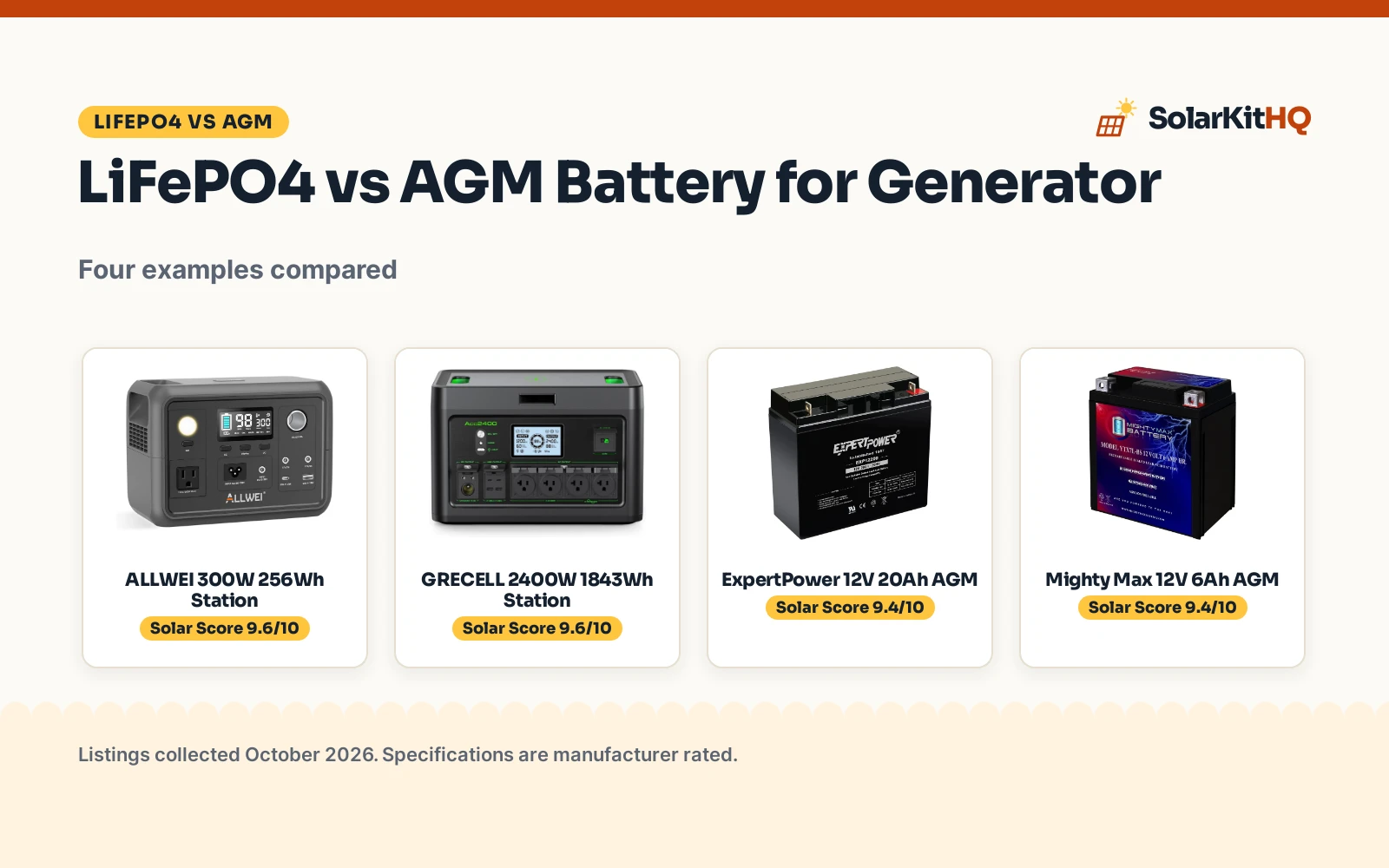
The short answer on lifepo4 vs agm battery for generator backup: pick a LiFePO4 power station if you want an all-in-one unit with AC outlets, USB ports and a stated BMS, and pick an AGM battery if you already own an inverter and charger set for lead acid and want a simple replacement. We compared LiFePO4 portable power stations from ALLWEI and GRECELL against AGM batteries from Mighty Max and ExpertPower. Note the mismatch in what is sold: the LiFePO4 examples are complete power stations, while the AGM examples are bare batteries. The comparison below keeps every figure tied to the listing that states it.
SolarKitHQ earns a commission when you buy through links on this page, at no extra cost to you. As an Amazon Associate I earn from qualifying purchases. Affiliate disclosure.
LiFePO4 vs AGM: side by side
| Generator battery | ALLWEI 300W 256Wh Station | GRECELL 2400W 1843Wh Station | ExpertPower 12V 20Ah AGM | Mighty Max 12V 6Ah AGM | Amazon |
|---|---|---|---|---|---|
| Type | LiFePO4 power station | LiFePO4 power station | AGM battery | AGM battery | |
| Capacity stated | 256Wh | 1843.2Wh | 12V 20Ah | 12V 6Ah | |
| AC output stated | 300W continuous, 600W peak | 2400W continuous | Not stated (bare battery) | Not stated (bare battery) | |
| Cycle claim | 3000 cycles stated | Not stated | Not stated | Not stated | |
| Protection stated | 6-layer BMS protection | Overcharge, temperature, low-battery | Spill-resistant sealed | Spill-proof sealed | |
| Warranty | 5 years in bullets (spec table says 2) | 24 months | 1-year limited | 1 year |
Specifications are manufacturer rated as listed, collected 22 October 2026.
What each side actually is
The two LiFePO4 listings are portable power stations: sealed boxes with a LiFePO4 battery, a pure sine wave inverter, AC outlets, USB ports and a battery management system inside. The two AGM listings are standalone 12V batteries with terminals and nothing else: no inverter, no outlets, no charger. That gap shapes the whole comparison. A power station is ready to run a laptop or a CPAP machine out of the box; a bare AGM battery needs an inverter and a charger around it before it powers anything, and neither AGM listing includes those.
Capacity and outlets
The ALLWEI station is listed at 256Wh with 300W continuous and 600W peak output, and the GRECELL at 1843.2Wh with 2400W continuous AC output. The AGM batteries are listed by amp-hours instead: 12V 6Ah for the Mighty Max and 12V 20Ah for the ExpertPower, with no watt-hour figure on either listing, so stored energy cannot be compared across the sides on stated figures. Outlets tell a similar story: the ALLWEI lists six ports and the GRECELL twelve, while the AGM listings state terminals only.
Cycle claims and warranties
Only the ALLWEI listing states a cycle count: 3000 charge-discharge cycles for its LiFePO4 cells. Neither AGM listing states a cycle count, so the listings leave that comparison unclear. On warranty, the ALLWEI bullets claim 5 years while its spec table says 2 year manufacturer; trust the bullets. The GRECELL lists 24 months, the Mighty Max a full one year, and the ExpertPower a 90-day money-back term with a 1-year limited warranty.
What the listings leave unclear
Several figures disagree inside their own listings. The ALLWEI warranty reads 5 years in the bullets and 2 year manufacturer in the spec table. The GRECELL is 55 pounds in the bullets and 55.6 pounds in the spec table. The ExpertPower is 11.9 pounds in the bullets and 12.2 pounds in the spec table, with the dimensions ordered differently too. The Mighty Max is a motorcycle battery, which makes it an odd fit for generator backup despite its side tag. And neither AGM listing states cycle life or watt-hours, so those lines stay blank on the AGM side of the table.
Four examples
| # | Product | Solar Score | Buy |
|---|---|---|---|
| 1 |  ALLWEI 300W 256Wh Station | 9.6/10 | Buy on Amazon |
| 2 |  GRECELL 2400W 1843Wh Station | 9.6/10 | Buy on Amazon |
| 3 |  ExpertPower 12V 20Ah AGM | 9.4/10 | Buy on Amazon |
| 4 |  Mighty Max 12V 6Ah AGM | 9.4/10 | Buy on Amazon |

ALLWEI 300W 256Wh Station
A 256Wh LiFePO4 power station with 300W continuous output, 600W peak, six ports and a stated 5-year warranty.
Pros
- 3000 charge-discharge cycles stated for the LiFePO4 cells
- 300W continuous and 600W peak pure sine wave AC output stated
- Six ports: AC, two DC5521, car port, 18W USB-A and 60W USB-C PD
- Built-in MPPT controller with AC, car, solar and dual charging stated
Cons
- Bullets claim a 5-year warranty while the spec table says 2 year manufacturer
- Solar panel is sold separately
- AC recharging takes 3.5 to 4 hours per the listing
- 256Wh is the smallest capacity in this group
Detailed Review
The listing states a 256Wh LiFePO4 portable power station with 300W continuous and 600W peak pure sine wave output, 3000 charge-discharge cycles, and an advanced BMS with 6-layer protection covering short-circuit, over-current and over-voltage. It lists one AC outlet, two DC5521 ports, a car cigarette lighter port, an 18W USB-A port and a 60W USB-C PD port, with up to 6 devices at once. Charging is stated at 3.5 to 4 hours on AC or car, 4 to 5 hours on a 100W solar panel, and 2 to 2.5 hours on dual AC plus solar, with a built-in MPPT controller. The unit is listed at 6.4 pounds and 9.25 by 5 by 6.81 inches with a 3-level LED light with SOS mode. The bullets claim a 5-year warranty while the spec table says 2 year manufacturer, so trust the bullets.
Who it's for: anyone who wants a light all-in-one LiFePO4 unit for camping or short outages. Who should skip it: anyone who needs more than 300W continuous or a bigger battery than 256Wh.
Its Solar Score of 9.6/10 comes from performance 29/35, build 20/25, value 21/25, safety 7/10 and warranty 3/5: 80 of 100 points, placed on our 9.2 to 9.8 scale.
Key Specifications
| Capacity | 256Wh LiFePO4 |
|---|---|
| Output | 300W continuous, 600W peak, pure sine wave |
| Ports | AC, 2x DC5521, car, USB-A 18W, USB-C PD 60W |
| Size | 9.25 x 5 x 6.81 in, 6.4 lb |
Figures as published on the retailer listing, collected 22 October 2026. Performance figures are manufacturer rated.
Safety and Warranty
What this listing states. Advanced BMS with 6-layer protection (short-circuit, over-current, over-voltage) stated, so safety scores 7 of 10. 5-year warranty stated in bullets (spec table says 2 year manufacturer). It does not say everything a buyer needs, such as who pays return shipping, so warranty scores 3 of 5. See How We Pick.
Battery safety. Charge with a charger and settings that match the stated chemistry, fuse the positive lead as the manual directs, cover terminals, keep within the stated temperature range, and never charge a damaged battery.
This is general buying information, not professional advice. Follow each product manual and local rules, and see our Safety Disclaimer.

GRECELL 2400W 1843Wh Station
An 1843.2Wh LiFePO4 power station with 2400W continuous AC output and 12 outlets.
Pros
- 1843.2Wh LiFePO4 battery with 2400W continuous AC output stated
- 12 outlets: 4 AC, 2 USB-A, 2 USB-C, 2 DC, car charger and 10W wireless pad
- USB-C PD100W and 2-hour fast charge stated
- Overcharge, temperature and low-battery protection stated
Cons
- 55 pounds stated, the heaviest in this group
- No cycle count is stated
- Solar panel is optional, not included
- Spec table lists 55.6 pounds against the bullets' 55 pounds
Detailed Review
The listing states a 2400W portable power station with an 1843.2Wh LiFePO4 battery, 2400W of continuous AC power, and 12 outlets: 4 AC ports, 2 USB-A, 2 USB-C, 2 DC, a car charger and a 10W wireless charging pad. It lists USB-C PD100W, a 2-hour fast charge, a 200W solar panel option, and overcharge, temperature and low-battery protection. The unit is listed at 55 pounds and 16.9 by 11.8 by 11 inches with a handle on each side. The spec table gives 55.6 pounds and a 24 month warranty.
Who it's for: home backup and RV owners who want the most watt-hours and AC output here. Who should skip it: anyone who needs a light packable unit, at 55 pounds.
Its Solar Score of 9.6/10 comes from performance 32/35, build 21/25, value 21/25, safety 5/10 and warranty 2/5: 81 of 100 points, placed on our 9.2 to 9.8 scale.
Key Specifications
| Capacity | 1843.2Wh LiFePO4 |
|---|---|
| Output | 2400W continuous AC |
| Outlets | 12: 4 AC, 2 USB-A, 2 USB-C, 2 DC, car, wireless pad |
| Size | 16.9 x 11.8 x 11 in, 55 lb |
Figures as published on the retailer listing, collected 22 October 2026. Performance figures are manufacturer rated.
Safety and Warranty
What this listing states. Overcharge, temperature and low-battery protection stated, so safety scores 5 of 10. 24 months warranty stated. It does not say everything a buyer needs, such as who pays return shipping, so warranty scores 2 of 5. See How We Pick.
Battery safety. Charge with a charger and settings that match the stated chemistry, fuse the positive lead as the manual directs, cover terminals, keep within the stated temperature range, and never charge a damaged battery.
This is general buying information, not professional advice. Follow each product manual and local rules, and see our Safety Disclaimer.

ExpertPower 12V 20Ah AGM
A 12V 20Ah sealed AGM battery that names generator use among its applications.
Pros
- 12V 20Ah AGM battery with generator use named in the title
- Maintenance-free sealed, valve-regulated, spill-resistant design
- NB terminals and a compact 7.13 by 3.03 by 6.57 inch case
- 11.9 pounds stated
Cons
- No cycle count is stated
- No protection features are listed
- Bullets say 11.9 lbs while the spec table says 12.2 pounds
- A bare battery: no inverter, outlets or charger included
Detailed Review
The listing states a 12V 20Ah sealed lead acid AGM battery with absorbed glass mat technology, a maintenance-free valve-regulated design, NB terminals, 11.9 pounds and 7.13 by 3.03 by 6.57 inches. Its title names generator use alongside UPS, lawn mowers and mobility devices. The spec table lists 12.2 pounds and a 90-day money-back term with a 1-year limited warranty.
Who it's for: owners with a 12V inverter and charger set for lead acid who want a simple AGM replacement. Who should skip it: anyone who wants an all-in-one unit with AC outlets.
Its Solar Score of 9.4/10 comes from performance 23/35, build 20/25, value 20/25, safety 3/10 and warranty 1/5: 67 of 100 points, placed on our 9.2 to 9.8 scale.
Key Specifications
| Capacity | 12V, 20Ah AGM |
|---|---|
| Terminals | NB |
| Size | 7.13 x 3.03 x 6.57 in |
| Weight | 11.9 lb |
Figures as published on the retailer listing, collected 22 October 2026. Performance figures are manufacturer rated.
Safety and Warranty
What this listing states. Sealed, spill-resistant AGM construction stated, so safety scores 3 of 10. 1-Year Limited Warranty stated. It does not say everything a buyer needs, such as who pays return shipping, so warranty scores 1 of 5. See How We Pick.
Battery safety. Charge with a charger and settings that match the stated chemistry, fuse the positive lead as the manual directs, cover terminals, keep within the stated temperature range, and never charge a damaged battery.
This is general buying information, not professional advice. Follow each product manual and local rules, and see our Safety Disclaimer.

Mighty Max 12V 6Ah AGM
A 12V 6Ah sealed AGM motorcycle battery, the smallest capacity in this group.
Pros
- Sealed AGM, spill-proof, mounts in any position
- Resists shocks and vibration per the listing
- 100 CCA cranking figure stated
- Compact 4.40 by 2.75 by 5.19 inch case
Cons
- A motorcycle battery tagged for generator backup, not a deep cycle unit
- 6Ah is the smallest capacity in this group
- No cycle count is stated
- Listing covers the battery and screws only, no harness or accessories
Detailed Review
The listing states a 12V 6Ah 100 CCA sealed lead acid AGM motorcycle battery, 4.40 by 2.75 by 5.19 inches, spill-proof with high discharge rate and deep discharge recovery, mountable in any position and resistant to shocks and vibration. The listing covers the battery and screws only, with no wire harness or mounting accessories. The warranty is a full one year.
Who it's for: small-engine starting duty where the maker lists this exact battery. Who should skip it: anyone sizing backup power for a generator, where 6Ah is far too small.
Its Solar Score of 9.4/10 comes from performance 21/35, build 20/25, value 20/25, safety 3/10 and warranty 0/5: 64 of 100 points, placed on our 9.2 to 9.8 scale.
Key Specifications
| Capacity | 12V, 6Ah, 100 CCA |
|---|---|
| Type | SLA/AGM, sealed |
| Size | 4.40 x 2.75 x 5.19 in |
| Mounting | Any position |
Figures as published on the retailer listing, collected 22 October 2026. Performance figures are manufacturer rated.
Safety and Warranty
What this listing states. Spill-proof sealed AGM construction stated, so safety scores 3 of 10. No warranty term, so warranty scores zero. See How We Pick.
Battery safety. Charge with a charger and settings that match the stated chemistry, fuse the positive lead as the manual directs, cover terminals, keep within the stated temperature range, and never charge a damaged battery.
This is general buying information, not professional advice. Follow each product manual and local rules, and see our Safety Disclaimer.
As an Amazon Associate I earn from qualifying purchases.
How we scored them
The Solar Score weighs performance, build, value, safety and warranty. For generator backup batteries, safety means a battery management system, stated protections or a sealed spill-proof build; the power stations state BMS or multi-layer protection, and the AGM batteries state sealed spill-proof construction. All four state a warranty term, from 1 year to 5 years. How we pick explains the weights.
| Product | Solar Score | Perf. /35 | Build /25 | Value /25 | Safety /10 | Warranty /5 |
|---|---|---|---|---|---|---|
| ALLWEI 300W 256Wh Station | 9.6 | 29 | 20 | 21 | 7 | 3 |
| GRECELL 2400W 1843Wh Station | 9.6 | 32 | 21 | 21 | 5 | 2 |
| ExpertPower 12V 20Ah AGM | 9.4 | 23 | 20 | 20 | 3 | 1 |
| Mighty Max 12V 6Ah AGM | 9.4 | 21 | 20 | 20 | 3 | 0 |
Scores run from 9.2 to 9.8: each product’s point total is placed on that range, so more points always means a higher score.
lifepo4 vs agm battery for generator: which should you choose?
Choose a LiFePO4 power station if you want one box that charges from a wall outlet, a car or a solar panel and runs AC devices directly: the ALLWEI suits light loads at 6.4 pounds, and the GRECELL suits home backup at 1843.2Wh and 2400W. Choose an AGM battery if your inverter, charger and wiring are already set for 12V lead acid: the ExpertPower names generator use and the Mighty Max suits small-engine starting. Do not buy a bare AGM battery expecting outlets; do not buy a 300W station expecting it to run a whole house.
| If you need | Look at |
|---|---|
| An all-in-one box with AC outlets | ALLWEI 300W 256Wh Station or GRECELL 2400W 1843Wh Station |
| A simple 12V replacement battery | ExpertPower 12V 20Ah AGM |
| The most watt-hours stated | GRECELL 2400W 1843Wh Station, 1843.2Wh |
| The longest warranty stated | ALLWEI 300W 256Wh Station, 5 years in the bullets |
Sizing Notes
- Match the unit to the load: the ALLWEI is listed at 300W continuous and 600W peak, the GRECELL at 2400W continuous; check each device against those figures.
- A bare AGM battery needs an inverter and charger sized for 12V lead acid; neither AGM listing includes them.
- Recharge paths stated: AC wall charging, 12V car charging and solar panel charging on the ALLWEI, with a built-in MPPT controller.
- Fuse the positive lead as the manual directs, and leave any connection to home wiring to a licensed electrician.
Frequently Asked Questions
Can a LiFePO4 power station replace a generator battery?
It depends on the job. The ALLWEI and GRECELL examples are all-in-one power stations that run AC devices directly, while the AGM examples are bare 12V batteries that need an inverter around them.
Which listing here states a cycle count?
Only the ALLWEI, at 3000 charge-discharge cycles. Neither AGM listing states a cycle count.
Which has the longest warranty?
The ALLWEI, at 5 years in the bullets (its spec table says 2 year manufacturer). The GRECELL states 24 months, and both AGM batteries state 1 year.
Do the AGM batteries include an inverter?
No. The Mighty Max and ExpertPower listings are bare batteries with terminals; the inverters, outlets and USB ports belong to the LiFePO4 power station examples.
Can the ALLWEI charge from solar?
Yes. The listing states solar panel charging in 4 to 5 hours with a 100W panel, plus AC, car and dual charging, with a built-in MPPT controller. The panel is sold separately.
Related guides
See every Deep Cycle and RV Batteries guide and all Batteries and Charging guides.
More picks: 12V battery for a generator, deep cycle battery for a generator, LiFePO4 vs AGM for home backup, portable power station for camping.