On this page
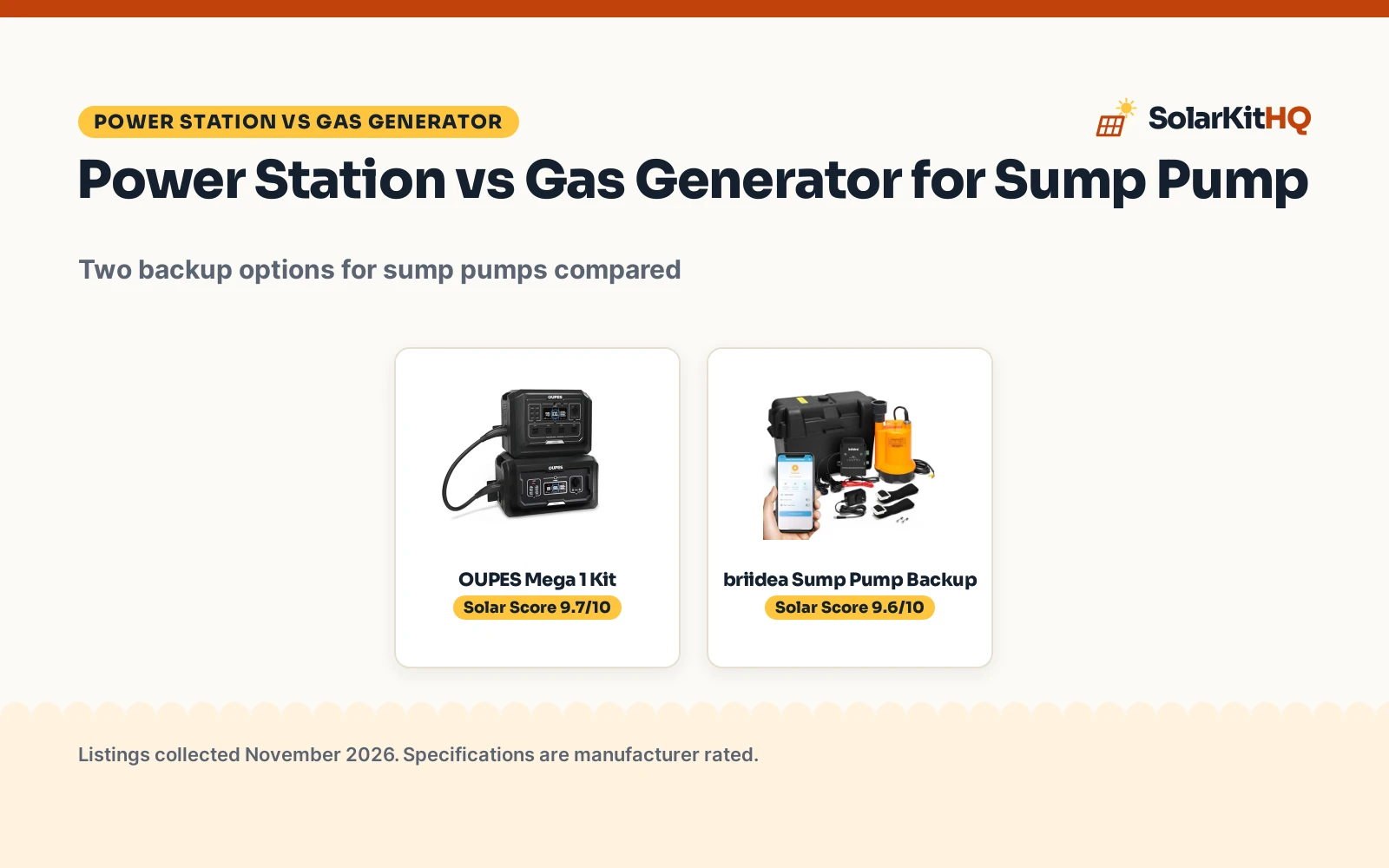
When the rain keeps falling and the power drops, the choice behind power station vs gas generator for sump pump backup is really a choice between two jobs. The short answer: a power station kit backs up the pump plus other home loads from one battery bank, while a dedicated battery backup sump pump system watches the pit and takes over the pump alone. We compared one example of each side on what each listing states: capacity and flow, output, monitoring, and warranty terms. Pick the station kit if you want backup for more than the pump; pick the dedicated pump system if you want a monitored second pump beside the first.
SolarKitHQ earns a commission when you buy through links on this page, at no extra cost to you. As an Amazon Associate I earn from qualifying purchases. Affiliate disclosure.
Power station vs gas generator for sump pump: side by side
| Power station vs gas generator | OUPES Mega 1 Kit | briidea Sump Pump Backup | Notes |
|---|---|---|---|
| Backup job | Whole-home backup kit | Sump pump backup only | Different scope |
| Capacity or flow | 3072Wh kit | 2,700 gallons per hour at 0 ft lift | Wh against gallons per hour |
| Output | 2000W AC, 4500W surge | 12V DC pump | AC outlets against a DC pump |
| Monitoring | Smart APP control | WiFi monitoring with app alerts | Both offer app monitoring |
| Warranty stated | 5-year warranty | 2 years | Both state a term |
| Battery included | Included in the kit | Not included | Check the box before buying |
Figures in this table are the manufacturer’s ratings as listed, captured 2 November 2026.
What each side actually powers
The OUPES example is a whole-home backup kit: a 1024Wh Mega 1 station plus a 2048Wh B2 expansion battery for 3072Wh in total, with 2000W AC output and 4500W surge. Its bullets name sump pumps among the home appliances it can run, alongside microwaves and CPAP machines, and it offers 13 output ports, including 4 AC outlets. The briidea example does one job only: it is a backup pump that takes over when the primary pump fails or water levels rise too high, and it powers nothing else in the house.
That difference in scope matters more than any single figure. A station kit keeps the pump and the rest of the house going from one bank, but its capacity is shared across every load plugged into it. A dedicated pump system spends its whole battery on the pit, but it asks you to supply that battery: the listing recommends an 80AH lead-acid 12V deep cycle battery, and the battery is not included.
Monitoring and alerts
Both examples offer app monitoring, in different depth. The OUPES example offers smart app control with real-time monitoring of battery level, ports and alerts from a smartphone. The briidea example goes further on the pump itself: WiFi monitoring on both 2.4G and 5G connections through an app, with system status, water levels, fault alerts and power outage notifications, plus a smart control box with 9 LED indicators and dual water level sensors. Its alerts cover faults, blown fuses, low battery and power outages, with silence and reset functions and a dry contact interface for alarms and security systems.
For a basement, that monitoring gap is real: the station kit tells you about the battery, while the pump system tells you about the water. A homeowner who travels will value the pump system’s water level and fault alerts; a homeowner who stays home during outages may care more about the station kit’s port and battery view.
What the listings leave unclear
First, the side labels need a plain note: the gas generator side example here is a battery backup pump system, not a fuel-burning generator. The listing states a 12V battery connection and no fuel or engine figure, so it should be judged as a battery backup, not as a generator. Second, neither listing states a runtime for a sump pump load, so neither side can claim a longer pumping time from these listings. Third, the briidea example states no flow figure above a 10 ft lift, and the OUPES example states no UL or ETL listing. Match the stated figures to your own setup rather than assuming either side covers every case.
Two examples

OUPES Mega 1 Kit
A modular LiFePO4 power station kit that pairs a 1024Wh station with a 2048Wh expansion battery for 3072Wh in total.
Pros
- 3072Wh total capacity from the station plus expansion battery
- 2000W AC output with 4500W surge for sump pumps and other home appliances
- Recharges from 0 to 80% via AC in 36 minutes for the Mega 1 only
- LiFePO4 cells with 3000+ life cycles and UPS switching in under 20ms
Cons
- Solar panels are sold separately, so solar recharging needs an added purchase
- The 36-minute recharge figure covers the Mega 1 only, not the expansion battery
- No UL, ETL or IP rating is stated in the listing
- No stated runtime for a sump pump load
Detailed Review
The listing states a 1024Wh Mega 1 station plus a 2048Wh B2 expansion battery for 3072Wh in total, with 2000W AC output and 4500W surge, 13 output ports, solar input up to 800W with panels sold separately, and app control. The maker lists LiFePO4 cells with 3000+ life cycles, UPS switching in under 20ms, and a 5-year warranty. The listing states no UL or ETL listing.
Who it's for: a homeowner who wants one battery kit to back up a sump pump and other essentials during an outage. Who should skip it: a buyer who wants a pump-only backup that runs straight from a battery, or solar panels included in the box.
Its Solar Score of 9.7/10 comes from performance 32/35, build 22/25, value 21/25, safety 8/10 and warranty 4/5: 87 of 100 points, placed on our 9.2 to 9.8 scale.
Key Specifications
| Capacity | 3072Wh kit (1024Wh + 2048Wh) |
|---|---|
| AC output | 2000W, 4500W surge |
| Solar input | Up to 800W (panels sold separately) |
| Weight | 27.8 pounds |
Figures as published on the retailer listing, collected 2 November 2026. Performance figures are manufacturer rated.
Safety and Warranty
What this listing states. LiFePO4 chemistry with UPS switching in under 20ms, so safety scores 8 of 10. 5-year warranty. It does not say everything a buyer needs, such as who pays return shipping, so warranty scores 4 of 5. See How We Pick.
Power station limits. Stay within the stated continuous output and solar input limits, keep the unit ventilated and dry, charge within the stated temperature range, and never connect it to home wiring except through equipment a licensed electrician installs.
This is general buying information, not professional advice. Follow each product manual and local rules, and see our Safety Disclaimer.

briidea Sump Pump Backup
A battery backup sump pump system with WiFi monitoring, an electronic water level sensor and a smart alarm, for use with a 12V battery.
Pros
- Removes up to 2,700 gallons per hour at 0 ft lift and 1,900 GPH at 10 ft lift
- Dual water level sensors and 9 LED indicators for monitoring
- WiFi monitoring on both 2.4G and 5G connections with outage and fault alerts
- Dry-run protection and a smart alarm system for faults, low battery and power outages
Cons
- Battery not included: it needs a 12V deep cycle battery, with an 80AH lead-acid battery recommended
- Pumps only: it cannot power other home loads during an outage
- No stated flow figure above a 10 ft lift
- No UL, ETL or IP rating is stated in the listing
Detailed Review
The listing states a DC pump that removes up to 2,700 gallons per hour at 0 ft lift and 1,900 GPH at a 10 ft lift, with an electronic water level switch, dry-run protection, a smart control box with 9 LED indicators and dual water level sensors, and WiFi monitoring on 2.4G and 5G connections through an app. It connects in parallel with an existing system and switches to battery power during outages. The battery is not included: the listing recommends an 80AH lead-acid 12V deep cycle battery.
Who it's for: a homeowner who already has a primary sump pump and wants a monitored battery backup for outages. Who should skip it: a buyer who wants one unit to power a sump pump plus other home loads, or a kit with the battery included.
Its Solar Score of 9.6/10 comes from performance 28/35, build 20/25, value 20/25, safety 7/10 and warranty 3/5: 78 of 100 points, placed on our 9.2 to 9.8 scale.
Key Specifications
| Pump flow | Up to 2,700 gallons per hour at 0 ft lift |
|---|---|
| Lift | 1,900 GPH at 10 ft lift |
| Battery | 12V deep cycle, not included |
| Dimensions | 17.5 Inches x 9.1 Inches x 12.0 Inches |
Figures as published on the retailer listing, collected 2 November 2026. Performance figures are manufacturer rated.
Safety and Warranty
What this listing states. Dry-run protection with fault, low battery and power outage alerts, so safety scores 7 of 10. 2 years. It does not say everything a buyer needs, such as who pays return shipping, so warranty scores 3 of 5. See How We Pick.
Power station limits. Stay within the stated continuous output and solar input limits, keep the unit ventilated and dry, charge within the stated temperature range, and never connect it to home wiring except through equipment a licensed electrician installs.
This is general buying information, not professional advice. Follow each product manual and local rules, and see our Safety Disclaimer.
As an Amazon Associate I earn from qualifying purchases.
Where the points went
The Solar Score scores each example on performance, build, value, safety and warranty. For backup power, safety means battery chemistry protections, dry-run protection and the alarms a listing names; both examples state safety features of that kind, and both state a warranty term, a 5-year warranty on the station kit and 2 years on the pump system. How we pick explains the weights.
| Product | Solar Score | Perf. /35 | Build /25 | Value /25 | Safety /10 | Warranty /5 |
|---|---|---|---|---|---|---|
| OUPES Mega 1 Kit | 9.7 | 32 | 22 | 21 | 8 | 4 |
| briidea Sump Pump Backup | 9.6 | 28 | 20 | 20 | 7 | 3 |
The Solar Score runs on a 9.2 minimum and a 9.8 maximum, and the weighted point total is placed on that line in proportion, so more points can only raise it.
Power station vs gas generator for sump pump: which should you choose?
Choose the station kit if an outage means more than a wet basement to you: lights, a fridge, Wi-Fi and medical devices are all named in its bullets, and one bank covers them together. Choose the dedicated pump system if your primary pump already handles the house and you want a monitored second pump that takes over on its own, with water level alerts while you are away. Readers weighing a similar choice for a work site can compare power station vs gas generator for job site, and readers comparing pump types can read solar sump pump vs electric sump pump. If the pump system appeals, a 12V battery for home backup is the part you must buy separately.
| If you need | Look at |
|---|---|
| Backup for the pump and other home loads | OUPES Mega 1 Kit |
| A monitored second pump beside the first | briidea Sump Pump Backup |
| App alerts during an outage | Either example |
Sizing Notes
- Match the station’s 2000W AC output and 4500W surge to the pump and other loads you plan to run.
- Match the kit’s 3072Wh capacity to the loads you plan to run during an outage.
- Match the backup pump system to a 12V deep cycle battery, with an 80AH lead-acid battery recommended.
- Check the pump’s stated flow at your lift: 2,700 gallons per hour at 0 ft lift and 1,900 GPH at 10 ft lift.
- Check solar input limits before adding panels: the station supports up to 800W solar input, with panels sold separately.
FAQ: power away from the grid
Can a power station run a sump pump?
The OUPES listing names sump pumps among the home appliances its 2000W AC output can run, with 4500W surge. Check your pump’s stated draw against those figures before buying.
Does the briidea system include a battery?
No. The listing states the battery is not included and recommends an 80AH lead-acid 12V deep cycle battery.
How much water can the briidea pump move?
Up to 2,700 gallons per hour at 0 ft lift, and 1,900 GPH at a 10 ft lift, as the listing states.
Can the OUPES kit recharge from solar?
Yes, with up to 800W solar input, but panels are sold separately.
Which example states the longer warranty?
The OUPES example states a 5-year warranty, and the briidea example states 2 years.
Related solar guides
See every Home Backup Power Stations guide and all Power Stations and Generators guides.
More picks: power station vs gas generator for job site, solar sump pump vs electric sump pump, best 12v battery for home backup, best portable power station for camping.