On this page
When the lights go out during dinner and the fridge hums to a stop, the question behind bluetti ac500 vs anker solix f3800 is which home backup setup actually covers the house. Pick the Anker side for a complete station listing; pick the BLUETTI side for a home that already owns the AC500 sets the kit ties together. The comparison below uses only what each listing states, and the listings are not like for like: the BLUETTI listing sells a connection kit, while the Anker listing sells a station.
SolarKitHQ earns a commission when you buy through links on this page, at no extra cost to you. As an Amazon Associate I earn from qualifying purchases. Affiliate disclosure.
Bluetti AC500 vs Anker SOLIX F3800: side by side
| Spec | Anker SOLIX F3800 Plus | BLUETTI Home Integration Kit | Takeaway |
|---|---|---|---|
| Capacity | 3,840Wh | Up to 12288Wh (joined-set kit system) | Kit figure covers joined station sets |
| AC output | 6,000W | Up to 10000W (joined-set kit system) | Kit figure needs the joined sets |
| Solar input | 3,200W | Not stated | Anker states a figure; BLUETTI does not |
| Voltage | 120V / 240V | Up to 240V (joined-set kit system) | Both state 240V at system level |
| Warranty | 5 years | 2 years | Anker states the longer term |
| Weight | 135.58 pounds | 28.6 pounds (kit only) | Kit weight excludes the stations |
We copied each rating from the seller’s listing as the brand states it; data date 4 November 2026.
Capacity and output
Capacity is where the scope gap shows. The Anker listing states 3,840Wh to start, with expansion to 26.9kWh when up to 6 batteries are added to a station. The title also states expansion to 53kWh, but the bullets tie that larger figure to adding 12 batteries and another F3800, so the 53kWh figure describes a setup with another station, not a station alone. The BLUETTI listing states a system of up to 12288Wh and 10000W at 240V, but that figure describes 2 sets of AC500 and B300S joined by the kit, not a station alone, and the kit box contains no stations. On output, the Anker listing states 6,000W, while the BLUETTI kit system states up to 10000W only as a figure for the joined sets. Neither side can be called better on capacity or output from these listings alone, because the figures cover different scopes.
Charging and solar input
The Anker listing states 3,200W solar input, recharge in 63 minutes via solar and generator, and recharge in 4 ways: solar, generator, home power panel, or AC outlet. It also states a 6,000W bypass for a 240V gas generator. A gas generator runs outdoors only, far from doors and windows, because of carbon monoxide. The BLUETTI listing states charging via solar panels or a 50A split-phase AC cable, or both at the same time, but states no solar input watt figure, and AC input works only through the 50A split-phase cable, not standard AC. On solar input, the Anker side states a figure and the BLUETTI side leaves it unclear, so no side-by-side solar charging comparison is possible from these listings.
Voltage and home connection
The Anker listing states 120V and 240V dual-voltage support, so it covers appliances on either voltage. The BLUETTI kit builds a 240V system from the joined sets and works only with the 100-120V US plug version. A licensed electrician should install both the BLUETTI kit and the Anker home power panel. Neither listing gives wiring steps, and none are given here.
What the listings leave unclear
The gaps that matter are scope gaps. The BLUETTI listing gives no solar input watts, no station weight, and no station capacity on its own, because it sells the kit and the kit weighs 28.6 pounds without the stations. The Anker listing gives no run time for a named appliance, and its 53kWh title figure needs another station that the bullets describe separately. The Anker listing also states that its 6,000W output is 58% more than other portable power stations at the same capacity, without naming the stations compared, so that claim cannot be checked from the listing.
Two examples

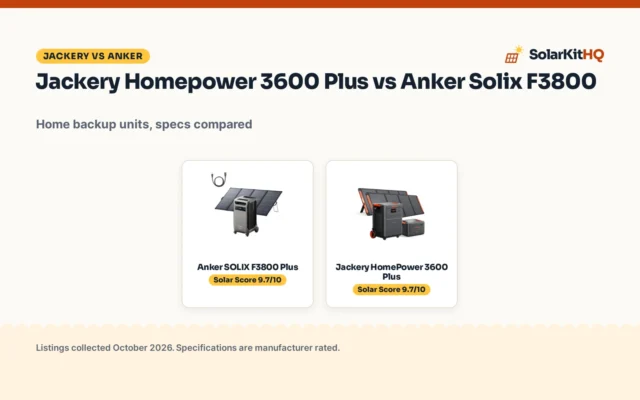
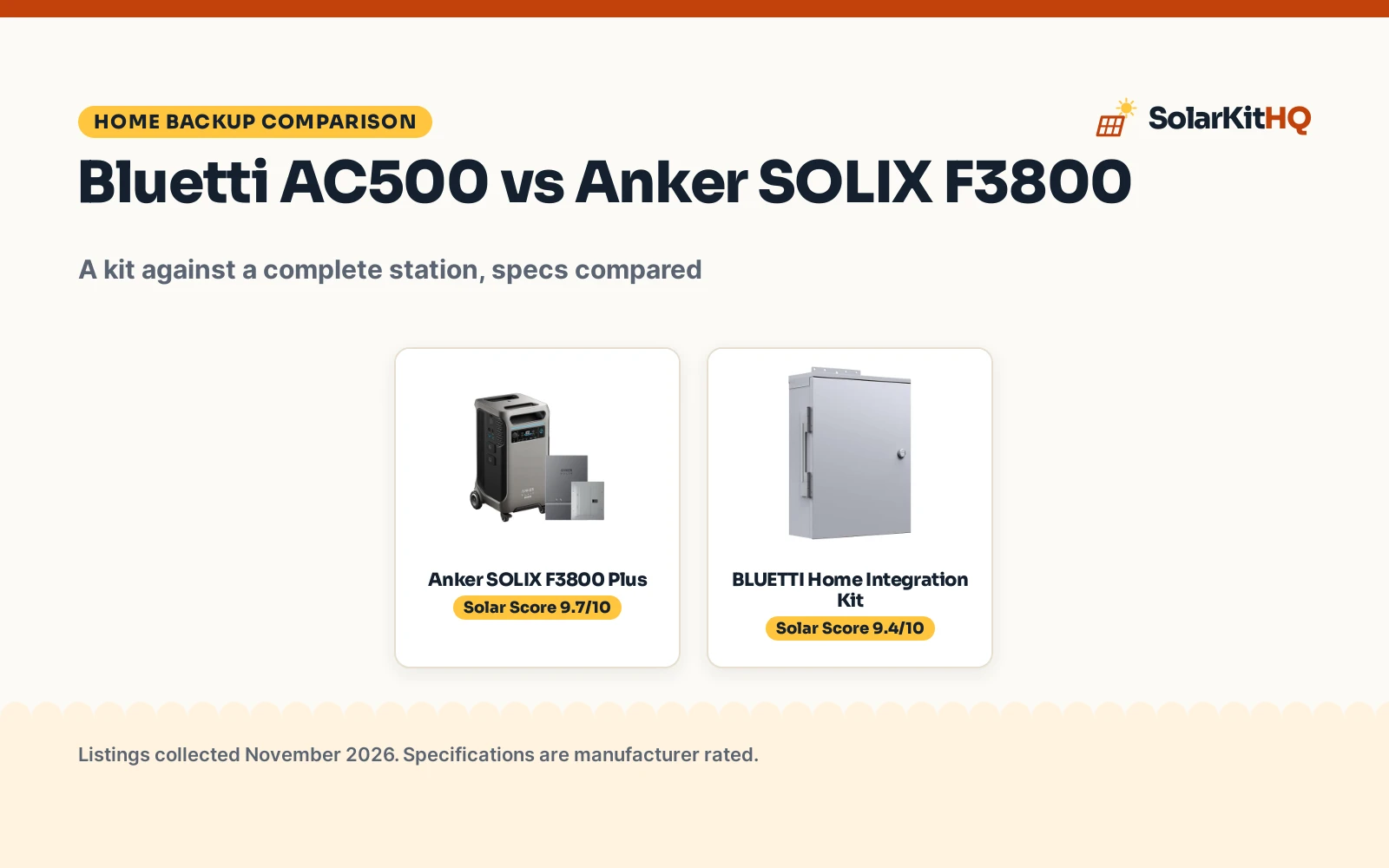
Anker SOLIX F3800 Plus
A 3,840Wh LiFePO4 portable power station with a home power panel, 6,000W output and 3,200W solar input.
Pros
- 3,840Wh LiFePO4 battery with 6,000W output and 120V/240V dual voltage
- 3,200W solar input and recharge in 63 minutes via solar and generator, per the listing
- Expands with up to 6 batteries for 26.9kWh on a station
- 5-year warranty with EV-grade LFP batteries and smart temperature management
Cons
- Title figure of 53kWh needs another station, not a station alone
- 135.58 pounds to move
- Home power panel connection needs a licensed electrician
- Expansion batteries are not in the box
Detailed Review
The listing states a 3,840Wh LiFePO4 station with 6,000W output, 120V and 240V dual-voltage support, 3,200W solar input, recharge in 63 minutes via solar and generator, and a 5-year warranty. The title states expansion to 53kWh, but the bullets tie that figure to adding 12 batteries and another F3800, so a station alone expands to 26.9kWh with up to 6 batteries; the title figure and the bullet figure describe different setups, and the bullets are the clearer guide. The box contains the station, an AC charging cable, 2 solar charging cables, a user manual, a warning notice and a warranty card.
Who it's for: buyers who want a complete station listing with stated capacity, output and solar input. Who should skip it: buyers who want the 53kWh title figure from a station alone, since that figure needs another station.
Its Solar Score of 9.7/10 comes from performance 32/35, build 21/25, value 21/25, safety 7/10 and warranty 4/5: 85 of 100 points, placed on our 9.2 to 9.8 scale.
Key Specifications
| Capacity | 3,840Wh, expandable to 26.9kWh with 6 batteries |
|---|---|
| Output | 6,000W |
| Solar input | 3,200W |
| Weight | 135.58 pounds |
Figures as published on the retailer listing, collected 4 November 2026. Performance figures are manufacturer rated.
Safety and Warranty
What this listing states. EV-grade LFP batteries, smart temperature management and impact-resistant design stated, so safety scores 7 of 10. 5-year warranty stated. It does not say everything a buyer needs, such as who pays return shipping, so warranty scores 4 of 5. See How We Pick.
Power station limits. Stay within the stated continuous output and solar input limits, keep the unit ventilated and dry, charge within the stated temperature range, and never connect it to home wiring except through equipment a licensed electrician installs.
This is general buying information, not professional advice. Follow each product manual and local rules, and see our Safety Disclaimer.

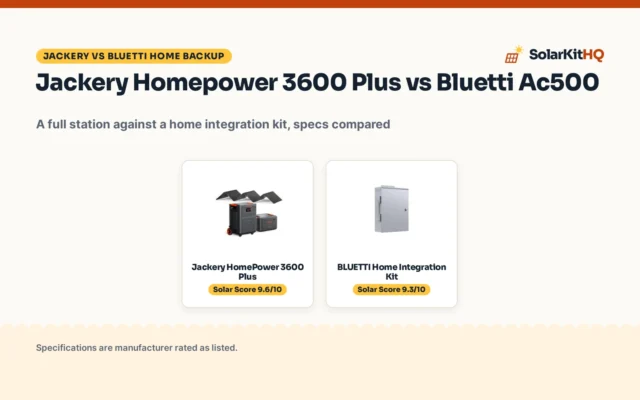
BLUETTI Home Integration Kit
A home integration kit that connects two AC500 and B300S sets to a main panel for a 12288Wh, 240V, 10000W backup system.
Pros
- Builds a 12288Wh, 240V, 10000W home backup system from two AC500 and B300S sets
- Charges via solar panels, a 50A split-phase AC cable, or both at the same time
- Includes the outlet box, sub-panel, charging cable and communication cable in the box
- 24/7 UPS home backup when tied to the home grid, per the listing
Cons
- The listing sells the integration kit only; the AC500 stations and B300S batteries are not included
- No solar input watt figure is stated
- AC input works only through the 50A split-phase cable, not standard AC
- Only the 100-120V US plug version works with this kit
Detailed Review
The listing states a home integration kit for connecting 2 sets of AC500 and B300S stations with a main panel, building a system of up to 12288Wh, 240V and 10000W, with 24/7 UPS home backup. Charging works via solar panels or a 50A split-phase AC cable, or both at the same time, and AC input works only through the 50A split-phase cable. The kit works only with the 100-120V US plug version, the box contains an outlet box, a sub-panel, cables and a communication cable, and the spec table states a 2-year warranty. The listing states no certification and no solar input watt figure.
Who it's for: buyers who already own the AC500 sets the kit joins and want them tied to a home panel. Who should skip it: buyers looking for a complete station listing, since this listing sells the kit only.
Its Solar Score of 9.4/10 comes from performance 28/35, build 20/25, value 18/25, safety 0/10 and warranty 3/5: 69 of 100 points, placed on our 9.2 to 9.8 scale.
Key Specifications
| System capacity | Up to 12288Wh (two sets) |
|---|---|
| System power | Up to 10000W, 240V |
| Charging | Solar panels, 50A split-phase AC cable, or both |
| Kit weight | 28.6 pounds |
Figures as published on the retailer listing, collected 4 November 2026. Performance figures are manufacturer rated.
Safety and Warranty
What this listing states. No UL, FCC or battery management statement is stated, so safety scores zero. 2-year warranty stated. It does not say everything a buyer needs, such as who pays return shipping, so warranty scores 3 of 5. See How We Pick.
Power station limits. Stay within the stated continuous output and solar input limits, keep the unit ventilated and dry, charge within the stated temperature range, and never connect it to home wiring except through equipment a licensed electrician installs.
This is general buying information, not professional advice. Follow each product manual and local rules, and see our Safety Disclaimer.
As an Amazon Associate I earn from qualifying purchases.
Where the points went
The Solar Score weighs performance, build, value, safety and warranty. For home backup stations, safety means stated protections, battery safeguards or certifications the listing names; the Anker listing states EV-grade LFP batteries, smart temperature management and an impact-resistant design, while the BLUETTI kit listing states no certification. Both state a warranty term, 5 years for Anker and 2 years for BLUETTI. How we pick explains the weights.
| Product | Solar Score | Perf. /35 | Build /25 | Value /25 | Safety /10 | Warranty /5 |
|---|---|---|---|---|---|---|
| Anker SOLIX F3800 Plus | 9.7 | 32 | 21 | 21 | 7 | 4 |
| BLUETTI Home Integration Kit | 9.4 | 28 | 20 | 18 | 0 | 3 |
We place weighted points on a scale whose ends are 9.2 and 9.8. Because the mapping is straight, a unit with more points never shows less.
Bluetti ac500 vs anker solix f3800: which should you choose?
Choose the Anker side for a complete station listing, with stated capacity, output, solar input and a 5-year warranty. Choose the BLUETTI side only for a home that already owns the AC500 sets the kit joins, and where a licensed electrician will handle the panel connection. If neither situation fits, the listings here do not settle the choice, because the BLUETTI listing is a kit and the Anker listing is a station.
Sizing Notes
- Match watt-hours to the loads planned: the Anker listing states 3,840Wh to start, while the BLUETTI system figure of up to 12288Wh covers the joined sets.
- Match solar input to the panel plan: the Anker listing states 3,200W solar input, while the BLUETTI listing states no solar input figure.
- Match voltage to the appliances: the Anker listing states 120V and 240V, and the BLUETTI kit builds a 240V system from the joined sets.
- Match the kit to the hardware on hand: the BLUETTI kit works with the 100-120V US plug version and charges through a 50A split-phase AC cable.
- Match warranty terms: the Anker listing states 5 years and the BLUETTI spec table states 2 years.
FAQ: power away from the grid
Is the BLUETTI listing a complete power station?
No. The BLUETTI listing sells a home integration kit for connecting AC500 and B300S sets to a main panel. Its box contents are an outlet box, a sub-panel, charging and communication cables, with no stations included.
How much capacity does the Anker F3800 Plus state?
It starts at 3,840Wh and expands to 26.9kWh when up to 6 batteries are added to a station. The title figure of 53kWh involves adding 12 batteries and another F3800.
What solar input does each listing state?
The Anker listing states 3,200W solar input. The BLUETTI listing states charging via solar panels but gives no solar input watt figure.
Which listing states the longer warranty?
The Anker listing states a 5-year warranty, while the BLUETTI spec table states a 2-year warranty.
Can both run 240V appliances?
The Anker listing states 120V and 240V dual-voltage support. The BLUETTI kit builds a 240V system from the joined sets. A licensed electrician should install both the BLUETTI kit and the Anker home power panel.
Related solar guides
See every home backup power stations guide and all power stations guides.
More picks: home backup power station for hurricane, solar generator for freezer, solar generator for boondocking, portable power station for a shed.