On this page
A panel on the roof and a battery in the cabin need a go-between, and that go-between decides how much of the sun reaches the battery. So what are the solar charge controller types? The main types are MPPT and PWM, and the difference is how each handles the panel voltage. The rest of this guide walks through the types, the figures that matter, and how to match a controller to a panel and a battery.
SolarKitHQ earns a commission when you buy through links on this page, at no extra cost to you. As an Amazon Associate I earn from qualifying purchases. Affiliate disclosure.
Solar charge controller types: MPPT vs PWM
MPPT stands for maximum power point tracking, and PWM stands for pulse width modulation. An MPPT controller takes the panel voltage, finds the point where the panel gives maximum power, and converts the extra voltage into charging current for the battery. A PWM controller connects the panel to the battery more directly and holds the panel near the battery voltage. The listings in this guide are MPPT units: the Victron SmartSolar range and the PowMr 60A unit. PWM units suit smaller setups where the panel voltage already sits close to the battery voltage.
Step 1: What a charge controller does
A charge controller sits between the panel and the battery. It takes the power the panel makes, shapes it into a charge the battery can take, and stops the battery from overcharging. Without a controller, a panel can push the battery past its safe voltage, and a battery left connected to a panel at night can drain back through the panel. The controller also gives the system a place to watch: the Victron SmartSolar units connect to the VictronConnect app and show real-time data and 30-day performance history. The PowMr unit shows PV voltage, output power, battery voltage, charging current, working mode and temperature on a backlight LCD.
| Controller | Max panel volts | Charge amps | Battery volts |
|---|---|---|---|
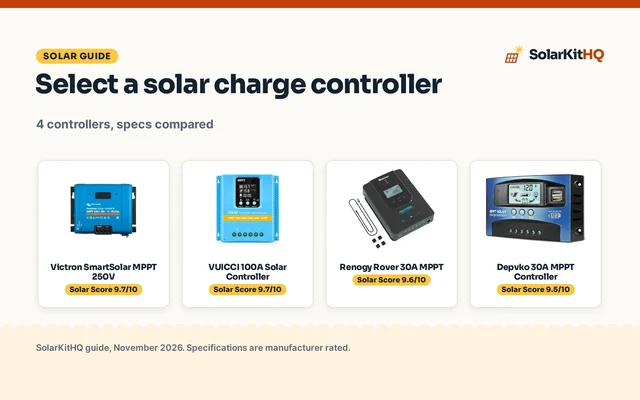
| Victron SmartSolar 75V 15A | 75V | 15A | 12/24V |
| Victron SmartSolar 100V 30A | 100V | 30A | 12/24V |
| Victron SmartSolar 150V 45A | 150V | 45A | 12/24/36/48V |
| PowMr 60A | 160V | 60A | 12/24/36/48V |
These are maker-stated figures from the listings. A controller that accepts a higher panel voltage and passes more charge current fits a larger array, while a smaller unit fits a small panel and battery pair.
Step 2: How MPPT works
An MPPT controller watches the panel voltage and current and hunts for the point where their product is highest. When the panel voltage sits above the battery voltage, the controller converts the extra voltage into more charging current instead of wasting it. That is why MPPT fits panels wired in series or panels with a high open-circuit voltage feeding a lower-voltage battery. The Victron SmartSolar units state lightning-fast tracking and charge algorithms that keep the output at its maximum even when panels sit partially covered in shade. The PowMr states efficiency of 98.1% and PV utilization of 99%, with automatic detection of 12V, 24V, 36V and 48V batteries.
MPPT also gives room to grow. The Victron SmartSolar 150V 45A takes panels up to 150V and charges 12V, 24V, 36V and 48V batteries. The PowMr 60A takes a maximum of 160V and 2800W of panel input. A controller with headroom for a larger panel array means the same controller can stay in place when the system grows.
Step 3: How PWM works
A PWM controller works more simply. It connects the panel to the battery and turns the connection on and off to hold the battery at the right voltage. The panel voltage drops to the battery voltage, so any voltage above the battery voltage goes unused. That makes PWM a fair pick when the panel voltage already matches the battery voltage, such as a panel built for a battery of the same voltage, and when the array is small. PWM units have fewer parts and fewer settings, which suits a simple setup where the owner wants the controller out of the way.
The trade-off is harvest. A PWM controller cannot turn extra panel voltage into charging current, so a high-voltage panel on a low-voltage battery wastes the difference. An MPPT controller earns its place where the panel voltage runs well above the battery voltage or where the array is large enough that the lost harvest matters. The listings in this guide are MPPT units, so compare the MPPT figures in the table above when you size a controller. See the MPPT vs PWM charge controller comparison for the full head-to-head.
Step 4: Match the controller to the panels and battery
The figures that decide the match are the highest panel voltage the controller accepts, the charge current it can pass, and the battery voltages it supports. The Victron SmartSolar 75V 15A accepts 75V and passes 15A for 12V and 24V batteries. The SmartSolar 100V 30A accepts 100V and passes 30A for 12V and 24V batteries. The SmartSolar 150V 45A accepts 150V and passes 45A for 12V, 24V, 36V and 48V batteries. The PowMr 60A accepts a maximum of 160V and 2800W of panel input and passes 60A for 12V, 24V, 36V and 48V batteries. Pick a controller whose limits sit above the panel array figures and whose battery list includes the battery voltage. See the solar charge controller size guide for the sizing steps.
Check the battery type too. The PowMr lists lead-acid, lithium, LiFePO4 and other types, with user settings for absorption voltage, floating voltage and low voltage disconnect, plus a temperature sensor in the box. The Victron units use battery presets in the VictronConnect app. For lithium batteries, the PowMr notes that manual parameter adjustment is needed, since a 12V lithium battery may range from 11.1V to 14.8V.
Ways to pick the right type
- Match the panel voltage to the battery voltage: if the panel voltage sits close to the battery voltage, PWM is enough; if it runs well above, MPPT earns its keep.
- Size the amps: the controller charge current must cover the array output, so a 60A unit like the PowMr suits a larger array than a 15A unit like the Victron 75V 15A.
- Look at the extras: the Victron units add Bluetooth and a 30-day history in the app, while the PowMr adds an LCD, a temperature sensor and a fan that starts above 45°C and stops below 40°C.
- Check the warranty: the Victron SmartSolar 100V 30A lists a 2 year manufacturer warranty.
FAQ: power away from the grid
What is the difference between MPPT and PWM?
An MPPT controller converts extra panel voltage into charging current, while a PWM controller holds the panel near the battery voltage. MPPT suits high-voltage panels and larger arrays. PWM suits small setups where the panel voltage already matches the battery voltage.
What size charge controller do I need?
Match the controller limits to the array: the highest panel voltage, the charge current and the battery voltage. The Victron SmartSolar 150V 45A accepts 150V and 45A for 12V to 48V batteries, while the PowMr 60A accepts 160V and 2800W of panel input. Pick a controller whose limits sit above the array figures.
Can an MPPT controller charge a lithium battery?
Yes, with the right settings. The PowMr lists lithium and LiFePO4 among the battery types it fits, and notes that a 12V lithium battery may range from 11.1V to 14.8V, so manual parameter adjustment is needed. The Victron units use battery presets in the app.
Does a charge controller need a display?
Not always. The PowMr has a backlight LCD that shows PV voltage, output power, battery voltage, charging current, working mode and temperature. The Victron SmartSolar units show the same kind of data in the VictronConnect app over Bluetooth, with a 30-day performance history.
Is a 60A charge controller enough for a large array?
It depends on the array figures. The PowMr 60A accepts a maximum of 160V and 2800W of panel input for 12V, 24V, 36V and 48V batteries. Compare the array voltage and watts with those limits before you buy.
Related solar guides
See the MPPT vs PWM charge controller, the solar charge controller size, the how to set a solar charge controller and the best MPPT charge controllers for a 24V system.