On this page
A campsite at dusk, the phone almost dead, and the battery bank waiting on the sun. The short answer on victron smartsolar vs renogy rover: the Renogy Rover side states a 3-year warranty and TVS surge protection on both of its listings, while the Victron SmartSolar answers with built-in Bluetooth, VE.Can networking and synchronized multi-controller charging but states no warranty. We compared three MPPT charge controllers on what each listing states: charging current, PV input, protection features, monitoring and warranty terms.
SolarKitHQ earns a commission when you buy through links on this page, at no extra cost to you. As an Amazon Associate I earn from qualifying purchases. Affiliate disclosure.
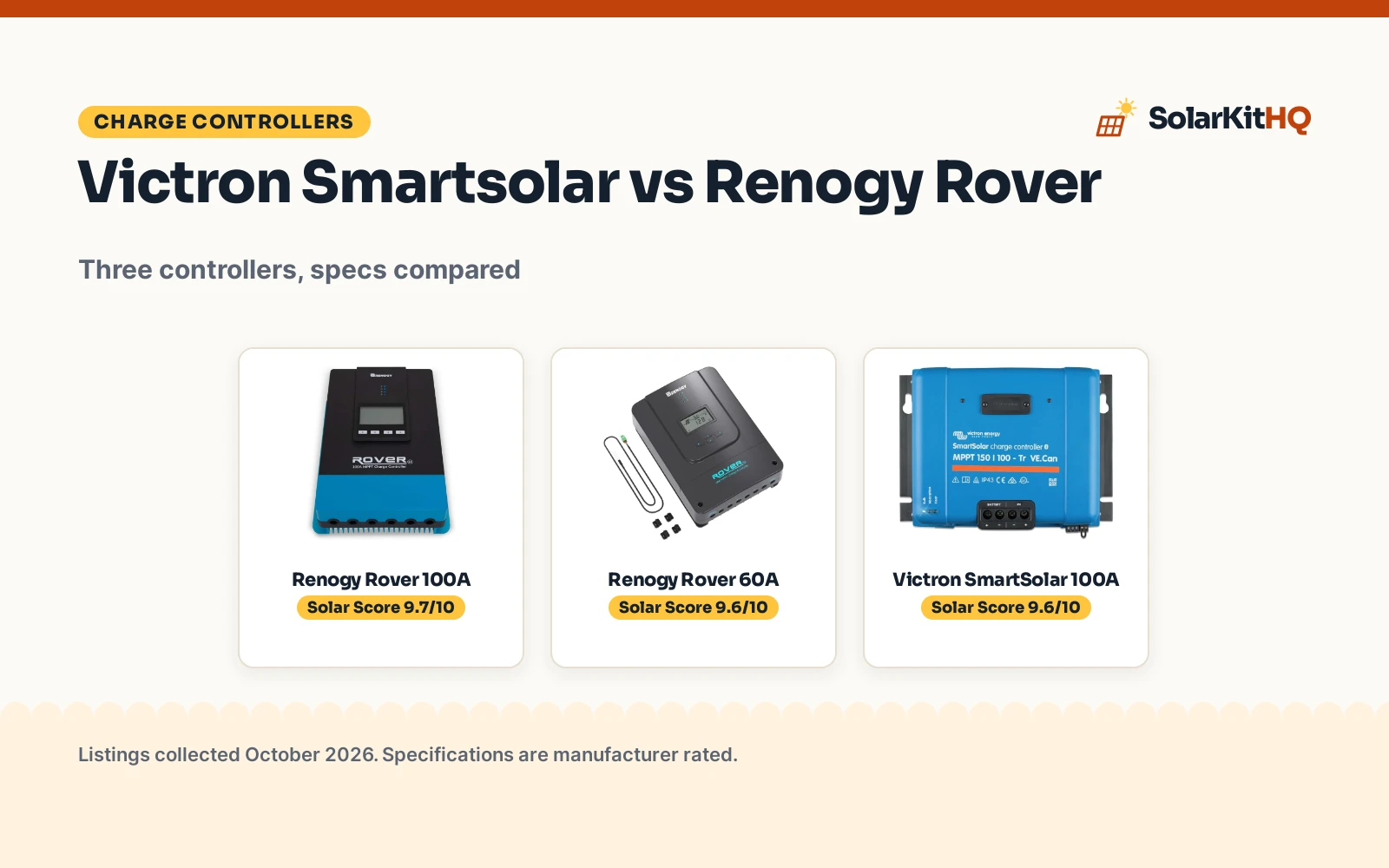
Victron SmartSolar vs Renogy Rover: side by side
| Victron SmartSolar vs Renogy Rover | Renogy Rover 100A | Renogy Rover 60A | Victron SmartSolar 100A | Amazon |
|---|---|---|---|---|
| Charging current | 100A | 60A | 100A | |
| PV input | 150V | 150V | 150V | |
| Battery voltage | 12/24/36/48V | 12/24/36/48V | 12/24/36/48V | |
| Stated tracking efficiency | 99.9% MPPT | 99.9% multi-peak | Not stated | |
| Monitoring | App with BT-2 module, sold separately | Backlit LCD and 365-day logging; app module sold separately | Bluetooth built in; VictronConnect app with 30-day history | |
| Protection stated | TVS lightning; overload, short, reverse, overcharge | TVS surge; reverse polarity, overload | Low-voltage load disconnect | |
| Housing | IP32 rating; aluminum | Aluminum; no rating stated | Not stated | |
| Warranty | 3-year material and workmanship | 3-year material and workmanship | Not stated | |
| Dimensions | 12.07 x 17.44 x 4.33 in | 12 x 8.07 x 4 in | 10.63 x 9.84 x 5.91 in | |
| Weight | 22 pounds | Not stated | Not stated |
Specifications are manufacturer rated as listed, collected 23 October 2026.
Charging current and PV input
All three controllers state a 150V PV input and 12, 24, 36 and 48V battery systems, so the split is on current: the Victron SmartSolar and the Renogy Rover 100A both state 100A, while the Renogy Rover 60A states 60A. The Renogy pair states 99.9% tracking efficiency figures, 99.9% MPPT for the 100A and 99.9% multi-peak tracking for the 60A, while the Victron listing claims fast optimum power point tracking without a figure. Do not call a side better on tracking unless the listings state comparable figures; the Victron side leaves it unclear. Battery chemistry support is broad on all three: the Renogy listings state AGM, gel, flooded and lithium, with the 100A adding LiFePO4 and the 60A a lithium reactivation feature, while the Victron listing states battery presets without naming chemistries.
Monitoring and connectivity
The Victron SmartSolar builds Bluetooth into the controller and pairs it with the VictronConnect app for real-time data and 30-day performance history, plus VE.Can for networking and synchronized charging across multiple controllers. The Renogy Rover 60A states a backlit LCD with 365-day logging, and the Renogy 100A’s bullets claim both 5 years and 300 days of data storage, so treat that figure as unsettled until the listing is corrected. Both Renogy listings need the BT-1 or BT-2 module, sold separately, for app monitoring, and the 100A adds RS485 and RS232 communication for larger systems. If you want the screen on the wall, the 60A is the only listing whose title and bullets both confirm one.
Protection and housing
The Renogy Rover 100A states an IP32 rating with TVS lightning protection and overload, short, reverse and overcharge safeguards in an aluminum housing, and the maker calls it out for RV, marine and off-grid use. The Renogy Rover 60A states TVS surge protection with reverse polarity and overload safeguards, also in aluminum, but no housing rating. The Victron listing states a configurable low-voltage load disconnect that drops loads when battery voltage runs too low, and states no certifications, no housing material and no temperature range. Say when a listing states none: the Victron side does here, which is why its safety score rests on the one stated feature alone.
What the listings leave unclear
The Victron SmartSolar listing states no warranty term, which the scoring rules treat as a hard zero on that criterion, and it gives no housing material, no temperature range and no tracking efficiency figure. The Renogy 100A listing contradicts itself on data logging, 5 years in one bullet and 300 days in another, and its spec table’s LCD or LED display type clashes with a title and bullets that name no display; trust the title and bullets. The Renogy 60A is the cleanest listing of the three: every figure it states appears once, and its 3-year material and workmanship warranty reads the same as its larger sibling’s.
Three examples
| # | Product | Solar Score | Buy |
|---|---|---|---|
| 1 |  Renogy Rover 100A | 9.7/10 | Buy on Amazon |
| 2 |  Renogy Rover 60A | 9.6/10 | Buy on Amazon |
| 3 |  Victron SmartSolar 100A | 9.6/10 | Buy on Amazon |

Renogy Rover 100A
A 100A MPPT controller with a 150V PV input, IP32 rating and a stated 3-year warranty.
Pros
- 100A charging current with 150V PV input
- 99.9% MPPT efficiency stated
- IP32 rating with TVS lightning protection
- 3-year material and workmanship warranty stated
Cons
- Bullets state both 5 years and 300 days of data storage
- Bluetooth module sold separately
- 22 pounds, the heaviest pick here
- Spec table says LCD or LED while title and bullets name no display
Detailed Review
The listing describes a 100A MPPT controller with 150V PV input for 12, 24, 36 and 48V battery systems, working with AGM, gel, flooded and lithium batteries. The bullets contradict themselves on data logging: one says the controller stores 5 years of data, another says 300 days, so treat the figure as unsettled. The spec table's LCD or LED display type also clashes with a title and bullets that name no display; the title and bullets win. Stated protections include TVS lightning protection and overload, short, reverse and overcharge safeguards, with an IP32 rating, and a 3-year material and workmanship warranty.
Who it's for: large RV, boat or off-grid home systems that need 100A and a stated warranty. Who should skip it: anyone who wants Bluetooth in the box, since the BT-2 module is sold separately.
Its Solar Score of 9.7/10 comes from performance 32/35, build 21/25, value 20/25, safety 8/10 and warranty 4/5: 85 of 100 points, placed on our 9.2 to 9.8 scale.
Key Specifications
| Charging current | 100A |
|---|---|
| PV input | 150V |
| Battery voltage | 12/24/36/48V |
| Rating | IP32 |
Figures as published on the retailer listing, collected 23 October 2026. Performance figures are manufacturer rated.
Safety and Warranty
What this listing states. IP32 rating; TVS lightning protection; overload, short, reverse and overcharge safeguards, so safety scores 8 of 10. 3-year material and workmanship warranty. It does not say everything a buyer needs, such as who pays return shipping, so warranty scores 4 of 5. See How We Pick.
Stay under the input limit. Keep your panels' combined open circuit voltage, with cold weather margin, under the controller's stated maximum PV input, connect the battery first unless the manual says otherwise, and fuse both sides as the manual directs.
This is general buying information, not professional advice. Follow each product manual and local rules, and see our Safety Disclaimer.

Renogy Rover 60A
A 60A MPPT controller with 150V PV input, backlit LCD and a stated 3-year warranty.
Pros
- 99.9% multi-peak tracking efficiency stated
- Backlit LCD with 365-day data logging
- 4-stage charging plus lithium reactivation stated
- 3-year material and workmanship warranty stated
Cons
- 60A, the lowest charging current here
- Bluetooth modules sold separately
- No IP rating stated
- 12 by 8.07 by 4 in needs wall space
Detailed Review
The listing describes a 60A MPPT controller with 150V PV input for 12, 24, 36 and 48V systems, claiming 99.9% multi-peak tracking efficiency and 98% conversion efficiency. It lists a backlit LCD with 365-day performance logging, 4-stage charging for lead-acid batteries and a lithium reactivation feature, with TVS surge protection and reverse polarity and overload safeguards. The Renogy DC Home app needs the BT-1 or BT-2 module, sold separately. A 3-year material and workmanship warranty is stated.
Who it's for: RV, cabin and marine systems where 60A and a backlit LCD suit the install. Who should skip it: 100A arrays, which want one of the larger picks.
Its Solar Score of 9.6/10 comes from performance 28/35, build 20/25, value 20/25, safety 7/10 and warranty 4/5: 79 of 100 points, placed on our 9.2 to 9.8 scale.
Key Specifications
| Charging current | 60A |
|---|---|
| PV input | 150V |
| Tracking | 99.9% multi-peak |
| Logging | 365 days |
Figures as published on the retailer listing, collected 23 October 2026. Performance figures are manufacturer rated.
Safety and Warranty
What this listing states. TVS surge protection; reverse polarity and overload safeguards, so safety scores 7 of 10. 3-year material and workmanship warranty. It does not say everything a buyer needs, such as who pays return shipping, so warranty scores 4 of 5. See How We Pick.
Stay under the input limit. Keep your panels' combined open circuit voltage, with cold weather margin, under the controller's stated maximum PV input, connect the battery first unless the manual says otherwise, and fuse both sides as the manual directs.
This is general buying information, not professional advice. Follow each product manual and local rules, and see our Safety Disclaimer.

Victron SmartSolar 100A
A 100A MPPT controller with built-in Bluetooth, VE.Can and synchronized multi-controller charging.
Pros
- 100A with 150V PV input
- Bluetooth built in with the VictronConnect app
- VE.Can networking and synchronized charging stated
- Intelligent load output with configurable disconnect
Cons
- No warranty term stated in the listing
- No housing material or rating stated
- No operating temperature range stated
- No tracking efficiency figure stated
Detailed Review
The listing describes a 100A MPPT controller with 150V PV input for 12, 24, 36 and 48V systems, with Tr terminals and VE.Can support. It claims fast optimum power point tracking and intelligent charge algorithms, synchronized charging across multiple controllers, and an intelligent load output that disconnects loads when battery voltage drops too low. The VictronConnect app gives real-time data and 30-day performance history over built-in Bluetooth. The listing states no warranty term, no housing material and no temperature range.
Who it's for: systems that will use VE.Can networking or several synchronized controllers. Who should skip it: buyers who want a stated warranty, since the listing gives none.
Its Solar Score of 9.6/10 comes from performance 32/35, build 21/25, value 19/25, safety 5/10 and warranty 0/5: 77 of 100 points, placed on our 9.2 to 9.8 scale.
Key Specifications
| Charging current | 100A |
|---|---|
| PV input | 150V |
| Battery voltage | 12/24/36/48V |
| Connectivity | Bluetooth, VE.Can |
Figures as published on the retailer listing, collected 23 October 2026. Performance figures are manufacturer rated.
Safety and Warranty
What this listing states. Configurable low-voltage load disconnect protects the battery from deep discharge, so safety scores 5 of 10. No warranty term, so warranty scores zero. See How We Pick.
Stay under the input limit. Keep your panels' combined open circuit voltage, with cold weather margin, under the controller's stated maximum PV input, connect the battery first unless the manual says otherwise, and fuse both sides as the manual directs.
This is general buying information, not professional advice. Follow each product manual and local rules, and see our Safety Disclaimer.
As an Amazon Associate I earn from qualifying purchases.
How we scored them
The Solar Score weighs performance, build, value, safety and warranty. For charge controllers, safety means the protection features and ratings each listing states, from TVS surge protection to IP ratings and low-voltage disconnects. Two of the three picks state a 3-year warranty; one states none. How we pick explains the weights.
| Product | Solar Score | Perf. /35 | Build /25 | Value /25 | Safety /10 | Warranty /5 |
|---|---|---|---|---|---|---|
| Renogy Rover 100A | 9.7 | 32 | 21 | 20 | 8 | 4 |
| Renogy Rover 60A | 9.6 | 28 | 20 | 20 | 7 | 4 |
| Victron SmartSolar 100A | 9.6 | 32 | 21 | 19 | 5 | 0 |
Scores run from 9.2 to 9.8: each product’s point total is placed on that range, so more points always means a higher score.
Victron SmartSolar vs Renogy Rover: which should you choose?
Match the current to the array
Current is the first filter: the Victron SmartSolar and the Renogy Rover 100A state 100A, while the Renogy Rover 60A states 60A, and all three accept 150V on the PV side. Size the controller to the array’s output rather than the battery alone, and check the listing’s own current figure before anything else. Our DC to DC charger vs MPPT charge controller comparison covers the other side of the charging question.
Decide how you want to watch it
Monitoring splits the two sides cleanly, and the small table below lays out the stated differences.
| Feature | Victron SmartSolar | Renogy Rover |
|---|---|---|
| Bluetooth | Built in | BT-1 or BT-2 module, sold separately |
| On-device display | Not stated | Backlit LCD stated on the 60A |
| Performance history | 30-day, in the app | 365-day logging on the 60A; 5 years or 300 days on the 100A |
| Multi-controller sync | Stated, via VE.Can | RS485 and RS232 on the 100A |
If the controller lives where you can see it, the 60A’s backlit LCD matters; if it lives in a locker, the Victron’s built-in Bluetooth matters more. Either way, budget the Renogy app module separately. For the AC side of the system, see our MPPT charge controller vs inverter charger comparison.
Read the warranty line
Both Renogy Rover listings state a 3-year material and workmanship warranty, quoted the same way on each. The Victron SmartSolar listing states no warranty term at all, which is a concrete gap rather than a missing detail. When two listings are close on specs, the stated warranty is the tiebreaker the listings themselves provide.
Sizing Notes
- Match the panel array’s open-circuit voltage to the 150V PV input limit each listing states.
- Match the battery bank to the 12, 24, 36 or 48V settings each listing states.
- Size the charging current, 100A or 60A, against the array’s output per the listing’s own figure.
- Check the Renogy listings’ stated protections against the install location; the 100A states an IP32 rating.
- Confirm the monitoring path before buying: built-in Bluetooth on the Victron, a separate module on the Renogy pair.
Frequently Asked Questions
Can these controllers charge a 48V battery bank?
Yes. All three listings state 12, 24, 36 and 48V battery systems, so each covers a 48V bank per its own listing.
Which listings state a warranty?
Both Renogy Rover listings state a 3-year material and workmanship warranty. The Victron SmartSolar listing states no warranty term.
Which controller has Bluetooth built in?
The Victron SmartSolar lists Bluetooth in its title and pairs it with the VictronConnect app. The Renogy pair needs the BT-1 or BT-2 module, sold separately.
What rating does the Renogy 100A housing carry?
The listing states an IP32 rating with TVS lightning protection. The other two listings state no housing rating.
Do the Renogy controllers work with lithium batteries?
Yes. Both Renogy listings state AGM, gel, flooded and lithium support, with the 100A adding LiFePO4 and the 60A a lithium reactivation feature.
Related guides
See every Charge Controllers guide and all Controllers and Inverters guides.
More picks: our 24V LiFePO4 batteries, battery monitors with shunt, solar panel kits with or without inverters and LiFePO4 vs AGM for generators.