On this page
When the lights go out at dinner time, ecoflow river 3 plus vs jackery 1000 v2 is the choice between a complete Jackery station bundle and an EcoFlow expansion battery. The short verdict is plain: pick the Jackery bundle for a complete station with AC outlets and a panel included, and pick the EcoFlow expansion battery only to add capacity to a RIVER 3 Plus already in use. The two listings are not the same kind of product, so this comparison scores each on what its own listing states and flags every place where a figure is missing or unclear.
SolarKitHQ earns a commission when you buy through links on this page, at no extra cost to you. As an Amazon Associate I earn from qualifying purchases. Affiliate disclosure.
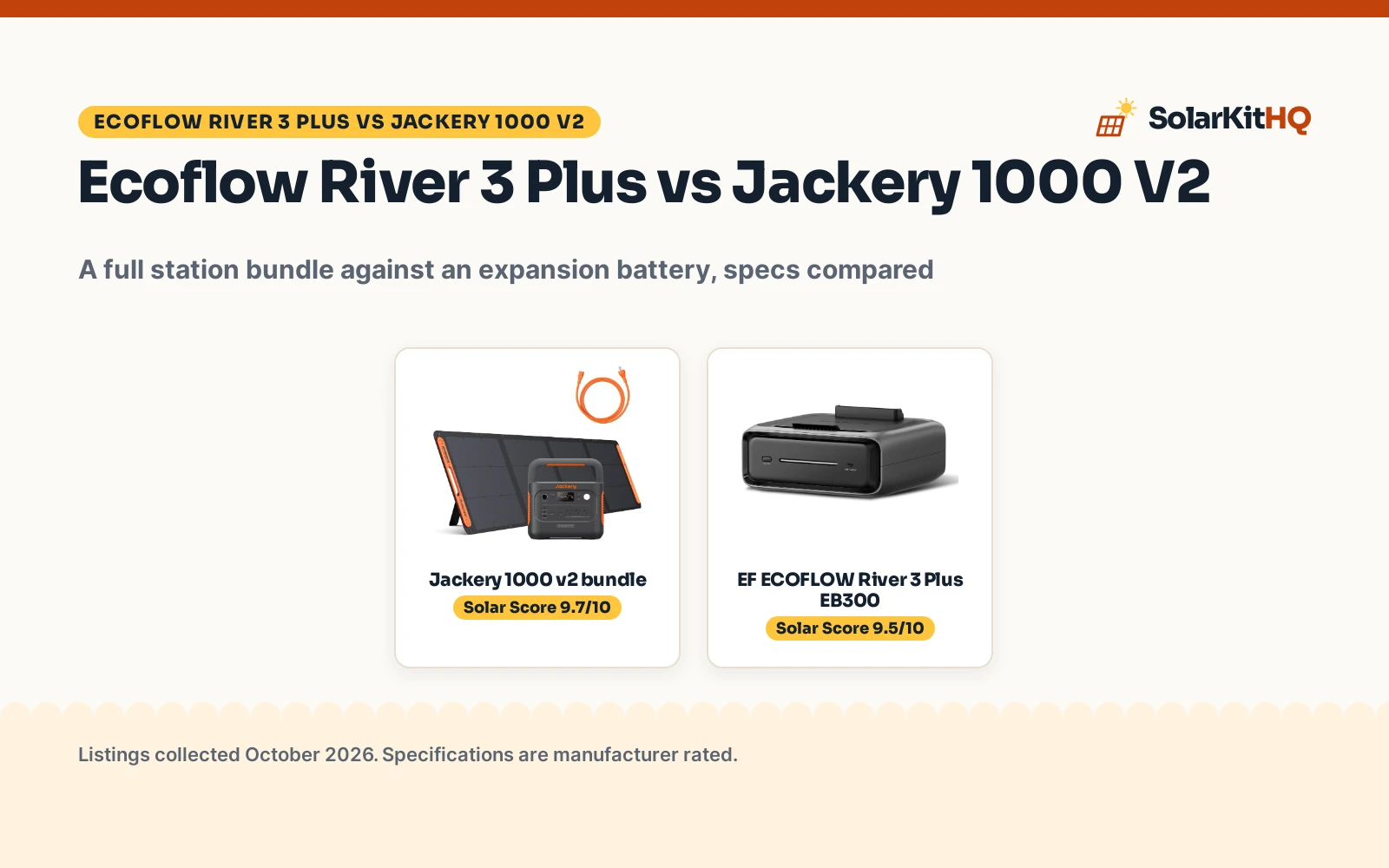
Ecoflow River 3 Plus vs Jackery 1000 V2: Side by Side
| Power station | Solar Score | Capacity | AC output | Outlets | Warranty |
|---|---|---|---|---|---|
| Jackery 1000 v2 bundle | 9.7/10 | 1070Wh | 1500W, 3000W surge | 3 AC outlets, 2 USB-C ports, 1 USB-A port, 1 DC car port | 2 year manufacturer |
| EF ECOFLOW River 3 Plus EB300 | 9.5/10 | 286Wh, 572Wh with RIVER 3 Plus | 140W USB-C | 1 outlet, 140W USB-C port | 5 Year |
Specifications are manufacturer rated as listed, collected 28 October 2026.
Capacity and output
On stated capacity, the Jackery listing gives 1070Wh against 286Wh for the EcoFlow unit on its own, and 572Wh once the EcoFlow battery is paired with RIVER 3 Plus. On output, the gap is wider: the Jackery listing states 1500W AC output with a 3000W surge, and names AC units, fridges and electric pots as loads it can run. The EcoFlow listing states no AC output at all; its stated output is a 140W USB-C port, with 1 outlet in the spec table. That difference decides the purchase for most readers: a station bundle runs household-style AC loads, while an expansion battery adds stored capacity and USB-C charging.
Charging and ports
The Jackery listing states charging from 0% to 100% in 1 hour in emergency mode via the Jackery App, with a default charging time of 1.7 hours, and names ChargeShield 2.0 technology. Its port list is generous: 3 pure sine wave AC outlets, 2 USB-C ports including PD 100W, 1 USB-A port, 1 DC car port and LED lights, with a quiet overnight mode at 30 dB and an energy efficiency mode through the app. The bundle includes a 200W panel, an Explorer 1000 v2, a User Manual and an AC Charging Cable. The EcoFlow listing takes a different route: the battery charges directly through its built-in USB-C port, and connected to RIVER 3 Plus it charges using solar, an AC outlet or a car in as fast as 1.5 hr. It stacks onto RIVER 3 Plus with a pogo pin connection, and on its own it charges small devices through the 140W USB-C port.
Protection and warranty
The EcoFlow listing states the stronger protection story on paper: X-Guard protection with 40 protective features including overheating and short circuit, an IP65 rating, a UL 94V-0-rated casing and a drop figure of 3.3 ft, plus a claimed 10-year lifespan for the LFP battery. Its warranty description is 5 Year, and the box contents mention 5-Year Service. The Jackery listing states ChargeShield 2.0 technology and an LFP battery retaining over 70% capacity after 4000 charge cycles, with a lifespan exceeding 10 years, but no IP rating is stated for the Jackery listing. Its warranty description is 2 year manufacturer, shorter than the EcoFlow term. Both listings state a warranty term, so neither safety nor warranty line is empty, but the EcoFlow listing states more named protections and the longer term.
What the listings leave unclear
The largest gap is the product type itself: the EcoFlow side is an expansion battery, not a full station, so its 572Wh figure only applies paired with RIVER 3 Plus, and its 140W USB-C port is no substitute for AC outlets. The EcoFlow listing states no weight, and it pairs the extra capacity with a car fridge figure of 7.2 hours and a travel kettle figure of 42 min without stating which configuration those figures belong to. It also states no charging time for direct USB-C charging on its own. On the Jackery side, the spec table lists Runtime as 1 hour while the bullets describe 1 hour as the emergency charging time, so the bullets are the safer reading, and no IP rating is stated. Readers should compare the Jackery bundle as a complete station and the EcoFlow unit as an add-on, not as two interchangeable stations.
Two examples
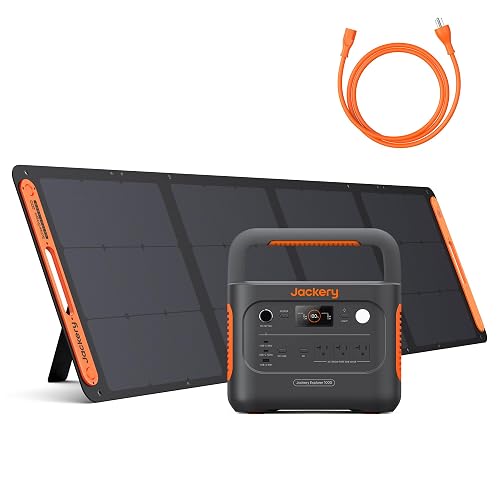
Jackery 1000 v2 bundle
A 1070Wh portable power station bundle with a 200W panel, 1500W AC output and 3 AC outlets, per the listing.
Pros
- 1500W AC output with a 3000W surge stated
- 1070Wh capacity with a 200W panel included in the bundle
- Charges from 0% to 100% in 1 hour in emergency mode via the Jackery App
- LFP battery retaining over 70% capacity after 4000 charge cycles stated
Cons
- 23.8 pounds stated
- Default charging time is 1.7 hours, longer than the 1 hour emergency mode
- Only 1 USB-A port stated
- 2 year manufacturer warranty, shorter than the 5 Year term on the EcoFlow listing
Detailed Review
The listing states a 1070Wh portable power station with 1500W AC output and a 3000W surge, 3 pure sine wave AC outlets, 2 USB-C ports including PD 100W, 1 USB-A port, 1 DC car port and LED lights, plus a 200W panel in the bundle. Charging runs from 0% to 100% in 1 hour in emergency mode via the Jackery App, with a default charging time of 1.7 hours, and the listing names ChargeShield 2.0 technology, a quiet overnight mode at 30 dB and an energy efficiency mode. The LFP battery is stated to retain over 70% capacity after 4000 charge cycles, with a lifespan exceeding 10 years, and the unit measures 8.82 by 12.87 by 9.72 inches at 23.8 pounds. One inconsistency to note: the spec table lists Runtime as 1 hour, while the bullets describe 1 hour as the emergency charging time, so the bullets are the safer reading.
Who it's for: campers, road trippers and homeowners who want a complete station with AC outlets and a panel in the bundle. Who should skip it: anyone who only wants to add capacity to a station already owned, or who wants a longer stated warranty term.
Its Solar Score of 9.7/10 comes from performance 33/35, build 22/25, value 21/25, safety 7/10 and warranty 1/5: 84 of 100 points, placed on our 9.2 to 9.8 scale.
Key Specifications
| Capacity | 1070Wh |
|---|---|
| AC output | 1500W, 3000W surge |
| Outlets | 3 AC outlets, 2 USB-C ports, 1 USB-A port, 1 DC car port |
| Size | 8.82 x 12.87 x 9.72 inches, 23.8 pounds |
Figures as published on the retailer listing, collected 28 October 2026. Performance figures are manufacturer rated.
Safety and Warranty
What this listing states. ChargeShield 2.0 technology stated, so safety scores 7 of 10. 2 year manufacturer. It does not say everything a buyer needs, such as who pays return shipping, so warranty scores 1 of 5. See How We Pick.
Power station limits. Stay within the stated continuous output and solar input limits, keep the unit ventilated and dry, charge within the stated temperature range, and never connect it to home wiring except through equipment a licensed electrician installs.
This is general buying information, not professional advice. Follow each product manual and local rules, and see our Safety Disclaimer.

EF ECOFLOW River 3 Plus EB300
A 286Wh LiFePO4 expansion battery for RIVER 3 Plus with a built-in 140W USB-C port, usable on its own.
Pros
- Adds 286Wh to RIVER 3 Plus for 572Wh stated
- Built-in 140W USB-C port for charging small devices and recharging on its own
- IP65 rating and UL 94V-0-rated casing stated
- 5 Year warranty description stated
Cons
- Not a standalone power station: only 1 outlet and a 140W USB-C port stated
- No AC outlet stated in the listing
- Needs RIVER 3 Plus for solar or AC charging in as fast as 1.5 hr
- No weight stated in the listing
Detailed Review
The listing states a 286Wh LiFePO4 expansion battery that adds capacity to RIVER 3 Plus for 572Wh, stacks with a pogo pin connection, and can be used on its own through its built-in 140W USB-C port for charging small devices and recharging the battery. The maker claims a 10-year lifespan, X-Guard protection with 40 protective features including overheating and short circuit, an IP65 rating, a UL 94V-0-rated casing and a drop figure of 3.3 ft. Charging through RIVER 3 Plus uses solar, an AC outlet or a car in as fast as 1.5 hr, and the box includes the RIVER 3 Plus Smart Extra Battery EB300, a Quick Start Guide and 5-Year Service. The listing also pairs the extra capacity with a car fridge figure of 7.2 hours and a travel kettle figure of 42 min, without stating which configuration those figures belong to.
Who it's for: RIVER 3 Plus owners who want more stored capacity, or anyone who wants a small-device battery that can run on its own through USB-C. Who should skip it: anyone shopping for a complete station with AC outlets, since this listing is an expansion battery, not a full station.
Its Solar Score of 9.5/10 comes from performance 23/35, build 21/25, value 19/25, safety 8/10 and warranty 3/5: 74 of 100 points, placed on our 9.2 to 9.8 scale.
Key Specifications
| Capacity | 286Wh, 572Wh with RIVER 3 Plus |
|---|---|
| USB-C | 140W built-in port |
| Size | 9.2 x 8.8 x 4.3 inches |
| Protection | X-Guard, 40 protective features stated |
Figures as published on the retailer listing, collected 28 October 2026. Performance figures are manufacturer rated.
Safety and Warranty
What this listing states. IP65 rating, UL 94V-0-rated casing and X-Guard protection against overheating and short circuit stated, so safety scores 8 of 10. 5 Year. It does not say everything a buyer needs, such as who pays return shipping, so warranty scores 3 of 5. See How We Pick.
Power station limits. Stay within the stated continuous output and solar input limits, keep the unit ventilated and dry, charge within the stated temperature range, and never connect it to home wiring except through equipment a licensed electrician installs.
This is general buying information, not professional advice. Follow each product manual and local rules, and see our Safety Disclaimer.
As an Amazon Associate I earn from qualifying purchases.
How we scored them
The Solar Score weighs performance, build, value, safety and warranty. For power stations and expansion batteries, safety means stated protection features, ratings and monitoring, and both listings state a warranty term. How we pick explains the weights.
| Product | Solar Score | Perf. /35 | Build /25 | Value /25 | Safety /10 | Warranty /5 |
|---|---|---|---|---|---|---|
| Jackery 1000 v2 bundle | 9.7 | 33 | 22 | 21 | 7 | 1 |
| EF ECOFLOW River 3 Plus EB300 | 9.5 | 23 | 21 | 19 | 8 | 3 |
Scores run from 9.2 to 9.8: each product’s point total is placed on that range, so more points always means a higher score.
ecoflow river 3 plus vs jackery 1000 v2: which should you choose?
Choose the Jackery bundle if the goal is a complete station: AC outlets, a panel in the bundle, app charging modes and a stated capacity of 1070Wh. It fits camping and emergency use, as the best portable power station for camping roundup shows for this class. Choose the EcoFlow EB300 if a RIVER 3 Plus is already owned and more stored capacity is the goal, or if a small battery for USB-C devices is enough on its own; the best power station with USB-C roundup covers that charging style. Do not buy the EcoFlow unit expecting AC outlets, and do not buy the Jackery bundle expecting an expansion battery: each listing does one job, and the scores reflect the listing, not the brand.
| If you need | Look at |
|---|---|
| A complete station with AC outlets | Jackery 1000 v2 bundle, 1500W AC output |
| More capacity for a RIVER 3 Plus | EF ECOFLOW River 3 Plus EB300, 286Wh |
| Small-device charging on its own | EF ECOFLOW River 3 Plus EB300, 140W USB-C port |
| The longest stated warranty | EF ECOFLOW River 3 Plus EB300, 5 Year |
Sizing Notes
- Match watt-hours to the loads planned: 1070Wh for the Jackery bundle, 286Wh for the EcoFlow unit on its own, 572Wh paired with RIVER 3 Plus.
- Match AC watts to the load: 1500W with a 3000W surge for the Jackery listing, against a 140W USB-C port only for the EcoFlow listing.
- Count outlets before buying: 3 AC outlets, 2 USB-C ports, 1 USB-A port and 1 DC car port for the Jackery listing, against 1 outlet and a USB-C port for the EcoFlow listing.
- Check the panel plan: the Jackery bundle includes a 200W panel, while the EcoFlow battery charges through RIVER 3 Plus using solar, an AC outlet or a car.
- Leave any change to home wiring to a licensed electrician.
Frequently Asked Questions
Is the EcoFlow listing a complete power station?
No. The EcoFlow listing is a 286Wh expansion battery for RIVER 3 Plus, usable on its own through a 140W USB-C port, while the Jackery listing is a complete 1070Wh station bundle with AC outlets and a 200W panel.
How much capacity does each listing state?
The Jackery listing states 1070Wh. The EcoFlow listing states 286Wh on its own and 572Wh paired with RIVER 3 Plus.
How fast does the Jackery listing state charging?
From 0% to 100% in 1 hour in emergency mode via the Jackery App, with a default charging time of 1.7 hours.
Can the EcoFlow battery be used on its own?
Yes. The listing states it can be used on its own through its built-in 140W USB-C port for charging small devices and recharging the battery.
Which listing states the longer warranty?
The EcoFlow listing, with a 5 Year warranty description, against a 2 year manufacturer description for the Jackery listing.
Related guides
See every Portable Power Stations guide and all Power Stations and Generators guides. Also see our solar generator vs ups and our portable power station vs inverter generator.
More picks: best suitcase power station, best portable power station for desktop computer, solar vs ac charging portable power station.