On this page
When a solar setup needs a battery bank, gel vs flooded battery for solar is a choice between lead-acid paths, but the listings behind this comparison tell a narrower story. The short answer: pick the flooded example if you want a stated deep-cycle battery with capacity and runtime figures, and look at the gel-side controller examples if you want charging control with a gel battery mode and stated protections. The gel side here is not a gel battery at all: both gel-side listings are charge controllers that support a gel mode, while the flooded side is an actual flooded battery. We compared three listings on what each states: item type, voltage, protections, capacity figures and warranty terms.
SolarKitHQ earns a commission when you buy through links on this page, at no extra cost to you. As an Amazon Associate I earn from qualifying purchases. Affiliate disclosure.
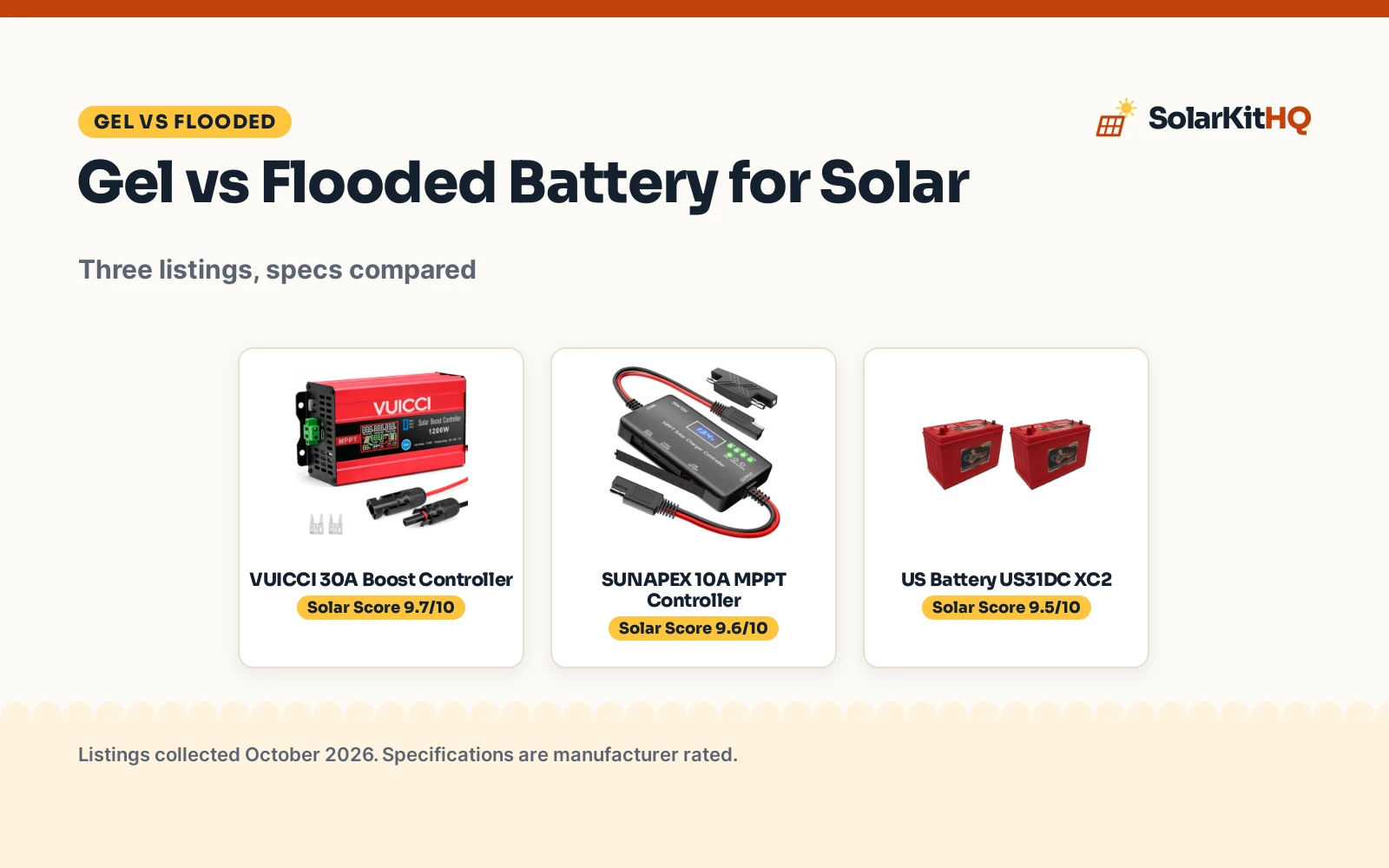
Gel vs Flooded Battery for Solar: side by side
| Gel vs Flooded | VUICCI 30A Boost Controller | SUNAPEX 10A MPPT Controller | US Battery US31DC XC2 | Amazon |
|---|---|---|---|---|
| Item type | Solar charge controller | Solar charge controller | Flooded deep cycle battery | |
| Voltage stated | 12-60V input, 48V/60V/72V output | 12V | 12V | |
| Current or capacity | 30A PV input, 15A charging | 10A charging | 130Ah at 20-hour rate | |
| Protection stated | Over-voltage, over-current, overload, overheating, reverse polarity, short-circuit, low-voltage | Reverse current, reverse polarity, short circuit, overload | Not stated | |
| Warranty stated | 12-month warranty | One-year warranty | 12 Month Manufacturer | |
| Weight stated | 1.8 lbs | Not stated | 66.0 pounds |
Specifications are manufacturer rated as listed, collected 29 October 2026.
What each listing actually is
This is the gap that shapes the whole comparison. The two gel-side listings are charge controllers, not batteries: the SUNAPEX example is a 10A MPPT controller for 12V systems, and the VUICCI example is a 30A boost MPPT controller with output at 48V, 60V and 72V. Both state a gel battery mode among other chemistries, so they represent the gel side as charging equipment, not as stored capacity. The flooded side is the opposite kind of listing: the US Battery example is a pack of 2 flooded lead acid deep cycle batteries, Group 31, 12V, with no charging equipment in the box. Any side-by-side verdict has to respect that split, or it compares a charger against a battery as if they were the same item.
Protection and charging control
Protection is where the controller examples state the longest protection lists. The VUICCI controller states over-voltage, over-current, overload, overheating, reverse polarity, short-circuit and low-voltage protection, plus a temperature-controlled cooling fan and a full metal housing. The SUNAPEX controller states reverse current, reverse polarity, short circuit and overload protection, plus zero standby power and reverse current prevention at night. The US Battery listing states no protection feature at all, which is normal for a battery listing but means the safety line of its score is empty. Neither controller listing states a battery capacity, so protection is a controller win only in the sense that the battery listing does not compete on that line.
Capacity and runtime: only one side states them
Capacity runs the other way. The US Battery example states 130Ah at the 20-hour rate and runtime figures of 59 minutes at 75 amps, 84 minutes at 56 amps and 225 minutes at 25 amps, plus dual SAE/Bolt terminals and a heat-sealed polypropylene case. Neither controller listing states a capacity or runtime figure, since controllers do not store energy: the SUNAPEX listing states 10A charging and the VUICCI listing states 30A PV input with 15A battery charging current. A buyer who needs stored amp-hours gets nothing usable from the controller listings on that question, and a buyer who needs charging control gets nothing usable from the battery listing on protections.
What the listings leave unclear
Several figures stay unresolved across the three listings. The SUNAPEX listing states no weight figure and no panel wattage range, while the VUICCI listing states panels from 10W to 1200W and a case at 6.7 by 2.36 by 3.7 inches weighing 1.8 lbs. The US Battery listing states no charging current and no controller pairing, so its charging setup is left to the buyer. The gel side also leaves the gel battery itself undescribed: neither controller listing states a gel battery capacity, weight or runtime, so this comparison cannot say how a gel battery itself performs, only how two controllers handle a gel mode.
Three examples
| # | Product | Solar Score | Buy |
|---|---|---|---|
| 1 |  VUICCI 30A Boost Controller | 9.7/10 | Buy on Amazon |
| 2 |  SUNAPEX 10A MPPT Controller | 9.6/10 | Buy on Amazon |
| 3 |  US Battery US31DC XC2 | 9.5/10 | Buy on Amazon |

VUICCI 30A Boost Controller
30A boost MPPT controller that steps 12V-60V panel input up to 48V, 60V or 72V output, with 99% tracking and 98% conversion stated.
Pros
- Boost design steps 12V-60V panel input up to 48V, 60V or 72V output
- 99% tracking rate and 98% conversion efficiency stated
- Full metal housing with temperature-controlled cooling fan
- 7 protections including over-voltage, overheating and low-voltage
Cons
- Output stated only at 48V, 60V and 72V, with no 12V output
- No standby power figure is stated
- Spare fuse details are not stated, though 2 spare fuses are included
- Case listed at 6.7 by 2.36 by 3.7 inches, larger than the SUNAPEX example
Detailed Review
The listing states a 30A MPPT controller with a built-in boost module, 99% tracking rate and 98% conversion efficiency, for panels from 10W to 1200W, with up to 30A PV input current and 15A battery charging current. It states compatibility with LiFePO4, NMC, lead-acid, AGM and gel batteries, a full metal housing, a temperature-controlled cooling fan, an HD color LCD, and 2 spare fuses. Gel is one of five chemistries listed, not the only one.
Who it's for: owners of 48V, 60V or 72V battery systems who want boost charging with a stated protection list. Who should skip it: owners of 12V battery systems, since the listing states output only at 48V and above.
Its Solar Score of 9.7/10 comes from performance 32/35, build 22/25, value 21/25, safety 9/10 and warranty 3/5: 87 of 100 points, placed on our 9.2 to 9.8 scale.
Key Specifications
| Charging | 30A PV input, 15A battery charging |
|---|---|
| Voltage | 12-60V input, 48V/60V/72V output |
| Efficiency | 99% tracking, 98% conversion |
| Warranty | 12-month warranty |
Figures as published on the retailer listing, collected 29 October 2026. Performance figures are manufacturer rated.
Safety and Warranty
What this listing states. Over-voltage, over-current, overload, overheating, reverse polarity, short-circuit and low-voltage protection, so safety scores 9 of 10. 12-month warranty. It does not say everything a buyer needs, such as who pays return shipping, so warranty scores 3 of 5. See How We Pick.
Battery safety. Charge with a charger and settings that match the stated chemistry, fuse the positive lead as the manual directs, cover terminals, keep within the stated temperature range, and never charge a damaged battery.
This is general buying information, not professional advice. Follow each product manual and local rules, and see our Safety Disclaimer.

SUNAPEX 10A MPPT Controller
10A MPPT controller for 12V LiFePO4, AGM, gel and sealed lead-acid batteries, with LCD monitoring and USB and Type-C outputs.
Pros
- 10A MPPT charging for 12V LiFePO4, AGM, gel and sealed lead-acid batteries
- LCD shows charging status, battery voltage and current
- USB and Type-C outputs for phones, GPS devices and cameras
- Zero standby power stated, with reverse current prevention at night
Cons
- Only 10A charging, below the VUICCI example at 30A PV input
- No panel wattage range is stated
- No weight figure is stated
- Gel support is one mode among four, not a gel-only design
Detailed Review
The listing states a 10A MPPT controller for 12V batteries with switchable modes for LiFePO4, AGM, gel and sealed lead-acid types, plus an LCD showing charging status, battery voltage and current. It states reverse current, reverse polarity, short circuit and overload protection, zero standby power, an included SAE adapter, and USB and Type-C outputs for phones, GPS devices, cameras and LED lights. Dimensions are stated as 4.1 by 2.0 by 0.8 inches, with no weight figure.
Who it's for: owners of 12V systems who want a small controller with a gel mode and live monitoring. Who should skip it: owners who need higher charging current or a stated panel wattage range, since the listing states neither beyond 10A.
Its Solar Score of 9.6/10 comes from performance 29/35, build 20/25, value 21/25, safety 8/10 and warranty 0/5: 78 of 100 points, placed on our 9.2 to 9.8 scale.
Key Specifications
| Charging | 10A MPPT, 12V |
|---|---|
| Battery modes | LiFePO4, AGM, gel, sealed lead-acid |
| Display | LCD voltage and current display |
| Warranty | one-year warranty |
Figures as published on the retailer listing, collected 29 October 2026. Performance figures are manufacturer rated.
Safety and Warranty
What this listing states. Reverse current, reverse polarity, short circuit and overload protection, so safety scores 8 of 10. No warranty term, so warranty scores zero. See How We Pick.
Battery safety. Charge with a charger and settings that match the stated chemistry, fuse the positive lead as the manual directs, cover terminals, keep within the stated temperature range, and never charge a damaged battery.
This is general buying information, not professional advice. Follow each product manual and local rules, and see our Safety Disclaimer.

US Battery US31DC XC2
Pack of 2 flooded lead acid deep cycle batteries, Group 31, 12V, rated 130Ah at the 20-hour rate with runtime figures at 3 currents.
Pros
- 130Ah at the 20-hour rate, Group 31, 12V
- Runtime figures at 3 currents: 59 minutes at 75 amps, 84 minutes at 56 amps, 225 minutes at 25 amps
- Dual SAE/Bolt terminals with heat-sealed polypropylene case
- XC2 formulation and Diamond Plate Technology stated for fast cycle-up
Cons
- No protection features are stated
- Non-sealed flooded design, unlike the sealed types the controllers support
- 66.0 pounds per the spec table, the heaviest item here
- No charging current or controller pairing is stated
Detailed Review
The listing states a pack of 2 US Battery US31DC XC2 flooded lead acid deep cycle batteries, BCI Group 31, 12V, rated 130Ah at the 20-hour rate. It states runtime figures of 59 minutes at 75 amps, 84 minutes at 56 amps and 225 minutes at 25 amps, dual SAE/Bolt terminals, and a heat-sealed polypropylene case built with XC2 formulation and Diamond Plate Technology. The spec table states 66.0 pounds and dimensions of 6.75 by 13.0 by 9.63 inches, with a 12 Month Manufacturer warranty.
Who it's for: buyers who want an actual flooded deep-cycle battery with stated capacity and runtime figures. Who should skip it: buyers who want stated protection features or a stated charging current, since the listing states neither.
Its Solar Score of 9.5/10 comes from performance 30/35, build 21/25, value 20/25, safety 0/10 and warranty 3/5: 74 of 100 points, placed on our 9.2 to 9.8 scale.
Key Specifications
| Capacity | 130Ah at 20-hour rate |
|---|---|
| Voltage | 12V, Group 31 |
| Runtime | 59 minutes at 75 amps, 84 minutes at 56 amps, 225 minutes at 25 amps |
| Warranty | 12 Month Manufacturer |
Figures as published on the retailer listing, collected 29 October 2026. Performance figures are manufacturer rated.
Safety and Warranty
What this listing states. No battery management system, protection or listing is stated, so safety scores zero. 12 Month Manufacturer. It does not say everything a buyer needs, such as who pays return shipping, so warranty scores 3 of 5. See How We Pick.
Battery safety. Charge with a charger and settings that match the stated chemistry, fuse the positive lead as the manual directs, cover terminals, keep within the stated temperature range, and never charge a damaged battery.
This is general buying information, not professional advice. Follow each product manual and local rules, and see our Safety Disclaimer.
As an Amazon Associate I earn from qualifying purchases.
How we scored them
The Solar Score weighs performance, build, value, safety and warranty. For batteries and controllers, safety means protections, certifications or fuses the listing actually states; a listing that states none scores zero on that line, whatever its capacity. All three listings state a warranty term of 12 months or one year. How we pick explains the weights.
| Product | Solar Score | Perf. /35 | Build /25 | Value /25 | Safety /10 | Warranty /5 |
|---|---|---|---|---|---|---|
| VUICCI 30A Boost Controller | 9.7 | 32 | 22 | 21 | 9 | 3 |
| SUNAPEX 10A MPPT Controller | 9.6 | 29 | 20 | 21 | 8 | 0 |
| US Battery US31DC XC2 | 9.5 | 30 | 21 | 20 | 0 | 3 |
Scores run from 9.2 to 9.8: each product’s point total is placed on that range, so more points always means a higher score.
Gel vs flooded battery for solar: which should you choose?
Choose the flooded example if you want an actual battery with stated capacity and runtime figures: the US Battery example states 130Ah at the 20-hour rate and runtime figures at 75, 56 and 25 amps. Choose a gel-side controller example if you want charging control with a gel battery mode: the SUNAPEX controller covers 12V systems with an LCD and USB outputs, and the VUICCI controller steps panel voltage up to 48V, 60V or 72V systems. Neither controller listing states a battery capacity, and the flooded listing states no protections, so the choice turns on whether you need a battery or a controller.
| If you need | Look at |
|---|---|
| A stated deep-cycle battery | US Battery US31DC XC2, 130Ah at 20-hour rate |
| A gel battery mode with LCD monitoring | SUNAPEX 10A MPPT Controller, 12V gel mode |
| A boost controller for higher voltage banks | VUICCI 30A Boost Controller, 48V/60V/72V output |
| Stated protection lists | VUICCI or SUNAPEX controllers, protection lists stated |
Sizing Notes
- Match the battery voltage to the controller: 12V for the SUNAPEX controller and the US battery, 48V, 60V or 72V output for the VUICCI controller.
- Check the tray and weight: the US battery is listed at 66.0 pounds with dimensions of 6.75 by 13.0 by 9.63 inches.
- Match protections to the setup: the controllers state protection lists, while the US battery listing states none.
- Check the warranty line: one-year, 12-month and 12 month terms stated across the three listings.
Frequently Asked Questions
Is the gel side here a gel battery?
No. Both gel-side listings are charge controllers: the SUNAPEX controller and the VUICCI controller each state a gel battery mode among other chemistries, while the flooded side is an actual flooded battery.
Which listing states a capacity figure?
Only the US Battery example, at 130Ah at the 20-hour rate with runtime figures at 75, 56 and 25 amps. Neither controller listing states a battery capacity.
Which listings state protections?
Both controllers: SUNAPEX states reverse current, reverse polarity, short circuit and overload protection, and VUICCI states over-voltage, over-current, overload, overheating, reverse polarity, short-circuit and low-voltage protection. The US Battery listing states none.
Can the controllers charge the flooded battery here?
The VUICCI listing states lead-acid compatibility, while the SUNAPEX listing states sealed lead-acid modes and the US battery is a non-sealed flooded design, so the SUNAPEX listing does not state flooded support. Check the controller listing against the battery type before pairing them.
Related guides
See every Deep Cycle and RV Batteries guide and all Batteries and Charging guides. Also see our lifepo4 vs agm battery for solar. Also see our agm vs lead acid battery for solar. Also see our lithium vs lead acid battery for solar.