On this page
A van parked off-grid for the weekend needs enough stored energy to run the fridge through the night and still start the morning with charge to spare, and the choice between two common sizes is where most buyers stall. The short answer on 150ah vs 200ah lifepo4 battery choice: the 200ah example here states more capacity at 2560Wh against 1920Wh for each 150ah example, while the 150ah Power Queen example states the longest warranty at 5 years and the only Bluetooth monitoring. This guide compares the three listings side by side, using only what each one states, and says plainly where a figure is missing rather than calling a side better on it.
SolarKitHQ earns a commission when you buy through links on this page, at no extra cost to you. As an Amazon Associate I earn from qualifying purchases. Affiliate disclosure.
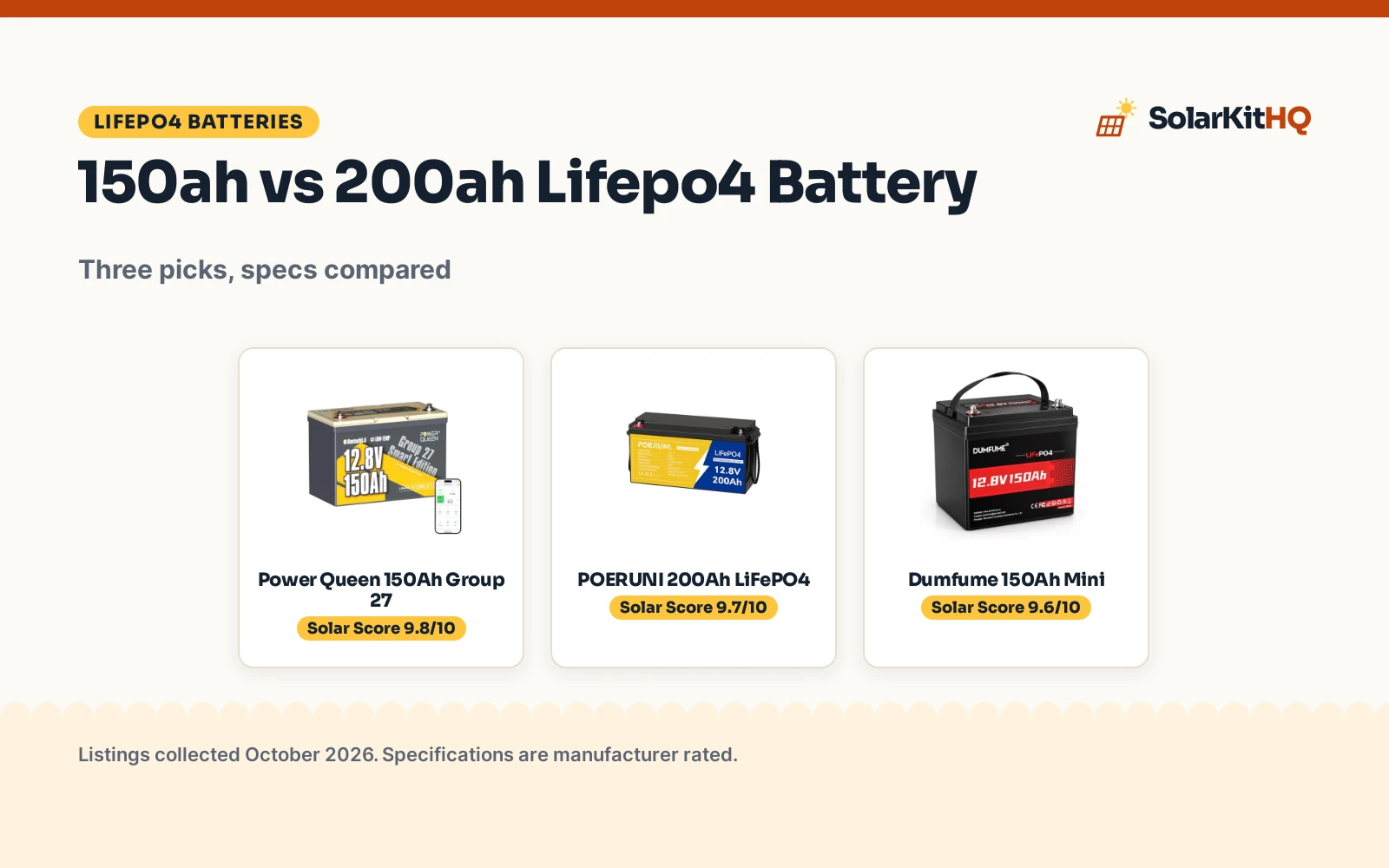
150ah vs 200ah lifepo4 battery: side by side
| Battery | Solar Score | Capacity | BMS | Warranty | Amazon |
|---|---|---|---|---|---|
| Power Queen 150Ah Group 27 | 9.8/10 | 1920Wh | 150A BMS | 5 years | View on Amazon |
| POERUNI 200Ah LiFePO4 | 9.7/10 | 2560Wh | 200A BMS | 1 year | View on Amazon |
| Dumfume 150Ah Mini | 9.6/10 | 1920Wh | 100A BMS | Not stated | View on Amazon |
Specifications are manufacturer rated as listed, collected 29 October 2026.
Capacity and output
Capacity is the clearest gap between the sides. Both 150ah examples state 1920Wh, while the single 200ah example states 2560Wh, so the larger side holds more stated energy per battery. Output watts are a different story: only the Power Queen example states an output figure, 1920W per battery and 3840W from a two-battery setup, while the dumfume and POERUNI listings state capacity and BMS current but no output watts. On output watts, then, the comparison has one stated side and two silent sides, and no winner can be called there.
Protection and monitoring
All three listings state a BMS, at 150A for the Power Queen, 100A for the dumfume and 200A for the POERUNI, each with overcharge, over-discharge and short-circuit protection named. Low-temperature detail separates them: the dumfume states a cutoff, with charging stopped below 0°C, plus discharge from -20°C to 70°C and charging from 5°C to 65°C, while the Power Queen states low-temperature protection without a figure and the POERUNI states a range of -20°C to 60°C with high/low temperature protection. An IP65 code is stated for both 150ah examples and for neither side of the 200ah example, since the POERUNI listing names no IP code. Bluetooth monitoring appears only on the Power Queen, at Bluetooth 5.0.
What the listings leave unclear
Three gaps deserve a plain note. First, the dumfume listing states no warranty term at all, against 5 years for the Power Queen and 1 year for the POERUNI, so warranty comparison ends there. Second, the POERUNI title wording on low-temperature behaviour reads as a power failure phrase rather than a stated cutoff figure, leaving its cold-weather line less precise than the dumfume figures. Third, the Power Queen cycle figure of 15000 appears in the title while its bullets give no cycle figure, and the POERUNI pairs a 10+ years service claim with a 1-year manufacturer warranty, so the service claim and the warranty term point in different directions.
Three examples
| # | Product | Solar Score | Buy |
|---|---|---|---|
| 1 |  Power Queen 150Ah Group 27 | 9.8/10 | Buy on Amazon |
| 2 |  POERUNI 200Ah LiFePO4 | 9.7/10 | Buy on Amazon |
| 3 |  Dumfume 150Ah Mini | 9.6/10 | Buy on Amazon |

Power Queen 150Ah Group 27
A 12V 150Ah Group 27 LiFePO4 battery with 1920Wh, a 150A BMS, Bluetooth 5.0 monitoring and a 5-year warranty.
Pros
- 1920Wh capacity with 1920W output power stated per battery
- 150A BMS with low-temperature protection and IP65 code stated
- Bluetooth 5.0 monitoring of SOC, voltage, temperature and BMS status
- 5-year warranty stated, the longest term in this guide
Cons
- Low-temperature protection stated without a cutoff figure
- Cycle figure of 15000 appears in the title, not the bullets
- No discharge temperature range stated
- Bluetooth monitoring needs a phone with the app
Detailed Review
The listing states a 12V 150Ah Group 27 LiFePO4 battery with 1920Wh, up to 1920W output power per battery and 3840W from a two-battery setup, a 150A BMS, low-temperature protection, an IP65 code, and Bluetooth 5.0 monitoring of SOC, voltage, temperature, charging and discharging time and BMS status. Weight is listed as 33.53 pounds and dimensions as 6.69 by 12.13 by 8.31 inches. The cycle figure of 15000 appears in the title while the bullets give no cycle figure.
Who it's for: RV and trailer owners who want a Group 27 fit with Bluetooth monitoring and the longest stated warranty here. Who should skip it: owners who need stated temperature cutoff figures or a larger capacity.
Its Solar Score of 9.8/10 comes from performance 32/35, build 22/25, value 21/25, safety 8/10 and warranty 4/5: 87 of 100 points, placed on our 9.2 to 9.8 scale.
Key Specifications
| Capacity | 1920Wh |
|---|---|
| Output | 1920W per battery |
| BMS | 150A BMS |
| Dimensions | 6.69 x 12.13 x 8.31 inches |
Figures as published on the retailer listing, collected 29 October 2026. Performance figures are manufacturer rated.
Safety and Warranty
What this listing states. 150A BMS; low-temperature protection; IP65 code stated, so safety scores 8 of 10. 5-year Warranty. It does not say everything a buyer needs, such as who pays return shipping, so warranty scores 4 of 5. See How We Pick.
Battery safety. Charge with a charger and settings that match the stated chemistry, fuse the positive lead as the manual directs, cover terminals, keep within the stated temperature range, and never charge a damaged battery.
This is general buying information, not professional advice. Follow each product manual and local rules, and see our Safety Disclaimer.

POERUNI 200Ah LiFePO4
A 12V 200Ah LiFePO4 battery with 2560Wh, a 200A BMS, 15000 cycles at 80% Depth of Discharge and a 1-year manufacturer warranty.
Pros
- 2560Wh capacity, the largest stated capacity in this guide
- 200A BMS with over-charge, over-discharge, over-current, short-circuit and high/low temperature protection
- 15000 cycles at 80% Depth of Discharge stated
- Wide temperature range of -20°C to 60°C stated
Cons
- 1-year manufacturer warranty, the shortest stated term here
- No IP code stated in the listing
- No Bluetooth monitoring stated
- Title wording on low-temperature behaviour is unclear
Detailed Review
The listing states a 12V 200Ah LiFePO4 battery with 2560Wh, a 200A BMS, 15000 cycles at 80% Depth of Discharge, and a wide temperature range of -20°C to 60°C, with protection against over-charge, over-discharge, over-current, short-circuit and high/low temperature. Weight is given as about 64 pounds and size as 19.49 by 6.69 by 9.49 inches. The title phrase on low-temperature behaviour reads as a power failure wording rather than a stated cutoff figure, so the low-temperature line is less clear than the dumfume figures.
Who it's for: owners who need the largest stated capacity here for RV, marine, solar or home backup use. Who should skip it: owners who want a long stated warranty, Bluetooth monitoring or an IP code.
Its Solar Score of 9.7/10 comes from performance 30/35, build 21/25, value 21/25, safety 7/10 and warranty 2/5: 81 of 100 points, placed on our 9.2 to 9.8 scale.
Key Specifications
| Capacity | 2560Wh |
|---|---|
| BMS | 200A BMS |
| Cycles | 15000 cycles at 80% Depth of Discharge |
| Dimensions | 19.49 x 6.69 x 9.49 inches |
Figures as published on the retailer listing, collected 29 October 2026. Performance figures are manufacturer rated.
Safety and Warranty
What this listing states. 200A BMS with over-charge, over-discharge, over-current, short-circuit and high/low temperature protection, so safety scores 7 of 10. 1 Year Manufacturer. It does not say everything a buyer needs, such as who pays return shipping, so warranty scores 2 of 5. See How We Pick.
Battery safety. Charge with a charger and settings that match the stated chemistry, fuse the positive lead as the manual directs, cover terminals, keep within the stated temperature range, and never charge a damaged battery.
This is general buying information, not professional advice. Follow each product manual and local rules, and see our Safety Disclaimer.

Dumfume 150Ah Mini
A compact 12V 150Ah mini LiFePO4 battery with 1920Wh, a 100A BMS, stated temperature ranges, an IP65 code and no warranty term stated.
Pros
- 1920Wh in a compact mini size at 41.03 pounds
- 100A BMS with overcharge, over-discharge, short circuit and overheating protection
- Low-temperature cutoff stated: charging stops below 0°C, with discharge -20°C to 70°C and charging 5°C to 65°C
- 4S4P expansion stated up to 51.2V 600Ah (30.72kWh)
Cons
- No warranty term is stated in the listing
- Designed for energy storage, not engine starting
- Storage over 6 months needs a full maintenance cycle every 6 months
- 100A BMS figure is lower than the 150A and 200A figures here
Detailed Review
The listing states a 12.8V 150Ah mini LiFePO4 battery with 1920Wh, a 100A BMS supporting up to 100A continuous charge and discharge, and protection against overcharge, over-discharge, short circuits and overheating. Temperature figures are the clearest here: discharge -20°C to 70°C, charging 5°C to 65°C, and the smart BMS stops charging below 0°C, with an IP65 code for the enclosure. Dimensions are given as 10.04 by 7.68 by 9.84 inches in the bullets, and expansion to 4S4P is stated up to 51.2V 600Ah. No warranty term appears in the listing.
Who it's for: owners who want a compact 150Ah battery with clear temperature figures for outdoor and marine use. Who should skip it: owners who want a stated warranty term or engine starting use.
Its Solar Score of 9.6/10 comes from performance 29/35, build 21/25, value 20/25, safety 8/10 and warranty 0/5: 78 of 100 points, placed on our 9.2 to 9.8 scale.
Key Specifications
| Capacity | 1920Wh |
|---|---|
| BMS | 100A BMS |
| Temperature | Discharge -20°C to 70°C; charging 5°C to 65°C |
| Dimensions | 10.04 x 7.68 x 9.84 inches |
Figures as published on the retailer listing, collected 29 October 2026. Performance figures are manufacturer rated.
Safety and Warranty
What this listing states. 100A BMS; low-temperature cutoff below 0°C; IP65 code stated, so safety scores 8 of 10. No warranty term, so warranty scores zero. See How We Pick.
Battery safety. Charge with a charger and settings that match the stated chemistry, fuse the positive lead as the manual directs, cover terminals, keep within the stated temperature range, and never charge a damaged battery.
This is general buying information, not professional advice. Follow each product manual and local rules, and see our Safety Disclaimer.
As an Amazon Associate I earn from qualifying purchases.
How we scored them
The Solar Score weighs performance, build, value, safety and warranty. For LiFePO4 batteries, safety means a BMS, low-temperature protection and an IP code the listing actually states; all three state a BMS, two state an IP65 code, and the dumfume states the clearest temperature figures. Warranty runs from 5 years to none stated, which is why the dumfume scores zero on that line despite its strong temperature detail. How we pick explains the weights.
| Product | Solar Score | Perf. /35 | Build /25 | Value /25 | Safety /10 | Warranty /5 |
|---|---|---|---|---|---|---|
| Power Queen 150Ah Group 27 | 9.8 | 32 | 22 | 21 | 8 | 4 |
| POERUNI 200Ah LiFePO4 | 9.7 | 30 | 21 | 21 | 7 | 2 |
| Dumfume 150Ah Mini | 9.6 | 29 | 21 | 20 | 8 | 0 |
Scores run from 9.2 to 9.8: each product’s point total is placed on that range, so more points always means a higher score.
150ah vs 200ah lifepo4 battery: which should you choose?
Choose the 200ah side if stated capacity is the constraint: the POERUNI example gives 2560Wh with a 200A BMS for RV, marine, solar and home backup use, accepting its 1-year warranty and missing IP code. Choose the 150ah Power Queen if warranty and monitoring matter more: 1920Wh with Bluetooth 5.0, a 150A BMS and a 5-year warranty in a Group 27 size. Choose the 150ah dumfume if a compact size and clear temperature figures matter more than a warranty term: 1920Wh at 41.03 pounds with a cutoff below 0°C and expansion to 4S4P.
| If you need | Look at |
|---|---|
| Largest stated capacity | POERUNI 200Ah LiFePO4, 2560Wh |
| Longest stated warranty | Power Queen 150Ah Group 27, 5 years |
| Bluetooth monitoring | Power Queen 150Ah Group 27, Bluetooth 5.0 |
| Clearest temperature figures | Dumfume 150Ah Mini, charging stops below 0°C |
Sizing Notes
- Match capacity to the loads: both 150ah examples state 1920Wh and the 200ah example states 2560Wh.
- Check the tray and the stated size: the Power Queen is Group 27 at 6.69 by 12.13 by 8.31 inches, the dumfume lists 10.04 by 7.68 by 9.84 inches, and the POERUNI lists 19.49 by 6.69 by 9.49 inches.
- Keep the planned draw under the stated BMS figure: 150A, 100A and 200A across the three examples.
- Check the low-temperature figures before cold-weather use: the dumfume stops charging below 0°C, the Power Queen states protection without a figure, and the POERUNI states -20°C to 60°C.
- Leave any connection to home wiring to a licensed electrician, and no wiring steps are given here.
Frequently Asked Questions
Which side states more capacity?
The 200ah side: the POERUNI example states 2560Wh, while each 150ah example states 1920Wh.
Which pick states Bluetooth monitoring?
Only the Power Queen, with Bluetooth 5.0 monitoring of SOC, voltage, temperature, charging and discharging time and BMS status.
Which pick states the longest warranty?
The Power Queen at 5 years, then the POERUNI at 1 year; the dumfume listing states no warranty term.
What low-temperature figures are stated?
The dumfume stops charging below 0°C, with discharge from -20°C to 70°C and charging from 5°C to 65°C. The POERUNI states -20°C to 60°C, and the Power Queen states protection without a figure.
Can the dumfume battery start an engine?
No. The listing states it is designed for energy storage, not engine starting, and notes storage applications only.
Related guides
See every Batteries and Charging guide. Also see our best LiFePO4 battery with BMS. Also see our LiFePO4 vs AGM battery for solar.
More picks: 150Ah vs 200Ah AGM battery, 50Ah vs 100Ah AGM battery, LiFePO4 vs AGM battery for home backup.