On this page
When the power cuts out at dinner time and the fridge, the lights and the router all go dark at once, the best tri fuel electric start generator is the one that fires up with a button and runs on whatever fuel is on hand. We compared four tri-fuel generators with electric start on the watts, run time, outlets, starting method and warranty terms their listings state. The two Westinghouse picks state full figures and lead the ranking, while the two title-only picks state only a watt figure and a start type, so they sit below the documented picks. Fuel generators run outdoors only, far from doors and windows, because of carbon monoxide, and any connection to home wiring is a job for a licensed electrician.
SolarKitHQ earns a commission when you buy through links on this page, at no extra cost to you. As an Amazon Associate I earn from qualifying purchases. Affiliate disclosure.
Quick picks
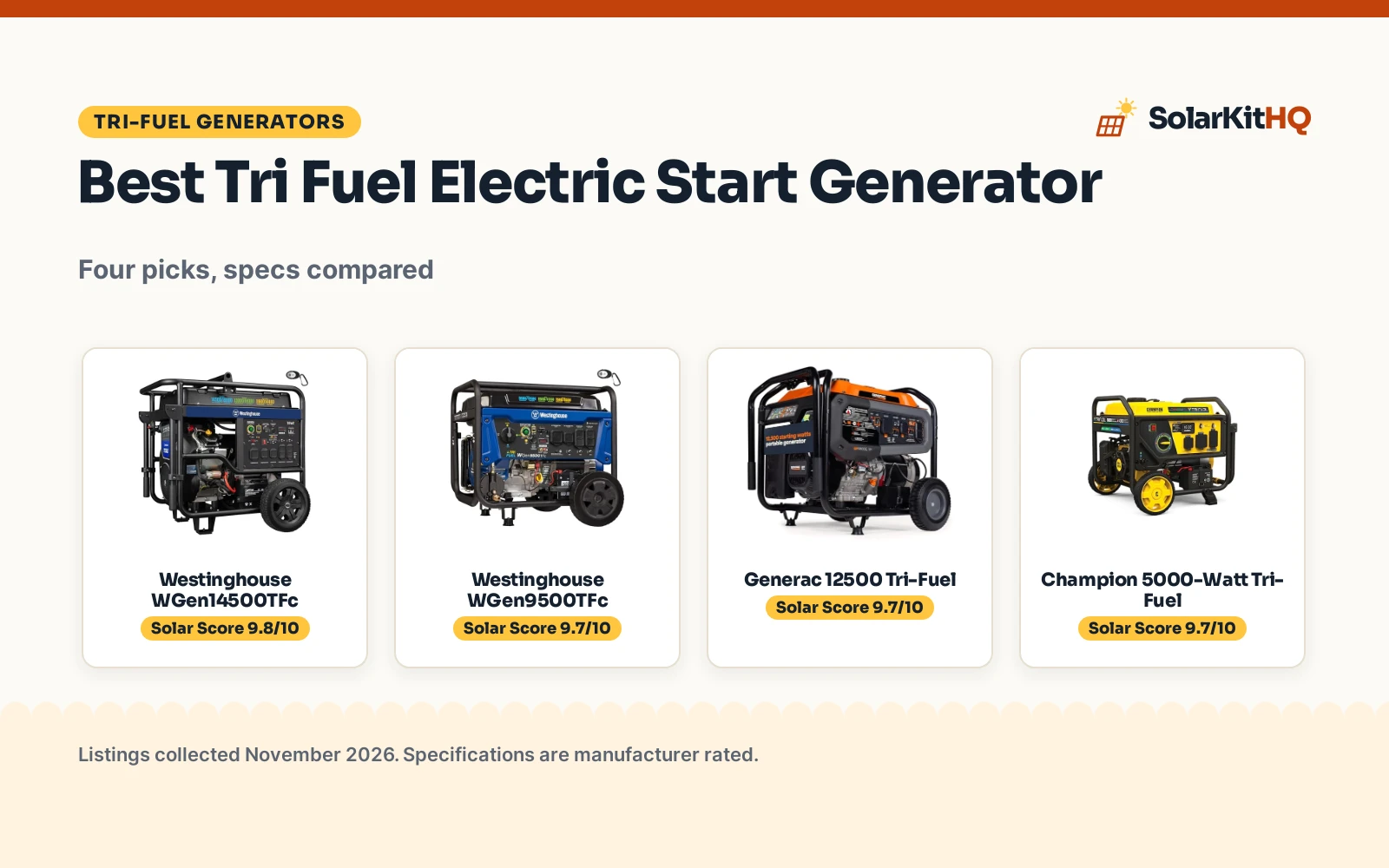
 Best Overall Westinghouse WGen14500TFc: 18000 peak watts with remote and push-button start Check price on Amazon
 Best Outlet Mix Westinghouse WGen9500TFc: GFCI household outlets plus RV-ready outlet Check price on Amazon
 Also Consider Generac 12500 Tri-Fuel: 12500 starting watts stated in the title Check price on Amazon
 Smallest Stated Watts Champion 5000-Watt Tri-Fuel: 5000 watts with electric start stated in the title Check price on Amazon
The kits we chose
| # | Product | Solar Score | Buy |
|---|---|---|---|
| 1 | Westinghouse WGen14500TFc | 9.8/10 | Buy on Amazon |
| 2 | Westinghouse WGen9500TFc | 9.7/10 | Buy on Amazon |
| 3 | Generac 12500 Tri-Fuel | 9.7/10 | Buy on Amazon |
| 4 | Champion 5000W Tri Fuel | 9.7/10 | Buy on Amazon |

Westinghouse WGen14500TFc
An 18000 peak watt tri-fuel generator with remote and push-button start, a 10.5-gallon tank and a CO sensor.
Pros
- 18000 peak watts and 14500 running watts on gasoline
- Remote and push-button start stated
- Less than 5% THD stated for sensitive electronics
- Copper windings stated to run cooler and last longer
Cons
- Heaviest pick here at 348.3 pounds
- Automatic transfer switch accessory sold separately
- No GFCI household outlet stated
- No propane or natural gas watt figures stated
Detailed Review
The listing states 18000 peak watts and 14500 running watts on gasoline, a choice of gasoline, propane or natural gas, up to 16 hours at 25% load on a 10.5-gallon tank, and push-button plus remote start. It lists a 713cc engine with full-pressure lubrication and an automotive-style oil filter, less than 5% THD for sensitive electronics, copper windings, 50A and 30A outlets, a CO sensor, automatic low-oil shutdown, and a 3-year limited residential warranty with lifetime technical support.
Who it's for: homeowners who want the highest stated watts here for home backup with remote start. Who should skip it: buyers who want stated propane or natural gas watt figures, which this listing does not give.
Its Solar Score of 9.8/10 comes from performance 33/35, build 22/25, value 21/25, safety 8/10 and warranty 4/5: 88 of 100 points, placed on our 9.2 to 9.8 scale.
Key Specifications
| Peak watts | 18000 |
|---|---|
| Running watts | 14500 |
| Run time | Up to 16 hours at 25% load |
| Tank | 10.5 gallons |
Figures as published on the retailer listing, collected 3 November 2026. Performance figures are manufacturer rated.
Safety and Warranty
What this listing states. CO sensor and automatic low-oil shutdown stated, so safety scores 8 of 10. 3-year limited residential warranty stated. It does not say everything a buyer needs, such as who pays return shipping, so warranty scores 4 of 5. See How We Pick.
Power station limits. Stay within the stated continuous output and solar input limits, keep the unit ventilated and dry, charge within the stated temperature range, and never connect it to home wiring except through equipment a licensed electrician installs.
This is general buying information, not professional advice. Follow each product manual and local rules, and see our Safety Disclaimer.

Westinghouse WGen9500TFc
A 12500 peak watt tri-fuel generator with remote, electric and recoil start, GFCI household outlets and a fuel gauge.
Pros
- Watts stated for all three fuels: gasoline, propane and natural gas
- Remote start with included key fob plus electric and recoil start
- Two GFCI 120V household outlets with rubber covers
- RV-ready 120/240V outlet stated
Cons
- Lower peak watts than the 18000 watt pick here
- 215.0 pounds stated in the spec table
- No THD figure stated
- Minimal assembly required
Detailed Review
The listing states 12500 peak watts and 9500 running watts on gasoline, 11200 peak watts and 8500 running watts on propane, and 9500 peak watts and 7500 running watts on natural gas, with up to 12 hours of run time. It lists a 457cc 4-stroke OHV engine with a cast iron sleeve, remote start with an included key fob plus electric and recoil start, two GFCI 120V household outlets, one 120V L14-30R outlet, one RV-ready 120/240V 14-50R outlet, rubber covers on all outlets, automatic low-oil and CO shutdown, a digital hour meter, and 3-year limited service, labor, and parts coverage.
Who it's for: buyers who want stated watts for all three fuels plus GFCI household outlets and an RV-ready outlet. Who should skip it: buyers who want the highest stated watts here, which the larger Westinghouse pick states.
Its Solar Score of 9.7/10 comes from performance 30/35, build 21/25, value 21/25, safety 8/10 and warranty 4/5: 84 of 100 points, placed on our 9.2 to 9.8 scale.
Key Specifications
| Peak watts | 12500 |
|---|---|
| Running watts | 9500 |
| Run time | Up to 12 hours |
| Engine | 457cc 4-stroke OHV |
Figures as published on the retailer listing, collected 3 November 2026. Performance figures are manufacturer rated.
Safety and Warranty
What this listing states. CO shutdown, automatic low-oil shutdown and GFCI outlets stated, so safety scores 8 of 10. 3-year limited service, labor, and parts coverage stated. It does not say everything a buyer needs, such as who pays return shipping, so warranty scores 4 of 5. See How We Pick.
Power station limits. Stay within the stated continuous output and solar input limits, keep the unit ventilated and dry, charge within the stated temperature range, and never connect it to home wiring except through equipment a licensed electrician installs.
This is general buying information, not professional advice. Follow each product manual and local rules, and see our Safety Disclaimer.

Generac 12500 Tri-Fuel
Tri-fuel portable generator stating gasoline, liquid propane, or natural gas operation, 9500 running watts and 12500 starting watts, and push-button electric start.
Pros
- Gasoline, liquid propane, or natural gas operation with a dial turn stated
- 9500 running watts and 12500 starting watts on gas stated
- Automatic voltage regulation stated
- COsense shutdown, 9.5-inch never-flat wheels and a folding handle stated
Cons
- Propane and natural gas watt figures are not stated separately
- 219 pounds stated
- No remote key fob is stated, only push-button electric start
- Warranty terms differ between the bullets and the spec table
Detailed Review
The bullets state a 3-year residential / 2-year commercial limited warranty, while the spec table says 8 Year Limited. The bullets win over the spec table, so compare on the 3-year residential / 2-year commercial terms. The spec table also lists PartNumber G0080632 against Model G0080631, a second mismatch inside the listing. The listing states a 500cc engine, automatic voltage regulation, COsense shutdown, a 7.5-gallon fuel tank, and a digital hour meter.
Who it's for: buyers who want three fuel options with automatic voltage regulation and COsense shutdown. Who should skip it: buyers who need stated propane or natural gas watts, or a remote key fob.
Its Solar Score of 9.7/10 comes from performance 30/35, build 21/25, value 21/25, safety 8/10 and warranty 3/5: 83 of 100 points, placed on our 9.2 to 9.8 scale.
Key Specifications
| Fuel | Gasoline, liquid propane, natural gas |
|---|---|
| Power on gas | 9500 running / 12500 starting watts |
| Run time | Up to 9.5 hours at 50% load on gasoline |
| Size | 27.5 x 27.1 x 27.6 inches |
Figures as published on the retailer listing, collected 3 November 2026. Performance figures are manufacturer rated.
Safety and Warranty
What this listing states. COsense CO detection shutdown and automatic voltage regulation stated, so safety scores 8 of 10. 3-year residential / 2-year commercial limited warranty stated. It does not say everything a buyer needs, such as who pays return shipping, so warranty scores 3 of 5. See How We Pick.
Follow the manual. Connect and use the product as the maker describes, stay within every stated rating, and read the manual before first use.
This is general buying information, not professional advice. Follow each product manual and local rules, and see our Safety Disclaimer.

Champion 5000W Tri Fuel
A tri-fuel generator with electric start for a fifth wheel owner who wants fuel choice at the campsite.
Pros
- Runs on gasoline, propane or natural gas, with LPG and NG hoses included
- Electric start with a battery included
- UL-recognized sensor with LED for CO shutoff or fault
- 4000 running watts on gasoline with RV-ready use stated
Cons
- No run time per tank is stated
- 135.0 pounds, the heaviest listing here
- Running watts drop on propane and natural gas
- The listing names no specific RV outlet type
Detailed Review
The listing states 5000 starting watts and 4000 running watts on gasoline, 4500 starting watts and 3600 running watts on propane, and 4050 starting watts and 3240 running watts on natural gas, with natural gas and propane hoses included, a 224cc engine, electric start with a battery included, and a UL-recognized sensor that uses an LED to indicate CO shutoff or fault. It also lists voltage, frequency, session run time and total run time tracking, and a 3-year limited warranty.
Who it's for: fifth wheel owners who want fuel choice at the campsite and electric start. Who should skip it: owners who want the lowest-weight unit to carry, since the listing gives 135.0 pounds.
Its Solar Score of 9.7/10 comes from performance 32/35, build 21/25, value 21/25, safety 9/10 and warranty 3/5: 86 of 100 points, placed on our 9.2 to 9.8 scale.
Key Specifications
| Running watts | 4000 (gasoline) |
|---|---|
| Starting watts | 5000 (gasoline) |
| Engine | 224cc |
| Weight | 135.0 pounds |
Figures as published on the retailer listing, collected 3 November 2026. Performance figures are manufacturer rated.
Safety and Warranty
What this listing states. UL-recognized sensor with LED indicating CO shutoff or fault, so safety scores 9 of 10. 3-year limited warranty. It does not say everything a buyer needs, such as who pays return shipping, so warranty scores 3 of 5. See How We Pick.
Follow the manual. Connect and use the product as the maker describes, stay within every stated rating, and read the manual before first use.
This is general buying information, not professional advice. Follow each product manual and local rules, and see our Safety Disclaimer.
As an Amazon Associate I earn from qualifying purchases.
More picks to compare
 Westinghouse WGen9500TFc EFIEFI tri-fuel model with remote start and up to 15 hours of run time.Check on Amazon
Numbers side by side
| Generator | Solar Score | Stated watts | Run time | Fuel | Warranty | Amazon |
|---|---|---|---|---|---|---|
| Westinghouse WGen14500TFc | 9.8/10 | 18000 peak, 14500 running | Up to 16 hours at 25% load | Gas, propane, natural gas | 3 years | View on Amazon |
| Westinghouse WGen9500TFc | 9.7/10 | 12500 peak, 9500 running | Up to 12 hours | Gas, propane, natural gas | 3 years | View on Amazon |
| Generac 12500 Tri-Fuel | 9.7/10 | 12500 starting | Not stated | Tri-fuel | Not stated | View on Amazon |
| Champion 5000-Watt Tri-Fuel | 9.7/10 | 5000 | Not stated | Tri-fuel | Not stated |
Specifications are manufacturer rated as listed, collected 3 November 2026.
Where the points went
The Solar Score weighs performance, build, value, safety and warranty. For a tri-fuel generator, safety means the CO shutdown, low-oil shutdown and outlet protections the listing actually states; a pick that states none scores zero on that line, whatever its watts. Two of the four picks state a warranty term, and both state a 3-year term. How we pick explains the weights.
| Product | Solar Score | Perf. /35 | Build /25 | Value /25 | Safety /10 | Warranty /5 |
|---|---|---|---|---|---|---|
| Westinghouse WGen14500TFc | 9.8 | 33 | 22 | 21 | 8 | 4 |
| Westinghouse WGen9500TFc | 9.7 | 30 | 21 | 21 | 8 | 4 |
Scores run from 9.2 to 9.8: each product’s point total is placed on that range, so more points always means a higher score.
How to choose the best tri fuel electric start generator
Match watts to the load
Start from the largest load you plan to run, and compare peak watts first. The Westinghouse WGen14500TFc states 18000 peak watts and 14500 running watts on gasoline, while the Westinghouse WGen9500TFc states 12500 peak watts and 9500 running watts on gasoline, so the larger pick covers a bigger starting load. The smaller Westinghouse also states propane and natural gas figures, 11200 peak watts and 8500 running watts on propane and 9500 peak watts and 7500 running watts on natural gas, which the larger pick does not state. The Generac pick states only 12500 starting watts and the Champion pick states only 5000 watts, so neither can be matched to a load beyond that one figure.
Fuel flexibility and run time
All four picks are tri-fuel designs, but only the two Westinghouse listings state run times. The larger Westinghouse states up to 16 hours at 25% load on a 10.5-gallon tank, while the smaller Westinghouse states up to 12 hours of run time. The title-only picks state no run time at all, so a buyer who needs a stated run time should stay with the documented picks. See how tri-fuel and dual-fuel designs differ in our dual fuel vs tri fuel generator guide, and see the natural gas angle in our best tri fuel generator natural gas guide.
Start method and outlets
Electric start is the point of this guide, and the starting methods still differ. The larger Westinghouse states push-button and remote start, the smaller Westinghouse states remote, electric and recoil start with an included key fob, and the Champion pick states electric start in its title. The Generac pick states no start method in its title.
| Generator | Start | Outlets |
|---|---|---|
| Westinghouse WGen14500TFc | Remote and push-button | 50A and 30A |
| Westinghouse WGen9500TFc | Remote, electric and recoil | GFCI household, RV-ready |
| Generac 12500 Tri-Fuel | Not stated | Not stated |
| Champion 5000-Watt Tri-Fuel | Electric start | Not stated |
Outlets matter as much as watts: the larger Westinghouse states 50A and 30A outlets, while the smaller Westinghouse states GFCI household outlets plus an RV-ready outlet. See our best inverter generator for home backup guide for the home backup side.
Warranty and safety lines
Both Westinghouse picks state a 3-year term, the larger a 3-year limited residential warranty with lifetime technical support and the smaller 3-year limited service, labor, and parts coverage. Both also state a CO sensor or CO shutdown plus automatic low-oil shutdown, which is what the safety line of the Solar Score rewards here. The title-only picks state no warranty term and no safety feature, so they score zero on both lines.
Read title-only listings with care
Two picks here state only a title, so their cards stay short on purpose: no run time, outlet, engine or warranty detail is claimed for them, because the listing gives none. That gap is itself useful information, since a documented pick lets you match watts, run time and outlets before you buy, while a title-only pick leaves every one of those questions open. If a title-only watt figure is what draws you to a pick, open the full listing and confirm the running watts, the fuels named, the starting method and the warranty term before you order. A pick that states none of those details should never outrank a pick that states all of them, whatever its headline watt figure says.
Sizing Notes
- Match peak watts to the largest load you plan to start: 18000 peak watts on the Westinghouse WGen14500TFc, 12500 peak watts on the Westinghouse WGen9500TFc.
- Match run time to the outage you plan for: up to 16 hours at 25% load on the larger Westinghouse, up to 12 hours on the smaller one.
- Match outlets to the loads: 50A and 30A outlets on the larger pick, GFCI household outlets plus an RV-ready outlet on the smaller pick.
- Title-only picks state no run time or outlet detail, so check the full listing before sizing a load to them.
FAQ: power away from the grid
Which pick here states the highest peak watts?
The Westinghouse WGen14500TFc, with 18000 peak watts and 14500 running watts on gasoline.
Which picks state watts for all three fuels?
The Westinghouse WGen9500TFc, with 12500 peak watts and 9500 running watts on gasoline, 11200 peak watts and 8500 running watts on propane, and 9500 peak watts and 7500 running watts on natural gas.
Do any picks here state a CO sensor or CO shutdown?
Yes. The larger Westinghouse states a CO sensor that shuts the generator down when elevated carbon monoxide is detected, and the smaller Westinghouse states automatic low-oil and CO shutdown. The title-only picks state no safety feature.
Which picks state a warranty term?
Both Westinghouse picks state a 3-year term. The title-only picks state no warranty term.
Can these generators run indoors?
No. Fuel generators run outdoors only, far from doors and windows, because of carbon monoxide.
Related solar guides
See every Inverter and Dual Fuel Generators guide and all Power Stations and Generators guides. Also see our best quiet inverter generator guide. Also see our best generators for camping trailers guide.
More picks: dual fuel vs propane generator, best RV generator box, best gas generator for camping, best value generator for RV.