On this page
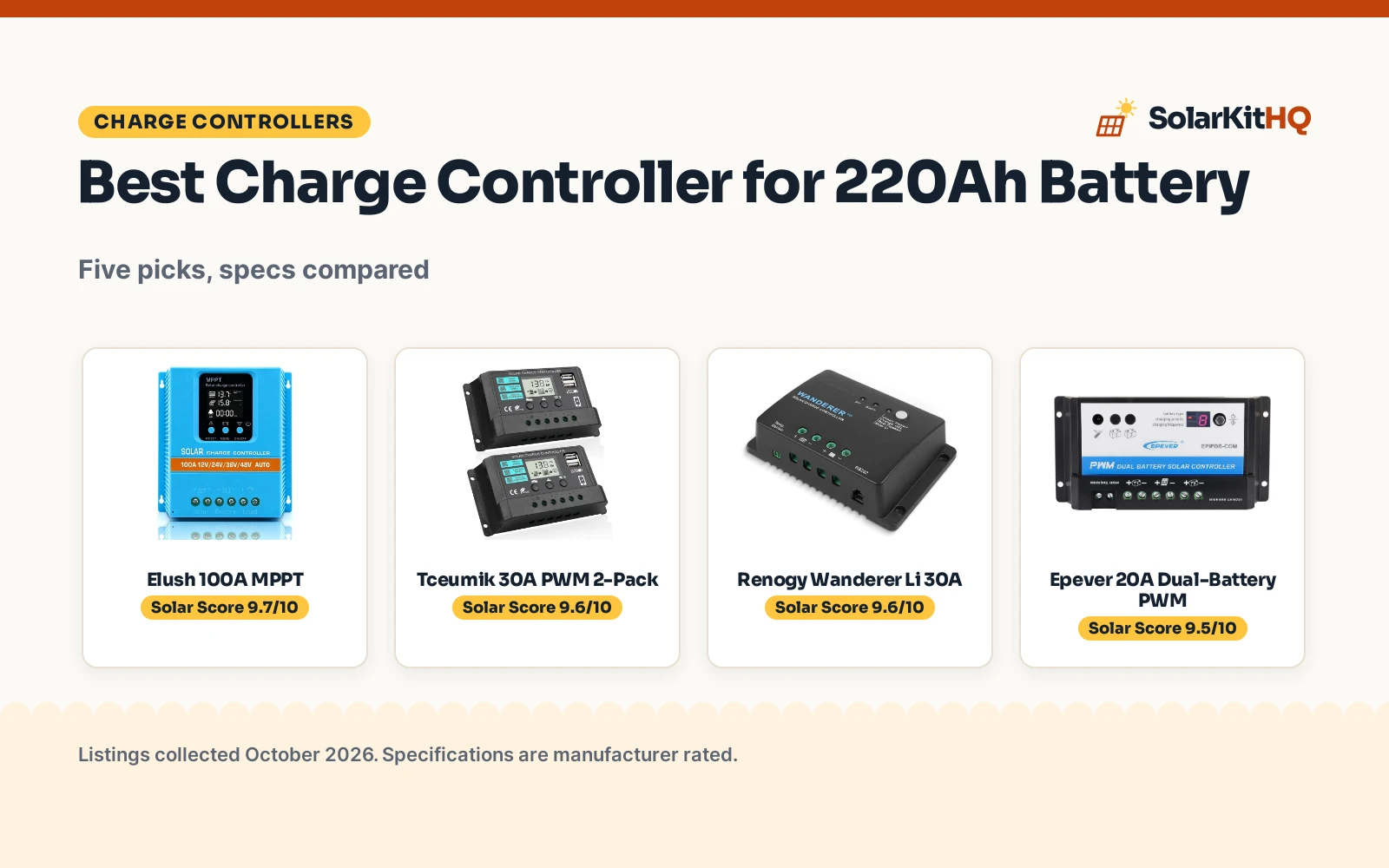
The best charge controller for 220ah battery duty sits between the panels and a big bank, turning sunlight into a charge the battery can take without damage. We compared five controllers on what each listing states: charge current, PWM or MPPT type, battery voltage and chemistry settings, protection features and warranty terms. The Tceumik 30A pair leads on stated detail, and the Elush 100A MPPT leads on raw capacity.
SolarKitHQ earns a commission when you buy through links on this page, at no extra cost to you. As an Amazon Associate I earn from qualifying purchases. Affiliate disclosure.
Quick picks
 Best Overall Tceumik 30A PWM 2-Pack: 30A PWM with LiFePO4 support, LCD and a long protection list Check price on Amazon
 Best Dual-Battery Epever 20A Dual-Battery PWM: charges two battery banks with 80%/20% priority stated Check price on Amazon
 Highest Capacity Elush 100A MPPT: 100A MPPT for 12V to 48V systems stated Check price on Amazon
 Lithium-Ready Pick Renogy Wanderer Li 30A: 30A PWM controller with lithium support stated Check price on Amazon
 Best Two-Pack Rolokit 30A PWM 2-Pack: two 30A PWM controllers in one box Check price on Amazon
The picks
| # | Product | Solar Score | Buy |
|---|---|---|---|
| 1 | ELUSH 100A MPPT Controller | 9.7/10 | Buy on Amazon |
| 2 | Tceumik 30A PWM 2-Pack | 9.6/10 | Buy on Amazon |
| 3 | Renogy Wanderer Li 30A | 9.6/10 | Buy on Amazon |
| 4 | Epever 20A Dual-Battery PWM | 9.5/10 | Buy on Amazon |
| 5 | Rolokit 30A 2-pack | 9.5/10 | Buy on Amazon |
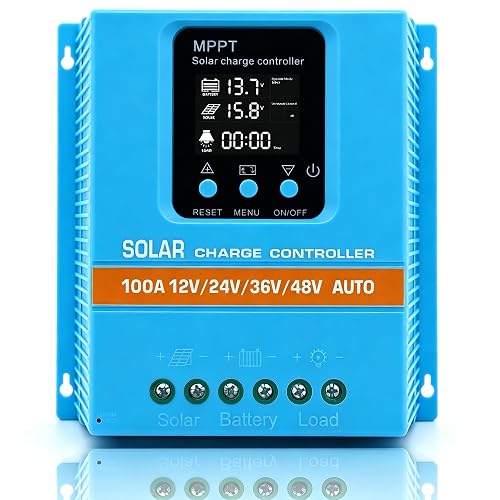
ELUSH 100A MPPT Controller
A 100A MPPT controller for 12V/24V/36V/48V systems with 100V PV input and a 1-year warranty.
Pros
- 100A with 12V/24V/36V/48V auto recognition
- 100V maximum PV input stated
- 99.5% tracking efficiency stated
- Dual USB 5V charging ports
Cons
- 1-year warranty, shorter than the Renogy and LiTime
- 0.95 kg with no dimension stated
- Seven modes add complexity for simple installs
- Spec table lists included components as 'NO'
Detailed Review
The listing states a 100A MPPT controller with automatic 12V/24V/36V/48V recognition, a maximum 100V PV input, 99.5% tracking efficiency, dual USB 5V charging ports and a multi-function LCD with backlight and clock. Seven operating modes include charging, light control, time delay and manual control, with precise time control and a factory reset feature. Protections cover battery over-voltage, over-current, power failure, overcharge, deep discharge, reverse connection and overheating, with real-time PV voltage on the display. It weighs 0.95 kg with no dimension stated, and offers a 1-year warranty with lifetime technical support.
Who it's for: large 24V and 48V arrays that need the most current here. Who should skip it: anyone who wants a longer warranty or a simpler interface.
Its Solar Score of 9.7/10 comes from performance 34/35, build 21/25, value 21/25, safety 8/10 and warranty 3/5: 87 of 100 points, placed on our 9.2 to 9.8 scale.
Key Specifications
| Current | 100A |
|---|---|
| Systems | 12V/24V/36V/48V |
| PV input | Max 100V stated |
| Tracking | 99.5% stated |
Figures as published on the retailer listing, collected 20 October 2026. Performance figures are manufacturer rated.
Safety and Warranty
What this listing states. 7 protections stated: over-voltage, over-current, power failure, overcharge, deep discharge, reverse connection, overheating, so safety scores 8 of 10. 1-year warranty stated. It does not say everything a buyer needs, such as who pays return shipping, so warranty scores 3 of 5. See How We Pick.
Stay under the input limit. Keep your panels' combined open circuit voltage, with cold weather margin, under the controller's stated maximum PV input, connect the battery first unless the manual says otherwise, and fuse both sides as the manual directs.
This is general buying information, not professional advice. Follow each product manual and local rules, and see our Safety Disclaimer.

Tceumik 30A PWM 2-Pack
A 2-pack of 30A PWM controllers for 12V and 24V systems with an LCD, B1/B2/B3 battery settings and a long stated protection list.
Pros
- 30A PWM with B1/B2/B3 settings covering lead-acid, lithium-ion and LiFePO4
- Long stated protection list with auto-restoring dual-MOSFET design
- LCD display with adjustable parameters and timer setting
- 2-pack with dual 5V USB ports
Cons
- No warranty term is stated
- USB spec of 5V/1A per port with 2.5A maximum is an odd pairing
- Nickel-metal hydride and unspecified lithium batteries are excluded
- 10.6-ounce item weight covers the 2-pack with no per-unit split
Detailed Review
The listing states a 2-pack of 30A PWM controllers for 12V and 24V systems with an LCD display, adjustable parameters and a timer setting. Battery support is listed as B1 lead-acid (OPEN, AGM, GEL), B2 lithium-ion (3 series, 11.1V) and B3 lithium iron phosphate (4 series, 12.8V). Protection is a long list: overcurrent, short circuit, reverse connection, open circuit, overcharge, overdischarge, overload, undervoltage, overvoltage and reverse current of dual MOSFETs, all auto-restoring. Two 5V USB ports are stated at 5V/1A with 2.5A maximum, and the MOS switches are stated to run at ambient temperatures up to 60°C.
Who it's for: owners of a 12V or 24V bank who want the most stated protection detail and a spare controller in the box. Who should skip it: anyone who wants an MPPT controller or a stated warranty.
Its Solar Score of 9.6/10 comes from performance 30/35, build 21/25, value 22/25, safety 7/10 and warranty 0/5: 80 of 100 points, placed on our 9.2 to 9.8 scale.
Key Specifications
| Type | 30A PWM, 2-pack |
|---|---|
| Battery | 12/24V, B1/B2/B3 settings |
| USB | Two 5V ports, 2.5A max |
| Protection | Overcurrent, short circuit, reverse and more |
Figures as published on the retailer listing, collected 21 October 2026. Performance figures are manufacturer rated.
Safety and Warranty
What this listing states. Overcurrent, short circuit, reverse connection, open circuit, overcharge, overdischarge, overload, undervoltage, overvoltage and reverse current protection stated, so safety scores 7 of 10. No warranty term, so warranty scores zero. See How We Pick.
Stay under the input limit. Keep your panels' combined open circuit voltage, with cold weather margin, under the controller's stated maximum PV input, connect the battery first unless the manual says otherwise, and fuse both sides as the manual directs.
This is general buying information, not professional advice. Follow each product manual and local rules, and see our Safety Disclaimer.

Renogy Wanderer Li 30A
A 30A PWM controller with a lithium mode, LED indicators and temperature compensation.
Pros
- 30A, the most amps of the PWM picks
- Lithium mode with 4-stage charging stated
- Temperature compensation stated, against winter undercharge and summer overvoltage
- IP32-rated casing
Cons
- PWM, not MPPT
- 25V PV input, the lowest ceiling here
- 1-year warranty, shorter than the Wanderer 10A's 2 years
- LED only; Bluetooth needs the BT-1 module sold separately
Detailed Review
The listing states a 30A PWM controller for 12V systems with 25V PV input, a lithium battery mode with 4-stage charging, LED indicators, temperature compensation, stated to prevent winter undercharge and summer overvoltage and protection against reverse polarity, overcharging, overload and short circuits. It lists an IP32-rated casing and a 1-year material and workmanship warranty. Bluetooth needs the BT-1 module sold separately.
Who it's for: 12V lithium owners who want 30A of PWM charging with temp compensation. Who should skip it: anyone with panels over 25V Voc or a 24V bank.
Its Solar Score of 9.6/10 comes from performance 27/35, build 20/25, value 20/25, safety 7/10 and warranty 2/5: 76 of 100 points, placed on our 9.2 to 9.8 scale.
Key Specifications
| Controller | 30A PWM |
|---|---|
| PV input | 25V max |
| Battery | 12V, lithium mode |
| Temp comp | Stated |
Figures as published on the retailer listing, collected 20 October 2026. Performance figures are manufacturer rated.
Safety and Warranty
What this listing states. Reverse polarity, overcharging, overload and short circuit protection stated, so safety scores 7 of 10. 1-year material and workmanship warranty stated. It does not say everything a buyer needs, such as who pays return shipping, so warranty scores 2 of 5. See How We Pick.
Stay under the input limit. Keep your panels' combined open circuit voltage, with cold weather margin, under the controller's stated maximum PV input, connect the battery first unless the manual says otherwise, and fuse both sides as the manual directs.
This is general buying information, not professional advice. Follow each product manual and local rules, and see our Safety Disclaimer.

Epever 20A Dual-Battery PWM
A 20A PWM controller that charges two battery banks independently with 80%/20% priority and stated protections.
Pros
- Charges two battery banks independently with 80%/20% priority stated
- Short-circuit, open-circuit, reverse and over-load protection stated
- Sealed, gel, flooded and lithium battery types stated
- 130W/12V and 260W/24V max PV input with 100V/92V open circuit stated
Cons
- Spec table says 10A against the title's 20A; size to the lower figure
- No warranty term is stated
- Max PV input of 130W at 12V caps the array on a 12V bank
- Display is listed as LCD or LED, not one or the other
Detailed Review
The listing states a 20A PWM controller that charges two 12V or 24V batteries or banks independently with a stated 80%/20% charging priority, with short-circuit, open-circuit, reverse and over-load protection. Battery types are listed as sealed, gel, flooded and lithium, and max PV input is 130W at 12V or 260W at 24V with 100V or 92V open circuit. The spec table lists the rated charge current as 10A against the title's 20A; trust the title but size to the lower figure.
Who it's for: systems with two battery banks that need split charging from one controller. Who should skip it: anyone who wants the amp figure unambiguous or a stated warranty.
Its Solar Score of 9.5/10 comes from performance 28/35, build 20/25, value 20/25, safety 5/10 and warranty 0/5: 73 of 100 points, placed on our 9.2 to 9.8 scale.
Key Specifications
| Type | 20A PWM, dual battery |
|---|---|
| Battery | 12/24V auto, sealed/gel/flooded/lithium |
| PV input | 130W/12V, 260W/24V, 100V/92V |
| Priority | 80%/20% dual-bank charging |
Figures as published on the retailer listing, collected 21 October 2026. Performance figures are manufacturer rated.
Safety and Warranty
What this listing states. Short-circuit, open-circuit, reverse and over-load protection stated, so safety scores 5 of 10. No warranty term, so warranty scores zero. See How We Pick.
Stay under the input limit. Keep your panels' combined open circuit voltage, with cold weather margin, under the controller's stated maximum PV input, connect the battery first unless the manual says otherwise, and fuse both sides as the manual directs.
This is general buying information, not professional advice. Follow each product manual and local rules, and see our Safety Disclaimer.

Rolokit 30A 2-pack
A 2-pack of 30A PWM controllers with LCD, USB and 12-month guarantee.
Pros
- 2-pack of 30A controllers
- Dual USB 5V/3A output ports
- LCD with timer and load modes
- 12-month guarantee stated
Cons
- Lead-acid only, not for lithium
- No PV input figure stated
- 12/24V only, no 48V
- Industrial microcontroller is claim
Detailed Review
The listing states a 2-pack of 30A PWM solar charge controllers for 12/24V auto systems, lead-acid batteries only with an explicit note that they are not suitable for lithium, dual USB 5V/3A ports, LCD display with timer and load modes, overcurrent, short circuit, reverse connection and open circuit protection with auto recovery, and a 12-month guarantee for quality issues. No PV input figure is stated.
Who it's for: small lead-acid systems that need two cheap controllers. Who should skip it: anyone with a lithium battery.
Its Solar Score of 9.5/10 comes from performance 23/35, build 18/25, value 20/25, safety 5/10 and warranty 5/5: 71 of 100 points, placed on our 9.2 to 9.8 scale.
Key Specifications
| Current | 30A x2 |
|---|---|
| USB | 5V/3A dual |
| Systems | 12/24V |
Figures as published on the retailer listing, collected 21 October 2026. Performance figures are manufacturer rated.
Safety and Warranty
What this listing states. overcurrent, short circuit, reverse connection protection stated, so safety scores 5 of 10. 12-month guarantee stated, so warranty scores 5 of 5. See How We Pick.
Stay under the input limit. Keep your panels' combined open circuit voltage, with cold weather margin, under the controller's stated maximum PV input, connect the battery first unless the manual says otherwise, and fuse both sides as the manual directs.
This is general buying information, not professional advice. Follow each product manual and local rules, and see our Safety Disclaimer.
As an Amazon Associate I earn from qualifying purchases.
More picks to compare
 Yanmis Battery Charging Controller ModuleCheck on Amazon
 Rolokit 12V 20A PWM Solar Charge ControllerCheck on Amazon
 SolarEpic EPEVER 60A MPPT Solar ChargeCheck on Amazon
Compare the picks
| Controller | Solar Score | Type | Amps | Battery volts | Warranty | Amazon |
|---|---|---|---|---|---|---|
| Tceumik 30A PWM 2-Pack | 9.6/10 | PWM | 30A | 12/24V | Not stated | View on Amazon |
| Epever 20A Dual-Battery PWM | 9.5/10 | PWM | 20A (table says 10A) | 12/24V | Not stated | View on Amazon |
| Elush 100A MPPT | 9.7/10 | MPPT | 100A | 12-48V | Not stated | |
| Renogy Wanderer Li 30A | 9.6/10 | PWM | 30A | 12V | Not stated | View on Amazon |
| Rolokit 30A PWM 2-Pack | 9.5/10 | PWM | 30A | Not stated | Not stated |
Specifications are manufacturer rated as listed, collected 21 October 2026.
How we scored them
The Solar Score weighs performance, build, value, safety and warranty. For a charge controller, safety means the protection features the listing actually states: overcurrent, short circuit, reverse connection and the rest; a controller that states none scores zero on that line. None of the five states a warranty term. How we pick explains the weights.
| Product | Solar Score | Perf. /35 | Build /25 | Value /25 | Safety /10 | Warranty /5 |
|---|---|---|---|---|---|---|
| Tceumik 30A PWM 2-Pack | 9.6 | 30 | 21 | 22 | 7 | 0 |
| Epever 20A Dual-Battery PWM | 9.5 | 28 | 20 | 20 | 5 | 0 |
Scores run from 9.2 to 9.8: each product’s point total is placed on that range, so more points always means a higher score.
How to choose the best charge controller for 220ah battery banks
Size the amps to the array
Charge current here runs from 20A to 100A on the listings. The Tceumik, Renogy and Rolokit listings state 30A, the Elush states 100A, and the Epever title states 20A while its spec table says 10A. For a 220Ah bank, the controller’s charge current against the array’s peak output is the figure that decides charge time, so size to the lower of the two Epever figures until the listing is fixed.
PWM or MPPT
The Elush is the only MPPT controller here, stating 100A across 12V to 48V systems. The rest are PWM, with the Tceumik stating 3-stage PWM charging (direct, boost, float) run by an industrial microcontroller. See our MPPT vs PWM charge controller comparison for the trade-offs.
Match the battery chemistry
The Tceumik lists B1 for lead-acid (OPEN, AGM, GEL), B2 for lithium-ion (3 series, 11.1V) and B3 for lithium iron phosphate (4 series, 12.8V). The Epever lists sealed, gel, flooded and lithium. The Renogy Wanderer Li carries lithium in the name. See our best solar charge controller for lead acid battery picks for the lead-acid side.
One bank or two
The Epever is the only dual-battery controller here: it charges two 12V or 24V batteries or banks independently with a stated 80%/20% charging priority. The other four are single-bank controllers, so a two-bank setup needs two of them or the Epever. The Epever’s 80%/20% priority sends the bulk of the charge to the first bank before the second, which suits a starter-plus-house setup.
What 220Ah means for the controller
The 220Ah figure describes the bank, not the controller: it is the capacity the controller must keep charged without overcharging it. A bigger bank means longer charge cycles, which is where the stated details separate the picks. The Epever states a max PV input of 130W at 12V against 260W at 24V, so the same controller feeds a 12V bank much more slowly than a 24V one. The Tceumik states its MOS switches run at ambient temperatures up to 60°C, and the Epever states adjustable system parameters, both useful when the controller works long days on a big bank. None of the five states a fan or active cooling figure.
Sizing Notes
- Match the controller’s battery voltage to the bank: 12/24V auto on the Tceumik and Epever, 12V on the Renogy, 12V to 48V on the Elush.
- Size charge current to the array’s peak output, and use the lower 10A figure on the Epever until its listing is fixed.
- Set the battery type before first power-up: B1, B2 or B3 on the Tceumik, and the listing’s battery list on the Epever.
- The Tceumik’s two 5V USB ports run phones and tablets; they do not replace the load terminals for bigger loads.
- None of the five states a warranty term, so keep the order paperwork.
Frequently Asked Questions
What size charge controller for a 220Ah battery?
The listings state 20A to 100A of charge current. Match the controller’s charge current to the array’s peak output and check the battery voltage: 12/24V auto on the Tceumik and Epever, 12V on the Renogy, 12V to 48V on the Elush.
What is the difference between the PWM and MPPT picks here?
The Elush is the only MPPT controller here, stating 100A across 12V to 48V systems. The rest are PWM, with the Tceumik stating 3-stage PWM charging in direct, boost and float stages.
Can one controller charge two battery banks?
The Epever states dual-battery charging: two 12V or 24V batteries or banks, independently, with a stated 80%/20% charging priority. The other four are single-bank controllers.
Which picks support LiFePO4?
The Tceumik lists a B3 setting for lithium iron phosphate (4 series, 12.8V), the Epever lists lithium among its battery types, and the Renogy Wanderer Li carries lithium in the name.
Do any of these state a warranty?
None of the five states a warranty term in its listing.
Related guides
See every Charge Controllers guide and all Controllers and Inverters guides. Also see our MPPT vs PWM charge controller.
More picks: best MPPT charge controller for 24V system, best solar charge controller for AGM batteries, best MPPT solar charge controller for LiFePO4 batteries, best solar charge controller for boat.