On this page
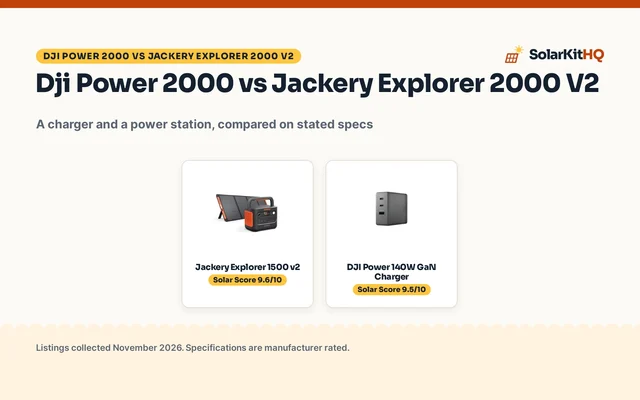
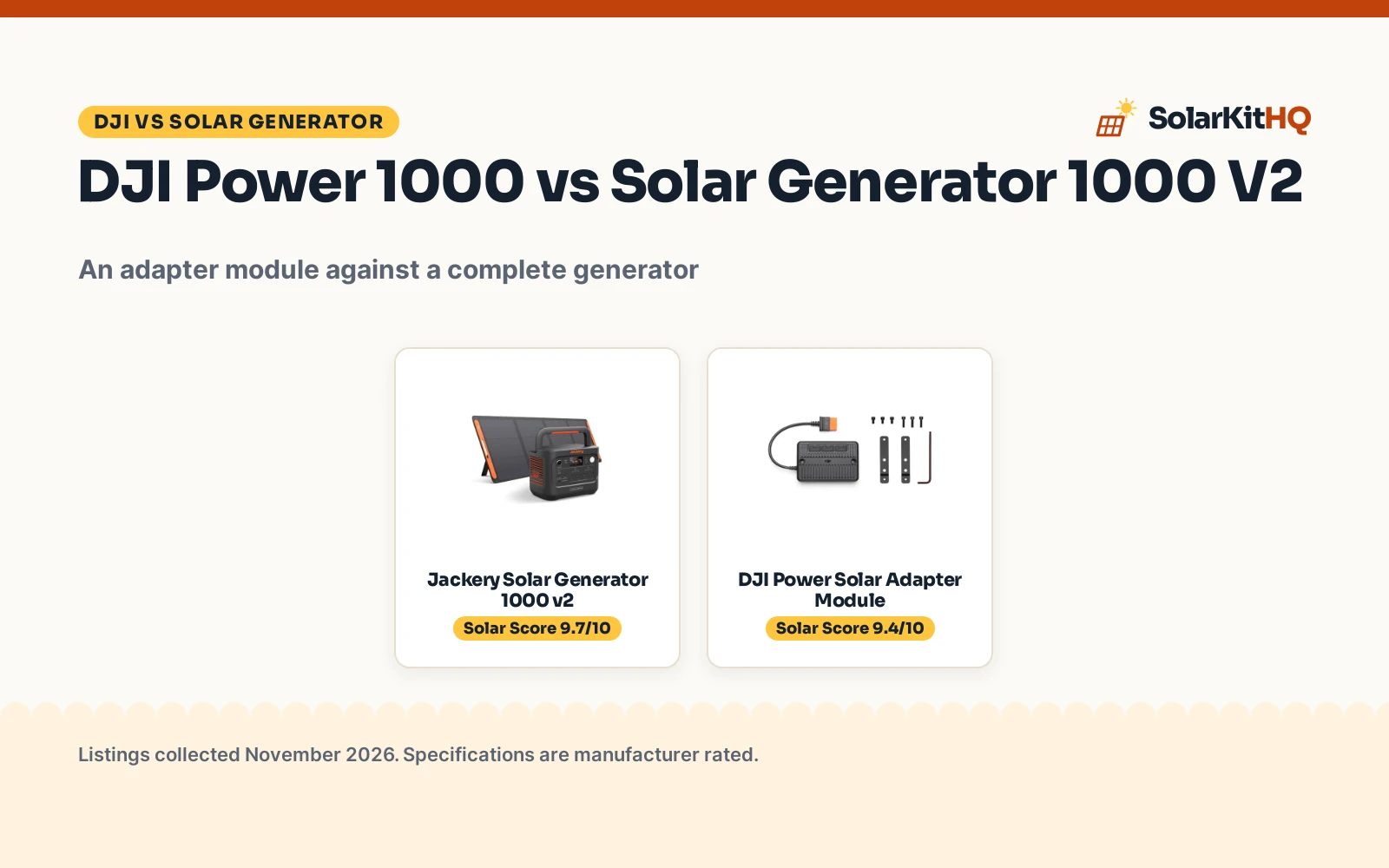
The short answer on dji power 1000 vs solar generator 1000 v2: these two listings are not the same kind of product, so the choice turns on what you already own. Pick the Jackery if you want a complete solar generator with a battery, outlets and a panel in the box. Pick the DJI module only if you already own a DJI Power station and want to add solar panels to it, since the module on its own stores no power and powers nothing. We compared the two listings on what each one states: capacity, outputs, solar input, battery, backup figures and warranty terms.
SolarKitHQ earns a commission when you buy through links on this page, at no extra cost to you. As an Amazon Associate I earn from qualifying purchases. Affiliate disclosure.
DJI Power 1000 vs Solar Generator 1000 V2: side by side
| Spec | Jackery Solar Generator 1000 v2 | DJI Power Solar Adapter Module | Notes |
|---|---|---|---|
| Type | Complete solar generator | MPPT adapter module | Different product types |
| Capacity | 1024Wh, expandable to 11kWh | Not stated | The adapter has no battery |
| AC output | 1800W rated, 3600W surge | Not stated | Only the Jackery listing states AC output |
| Solar input | 200W panel included | Up to 400W with DJI Power 1000 | Caps are per-listing figures |
| Outlets | 4 AC outlets, 140W USB-C | Not stated | Only the Jackery listing states outlets |
| Battery | LiFePO4, 6000 cycles | Not stated | Only the Jackery listing states a battery |
| Backup | 10ms UPS, 3kV surge protection | Not stated | Only the Jackery listing states backup figures |
| Warranty | 5-Year Warranty | Not stated | Only the Jackery listing states a warranty |
| Weight | Not stated | 1.26 Pounds | Only the DJI listing states weight |
We copied each rating from the seller’s listing as the brand states it; data date 3 November 2026.
What each side actually is
The naming here hides the real gap. The DJI side is the DJI Power Solar Panel Adapter Module (MPPT), a small module that connects solar panels to a DJI Power station. It is not a power station itself: the listing states no battery capacity, no AC output and no outlets, and the box holds the module, brackets, a key and screws, not a station. The Jackery side is the opposite: a complete solar generator, with a 1024Wh LiFePO4 station and a 200W solar panel in the box, plus an AC charging cable, a connector cable and a manual.
That difference decides the comparison before any spec does. A reader who owns no power station gets nothing usable from the DJI module alone, while a reader who already owns a DJI Power 1000, 1000 V2, 2000 or 500 and wants solar input is exactly who the module is for. The Jackery, by contrast, works on its own from the box, with its own battery, outlets and panel.
Solar input and charging
On solar input, the DJI module is the more flexible piece, within strict limits. One module connects up to three solar panels, with each panel capped at 200W and the module total capped at 400W with the DJI Power 1000 and 300W with the DJI Power 500. Input voltage runs 12 to 30 V, with 10 A on a single channel and 20 A across triple channels, and the open-circuit voltage of any panel must stay under 30 V. The listing says to install the included metal heat dissipation bracket while using panels.
The Jackery takes a simpler path: one 200W solar panel comes in the box, and the station itself starts at 1024Wh and expands to 11kWh by adding up to 5 battery packs, sold separately. The listing states no maximum solar input figure for the station beyond the included panel, so a reader planning a larger array should check the manual rather than assume the DJI caps apply. The Jackery App monitors real-time usage, adjusts charging speeds and activates Energy Saving Mode over Wi-Fi or Bluetooth.
Outlets, backup and control
This section belongs almost entirely to the Jackery, because only its listing states outlets and backup figures. It lists 1800W rated AC output with a 3600W surge peak, four AC outlets split across two independently controlled circuits, and 140W USB-C output. Critical devices can sit on one circuit with a cut-off battery level set for the other, so the non-priority circuit switches off automatically and the station keeps essentials running longer. While plugged in, the listing states switchover to battery in under 10 milliseconds, with 3kV / 1000J surge protection and pure sine wave output.
The DJI module states none of that, and that is not a loss for it: an adapter module has no outlets to state. Its control story is the panel side instead: the module accepts DJI-certified Zignes solar panels as well as other panels within its voltage and watt limits, and it works with the DJI Power series listed above. A reader comparing outputs should not put the DJI 400W solar cap next to the Jackery 1800W AC output: one is a solar input cap, the other is station output, and they measure different things.
What the listings leave unclear
Several figures are simply absent, and the honest move is to say so rather than fill them in. The DJI listing states no battery capacity, no AC output, no outlets and no warranty term, and it states no station in the box. The Jackery listing states no weight, only dimensions of 12.3 by 7.9 by 9.3 inches. The DJI bullet wording on the Power 500 cap reads unclearly against the spec summary, which gives Max 300W with the DJI Power 500; this article uses the spec summary figure.
The temperature figures also need care. The Jackery lists ceramic-coated LiFePO4 cells with 6000 charge cycles and at least 70 percent capacity remaining, even in temperatures as low as 14 degrees Fahrenheit. The DJI module lists an operating temperature of minus 10 to 45 degrees Celsius, which the listing also gives as 41 to 113 degrees Fahrenheit. Those are different claims about different products, and neither listing states the other’s temperature figure.
Two examples
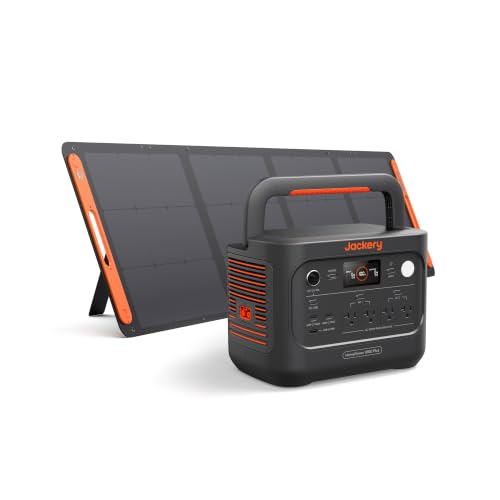
Jackery Solar Generator 1000 v2
A complete solar generator with a 1024Wh LiFePO4 station and a 200W solar panel, with 1800W AC output and a 5-year warranty.
Pros
- 1024Wh LiFePO4 battery expands to 11kWh with up to 5 battery packs
- 1800W rated AC output with a 3600W surge peak
- Four AC outlets on two independently controlled circuits
- 10ms UPS switchover with 3kV / 1000J surge protection
Cons
- Battery packs for expansion are sold separately
- No weight stated in the listing
- App monitoring needs Wi-Fi or Bluetooth
- No maximum solar input figure stated for the station
Detailed Review
The Jackery is the only complete generator here: a 1024Wh LiFePO4 station plus a 200W solar panel in the box, with 1800W rated AC output and a 3600W surge peak. Four AC outlets split across two independently controlled circuits let critical devices sit on one circuit with a cut-off level for the other, and the 140W USB-C output covers smaller gear. The listing states 6000 charge cycles with at least 70 percent capacity remaining, and operation down to 14 degrees Fahrenheit.
For backup use, the listing states switchover to battery in under 10 milliseconds while plugged in, with 3kV / 1000J surge protection and pure sine wave output. The Jackery App monitors real-time usage over Wi-Fi or Bluetooth, adjusts charging speeds and activates Energy Saving Mode. Expansion to 11kWh needs up to 5 battery packs, sold separately, and the box includes the station, the 200W panel, an AC charging cable, an 8020 to solar connector cable and a manual, with a 5-year warranty.
Its Solar Score of 9.7/10 comes from performance 32/35, build 21/25, value 21/25, safety 8/10 and warranty 4/5: 86 of 100 points, placed on our 9.2 to 9.8 scale.
Key Specifications
| Capacity | 1024Wh LiFePO4, expandable to 11kWh |
|---|---|
| AC output | 1800W rated, 3600W surge |
| Solar panel | 200W included |
| Size | 12.3 x 7.9 x 9.3 inches |
Figures as published on the retailer listing, collected 3 November 2026. Performance figures are manufacturer rated.
Safety and Warranty
What this listing states. Built-in 3kV / 1000J surge protection, so safety scores 8 of 10. 5-Year Warranty. It does not say everything a buyer needs, such as who pays return shipping, so warranty scores 4 of 5. See How We Pick.
Power station limits. Stay within the stated continuous output and solar input limits, keep the unit ventilated and dry, charge within the stated temperature range, and never connect it to home wiring except through equipment a licensed electrician installs.
This is general buying information, not professional advice. Follow each product manual and local rules, and see our Safety Disclaimer.

DJI Power Solar Adapter Module
An MPPT adapter module that lets a DJI Power station take solar input from up to three panels, with a 400W total cap on the Power 1000.
Pros
- Connects up to three solar panels to a DJI Power station
- 400W total solar cap with the DJI Power 1000
- Metal heat dissipation bracket included
- Works with DJI Power 1000 V2, 2000, 1000 and 500
Cons
- No battery, AC output or outlets: it is an adapter, not a station
- No warranty term stated
- Panels must stay under 30 V open-circuit and 200 W each
- Bullet wording on the Power 500 cap is unclear; the spec summary gives 300W
Detailed Review
The DJI listing is an adapter module, not a power station: it carries no battery and states no AC output, and it needs a DJI Power station to work with. One module connects up to three solar panels, with each panel capped at 200W and the module total capped at 400W with the DJI Power 1000 and 300W with the DJI Power 500. Input voltage runs 12 to 30 V, with 10 A on a single channel and 20 A across triple channels, and the open-circuit voltage of any panel must stay under 30 V.
The box holds the module, two metal heat dissipation brackets, one ball-end key, three 10mm screws and three 20mm screws, and the listing says to install the included bracket while using panels. The module is listed as compatible with the DJI Power 1000 V2, 2000, 1000 and 500, and with DJI-certified Zignes solar panels. No warranty term is stated, and the listing states no station, battery or outlets of its own.
Its Solar Score of 9.4/10 comes from performance 23/35, build 20/25, value 19/25, safety 5/10 and warranty 0/5: 67 of 100 points, placed on our 9.2 to 9.8 scale.
Key Specifications
| Solar input | Up to 3 panels, 200W each |
|---|---|
| Total cap | 400W with DJI Power 1000, 300W with Power 500 |
| Input | 12-30 V DC, 10 A single, 20 A triple |
| Weight | 1.26 Pounds |
Figures as published on the retailer listing, collected 3 November 2026. Performance figures are manufacturer rated.
Safety and Warranty
What this listing states. Open-circuit voltage limit under 30 V, metal heat dissipation bracket, so safety scores 5 of 10. No warranty term, so warranty scores zero. See How We Pick.
Power station limits. Stay within the stated continuous output and solar input limits, keep the unit ventilated and dry, charge within the stated temperature range, and never connect it to home wiring except through equipment a licensed electrician installs.
This is general buying information, not professional advice. Follow each product manual and local rules, and see our Safety Disclaimer.
As an Amazon Associate I earn from qualifying purchases.
Where the points went
The Solar Score weighs performance, build, value, safety and warranty. Safety here means surge protection on the Jackery and the voltage limit and heat bracket on the DJI module. One pick states a warranty term. How we pick explains the weights.
| Product | Solar Score | Perf. /35 | Build /25 | Value /25 | Safety /10 | Warranty /5 |
|---|---|---|---|---|---|---|
| Jackery Solar Generator 1000 v2 | 9.7 | 32 | 21 | 21 | 8 | 4 |
| DJI Power Solar Adapter Module | 9.4 | 23 | 20 | 19 | 5 | 0 |
We place weighted points on a scale whose ends are 9.2 and 9.8. Because the mapping is straight, a unit with more points never shows less.
DJI Power 1000 vs Solar Generator 1000 V2: which should you choose?
Choose the Jackery Solar Generator 1000 Plus v2 if you want one purchase that covers the whole job: a 1024Wh station, a 200W panel, 1800W AC output, four outlets, 10 millisecond backup switchover and a 5-year warranty, with expansion to 11kWh if you add battery packs later. It is the only pick here that works on its own from the box.
Choose the DJI Power Solar Panel Adapter Module only if you already own a DJI Power station and want to charge it from the sun. Within its limits, up to three panels at 200W each and 400W total on the Power 1000, it is a focused, single-purpose part. If you own no DJI station, this module alone gives you no battery, no outlets and no power, and the Jackery is the pick that fits.
Sizing Notes
- Match panel watts and voltage to the module input: each panel under 200W and under 30 V open-circuit, with the module total capped at 400W on the Power 1000.
- Match watt-hours to the loads you plan: the Jackery starts at 1024Wh and expands to 11kWh with up to 5 battery packs.
- Keep continuous and surge watts apart: the Jackery lists 1800W rated AC output with a 3600W surge peak.
- Check the box before ordering: the DJI box holds the module and brackets, not a power station.
FAQ: power away from the grid
Is the DJI pick a power station?
No. The DJI listing is an adapter module that connects solar panels to a DJI Power station. It states no battery, AC output or outlets of its own.
Can the DJI module charge a Jackery station?
The listing states compatibility with DJI Power stations and DJI-certified Zignes solar panels only. It states no Jackery compatibility.
How much solar can the DJI module take?
Up to three panels at 200W each, with the module total capped at 400W with the DJI Power 1000 and 300W with the DJI Power 500, at 12 to 30 V input.
Which pick has the longer warranty?
The Jackery states a 5-year warranty. The DJI listing states no warranty term.
Related solar guides
See every Solar Generators guide and all Power Stations and Generators guides. For portable power, see the best portable power station for camping guide, and for the DJI side, the dji power 1000 vs ecoflow delta 3 comparison.