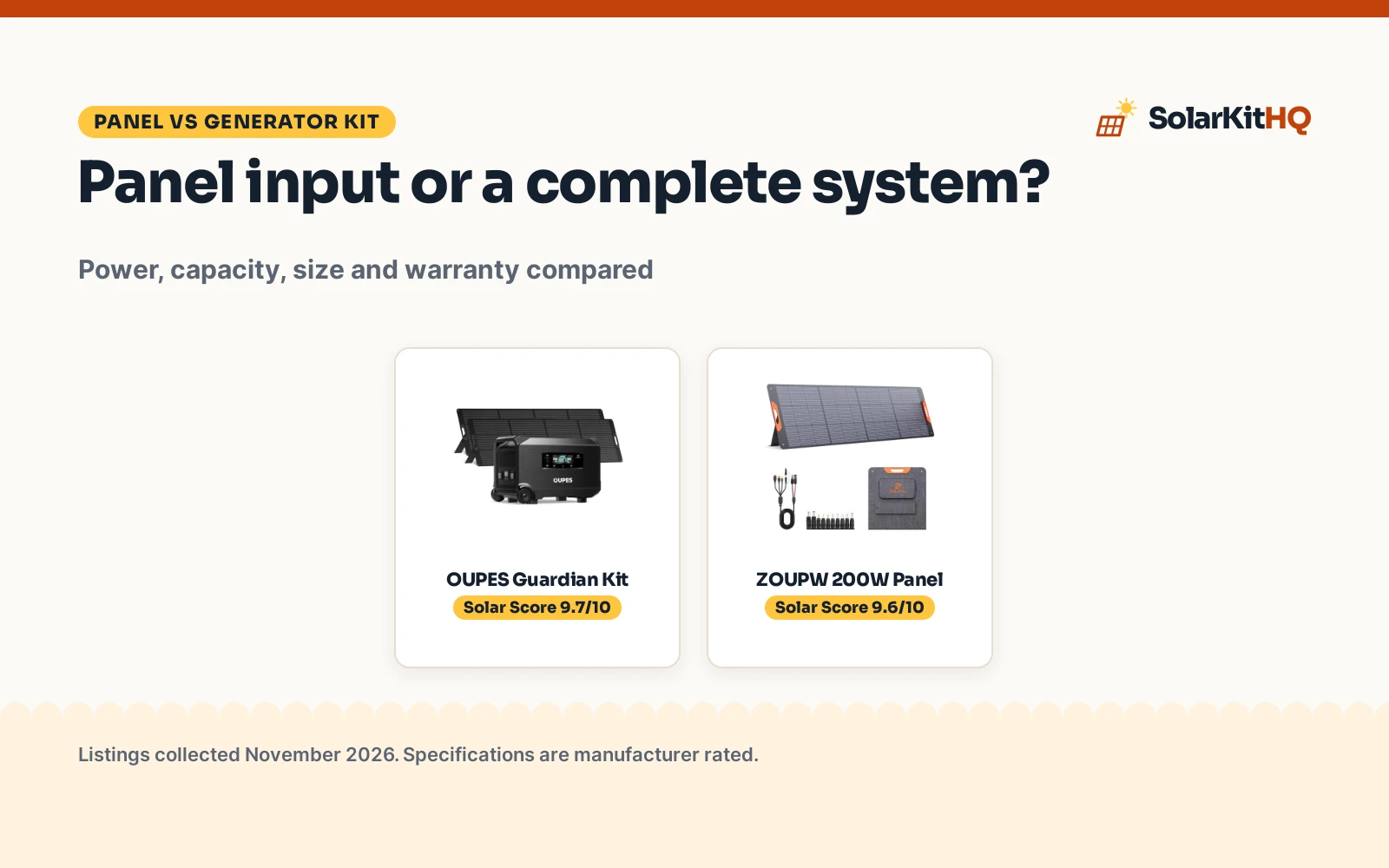
On this page
An outage at dinner time and a campsite at dusk with a dead phone are the two moments that make a solar setup feel urgent, and they call for different kit. The jackery 1000 v2 vs solar generator 1000 v2 question, as the listings frame it, is really a choice between adding solar input to a station that already exists and buying a complete generator system in one box. Choose the panel side if a compatible station is already on the shelf. Choose the kit side if the whole system still needs buying.
SolarKitHQ earns a commission when you buy through links on this page, at no extra cost to you. As an Amazon Associate I earn from qualifying purchases. Affiliate disclosure.
Jackery 1000 v2 vs Solar Generator 1000 v2 Side by Side
| Factor | ZOUPW 200W Panel | OUPES Guardian Kit | Takeaway |
|---|---|---|---|
| What it is | 200W portable solar panel | Solar generator kit with station and panels | Panel is an input; kit is a complete system |
| Power | 200W at STC, Vmp 18.6V, Imp 10.75A | 6000W output, 240V, dual 120V and 240V | Panel watts feed a station; kit watts run loads |
| Capacity | Not stated (panel stores nothing) | 4608Wh LiFePO4, expandable to 41,472Wh | No capacity comparison can be made |
| Panels included | 1 panel, 5-in-1 cable | 2 panels at 240W each | Kit brings its own panels |
| Weight | 19.8 lb | 111.0 pounds (station) | Panel is the lighter item to carry |
| Size | 25 x 23.1 x 2.76 in folded; 93.4 x 23.1 in unfolded | 24.9 Inches x 16.2 inches x 16.8 inches (station) | Panel folds flat; kit is a home backup unit |
| Direct charging | USB-A (QC3.0), USB-C (PD 60W) | USB-C PD (140W), USB-A, 12V car port, 9 AC outlets | Both list direct device charging |
| Warranty | 12-month warranty | 5-year warranty | Longer stated term on the kit side |
These specs are rated by the maker and quoted from each listing on 2 November 2026.
What each side actually is
The two sides are not the same kind of product, and that fact shapes every other comparison in this article. The ZOUPW example on the Jackery side is a 200W portable solar panel, not a power station: a foldable monocrystalline panel with a 5-in-1 cable that the listing says charges most solar generators on the market, including the Jackery Explorer 1000V2, 1500, 2000 Pro and Plus models, plus Bluetti, EcoFlow and Anker models named on the listing. It makes power from sunlight and feeds it to a station. It stores nothing on its own.
The OUPES example on the solar generator side is a complete system in one purchase: a Guardian 6000 power station with 4608Wh of LiFePO4 capacity plus two 240W solar panels, sold as a kit for immediate off-grid capability. It stores power, converts it to 120V and 240V output, and includes the panels to recharge it. Comparing a panel against a kit on watts alone would mislead, because one side is an input and the other side is input, storage and output together.
Power and capacity
On the panel side, the figures are panel figures: 200W at STC, with Vmp 18.6V and Imp 10.75A, from monocrystalline silicon cells listed at 23.5% efficiency. The listing also describes stable output in low-light or cloudy conditions and higher yield during shorter winter days, reported here as the maker claim. The panel also carries its own direct charging: a junction box with USB-A (QC3.0) and USB-C (PD 60W) ports for phones, tablets, GPS devices and cameras while off-grid.
On the kit side, the figures are system figures: 6000W output at 240V, with dual voltage output for both 120V and 240V appliances, including refrigerators, medical equipment, well pumps and small HVAC systems as named on the listing. Capacity is 4608Wh from LiFePO4 cells rated for 4000+ lifecycle charges with a 10+ year lifespan, expandable with additional G5 Extra Batteries, sold separately, to 41,472Wh. Outputs include 9 AC outlets, USB-C PD (140W), USB-A and a 12V car port, plus app monitoring of generation, consumption and battery status.
Because the panel stores nothing, no capacity figure can be quoted for it, and because the kit listing states no panel efficiency figure, no efficiency comparison can be made between the sides. The honest power comparison is about role: the panel adds solar input to a station, while the kit replaces the station, the storage and the panels in one purchase.
Size, weight and portability
The panel folds into a briefcase shape for carrying and storage, listed at 25 x 23.1 x 2.76 in and 19.8 lb, then unfolds to a 93.4 x 23.1 in array, with adjustable kickstands that angle the panel up to 45 degrees toward the sun. The listing describes a one-piece laminated body with no stitching and no exposed edges, an ETFE laminated surface, and an IP67 rating, plus a magnetic handle design for setup. The maker lists 25-30% more energy than flat-laying panels through the day with the kickstands angled, reported here as the maker claim.
The kit is a different scale of object: the station alone is listed at 111.0 pounds with dimensions of 24.9 Inches x 16.2 inches x 16.8 inches, and the kit adds two panels on top of that. It is listed for home integration through transfer switches or inlet boxes, with UPS-protected power at under 20ms transfer time for computers and sensitive electronics during outages. Portability here means moving a home backup system into place, not carrying a panel in one hand to a campsite table.
Warranty and support
The panel listing states a 12-month warranty, with a 30-day money-back term stated alongside it and customer service stated on the listing. The kit listing states a 5-year warranty, with US-based customer support stated alongside it. That gap is the clearest like-for-like difference in the whole comparison: both listings state a warranty term in plain figures, and the kit term is longer. A buyer who values a longer stated term will weigh that against the panel lower scope, since the panel purchase is a single accessory rather than a whole system.
What the listings leave unclear
Several gaps keep this comparison from being a straight head-to-head. The panel listing gives no station capacity, no station output and no charge time, because the panel is not a station. The kit listing gives no panel efficiency figure and no single-panel weight, because the kit is sold as a system. The panel dimensions also need care: the bullets give a folded size of 25 x 23.1 x 2.76 in and an unfolded array of 93.4 x 23.1 in, while the spec table gives 93.39 inches x 23.11 inches x 1.77 inches. The bullets are trusted over the spec table here, and the folded and unfolded figures are kept separate above.
The kit listing also states whole-home backup through transfer switches, but gives no installation steps, and this article gives none either: check the manual and the transfer switch requirements before planning a home connection. Neither listing states a safety certification beyond the panel IP67 rating and the kit BMS protection, so no broader certification comparison can be made.
The two examples
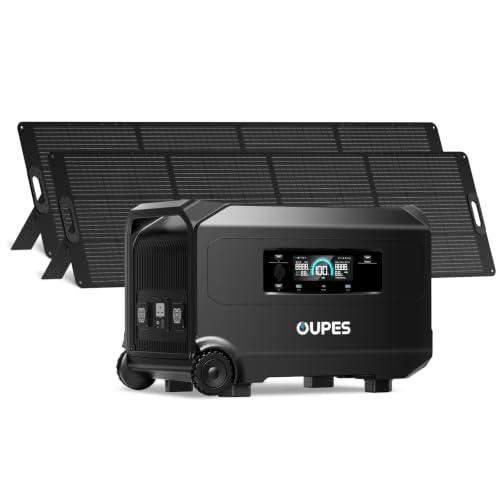
OUPES Guardian Kit
A complete solar generator kit with a 4608Wh LiFePO4 station, 6000W output at 240V, two 240W solar panels, 9 AC outlets and a 5-year warranty, for home backup and off-grid power.
Pros
- 4608Wh LiFePO4 capacity, expandable to 41,472Wh with additional G5 Extra Batteries
- 6000W output with dual 120V and 240V output for home appliances
- Two 240W solar panels included for immediate off-grid capability
- 9 AC outlets plus USB-C PD (140W), USB-A and a 12V car port
Cons
- Station listed at 111.0 pounds, before the two panels are added
- No panel efficiency figure is stated on the listing
- Expansion batteries are sold separately, not included in the kit
- No single-panel weight is stated on the listing
Detailed Review
The OUPES kit is a whole-system purchase: a Guardian 6000 power station with 4608Wh of LiFePO4 capacity, 6000W output, dual 120V and 240V output, and two 240W solar panels in the box. The listing covers refrigerators, medical equipment, well pumps and small HVAC systems, with UPS-protected power at under 20ms transfer time, app monitoring of generation, consumption and battery status, and LiFePO4 cells rated for 4000+ lifecycle charges with a 10+ year lifespan and comprehensive BMS protection. Transfer switch readiness and inlet box connection are stated as features, with no installation steps given on the listing.
Who it is for: a household that needs home backup with 120V and 240V loads and wants storage, output and panels in one purchase. Who should skip it: anyone who already owns a station and only needs solar input, or anyone who needs panel portability at 19.8 lb, since this station alone is listed at 111.0 pounds.
Its Solar Score of 9.7/10 comes from performance 32/35, build 22/25, value 21/25, safety 8/10 and warranty 4/5: 87 of 100 points, placed on our 9.2 to 9.8 scale.
Key Specifications
| Type | Solar generator kit with power station and panels |
|---|---|
| Capacity | 4608Wh LiFePO4, expandable to 41,472Wh |
| Output | 6000W, 240V, dual 120V and 240V |
| Panels | 2 panels at 240W each |
| Outlets | 9 AC outlets, USB-C PD (140W), USB-A, 12V car port |
| Transfer time | Under 20ms UPS transfer |
| Battery life | 4000+ lifecycle charges, 10+ year lifespan |
| Weight | 111.0 pounds (station) |
| Dimensions | 24.9 Inches x 16.2 inches x 16.8 inches |
| Warranty | 5-Year Warranty |
Figures as published on the retailer listing, collected 2 November 2026. Performance figures are manufacturer rated.
Safety and Warranty
What this listing states. Comprehensive BMS protection; UPS transfer time under 20ms, so safety scores 8 of 10. 5-Year Warranty. It does not say everything a buyer needs, such as who pays return shipping, so warranty scores 4 of 5. See How We Pick.
Follow the manual. Connect and use the product as the maker describes, stay within every stated rating, and read the manual before first use.
This is general buying information, not professional advice. Follow each product manual and local rules, and see our Safety Disclaimer.

ZOUPW 200W Panel
A foldable 200W monocrystalline solar panel with a 5-in-1 cable, IP67 rating, kickstands and direct USB charging, for feeding a compatible power station.
Pros
- 200W at STC with Vmp 18.6V and Imp 10.75A from monocrystalline cells at 23.5% efficiency
- 5-in-1 cable in XT60, Anderson, DC7909, DC8020 and DC5521 forms for named stations
- Folds to 25 x 23.1 x 2.76 in at 19.8 lb, with kickstands angled up to 45 degrees
- Direct charging from USB-A (QC3.0) and USB-C (PD 60W) ports without a station
Cons
- Panel only: it stores nothing and needs a compatible station to hold power
- 12-month warranty term, shorter than the kit 5-year term
- No station capacity, output or charge time can be quoted from this listing
Detailed Review
The ZOUPW example is a 200W monocrystalline panel built as a one-piece laminated body with no stitching and no exposed edges, an ETFE laminated surface and an IP67 rating, folding into a briefcase shape with magnetic handles and adjustable kickstands. It delivers 200W at STC at Vmp 18.6V and Imp 10.75A, with cells listed at 23.5% efficiency and stable output in low-light or cloudy conditions, and the maker lists 25-30% more energy than flat-laying panels with the kickstands angled. The included 10ft 5-in-1 cable covers XT60, Anderson, DC7909, DC8020 and DC5521 connections, and the junction box adds USB-A (QC3.0) and USB-C (PD 60W) direct charging. A contradiction inside the listing is noted, trusting the bullets over the spec table: the bullets give a folded size of 25 x 23.1 x 2.76 in and an unfolded array of 93.4 x 23.1 in, while the spec table gives 93.39 inches x 23.11 inches x 1.77 inches.
Who it is for: an owner who already has a compatible station, including the Jackery Explorer 1000V2 named on the listing, and needs solar input for camping, RV or off-grid use. Who should skip it: anyone who needs storage or AC output, since this panel alone provides neither.
Its Solar Score of 9.6/10 comes from performance 28/35, build 21/25, value 20/25, safety 7/10 and warranty 3/5: 79 of 100 points, placed on our 9.2 to 9.8 scale.
Key Specifications
| Type | Portable solar panel, monocrystalline, one-piece laminated |
|---|---|
| Power | 200W at STC, Vmp 18.6V, Imp 10.75A |
| Efficiency | 23.5% |
| Cable | 10ft 5-in-1 cable: XT60, Anderson, DC7909, DC8020, DC5521 |
| Direct charging | USB-A (QC3.0), USB-C (PD 60W) |
| Folded size | 25 x 23.1 x 2.76 in |
| Unfolded size | 93.4 x 23.1 in |
| Weight | 19.8 lb |
| Rating | IP67 rating, ETFE laminated surface |
| Warranty | Manufacturer warranty for 12 months from date of purchase |
Figures as published on the retailer listing, collected 2 November 2026. Performance figures are manufacturer rated.
Safety and Warranty
What this listing states. IP67 rating; ETFE laminated surface, so safety scores 7 of 10. Manufacturer warranty for 12 months from date of purchase. It does not say everything a buyer needs, such as who pays return shipping, so warranty scores 3 of 5. See How We Pick.
Follow the manual. Connect and use the product as the maker describes, stay within every stated rating, and read the manual before first use.
This is general buying information, not professional advice. Follow each product manual and local rules, and see our Safety Disclaimer.
As an Amazon Associate I earn from qualifying purchases.
Where the points went
The Solar Score weighs performance, build, value, safety and warranty. Performance covers stated power, capacity and output for the role each product plays. Build covers materials and construction the listing states. Value covers what comes in the box against the scope of the purchase. Safety covers stated protection features, and warranty covers a concrete term only. A factor the listing does not state scores zero.
| Product | Solar Score | Perf. /35 | Build /25 | Value /25 | Safety /10 | Warranty /5 |
|---|---|---|---|---|---|---|
| OUPES Guardian Kit | 9.7 | 32 | 22 | 21 | 8 | 4 |
| ZOUPW 200W Panel | 9.6 | 28 | 21 | 20 | 7 | 3 |
Every total is translated into a figure between 9.2 and 9.8 with a linear formula; ranking by points and ranking by score always agree.
Jackery 1000 v2 vs Solar Generator 1000 v2: Which Should You Choose?
| Already own a compatible station | ZOUPW panel |
| Need a complete system | OUPES kit |
| Longest stated warranty | OUPES kit, 5 years |
| Lower listed weight | ZOUPW panel, 19.8 lb |
That table is the whole verdict in short form. A station already on the shelf points to the panel, because the panel adds the solar input that station needs. No station yet, or a home backup role with 120V and 240V loads, points to the kit, because it brings storage, output and panels together. Do not buy the panel expecting it to store power, and do not buy the kit expecting panel portability.
Sizing Notes
- Match the panel voltage and watts to the station input it will feed: the ZOUPW panel lists Vmp 18.6V, Imp 10.75A and 200W at STC, with a 5-in-1 cable in XT60, Anderson, DC7909, DC8020 and DC5521 forms.
- Match watt-hours to the loads planned: the OUPES kit lists 4608Wh, expandable to 41,472Wh with additional G5 Extra Batteries, sold separately.
- Match outlets to the loads: the kit lists 9 AC outlets, USB-C PD (140W), USB-A and a 12V car port, with dual 120V and 240V output.
- Check the manual for transfer switch and UPS requirements before planning a home connection, and leave 240V work to a qualified technician.
FAQ: power away from the grid
Is the ZOUPW example a power station?
No. It is a 200W portable solar panel for power stations, with a 5-in-1 cable listed for Jackery Explorer 1000V2 and other named models. It generates power from sunlight and feeds a station. It stores nothing on its own.
Can the OUPES kit run a whole home?
The listing describes whole-home backup through transfer switches or inlet boxes, with 6000W output at 240V and dual 120V and 240V output. It does not state which specific home loads it will run together, so match the listed output and 4608Wh capacity to the loads planned and check the manual before planning a connection.
Which side has the longer stated warranty?
The OUPES kit, at 5 years, against the ZOUPW panel at 12 months. The panel listing also states a 30-day money-back term alongside its warranty.
Can the panel charge phones directly?
Yes, per the listing. The integrated junction box features USB-A (QC3.0) and USB-C (PD 60W) ports for smartphones, tablets, GPS devices and cameras while off-grid, without a power station in the loop.
How heavy is each example to move?
The panel is listed at 19.8 lb folded into a briefcase shape. The kit station is listed at 111.0 pounds, before the two panels are added, so the two examples sit in different portability classes.
Related solar guides
See every solar generators guide. For the panel side, see the best solar panel kit for RV, and for portable power, the best portable power station for camping. Also see our solar generator vs UPS comparison.