On this page
At dusk on a campsite, the phone is dead, the fridge is warming, and the roof above the van still has room for panels. That gap between a dead battery and a working camp is what this comparison is about: renogy 200w vs rich solar 200w, a pair of panels against a single panel, both aimed at RV, marine, trailer, camper, rooftop and farm off-grid setups. We compared what each listing states: watts, size, weight, mounting, efficiency claims and warranty terms. The short verdict: pick the Renogy pair if you want a stated efficiency figure and two smaller panels to place, and pick the Rich Solar panel if you want one panel with a stated warranty term and a stated current figure.
SolarKitHQ earns a commission when you buy through links on this page, at no extra cost to you. As an Amazon Associate I earn from qualifying purchases. Affiliate disclosure.
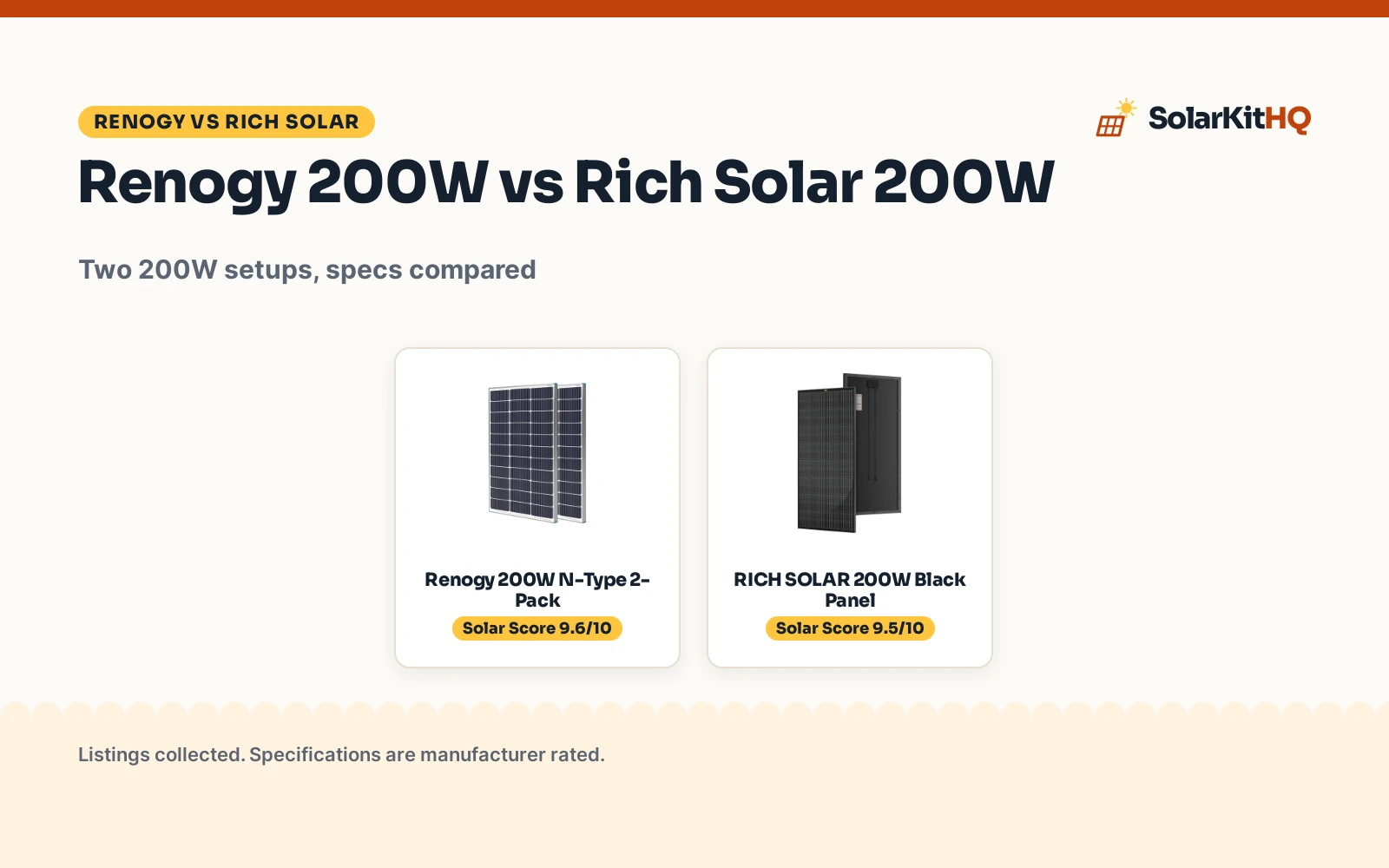
Renogy 200w vs Rich Solar 200w: side by side
| Solar panels | Solar Score | Watts | Panel size | Weight | Warranty stated |
|---|---|---|---|---|---|
| Renogy 200W N-Type 2-Pack | 9.6/10 | 200W, 2 panels of 100W | 34.1 x 22.8 x 1.2 inches | 26.0 pounds | Not stated |
| RICH SOLAR 200W Black Panel | 9.5/10 | 200W, single panel | 58.7 x 26.8 x 1.2 inches | 23.6 pounds | 25-year power output; 5-year material and craftsmanship |
All numbers here are manufacturer claims from the listings, not our measurements (2 November 2026).
Two panels or one
The split is the first thing that separates the two sides. The Renogy side reaches 200W through two 100W N-Type panels, each listed at 34.1 x 22.8 x 1.2 inches, while the Rich Solar side reaches 200W through a single panel listed at 58.7 x 26.8 x 1.2 inches. A pair lets you place two smaller rectangles where one long rectangle will not sit, while the single panel keeps the wiring to one unit. Weight does not settle the comparison: the Rich Solar panel lists 23.6 pounds for one panel, and the Renogy listing lists 26.0 pounds without saying whether that figure covers one panel or the pair, so a direct weight comparison stays unclear. Both sides list 12 volt working, so the choice here is about layout, not voltage.
Efficiency and heat
On stated efficiency, only the Renogy side gives a figure. Its listing states grade A+ cells, 16BB cell technology and a 25% conversion efficiency, plus 20W more power output than conventional PERC panels of the same design. It also states a low temperature coefficient that limits power loss in high-temperature conditions, low degradation of 1% or less in the first year and 0.4% or less annually, and a 25-year 80% output figure. The Rich Solar side makes no efficiency percentage claim; it states excellent low-light performance on early mornings, evenings and cloudy days, and a stated 10.9 amps for charging 12 volt batteries. The Renogy listing gives the numbers a buyer can line up against another panel; the Rich Solar listing gives a current figure and a low-light claim, but no percentage to compare.
Mounting and build
Mounting is where the Rich Solar panel gives the fullest detail. Its listing states strong high transmission anti-reflective coated tempered glass, an anodized aluminum frame, and 14 pre-drilled holes compatible with standard Z-brackets, ground mounts, side pole mounts and tilt mounts. It also states 3-foot quick connect cables with connectors, and working in series or in parallel. The Renogy side states 16BB cell technology that mitigates hot spots and hidden cracks, and an IP67 code in the title, but it states no mounting hole count and no cable length. If the mount matters to you, the Rich Solar listing answers more questions; if the cell build matters more, the Renogy listing says more about its cells.
What the listings leave unclear
Neither listing answers everything. The Renogy listing leaves the weight basis unclear, states no warranty term and states no current figure, so buyers who want those figures will not find them there. The Rich Solar listing states no efficiency percentage and no IP code, so buyers who want those figures will not find them there either. The Renogy listing also states high-temperature performance without a temperature figure, and the Rich Solar listing states low-light performance without a measured figure. Treat the unstated items as gaps, not as wins for either side.
Two examples

Renogy 200W N-Type 2-Pack
A pair of 100W N-Type panels with 16BB cells, a stated 25% conversion efficiency and an IP67 code, sized for RV, marine, trailer, camper, rooftop and farm off-grid setups.
Pros
- Stated 25% conversion efficiency with 16BB cells
- Pair format gives 200W from two 100W panels
- IP67 code stated in the listing title
- Low degradation figures stated: 1% or less in the first year, 0.4% or less annually
Cons
- No warranty term is stated
- Weight of 26.0 pounds is stated without saying whether it covers one panel or the pair
- High-temperature claim gives no temperature figure
- Panel voltage is 12V with no stated current figure
Detailed Review
The listing states two 100W N-Type panels with grade A+ cells, 16BB cell technology, a stated 25% conversion efficiency, and 20W more power output than conventional PERC panels of the same design. It states a low temperature coefficient for high-temperature conditions, low degradation of 1% or less in the first year and 0.4% or less annually, and a 25-year 80% output figure. Panel size is 34.1 x 22.8 x 1.2 inches and weight is 26.0 pounds, though the listing does not say whether that weight covers one panel or the pair. The IP67 code appears in the title.
Who it's for: RV, marine, trailer, camper, rooftop and farm owners who want 200W split across two panels with a stated efficiency figure. Who should skip it: anyone who wants a stated warranty term or a stated current figure in the listing.
Its Solar Score of 9.6/10 comes from performance 30/35, build 21/25, value 21/25, safety 8/10 and warranty 0/5: 80 of 100 points, placed on our 9.2 to 9.8 scale.
Key Specifications
| Watts | 200W, 2 panels of 100W |
|---|---|
| Panel size | 34.1 x 22.8 x 1.2 inches |
| Weight | 26.0 pounds |
| Efficiency stated | 25% |
Figures as published on the retailer listing, collected 2 November 2026. Performance figures are manufacturer rated.
Safety and Warranty
What this listing states. IP67 code stated in the listing title, so safety scores 8 of 10. No warranty term, so warranty scores zero. See How We Pick.
Panels make voltage in daylight. Keep connectors covered until you connect them, check the panel's stated open circuit voltage and current against your controller or power station input limits, and use cables rated for the current. Roof and permanent mounts belong to a qualified installer.
This is general buying information, not professional advice. Follow each product manual and local rules, and see our Safety Disclaimer.

RICH SOLAR 200W Black Panel
A single 200W monocrystalline panel with a stated 10.9 amps, 3-foot quick connect cables, and a tempered glass and anodized aluminum frame.
Pros
- Stated 10.9 amps for charging 12 volt batteries
- Tempered glass with an anti-reflective coating and an anodized aluminum frame
- 14 pre-drilled holes fit standard Z-brackets, ground mounts, side pole mounts and tilt mounts
- 25-year power output warranty and 5-year material and craftsmanship warranty stated
Cons
- No efficiency percentage is stated
- No IP code is stated
- At 58.7 inches long, it asks for more unbroken roof length than either Renogy panel
- Low-light performance claim gives no measured figure
Detailed Review
The listing states a single 200W monocrystalline panel for 12 volt batteries, and it generates 10.9 amps, with 3-foot quick connect cables with connectors, and working in series or in parallel. It states strong high transmission anti-reflective coated tempered glass, an anodized aluminum frame, and 14 pre-drilled holes compatible with standard Z-brackets, ground mounts, side pole mounts and tilt mounts. The warranty bullet states a 25-year limited warranty for power output and a 5-year limited warranty for material and craftsmanship. No efficiency percentage and no IP code appear in the listing.
Who it's for: RV, trailer, camper, marine and off-grid owners who want 200W from one panel with a stated warranty. Who should skip it: anyone who wants a stated efficiency percentage or a smaller panel footprint.
Its Solar Score of 9.5/10 comes from performance 28/35, build 21/25, value 21/25, safety 0/10 and warranty 4/5: 74 of 100 points, placed on our 9.2 to 9.8 scale.
Key Specifications
| Watts | 200W, single panel |
|---|---|
| Panel size | 58.7 x 26.8 x 1.2 inches |
| Weight | 23.6 pounds |
| Current stated | 10.9 amps |
Figures as published on the retailer listing, collected 2 November 2026. Performance figures are manufacturer rated.
Safety and Warranty
What this listing states. No UL, TÜV or IEC listing and no weather rating is stated, so safety scores zero. 25-year limited warranty for power output; 5-year limited warranty for material and craftsmanship. It does not say everything a buyer needs, such as who pays return shipping, so warranty scores 4 of 5. See How We Pick.
Panels make voltage in daylight. Keep connectors covered until you connect them, check the panel's stated open circuit voltage and current against your controller or power station input limits, and use cables rated for the current. Roof and permanent mounts belong to a qualified installer.
This is general buying information, not professional advice. Follow each product manual and local rules, and see our Safety Disclaimer.
As an Amazon Associate I earn from qualifying purchases.
Where the points went
The Solar Score weighs performance, build, value, safety and warranty. For solar panels, safety means a stated code or protection the listing names; the Renogy pair states IP67, and the Rich Solar panel names no code. One of the two states a warranty term, with a 25-year power output term and a 5-year material and craftsmanship term. How we pick explains the weights.
| Product | Solar Score | Perf. /35 | Build /25 | Value /25 | Safety /10 | Warranty /5 |
|---|---|---|---|---|---|---|
| Renogy 200W N-Type 2-Pack | 9.6 | 30 | 21 | 21 | 8 | 0 |
| RICH SOLAR 200W Black Panel | 9.5 | 28 | 21 | 21 | 0 | 4 |
Scores start at 9.2 for the lowest totals and top out at 9.8. In between, a kit’s position follows its weighted points one to one in order.
Renogy 200w vs Rich Solar 200w: which should you choose?
Choose the Renogy pair if you want a stated 25% efficiency figure, 16BB cells and two 100W panels that split 200W across two smaller rectangles, and if you can live without a stated warranty term in the listing. Choose the Rich Solar panel if you want 200W from one panel, a stated 10.9 amps, 14 pre-drilled mounting holes and a stated warranty term, and if you can live without a stated efficiency percentage. Neither side wins on every stated figure, so match the stated figures to the roof space, the mount and the paperwork you care about.
Sizing Notes
- Match the 200W total and the 12 volt figure against the controller or power station input before you buy.
- Check the panel size against the roof space: each Renogy panel is 34.1 x 22.8 inches, and the Rich Solar panel is 58.7 x 26.8 inches.
- Match the cable length and the mount type to the layout: the Rich Solar listing states 3-foot quick connect cables and 14 pre-drilled holes for standard mounts.
- Fuse the circuit as the manual directs, and leave changes to the RV electrical system to a qualified technician.
FAQ: power away from the grid
Which panel here states an efficiency percentage?
The Renogy pair does, at a stated 25% conversion efficiency with 16BB cells. The Rich Solar panel states no efficiency percentage.
Which panel here states a warranty?
The Rich Solar panel does, with a 25-year limited warranty for power output and a 5-year limited warranty for material and craftsmanship. The Renogy listing states no warranty term.
Can the Rich Solar panel work in series or in parallel?
Yes, the listing states that it works in series or in parallel, with 3-foot quick connect cables with connectors.
Which setup splits more easily across a small roof?
The Renogy pair, since each panel is listed at 34.1 x 22.8 inches, against the single Rich Solar panel at 58.7 x 26.8 inches.
Related solar guides
See every Rigid and Flexible Panels guide and all Solar Panels and Kits guides. For more panel comparisons, see the best 200 watt solar panel for tiny house and the best 100 watt solar panel for tiny house. Also see our Renogy Wanderer vs Renogy Adventurer.