On this page
At dusk in a parked RV, the lights run from a battery bank that spent the day under panels, and a small controller on the wall decides how that bank charges through the night. For renogy wanderer vs renogy adventurer, the choice turns on system voltage, on how the controller shows its work, and on how it mounts. Pick the Wanderer side for a setup that values LED indicators and tool-free mounting. Pick the Adventurer side for a setup that wants an LCD display and a choice of flush or surface mounting.
SolarKitHQ earns a commission when you buy through links on this page, at no extra cost to you. As an Amazon Associate I earn from qualifying purchases. Affiliate disclosure.
Renogy Wanderer vs Renogy Adventurer: side by side
| Renogy Wanderer vs Renogy Adventurer | Renogy 30A Adventurer 50V | Renogy 30A Adventurer Flush | Renogy 30A Wanderer Li | Amazon |
|---|---|---|---|---|
| System voltage | 12V/24V | 12V/24V | 12V | |
| PV input stated | 50V | Not stated | 25V | |
| Display | LCD | LCD | LED | |
| USB port | USB 2.4A | Not stated | Not stated | |
| Mounting | Flush or surface mount | Flush mount, surface kit included | DIN rail or wall mount | |
| Weight stated | 0.6 pounds | 0.6 pounds | Not stated | |
| Temperature range stated | -4°F to 140°F | -4°F to 140°F | -4°F to 140°F with BT-1 module | |
| Warranty | 2-year | 2-year | 2-year |
We copied each rating from the seller’s listing as the brand states it; data date 1 November 2026.
System voltage and PV input
System voltage is the sharpest split in this group. The Renogy 30A Wanderer Li listing states a 12V controller with a 25V PV input. The Renogy 30A Adventurer 50V listing states automatic detection of 12V/24V systems with a 50V PV input. The Renogy 30A Adventurer Flush listing states automatic detection of 12V/24V systems, but states no PV input figure, so a panel match cannot be checked from that listing alone.
All 3 listings state 30A PWM charging with bulk, boost, float and equalization stages. The Renogy 30A Wanderer Li listing adds a 120-minute boost stabilization figure and an equalization interval of every 25 days. The Renogy 30A Adventurer 50V listing states that its controller revives over-discharged lithium batteries. The Renogy 30A Adventurer Flush listing states the same revival claim for over-discharged lithium batteries.
Display and monitoring
Display is the next clear split. The Renogy 30A Wanderer Li listing states LED indicators for monitoring charging stages. The Renogy 30A Adventurer 50V listing states a backlit LCD for status updates, with DC Home App monitoring through BT-1 compatibility. The Renogy 30A Adventurer Flush listing states a backlit LCD for status updates, with DC Home App monitoring through BT-1 compatibility.
On the Wanderer side, app monitoring needs an extra purchase. The Renogy 30A Wanderer Li listing states that the BT-1 module is sold separately, so LED indicators are the built-in display. Both Adventurer listings state self-diagnostics alongside the LCD display. The Wanderer listing states LED monitoring of charging stages and states no self-diagnostics feature.
Mounting and size
Mounting is where the sides differ in fitting. The Renogy 30A Adventurer 50V listing includes a flush-mount bezel and a surface-mount attachment. The Renogy 30A Adventurer Flush listing states a flush mount design with a surface kit included. The Renogy 30A Wanderer Li listing states tool-free DIN rail or wall mounting.
Size figures need a careful read. The Renogy 30A Adventurer 50V listing states 6.56 x 4.5 x 1.9 inches at 0.6 pounds. The Renogy 30A Adventurer Flush listing states the same 6.56 x 4.5 x 1.9 inches size at 0.6 pounds. The Renogy 30A Wanderer Li bullets state 5.5 x 3.9 x 1.8 inches, while its spec table states 6.45 x 4.31 x 1.76 inches.
Battery types and temperature
Battery chemistry is shared ground, with a split on selection. The Renogy 30A Wanderer Li listing states support for lithium, AGM, gel and flooded batteries, with lithium selection manual and lead-acid types automatic. The Renogy 30A Adventurer 50V listing states the same battery set, with lithium selection manual and AGM, gel and flooded selection automatic. The Renogy 30A Adventurer Flush listing states charging for lithium, AGM, gel and flooded batteries, and states no manual or automatic selection split.
Temperature figures match across the group. The Renogy 30A Wanderer Li listing states temperature compensation from -4°F to 140°F when the BT-1 module is added. The Renogy 30A Adventurer 50V listing states withstanding -4°F to 140°F with auto temperature compensation. The Renogy 30A Adventurer Flush listing states withstanding -4°F to 140°F with auto temperature compensation.
What the listings leave unclear
The Wanderer listing carries the clearest internal mismatch. Its bullets state 5.5 x 3.9 x 1.8 inches, while its spec table states 6.45 x 4.31 x 1.76 inches, so this article follows the bullets and treats the spec table figure as the outlier. The Renogy 30A Adventurer Flush listing states no PV input figure and no USB port, so those points stay open. The Renogy 30A Adventurer 50V listing states no IP code, and the Renogy 30A Adventurer Flush listing also states no IP code.
No listing in this group states a panel wattage figure, so panel matching here rests on voltage and current figures alone.
The kits we chose
| # | Product | Solar Score | Buy |
|---|---|---|---|
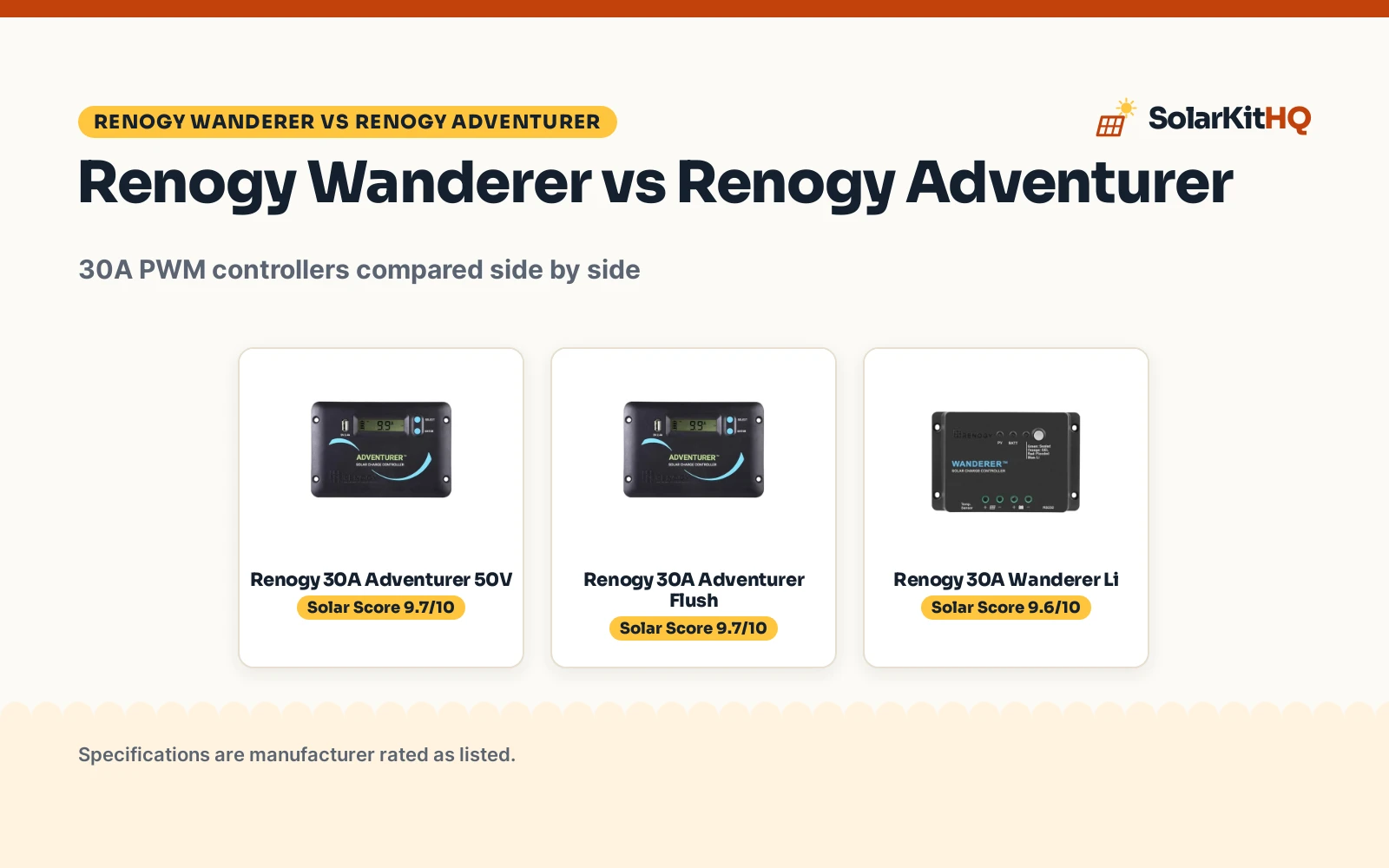
| 1 |  Renogy 30A Adventurer 50V | 9.7/10 | Buy on Amazon |
| 2 |  Renogy 30A Adventurer Flush | 9.7/10 | Buy on Amazon |
| 3 |  Renogy 30A Wanderer Li | 9.6/10 | Buy on Amazon |

Renogy 30A Adventurer 50V
A 30A PWM controller for 12V/24V systems with an LCD display, a 50V PV input and flush or surface mounting.
Pros
- 12V/24V system detection with 30A PWM charging across lithium, AGM, gel and flooded batteries
- LCD display plus DC Home App monitoring through BT-1 compatibility
- Flush mount bezel and surface mount kit both included
- USB 2.4A port stated
Cons
- Flush mounting needs a precisely cut opening, tolerance 1mm or less, and no cutout template is provided
- No IP code stated
- Lithium selection is manual, while AGM, gel and flooded selection is automatic
- Same 6.56 x 4.5 x 1.9 inches size and 0.6 pounds weight as the older Adventurer listing
Detailed Review
The listing states a 30A PWM controller with automatic detection of 12V/24V systems, a 50V PV input, a backlit LCD, DC Home App monitoring through BT-1 compatibility, a USB 2.4A port, flush or surface mounting, temperature compensation from -4°F to 140°F, protection against overcharging and short circuits, and a 2-year material and workmanship warranty.
Who it's for: RV and off-grid owners who want an LCD display, a USB port and a choice of flush or surface mounting. Who should skip it: owners who need a stated IP code, or who want to avoid cutting a wall opening for a flush fit.
Its Solar Score of 9.7/10 comes from performance 30/35, build 21/25, value 21/25, safety 8/10 and warranty 4/5: 84 of 100 points, placed on our 9.2 to 9.8 scale.
Key Specifications
| System | 12V/24V |
|---|---|
| PV input | 50V |
| Display | LCD |
| USB | 2.4A |
Figures as published on the retailer listing, collected 1 November 2026. Performance figures are manufacturer rated.
Safety and Warranty
What this listing states. Overcharge and short circuit protection stated, with auto temperature compensation, so safety scores 8 of 10. 2-year material and workmanship warranty. It does not say everything a buyer needs, such as who pays return shipping, so warranty scores 4 of 5. See How We Pick.
Stay under the input limit. Keep your panels' combined open circuit voltage, with cold weather margin, under the controller's stated maximum PV input, connect the battery first unless the manual says otherwise, and fuse both sides as the manual directs.
This is general buying information, not professional advice. Follow each product manual and local rules, and see our Safety Disclaimer.

Renogy 30A Adventurer Flush
A 30A PWM controller for 12V/24V systems with an LCD display and a flush mount design.
Pros
- 12V/24V system detection with 30A PWM charging across lithium, AGM, gel and flooded batteries
- Backlit LCD for status updates plus self-diagnostics stated
- Flush mount design with a surface kit included
- Negative ground compatibility stated, with overcharging and short circuit protection
Cons
- No PV input figure stated
- No USB port stated
- No IP code stated
- Flush mounting means fitting the controller into a wall opening
Detailed Review
The listing states a 30A PWM controller with automatic detection of 12V/24V systems, a backlit LCD, DC Home App monitoring through BT-1 compatibility, a flush mount design with a surface kit included, temperature compensation from -4°F to 140°F, negative ground compatibility, protection against overcharging and short circuits, and a 2-year material and workmanship warranty.
Who it's for: RV owners who want an LCD display and a flush wall fit with a surface kit as a fallback. Who should skip it: owners who need a stated PV input figure or a USB port.
Its Solar Score of 9.7/10 comes from performance 29/35, build 21/25, value 20/25, safety 8/10 and warranty 4/5: 82 of 100 points, placed on our 9.2 to 9.8 scale.
Key Specifications
| System | 12V/24V |
|---|---|
| Display | LCD |
| Weight | 0.6 pounds |
| Size | 6.56 x 4.5 x 1.9 inches |
Figures as published on the retailer listing, collected 1 November 2026. Performance figures are manufacturer rated.
Safety and Warranty
What this listing states. Negative ground compatibility with overcharging and short circuit protection stated, so safety scores 8 of 10. 2-year material and workmanship warranty. It does not say everything a buyer needs, such as who pays return shipping, so warranty scores 4 of 5. See How We Pick.
Stay under the input limit. Keep your panels' combined open circuit voltage, with cold weather margin, under the controller's stated maximum PV input, connect the battery first unless the manual says otherwise, and fuse both sides as the manual directs.
This is general buying information, not professional advice. Follow each product manual and local rules, and see our Safety Disclaimer.

Renogy 30A Wanderer Li
A 30A PWM controller for 12V systems with LED indicators, a 25V PV input and an IP32 code stated.
Pros
- 30A PWM charging with bulk, boost, float and equalization stages stated
- IP32 code stated with corrosion-resistant materials
- Tool-free DIN rail or wall mounting
- Battery type switching with LED monitoring of charging stages
Cons
- 12V systems only; no 24V system detection stated
- No LCD display; monitoring is by LED indicators only
- DC Home App monitoring needs the BT-1 module, sold separately
Detailed Review
The listing states a 12V 30A Wanderer Li PWM controller with a 25V PV input, 4-stage charging with a 120-minute boost stabilization figure and equalization every 25 days, LED monitoring of charging stages, tool-free DIN rail or wall mounting, an IP32 code, temperature compensation from -4°F to 140°F when the BT-1 module is added, protection against overcharging and short circuits, and a 2-year material and workmanship warranty. The bullets list 5.5 x 3.9 x 1.8 inches while the spec table lists 6.45 x 4.31 x 1.76 inches, so this article follows the bullets over the spec table.
Who it's for: 12V RV, boat and off-grid owners who want LED simplicity and tool-free mounting. Who should skip it: owners who need 24V detection, an LCD display, or app monitoring without an extra module.
Its Solar Score of 9.6/10 comes from performance 28/35, build 20/25, value 20/25, safety 8/10 and warranty 4/5: 80 of 100 points, placed on our 9.2 to 9.8 scale.
Key Specifications
| System | 12V |
|---|---|
| PV input | 25V |
| Display | LED |
| Size | 5.5 x 3.9 x 1.8 inches |
Figures as published on the retailer listing, collected 1 November 2026. Performance figures are manufacturer rated.
Safety and Warranty
What this listing states. Overcharge and short circuit protection stated, IP32 code stated, so safety scores 8 of 10. 2-year material and workmanship warranty. It does not say everything a buyer needs, such as who pays return shipping, so warranty scores 4 of 5. See How We Pick.
Stay under the input limit. Keep your panels' combined open circuit voltage, with cold weather margin, under the controller's stated maximum PV input, connect the battery first unless the manual says otherwise, and fuse both sides as the manual directs.
This is general buying information, not professional advice. Follow each product manual and local rules, and see our Safety Disclaimer.
As an Amazon Associate I earn from qualifying purchases.
Where the points went
The Solar Score weighs performance, build, value, safety and warranty. For charge controllers, safety means stated protection against overcharge and short circuits, plus any stated code such as IP32. All 3 listings state overcharge and short circuit protection, and all 3 state a 2-year material and workmanship warranty. How we pick explains the weights.
| Product | Solar Score | Perf. /35 | Build /25 | Value /25 | Safety /10 | Warranty /5 |
|---|---|---|---|---|---|---|
| Renogy 30A Adventurer 50V | 9.7 | 30 | 21 | 21 | 8 | 4 |
| Renogy 30A Adventurer Flush | 9.7 | 29 | 21 | 20 | 8 | 4 |
| Renogy 30A Wanderer Li | 9.6 | 28 | 20 | 20 | 8 | 4 |
We place weighted points on a scale whose ends are 9.2 and 9.8. Because the mapping is straight, a unit with more points never shows less.
How to choose the best renogy wanderer vs renogy adventurer
Start from system voltage. A 12V/24V system points to the Adventurer listings, while a 12V system keeps the Wanderer listing in play. For background on controller types, see the MPPT vs PWM charge controller comparison, and for a 12V-focused roundup, see best PWM charge controller for 12V battery. If a 24V system is planned, the best MPPT charge controller for 24V system roundup covers that voltage range.
Then weigh display against mounting. An LCD display suits an owner who wants status at a glance on the wall. LED indicators suit an owner who wants a compact controller and is happy to read stages from lights. Flush mounting suits a tidy wall fit, while DIN rail or wall mounting suits a compartment or board fit.
| If you need | Look at |
|---|---|
| LCD display | Renogy 30A Adventurer 50V, LCD stated |
| USB port | Renogy 30A Adventurer 50V, USB 2.4A stated |
| 12V/24V system detection | Renogy 30A Adventurer 50V, 12V/24V stated |
| LED indicators | Renogy 30A Wanderer Li, LED stated |
| Tool-free mounting | Renogy 30A Wanderer Li, DIN rail or wall mounting stated |
Sizing Notes
- Match the panel voltage to the controller PV input figure: 25V on the Wanderer listing and 50V on the newer Adventurer listing, with no PV input figure stated on the older Adventurer listing.
- Match the battery voltage and chemistry to the controller: 12V on the Wanderer listing and 12V/24V on the Adventurer listings, with lithium selection manual on the Wanderer and newer Adventurer listings.
- Check the case size against the mounting space: 5.5 x 3.9 x 1.8 inches from the Wanderer bullets and 6.56 x 4.5 x 1.9 inches on the Adventurer listings.
- Keep the load within the 30A figure stated on all 3 listings.
- Fuse the positive lead as the manual directs, and leave changes to the RV’s 120V system to a qualified technician.
FAQ: power away from the grid
Which side suits a 24V system?
The Adventurer listings state automatic detection of 12V/24V systems. The Wanderer listing states a 12V controller, so it does not state 24V system detection.
Which controller in this group has an LCD display?
The Adventurer listings state a backlit LCD display. The Wanderer listing states LED indicators instead.
Does app monitoring need an extra module?
On the Wanderer listing, DC Home App monitoring needs the BT-1 module, sold separately. The Adventurer listings state BT-1 compatibility for DC Home App monitoring.
What warranty term do these controllers state?
All 3 listings state a 2-year material and workmanship warranty.
Related solar guides
See every Charge Controllers guide and all Controllers and Inverters guides. For the Wanderer side, see the Renogy Rover vs Wanderer comparison. Also see our best solar charge controller for boat. Also see our best solar charge controller for lead acid battery. Also see our best MPPT solar charge controller for lithium batteries. Also see our MPPT vs PWM for RV.
More picks: MPPT vs PWM for boat, best MPPT solar charge controller for RV, best solar charge controller for AGM batteries.