On this page
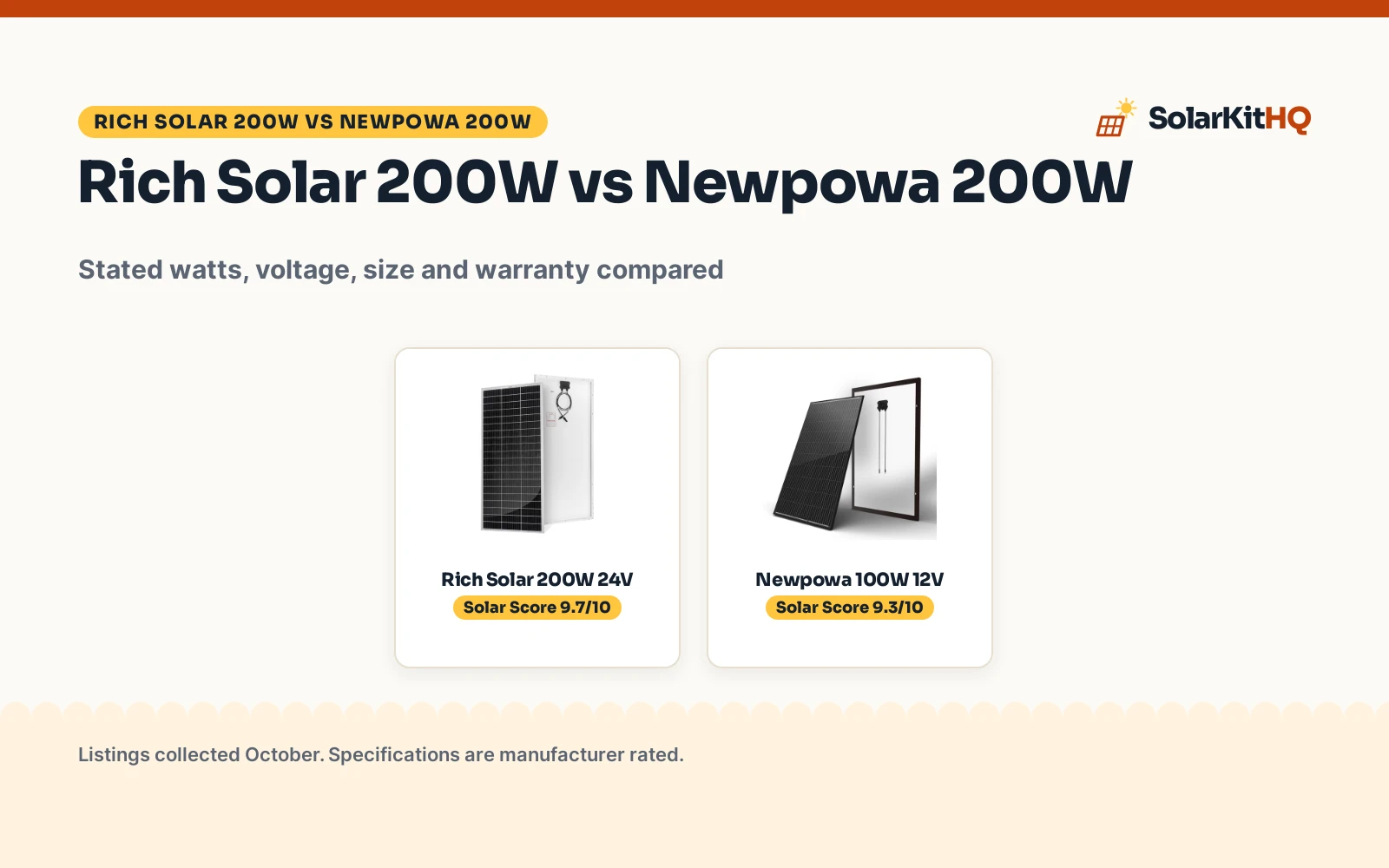
Dinner is on the table when the lights cut out, the fridge hums to a stop, and the phone on the counter has no charge left, which is when rich solar 200w vs newpowa 200w starts to matter for an RV roof or a cabin battery bank. The comparison below uses what each listing states: watts, voltage, size, weight, build and warranty terms. The short answer is that the Rich Solar listing states a 200W 24V panel with UL certification and a 25-year output warranty, while the Newpowa listing states a 100W 12V panel with rear-side gain, so the two are not matched on watts. Pick the Rich Solar example if your system runs at 24V and you want the stated 200W panel; pick the Newpowa example if your system runs at 12V and you want a lighter panel that can use reflected light.
SolarKitHQ earns a commission when you buy through links on this page, at no extra cost to you. As an Amazon Associate I earn from qualifying purchases. Affiliate disclosure.
Rich Solar 200W vs Newpowa 200W: side by side
| Solar panel | Solar Score | Watts | Voltage | Weight | Warranty |
|---|---|---|---|---|---|
| Rich Solar 200W 24V | 9.7/10 | 200W | 24V | 24.0 lb | 25-year output |
| Newpowa 100W 12V | 9.3/10 | 100W | 12V | 12.74 lb | 2-year workmanship |
These specs are rated by the maker and quoted from each listing on 5 November 2026.
Watts and voltage
The gap in stated watts is the first thing to settle. The Rich Solar listing states 200W at 24V, with a Vmp of 36.3V, a Voc of 43.5V and an Imp of 5.51A, and the bullets say the panel suits 24V and 48V battery setups. The Newpowa listing states 100W at 12V, with a Vmp of 17.1V and an Imp of 5.85A. On stated watts alone the two listings are not a matched pair, and the voltage split decides the setup each one fits: the Rich Solar example belongs with a 24V setup, and the Newpowa example belongs with a 12V setup.
Size, weight and build
The Rich Solar example is listed at 58.7 by 26.8 by 1.4 inches and 24.0 pounds, with an anodized aluminum frame, 3.2mm tempered glass and an IP67-rated junction box, and the listing gives load figures of 5400 Pa for snow and 2400 Pa for wind. The Newpowa example is listed in the bullets at 36.61 by 22.83 by 1.18 inches and 12.74 pounds, with pre-installed diodes in the junction box and pre-attached 3ft cables, with the same load figures of 5400 Pa for snow and 2400 Pa for wind. The Newpowa spec table disagrees with its own bullets, giving 38.58 by 20.87 by 1.18 inches and 13.2 pounds, so use the bullet figures when you compare. The Newpowa rear side captures reflected light, and the listing says to mount the panel 28-50 inches above ground for rear-side gains.
Warranty and certification
The Rich Solar listing states UL certification and a 25-year linear power output performance warranty, and it calls the panel PID-resistant. The Newpowa listing states a 2-year material and parts workmanship assurance, with output above 90% at 10 years and above 80% at 25 years, and it states no UL certification and no IP figure. On warranty length the Rich Solar example states the longer term, while the Newpowa example states output assurances across 10 years and 25 years.
What the listings leave unclear
The Rich Solar title claims 25% efficiency while the bullets state up to 24.8%, so use the bullet figure. The Newpowa listing is a 100W panel, so it does not answer the 200W side of the comparison on watts, and its bullets and spec table give different dimensions and weights. Neither listing states a figure for low-light output beyond the efficiency claim, and the Newpowa listing states no certification.
Two examples

Rich Solar 200W 24V
A 200W 24V N-Type TOPCon panel with a 36.3V Vmp, a 43.5V Voc, an IP67-rated junction box, UL certification and a 25-year output warranty.
Pros
- States 200W at 24V with a 36.3V Vmp and a 43.5V Voc for 24V and 48V battery setups
- UL certified with an IP67-rated junction box and PID-resistant build stated
- Anodized aluminum frame with 3.2mm tempered glass, rated for 5400 Pa snow loads and 2400 Pa wind pressure
- 25-year linear power output performance warranty with U.S.-based customer support stated
Cons
- 24.0 pounds and 58.7 by 26.8 inches needs a large roof area
- 24V panel needs a controller and battery setup matched to 24V, not a 12V setup
- No low-light output figure is given, only the up to 24.8% efficiency claim
Detailed Review
The listing states a 200W 24V N-Type TOPCon monocrystalline panel with a 36.3V Vmp, a 43.5V Voc and a 5.51A Imp, a 25% efficiency claim in the title and up to 24.8% in the bullets, an anodized aluminum frame, 3.2mm tempered glass, an IP67-rated junction box, and load figures of 5400 Pa for snow and 2400 Pa for wind. It is UL certified and PID-resistant, with pre-attached 3ft cables and MC4 connectors, and the warranty is a 25-year linear power output performance warranty. The title says 25% while the bullets say up to 24.8%, so use the bullet figure when you compare.
Who it's for: RV, van, cabin and boat owners building a 24V or 48V system who want the stated 200W panel with UL certification. Who should skip it: anyone with a 12V system or a small roof, since the panel is 58.7 by 26.8 inches and 24.0 pounds.
Its Solar Score of 9.7/10 comes from performance 30/35, build 21/25, value 20/25, safety 8/10 and warranty 4/5: 83 of 100 points, placed on our 9.2 to 9.8 scale.
Key Specifications
| Power | 200W, 24V, Vmp 36.3V, Voc 43.5V, Imp 5.51A |
|---|---|
| Size | 58.7 x 26.8 x 1.4 in, 24.0 lb |
| Build | Anodized aluminum frame, 3.2mm tempered glass, IP67 junction box |
| Load figures | 5400 Pa snow, 2400 Pa wind |
Figures as published on the retailer listing, collected 5 November 2026. Performance figures are manufacturer rated.
Safety and Warranty
What this listing states. UL certified, IP67-rated junction box, PID-resistant, 3.2mm tempered glass stated, so safety scores 8 of 10. 25-year linear power output performance warranty stated. It does not say everything a buyer needs, such as who pays return shipping, so warranty scores 4 of 5. See How We Pick.
Panels make voltage in daylight. Keep connectors covered until you connect them, check the panel's stated open circuit voltage and current against your controller or power station input limits, and use cables rated for the current. Roof and permanent mounts belong to a qualified installer.
This is general buying information, not professional advice. Follow each product manual and local rules, and see our Safety Disclaimer.

Newpowa 100W 12V
A 100W 12V monocrystalline panel whose rear side captures reflected light, with a 17.1V Vmp, a 5.85A Imp and a 2-year workmanship assurance.
Pros
- Rear side captures reflected light for extra output when mounted 28-50 inches above ground
- States 100W at 12V with a 17.1V Vmp and a 5.85A Imp for a 12V battery setup
- Pre-installed diodes in the junction box and pre-attached 3ft cables
- Withstands 2400 Pa wind pressure and 5400 Pa snow loads, per the listing
Cons
- The listing states 100W, not 200W, so it does not match the 200W side of this comparison
- No UL certification or IP figure is stated
- Workmanship assurance is 2 years, shorter than the Rich Solar 25-year output warranty
Detailed Review
The listing states a 100W 12V monocrystalline panel with a 17.1V Vmp and a 5.85A Imp, a rear side that captures reflected light, pre-installed diodes in the junction box and pre-attached 3ft cables. The bullets give dimensions of 36.61 by 22.83 by 1.18 inches and a weight of 12.74 pounds, while the spec table gives 38.58 by 20.87 by 1.18 inches and 13.2 pounds, so use the bullet figures when you compare. The workmanship assurance is 2 years, with output above 90% at 10 years and above 80% at 25 years. The listing states 100W, so it does not match the 200W side of this comparison.
Who it's for: owners of a 12V system who want a lighter panel with rear-side gain and can mount it 28-50 inches above ground. Who should skip it: anyone who needs the stated 200W panel or a 24V panel for a 24V or 48V system.
Its Solar Score of 9.3/10 comes from performance 23/35, build 19/25, value 19/25, safety 0/10 and warranty 2/5: 63 of 100 points, placed on our 9.2 to 9.8 scale.
Key Specifications
| Power | 100W, 12V, Vmp 17.1V, Imp 5.85A |
|---|---|
| Size | 36.61 x 22.83 x 1.18 in, 12.74 lb |
| Rear side | Captures reflected light; mount 28-50 inches above ground |
| Load figures | 5400 Pa snow, 2400 Pa wind |
Figures as published on the retailer listing, collected 5 November 2026. Performance figures are manufacturer rated.
Safety and Warranty
What this listing states. No UL, TÜV or IEC listing and no weather rating is stated, so safety scores zero. 2-year material and parts workmanship assurance; output above 90% at 10 years, above 80% at 25 years. It does not say everything a buyer needs, such as who pays return shipping, so warranty scores 2 of 5. See How We Pick.
Panels make voltage in daylight. Keep connectors covered until you connect them, check the panel's stated open circuit voltage and current against your controller or power station input limits, and use cables rated for the current. Roof and permanent mounts belong to a qualified installer.
This is general buying information, not professional advice. Follow each product manual and local rules, and see our Safety Disclaimer.
As an Amazon Associate I earn from qualifying purchases.
Where the points went
The Solar Score weighs performance, build, value, safety and warranty. For solar panels, safety means a UL certification, an IP-rated junction box or another protection the listing names; the Rich Solar example states UL certification and an IP67-rated junction box, and the Newpowa example states none. Both state a warranty term. How we pick explains the weights.
| Product | Solar Score | Perf. /35 | Build /25 | Value /25 | Safety /10 | Warranty /5 |
|---|---|---|---|---|---|---|
| Rich Solar 200W 24V | 9.7 | 30 | 21 | 20 | 8 | 4 |
| Newpowa 100W 12V | 9.3 | 23 | 19 | 19 | 0 | 2 |
Every total is translated into a figure between 9.2 and 9.8 with a linear formula; ranking by points and ranking by score always agree.
How to choose the best rich solar 200w vs newpowa 200w
Match the voltage to your battery setup
Start with voltage, because it decides the rest of the system. The Rich Solar example states 24V, with a Vmp of 36.3V and a Voc of 43.5V, and the bullets say it suits 24V and 48V battery setups. The Newpowa example states 12V, with a Vmp of 17.1V. If your battery bank and controller are set for 12V, the Newpowa example fits that setup; if they are set for 24V, the Rich Solar example fits. See the 12V vs 24V solar panel comparison for the same split.
Weigh the stated watts honestly
Do not treat the two listings as a matched 200W pair. The Rich Solar listing states 200W, and the Newpowa listing states 100W, so the Newpowa example gives a smaller panel for a smaller 12V setup. Size the controller and the battery bank from the watts each listing states, not from the comparison label. See the best MPPT solar charge controller for RV guide for controllers built for RV roofs.
Check the roof space and the mount
The Rich Solar example is listed at 58.7 by 26.8 by 1.4 inches and 24.0 pounds, so measure the roof space before you order. The Newpowa example is listed in the bullets at 36.61 by 22.83 by 1.18 inches and 12.74 pounds, so it takes less roof space, and its rear side needs 28-50 inches above ground for rear-side gains. Both listings state pre-drilled mounting: the Rich Solar listing states pre-drilled holes on the back frame.
Read the warranty before you buy
The Rich Solar listing states a 25-year linear power output performance warranty and UL certification. The Newpowa listing states a 2-year material and parts workmanship assurance, with output above 90% at 10 years and above 80% at 25 years. A longer stated warranty does not change the watts, so weigh it after voltage and size. See the best bifacial solar panels guide for panels that use reflected light.
| If you need | Look at |
|---|---|
| Stated 200W at 24V | Rich Solar 200W 24V, Vmp 36.3V |
| Stated 100W at 12V | Newpowa 100W 12V, Vmp 17.1V |
| UL certification stated | Rich Solar 200W 24V |
| Rear-side gain | Newpowa 100W 12V, mount 28-50 inches above ground |
| Longest stated output warranty | Rich Solar 200W 24V, 25-year output warranty |
Sizing Notes
- Match the panel voltage to the controller and battery setup: the Rich Solar example states 24V and the Newpowa example states 12V.
- Check the roof space against the stated size: 58.7 by 26.8 inches for the Rich Solar example and 36.61 by 22.83 inches for the Newpowa example, using the bullet figures.
- Size the controller from the stated watts and Vmp: 200W and 36.3V for the Rich Solar example, 100W and 17.1V for the Newpowa example.
- Mount the Newpowa example 28-50 inches above ground for rear-side gains.
- Fuse the positive lead as the manual directs, and leave changes to the RV electrical system to a qualified technician.
FAQ: power away from the grid
Is the Newpowa panel in this comparison a 200W panel?
No. The Newpowa listing states 100W at 12V, with a Vmp of 17.1V and an Imp of 5.85A, so it does not match the 200W side of the comparison on watts.
Which panel states the higher voltage?
The Rich Solar example states 24V, with a Vmp of 36.3V and a Voc of 43.5V. The Newpowa example states 12V, with a Vmp of 17.1V.
Which panel states UL certification?
The Rich Solar example states UL certification and an IP67-rated junction box. The Newpowa listing states no UL certification and no IP figure.
Which panel has the longer stated output warranty?
The Rich Solar example states a 25-year linear power output performance warranty. The Newpowa example states a 2-year workmanship assurance, with output above 90% at 10 years and above 80% at 25 years.
Can the Newpowa panel use reflected light?
Yes. The listing states that the rear side captures reflected light, and it says to mount the panel 28-50 inches above ground for rear-side gains.
Related solar guides
See every Rigid and Flexible Panels guide and all Solar Panels and Kits guides.
More picks: best 200 watt solar panel for tiny house, best solar panel kit for RV, best bifacial solar panels and best MPPT solar charge controller for RV.