On this page
The best solar powered generator for power outage is the one that is charged, sized for the loads that actually matter, and sitting where you can reach it when the lights go out. An outage at dinner time sorts priorities fast: the phones, the lights and the Wi-Fi router beat everything else. We compared five solar generators using only what each Amazon listing publishes: watt-hours, AC output, ports, the panel situation, weight and the warranty term. Capacities here run from phone-bank size to a 296Wh unit with real AC outlets.
SolarKitHQ earns a commission when you buy through links on this page, at no extra cost to you. As an Amazon Associate I earn from qualifying purchases. Affiliate disclosure.
Quick picks
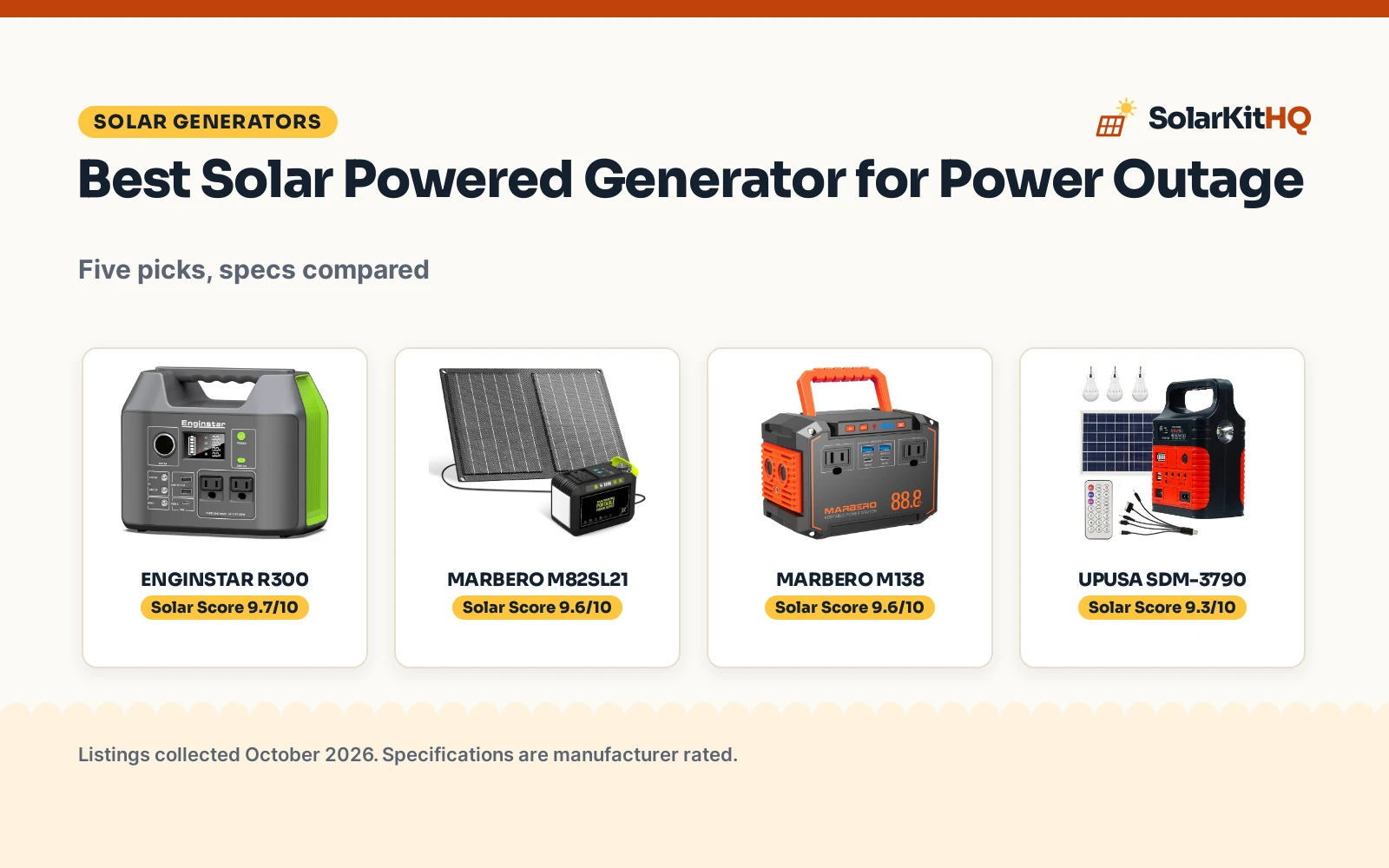
 Best Overall ENGINSTAR R300: 296Wh, 300W pure sine wave, UL-certified BMS, 12-month service Check price on Amazon
 Best Panel Kit MARBERO M82SL21: 88Wh with 21W panel included, 80W AC, 8 ports Check price on Amazon
 Best Small Unit MARBERO M138: 88.8Wh at 2.27 lb, 6 ports, BMS, 12-month warranty Check price on Amazon
 Best LiFePO4 Mini UPUSA SDM-3790: 10000mAh LiFePO4, USB and DC, SOS light, 2-year warranty Check price on Amazon
 Lightest Here UPUSA SDM-0603: 12500mAh with 5W panel, 16 oz, 90-day warranty Check price on Amazon
The picks
| # | Product | Solar Score | Buy |
|---|---|---|---|
| 1 | ENGINSTAR R300 | 9.7/10 | Buy on Amazon |
| 2 | MARBERO M82SL21 | 9.6/10 | Buy on Amazon |
| 3 | MARBERO M138 | 9.6/10 | Buy on Amazon |
| 4 | UPUSA SDM-3790 | 9.3/10 | Buy on Amazon |
| 5 | UPUSA SDM-0603 | 9.3/10 | Buy on Amazon |

ENGINSTAR R300
A 296Wh unit with 300W pure sine wave AC, 8 outputs, a smart BMS and UL battery certification.
Pros
- 296Wh with 300W pure sine wave AC stated
- 8 outputs including 2 AC, USB-C 18W, 12V car and DC ports
- Smart BMS with 1000 recharge cycles stated
- Certification to battery standards set by UL stated
Cons
- Listing states it may not support refrigerators or microwaves
- Solar panel sold separately
- Spec table lists a 4-stroke engine type and 2 outlets against the bullets' 8 outputs
- 6.5 lb is the heaviest here
Detailed Review
EnginStar lists a 296Wh unit with 300W pure sine wave AC, two 110V AC outlets, 3 USB outputs including 1 USB-C at 18W, a 12V car port, a 12V DC and a 24V DC barrel port. It recharges in 7 hours on the wall adapter or from a 12 to 25V solar panel sold separately, weighs 6.5 pounds and measures 9 by 5.5 by 7.5 inches. The smart BMS is stated with overload, over-discharge, overcharge, overheating and short circuit protections, and the listing states certification to battery standards set by UL with 1000 recharge cycles. The spec table lists a 4-stroke engine type and 2 total power outlets; trust the title and bullets on both. The listing states it supports devices under 300W and may not support refrigerators, microwaves, grills or heaters. Warranty is 12 months of service.
Who it's for: outage planners who want the most watt-hours and real AC outlets here. Who should skip it: anyone who needs to run a full-size fridge or microwave.
Its Solar Score of 9.7/10 comes from performance 29/35, build 20/25, value 21/25, safety 9/10 and warranty 3/5: 82 of 100 points, placed on our 9.2 to 9.8 scale.
Key Specifications
| Capacity | 296Wh |
|---|---|
| AC output | 300W pure sine wave |
| Outputs | 8 total |
| Weight | 6.5 lb |
Figures as published on the retailer listing, collected 19 October 2026. Performance figures are manufacturer rated.
Safety and Warranty
What this listing states. Smart BMS stated; certified to battery standards set by UL, so safety scores 9 of 10. 12 months service. It does not say everything a buyer needs, such as who pays return shipping, so warranty scores 3 of 5. See How We Pick.
Power station limits. Stay within the stated continuous output and solar input limits, keep the unit ventilated and dry, charge within the stated temperature range, and never connect it to home wiring except through equipment a licensed electrician installs.
This is general buying information, not professional advice. Follow each product manual and local rules, and see our Safety Disclaimer.

MARBERO M82SL21
An 88Wh unit with a 21W panel included, 80W AC with 120W surge and 8 ports.
Pros
- 88Wh with a 21W panel included
- 80W with 120W surge stated
- 8 ports
- 2.3 lb is the lightest AC unit here
Cons
- No BMS is stated
- No UL, ETL, CSA, FCC or IP rating is stated
- No solar input voltage is stated
- 80W continuous limits it to small devices
Detailed Review
MARBERO lists an 88Wh unit with 80W AC output and a 120W surge, 8 ports, and a 21W foldable panel in the box. It weighs 2.3 pounds and measures 6.5 by 3.2 by 4.6 inches. The listing positions it for tent camping, road trips and outages, with daytime solar top-ups and stored power at night. Short circuit protection is stated. No UL, ETL, CSA, FCC or IP rating is stated. Warranty is 12 months.
Who it's for: campers who want a complete panel kit at the lowest weight with AC. Who should skip it: anyone who needs a stated BMS or more than 80W continuous.
Its Solar Score of 9.6/10 comes from performance 28/35, build 19/25, value 21/25, safety 8/10 and warranty 3/5: 79 of 100 points, placed on our 9.2 to 9.8 scale.
Key Specifications
| Capacity | 88Wh |
|---|---|
| AC output | 80W, 120W surge |
| Panel | 21W included |
| Weight | 2.3 lb |
Figures as published on the retailer listing, collected 19 October 2026. Performance figures are manufacturer rated.
Safety and Warranty
What this listing states. Short circuit protection stated, so safety scores 8 of 10. 12 months warranty. It does not say everything a buyer needs, such as who pays return shipping, so warranty scores 3 of 5. See How We Pick.
Power station limits. Stay within the stated continuous output and solar input limits, keep the unit ventilated and dry, charge within the stated temperature range, and never connect it to home wiring except through equipment a licensed electrician installs.
This is general buying information, not professional advice. Follow each product manual and local rules, and see our Safety Disclaimer.

MARBERO M138
An 88.8Wh unit with 80W AC and 150W surge, 6 ports, BMS and a 12-month warranty.
Pros
- 88.8Wh at 2.27 lb
- 6 ports with QC3.0 and PD3.0 fast charging
- BMS with 500 plus charges stated
- LED flashlight with 37 to 68 hour runtime and SOS
Cons
- AC rating is contradictory: 2 x 100W outlets against 80W output
- Solar panel not included
- No UL, ETL, CSA, FCC or IP rating is stated
- Spec table lists 2.4 lb against the bullets' 2.27 lb
Detailed Review
MARBERO lists an 88.8Wh (24,000mAh) unit with two AC outlets rated 100W at 150W max, and separately states 80W AC output with a 150W surge. It has 2 QC3.0 USB-A at 18W and 2 PD3.0 USB-C at 18W and 30W, charges 0 to 80 percent in 3 hours on AC, and takes DC 13V to 25V at 1.7A max solar, not included. It weighs 2.27 pounds in the bullets against 2.4 pounds in the spec table, and measures 6.12 by 3.69 by 4.19 inches. The LED flashlight runs 37 to 68 hours with an SOS mode. The smart BMS lists over/under-voltage, over-current, overload, over-temperature and short-circuit protections with 500 plus charges. The listing states it powers a 100W device for under 1 hour and suits low-wattage electronics. Warranty is 12 months.
Who it's for: buyers who want fast-charging USB ports and a light AC unit for small electronics. Who should skip it: anyone who needs a clear AC rating or a panel in the box.
Its Solar Score of 9.6/10 comes from performance 27/35, build 19/25, value 20/25, safety 8/10 and warranty 3/5: 77 of 100 points, placed on our 9.2 to 9.8 scale.
Key Specifications
| Capacity | 88.8Wh |
|---|---|
| AC output | 80W, 150W surge |
| Ports | 6 total |
| Weight | 2.27 lb |
Figures as published on the retailer listing, collected 19 October 2026. Performance figures are manufacturer rated.
Safety and Warranty
What this listing states. Smart BMS stated with over/under-voltage, over-current, overload, over-temperature and short-circuit protection, so safety scores 8 of 10. 12 months warranty. It does not say everything a buyer needs, such as who pays return shipping, so warranty scores 3 of 5. See How We Pick.
Power station limits. Stay within the stated continuous output and solar input limits, keep the unit ventilated and dry, charge within the stated temperature range, and never connect it to home wiring except through equipment a licensed electrician installs.
This is general buying information, not professional advice. Follow each product manual and local rules, and see our Safety Disclaimer.

UPUSA SDM-3790
A 10000mAh LiFePO4 mini unit with USB and DC charging, LED lights with SOS and a 2-year warranty.
Pros
- LiFePO4 battery stated
- Solar panel included
- Three LED lamps with SOS mode
- 2-year warranty is the longest here
Cons
- No AC output is stated
- No BMS is stated
- Spec table dimensions do not describe a real unit
- 37 Wh is the smallest stated capacity here
Detailed Review
Upusa lists a 10000mAh unit with a LiFePO4 battery, 37 Wh in the spec table, USB and DC ports, and three LED lamps with individual switches plus an SOS mode. A solar panel is included, and it recharges by panel, wall outlet or USB car charger. It weighs 16 ounces. The spec table's dimension line does not describe a real unit; trust the title and bullets. No BMS, UL, ETL, CSA, FCC or IP rating is stated. Warranty is 2 years.
Who it's for: buyers who want a LiFePO4 mini unit with the longest warranty here. Who should skip it: anyone who needs AC output.
Its Solar Score of 9.3/10 comes from performance 23/35, build 18/25, value 19/25, safety 0/10 and warranty 3/5: 63 of 100 points, placed on our 9.2 to 9.8 scale.
Key Specifications
| Capacity | 10000mAh LiFePO4 |
|---|---|
| Outputs | USB, DC |
| Weight | 16 oz |
| Warranty | 2 years |
Figures as published on the retailer listing, collected 19 October 2026. Performance figures are manufacturer rated.
Safety and Warranty
What this listing states. No UL, FCC or battery management statement is stated, so safety scores zero. 2 years. It does not say everything a buyer needs, such as who pays return shipping, so warranty scores 3 of 5. See How We Pick.
Power station limits. Stay within the stated continuous output and solar input limits, keep the unit ventilated and dry, charge within the stated temperature range, and never connect it to home wiring except through equipment a licensed electrician installs.
This is general buying information, not professional advice. Follow each product manual and local rules, and see our Safety Disclaimer.

UPUSA SDM-0603
A 12500mAh mini unit with a 5W solar panel, USB QC 3.0 ports and LED lights.
Pros
- 12500mAh with a 5W panel included
- 16 oz is the lightest here
- Complete adapter, plug and cable set in the box
- LED flashlights and lamps with individual switches
Cons
- No AC output is stated
- No BMS is stated
- 90-day warranty is the shortest here
- 5W output suits only the smallest devices
Detailed Review
Upusa lists a 12500mAh unit with a 5W solar panel included, USB QC 3.0 ports, LED flashlights and lamps with individual switches, and a 16 oz weight in a 3 by 2 by 3 inch body. It recharges by the included panel or an AC adapter and ships with an adapter, battery, plugs, cords and cables. The spec table lists 144 watts and 5 watts output; trust the title and bullets. No BMS, UL, ETL, CSA, FCC or IP rating is stated. Warranty is 90 days.
Who it's for: buyers who want the lightest complete kit here for phones and lights. Who should skip it: anyone who needs AC output or a longer warranty.
Its Solar Score of 9.3/10 comes from performance 22/35, build 18/25, value 19/25, safety 0/10 and warranty 2/5: 61 of 100 points, placed on our 9.2 to 9.8 scale.
Key Specifications
| Capacity | 12500mAh |
|---|---|
| Panel | 5W included |
| Weight | 16 oz |
| Warranty | 90 days |
Figures as published on the retailer listing, collected 19 October 2026. Performance figures are manufacturer rated.
Safety and Warranty
What this listing states. No UL, FCC or battery management statement is stated, so safety scores zero. 90 days. It does not say everything a buyer needs, such as who pays return shipping, so warranty scores 2 of 5. See How We Pick.
Power station limits. Stay within the stated continuous output and solar input limits, keep the unit ventilated and dry, charge within the stated temperature range, and never connect it to home wiring except through equipment a licensed electrician installs.
This is general buying information, not professional advice. Follow each product manual and local rules, and see our Safety Disclaimer.
As an Amazon Associate I earn from qualifying purchases.
More picks to compare
 powkey 200W Solar Powered GeneratorCheck on Amazon
 Apowking Portable Solar GeneratorCheck on Amazon
 Apowking Solar Powered GeneratorCheck on Amazon
 STARYLINE 1000W Portable Power Station 1024WhCheck on Amazon
Compare the picks
| Solar generator | Solar Score | Capacity | AC output | Panel | Weight | Warranty | Amazon |
|---|---|---|---|---|---|---|---|
| ENGINSTAR R300 | 9.7/10 | 296Wh | 300W | Sold separately | 6.5 lb | 12 months | View on Amazon |
| MARBERO M82SL21 | 9.6/10 | 88Wh | 80W, 120W surge | 21W included | 2.3 lb | 12 months | View on Amazon |
| MARBERO M138 | 9.6/10 | 88.8Wh | 80W, 150W surge | Not included | 2.27 lb | 12 months | View on Amazon |
| UPUSA SDM-3790 | 9.3/10 | 10000mAh, 37Wh | USB/DC only | Included | 16 oz | 2 years | View on Amazon |
| UPUSA SDM-0603 | 9.3/10 | 12500mAh | 5W | 5W included | 16 oz | 90 days | View on Amazon |
Specifications are manufacturer rated as listed, collected 19 October 2026.
How we scored them
The Solar Score weighs performance, build, value, safety and warranty. For an outage generator, safety means a battery management system, stated electrical protections or a safety certification the listing names; three of the five name a BMS or stated protections. All five state a warranty term. How we pick explains the weights.
| Product | Solar Score | Perf. /35 | Build /25 | Value /25 | Safety /10 | Warranty /5 |
|---|---|---|---|---|---|---|
| ENGINSTAR R300 | 9.7 | 29 | 20 | 21 | 9 | 3 |
| MARBERO M82SL21 | 9.6 | 28 | 19 | 21 | 8 | 3 |
| MARBERO M138 | 9.6 | 27 | 19 | 20 | 8 | 3 |
| UPUSA SDM-3790 | 9.3 | 23 | 18 | 19 | 0 | 3 |
| UPUSA SDM-0603 | 9.3 | 22 | 18 | 19 | 0 | 2 |
Scores run from 9.2 to 9.8: each product’s point total is placed on that range, so more points always means a higher score.
How to choose the best solar powered generator for power outage
Start with the loads that matter
The EnginStar R300 is the only unit here with 300W of pure sine wave AC, and its own listing draws the line: it supports devices under 300W and may not support refrigerators, microwaves, grills or heaters. The MARBERO M138 states it powers a 100W device for under 1 hour and suits low-wattage electronics. The two Upusa units are phone-bank size with USB and DC outputs and no stated AC. Match the unit to the loads you will actually plug in during an outage, not the ones you hope to.
Watt-hours decide how long the lights stay on
Capacity runs from the Upusa units at 10000mAh and 12500mAh to the MARBERO M82SL21 at 88Wh, the MARBERO M138 at 88.8Wh, and the EnginStar at 296Wh. The EnginStar lists 1000 recharge cycles, the M138 lists over 500 charges, and the M82SL21 kit pairs its 88Wh with a 21W panel for daytime top-ups. Bigger is not automatically better: a 296Wh unit you never charge is worth less than an 88Wh kit with its panel in the sun.
| Solar generator | Capacity | AC output | Panel | Weight |
|---|---|---|---|---|
| ENGINSTAR R300 | 296Wh | 300W | Sold separately | 6.5 lb |
| MARBERO M82SL21 | 88Wh | 80W, 120W surge | 21W included | 2.3 lb |
| MARBERO M138 | 88.8Wh | 80W, 150W surge | Not included | 2.27 lb |
| UPUSA SDM-3790 | 10000mAh, 37Wh | USB/DC only | Included | 16 oz |
| UPUSA SDM-0603 | 12500mAh | 5W | 5W included | 16 oz |
Ports, lights and recharging
The EnginStar lists 8 outputs including two 110V AC outlets, USB-C 18W, a 12V car port and DC ports, and recharges in 7 hours on the wall adapter or from a 12 to 25V panel sold separately. The M138 lists 6 ports with QC3.0 and PD3.0 fast charging, charges 0 to 80 percent in 3 hours on AC, and takes DC 13V to 25V solar. The M82SL21 lists 8 ports with its 21W panel in the box. Both Upusa units charge by panel, wall or car, and all five except the EnginStar include LED lighting, with SOS modes on the MARBEROs and the Upusa 3790. For the charging side, see our solar charger and power bank guides.
Storage and the small print
The EnginStar listing asks for a recharge every 2 to 3 months in storage and 40 to 70 percent charge, in a dry place between 40 and 100 degrees Fahrenheit. The M138’s BMS and the EnginStar’s UL-referenced battery standards are the two strongest safety statements here; the Upusa units state no BMS. Warranties run from 90 days on the Upusa 0603 to 2 years on the Upusa 3790, with 12 months on the other three. For bigger outage setups, see our home backup power station guides and the LiFePO4 battery explainers.
Sizing Notes
- Match each device’s label watts to the continuous AC rating: 300W on the EnginStar, 80W on the MARBEROs, and note the EnginStar listing excludes refrigerators and microwaves.
- Compare the watt-hours against your loads: 296Wh on the EnginStar, 88Wh on the M82SL21, 88.8Wh on the M138.
- Check the solar input before buying a panel: the EnginStar takes 12 to 25V panels sold separately, and the M138 takes DC 13V to 25V at 1.7A max, not included.
- Keep the EnginStar at 40 to 70 percent charge with a recharge every 2 to 3 months when stored, per the listing.
Frequently Asked Questions
Which has the most capacity?
The EnginStar R300 at 296Wh. The MARBERO M138 states 88.8Wh and the M82SL21 88Wh; the Upusa units state milliamp-hours rather than watt-hours.
Which is the lightest?
The two Upusa units at 16 ounces each. The lightest AC unit is the MARBERO M138 at 2.27 pounds.
Which listings state a warranty?
The Upusa 3790 states 2 years, the EnginStar, MARBERO M138 and M82SL21 each state 12 months, and the Upusa 0603 states 90 days.
Can the EnginStar run a refrigerator?
The listing says it may not support refrigerators, microwaves, grills or heaters, and supports devices under 300W. Treat that as the maker’s limit.
Do the panels come included?
The MARBERO M82SL21 includes a 21W panel and both Upusa units include panels. The EnginStar panel is sold separately and the M138 panel is not included.
Related guides
See every Solar Generators guide and all Power Stations and Generators guides. Also see our best portable power station for camping. Also see our best solar panel kit for RV. Also see our LiFePO4 vs AGM battery for RV. Also see our best solar powered generator with panels. Also see our best solar generator for a shed. Also see our best lifepo4 battery for inverter. Also see our best inverter charger for van. Also see our best solar generator for full time rv living. Also see our best solar power bank for bikepacking. Also see our portable power station vs power bank. Also see our solar power bank vs power bank. Also see our anker solix c300 vs ecoflow river 2. Also see our 1000 watt vs 2000 watt solar generator. Also see our 3000 watt vs 5000 watt solar generator. Also see our anker solix c1000 vs ecoflow delta 3. Also see our 5000mah vs 10000mah solar power bank. Also see our best solar generator for backpacking. Also see our best solar generator for boondocking. Also see our best solar generator for freezer. Also see our best solar generator for money. Also see our anker solix c300 vs jackery explorer 300. Also see our anker solix c1000 vs f2000. Also see our ecoflow delta 3 vs delta pro. Also see our anker solix c300 vs ecoflow river 3 plus. Also see our jackery explorer 240 vs 300. Also see our best portable power station for nursery. Also see our 4000 watt vs 5000 watt solar generator. Also see our jackery explorer 2000 v2 vs ecoflow delta pro. Also see our 500 watt vs 1000 watt solar generator. Also see our solar garden lights vs solar string lights. Also see our best solar charger for truck drivers. Also see our solix c1000 gen 2 vs ecoflow delta 3. Also see our best solar charger for electric fence under 150. Also see our solar vs ac charging portable power station. Also see our power station usb. Also see our power station bag. Also see our solar phone case vs solar power bank. Also see our solar generator vs ups. Also see our solar generator vs gas generator home backup. Also see our jackery explorer 2000 pro vs ecoflow delta pro. Also see our dji power 1000 vs goal zero yeti 1000. Also see our bluetti elite 100 v2 vs ecoflow delta 2. Also see our anker solix c300 vs ecoflow delta 3. Also see our best solar power bank for overlanding. Also see our jackery solar generator 300 vs ecoflow delta 3. Also see our jackery explorer 300 vs ecoflow delta 3. Also see our best portable power station for rice cooker. Also see our ecoflow delta 3 classic vs delta 3 plus. Also see our best solar power bank for digital nomads. Also see our dji power 2000 vs ecoflow delta pro 3. Also see our best solar charger for garmin inreach.